Tech’s Monday Bounce Reverses, Pushing the Nasdaq-100 into Correction

Executive Summary
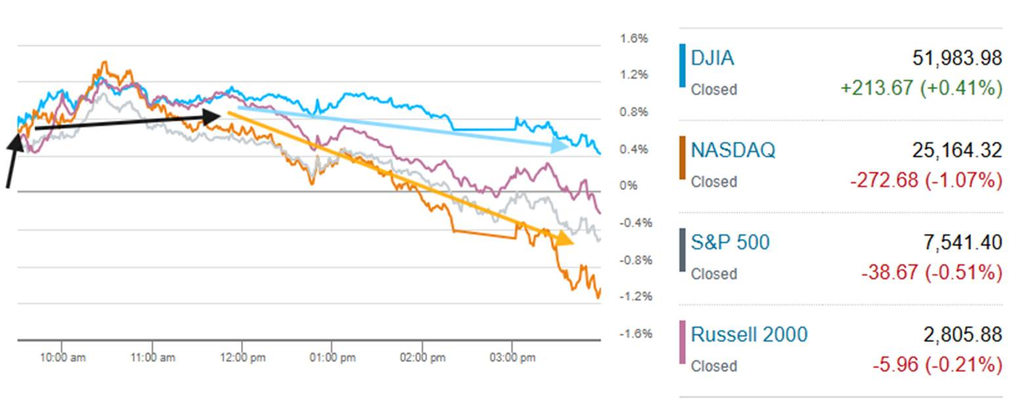
I noted Friday “after a session like Friday’s, some sort of bounce wouldn’t be unusual on a Monday,” and after its worst month since March 2025, Tech did start November with a bounce, but it couldn’t even make it to the noon hour before the selling started taking the Nasdaq and S&P 500, which were up more than 1% at one point, into the red despite a strong performance from the average stock as oil sank on hopes for US-Iran peace talks.
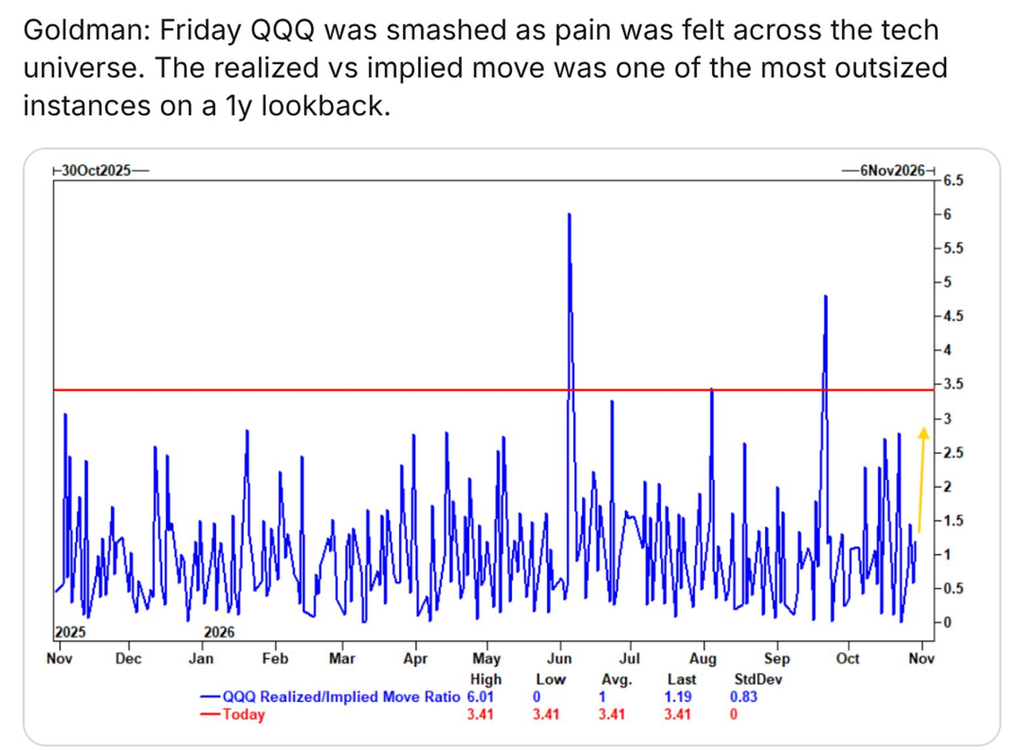
The S&P 500 Tech sector fell another 2.7% after Friday’s 4.2% drop (its worst session since April 2025), dragging the Nasdaq (-1.1%) and S&P 500 (-0.5%) to a third straight decline and their lowest closes since July 30 and July 31, respectively. The Russell 2000 (-0.2%) followed them lower, while the Dow Jones Industrial Average (DJIA) (+0.4%) was able to hold on to at least some of its gains.
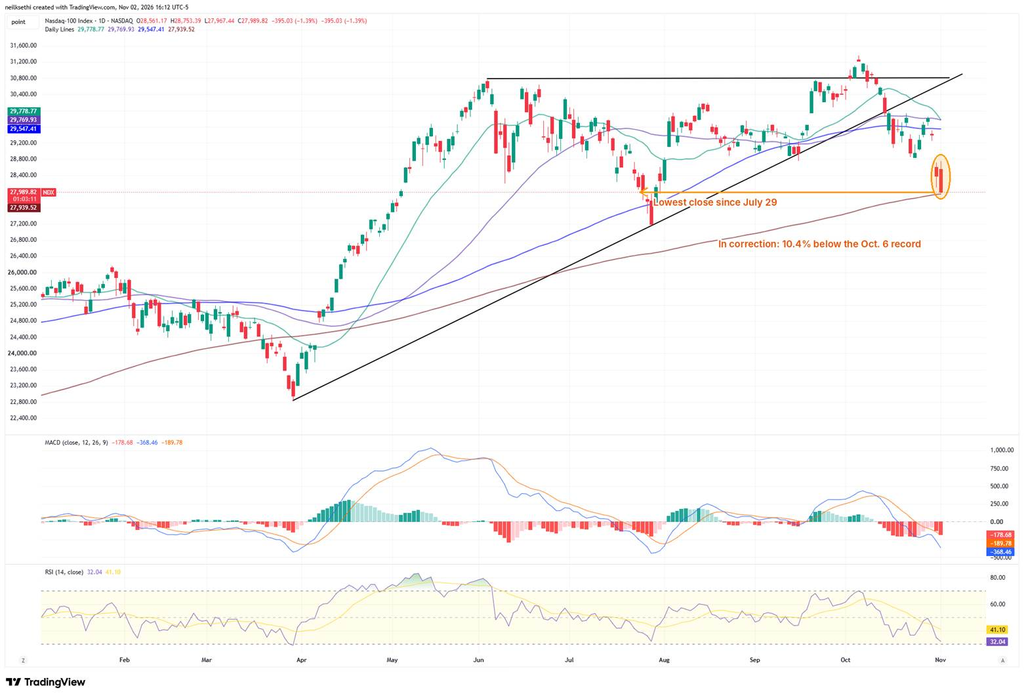
The Nasdaq-100 (-1.4%) closed 10.4% below its October 6 record, its first close in correction territory since July 29, and the Philadelphia Semiconductor Index ($SOX) (-3.4%) fell to its lowest close since April 29, 29.4% below its June 22 record. The SOX had been up nearly 2% early, per Briefing.com, and is now down 12% in three sessions, per Bloomberg.
Schwab
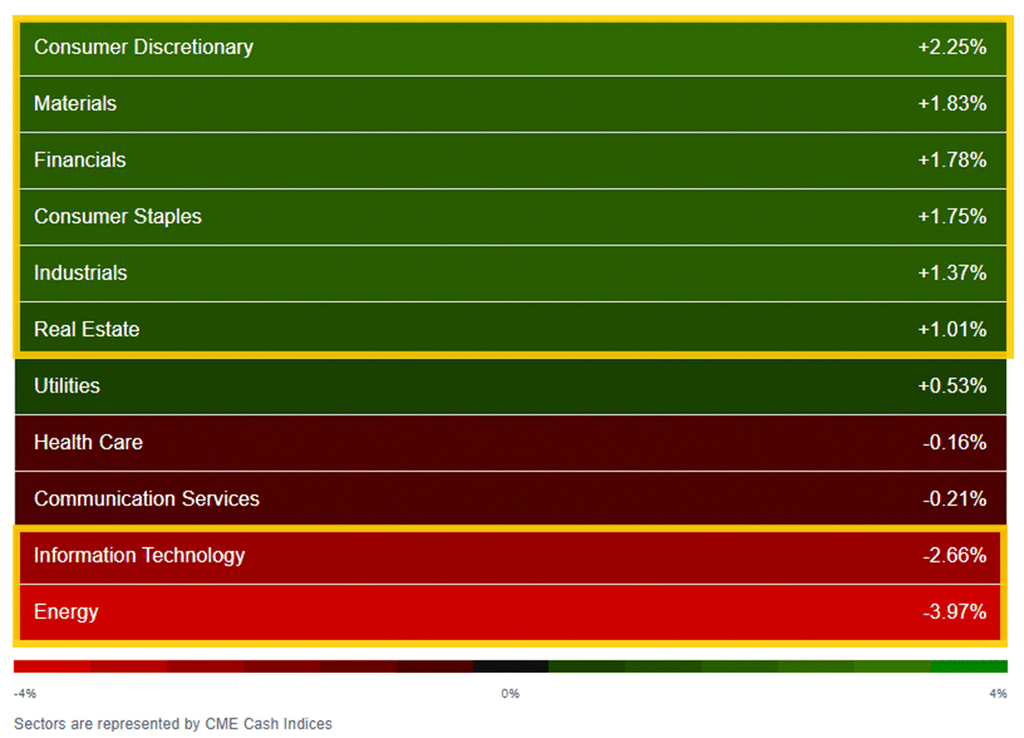
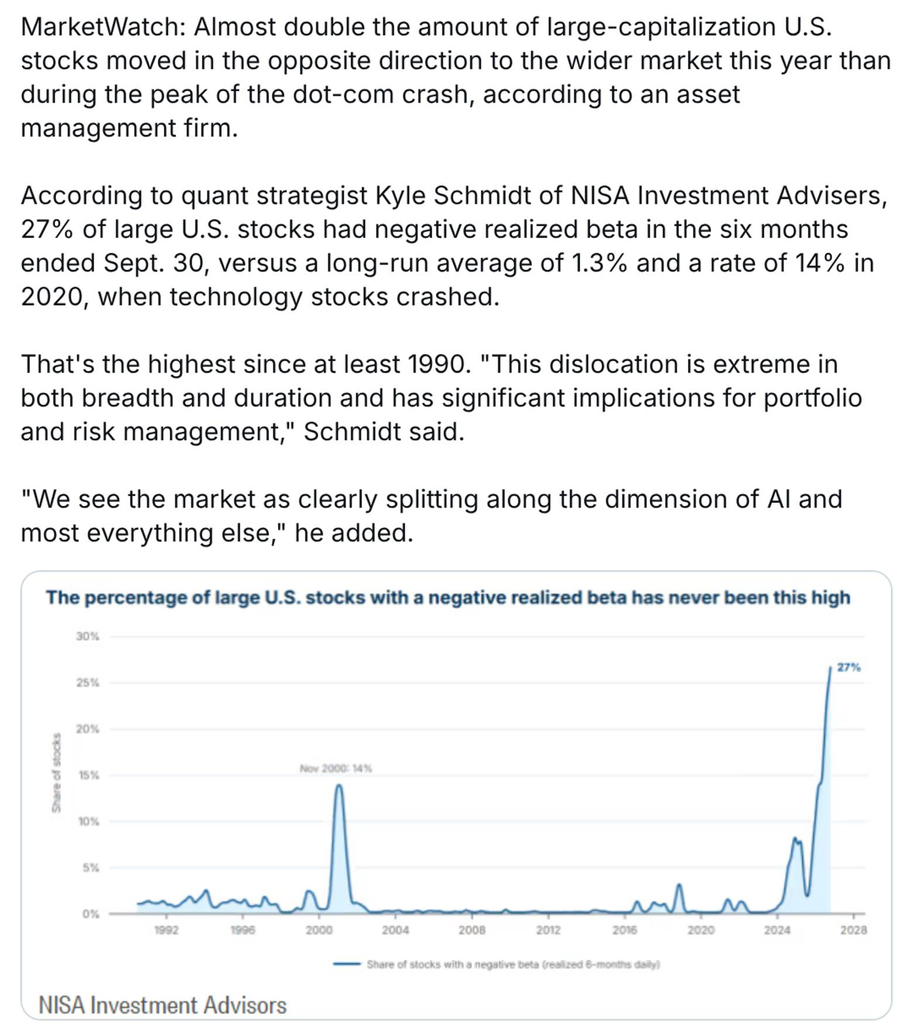
The rest of the market, though, rallied again, adding to the recent outperformance of the equal-weight S&P 500 index after it ended October with the largest monthly gap versus the cap-weighted version since 2009. The equal-weighted S&P 500 gained 0.73% Monday, beating the cap-weighted index by more than a point for a third straight session. Seven of 11 sectors were higher, six by at least 1%, led by Consumer Discretionary and Materials, while Energy (-4.0%) joined Tech as the two sectors down over 1%. In all, 346 S&P 500 components rose and just 156 fell.
WTI settled $7.55 lower (-7.3%) at $96.51 a barrel in the cash session, per Briefing.com, and Brent fell 7.6%, per the WSJ, after Iran’s President Masoud Pezeshkian said his government has been granted more authority by the country’s Supreme Leader to pursue peace talks, and President Trump said, “They want to make a deal, and that could happen,” per Bloomberg.
In economic data, ISM’s October manufacturing PMI rose a point to 55.5 (54.7 Briefing.com consensus), the highest since July, with production at its highest since November 2021 (more here: ISM Manufacturing Accelerates, Production Hits Highest Since 2021), while S&P Global’s final manufacturing PMI was revised down to 54.9 from the 56.0 flash, even as prices rose the most since 2022 (more here: S&P Manufacturing PMI Eases from 52-Month High but Prices Rise the Most Since 2022). September construction spending fell 1.9% (+0.5% Briefing.com consensus), with residential spending slumping under higher financing costs, though August was revised up to +2.0%, per Briefing.com (article on that coming tomorrow).
Ahead of Wednesday’s refunding announcement, Treasury estimated it will borrow $618 billion this quarter, $10 billion less than it’s August estimate, but $800 billion in January–March (more here: Borrowing Update and Mo’ Bills Mo’ Problems?).
Treasuries rallied across the curve, with the 2-year yield down 1 basis point to 4.58% and the 10-year down 3 basis points to 4.90%, per Briefing.com, and long-term Treasuries outperforming, per Bloomberg. Gold rebounded 1.5%, and the VIX rose to 21.18, its highest close since June 10.
Fed rate hike expectations were little changed from Friday’s 72% odds of a December hike and 58 basis points of hikes priced through December 2027, per CME FedWatch.
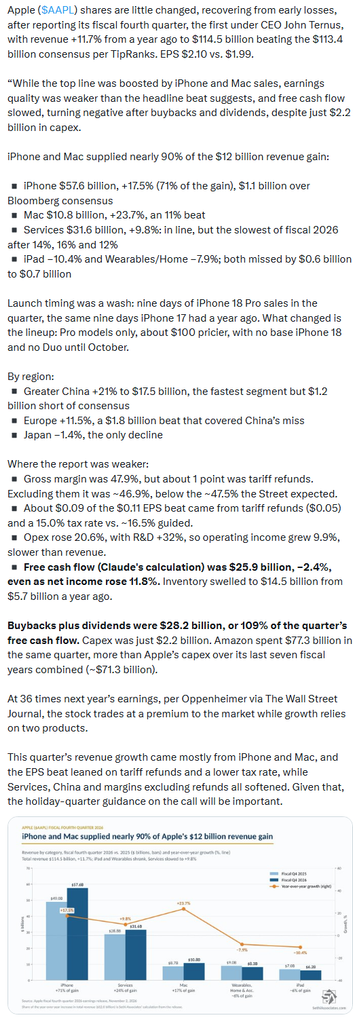
In the after hours Apple ($AAPL) shares have turned lower following its earnings release (see post below) while Palantir Technologies ($PLTR) was up 1%, but only after falling nearly 9% Friday and Monday.
Tuesday is Election Day, with economic data in the form of September JOLTS and factory orders and AMD ($AMD), Amgen ($AMGN), Arista Networks ($ANET) and Booking Holdings ($BKNG) reporting after the close.
Market Commentary
Equities:
- “Investors are waking up to the fact that the chip shortage may be an illusion,” said the chief investment officer at a North American hedge fund interviewed by the Financial Times. Demand for components “should not be soft right now, in this part of the cycle,” they added, referring to Intel’s earnings report.
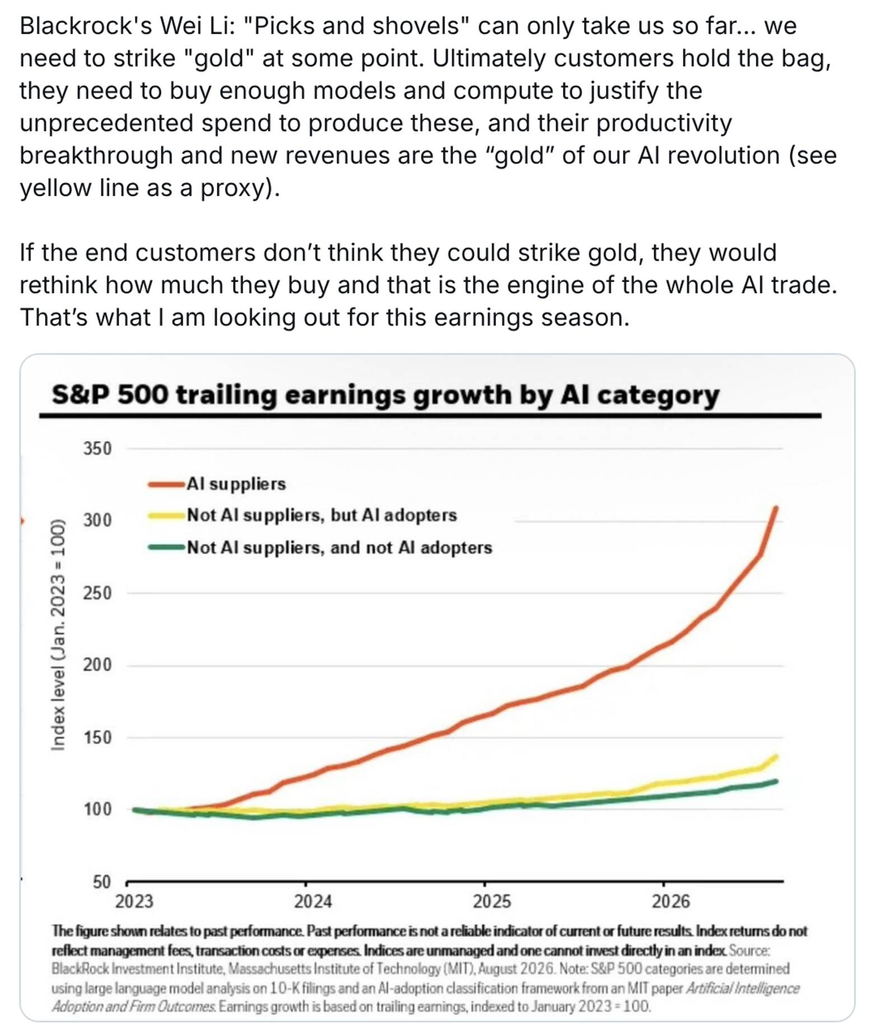
- “The combination of deteriorating cash flows and rising capital commitments means the debate over whether AI returns can ultimately justify the scale of investment may not be resolved any time soon,” said Emmanuel Cau, head of European and Apac equity strategy at Barclays. “The direction of travel into next year should naturally be towards slower earnings growth” from the big technology companies, Cau said.
- “Expectations built into [tech share] prices are being challenged and are now resetting,” said Hank Calenti, global markets strategist at SMBC. “The weakness is due to a combination of some firms not earning as much as expected and others spending more on capex than forecast.”
- “Bonuses are being determined,” said Charlie McElligott, a strategist at Nomura. “If [a hedge fund] takes a stupid drawdown late in the year, in a market like this, you blow yourself up. You’re incentivized to take risk off the table.”
- “It’s going to be an extremely interesting week in the markets,” said Matt Maley at Miller Tabak. “We’ll have political issues to decipher as well as geopolitical ones. And growing doubts about AI investment returns will likely matter much more than historical patterns in determining the market’s direction going forward.”
- “The stock market’s longer-term bullish narrative may have taken some hits in recent weeks, but it’s still intact,” said Chris Larkin, managing director of trading and investing at E*Trade. “The challenge has been short-term momentum — stringing together more than a few days without being disrupted by surging oil prices, concerns about AI spending, inflation, or geopolitics.” He added, “The market has more potential ‘volatility triggers’ to face — including this week’s midterms and jobs data — but its ability to bend but not break under pressure has been a positive sign.”
- “This looks more like a bullish rotation with a derating at its core than the beginning of a broad market deterioration,” said Florian Ielpo, head of macro research at Lombard Odier Investment Management.
- “We’re buying quality,” said Jeff Buchbinder, chief equity strategist at LPL Financial, in a phone interview. “When you buy quality products, you are getting a little bit of a value tilt, and you’re getting a little bit of underweight to the AI trade, particularly to the lower-quality segment of the AI trade.”
- Consumer staples tend to be “a safer place to be within the equity market,” said Empower’s Marta Norton, “as there’s just not a whole lot of earnings volatility there.” But she cautioned that, at this point, the consumer-staples sector appears “overvalued” following its recent surge.
- “We think it’s now time to tiptoe back in,” Barclays research chair Ajay Rajadhyaksha said of risky assets such as stocks, turning bullish now that earnings season is almost over and stock prices have fallen from record highs.
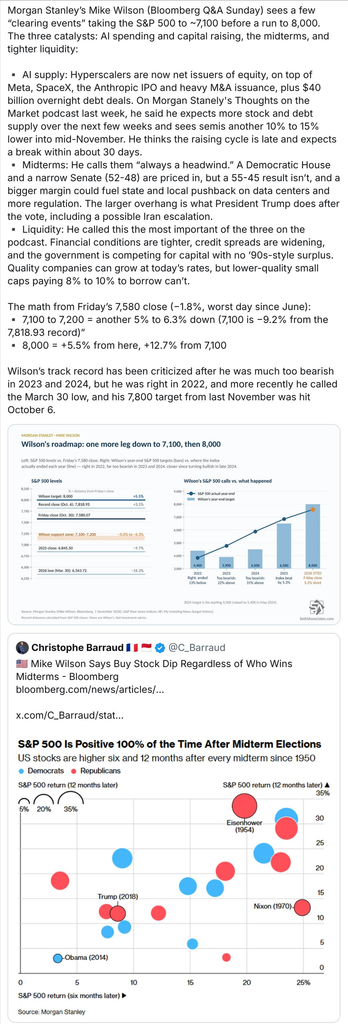
- “I’m pretty convinced that we’re going to have a pretty good at least six month period, maybe 12, we’ll see if it carries to 12. But yeah, there’s going to be a snapback post-midterms,” Morgan Stanley’s Mike Wilson told Bloomberg, although he sees a few “clearing events” (AI supply, the midterms and tighter liquidity) taking the S&P 500 to about 7,100 first (via my X post).
Bonds/Fed:
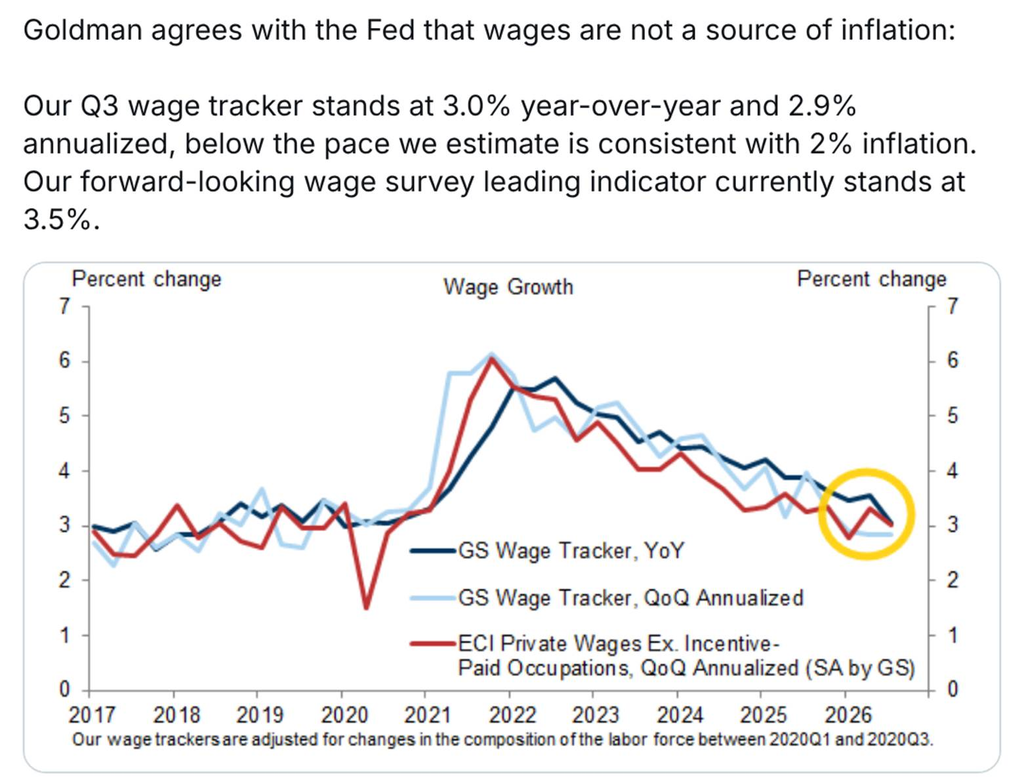
- “Our Q3 wage tracker stands at 3.0% year-over-year and 2.9% annualized, below the pace we estimate is consistent with 2% inflation. Our forward-looking wage survey leading indicator currently stands at 3.5%,” Goldman said, agreeing with the Fed that wages are not a source of inflation (see my X post below).
Stock and Sector Breakdown
Schwab
Despite the headline decline, seven of 11 S&P 500 sectors rose, six up by at least 1%, led by Consumer Discretionary (+2.25%) and Materials (+1.83%), with Financials (+1.78%), Consumer Staples (+1.75%), Industrials (+1.37%), Real Estate (+1.01%) and Utilities (+0.53%) also higher.
To the downside, Energy (-3.97%) was the worst as oil sank, with Tech (-2.66%) second-worst, its 12th straight session in the top two or bottom two sectors, and Health Care (-0.16%) and Communication Services (-0.21%) slightly lower.
AI infrastructure was a notable laggard after Marvell Technology ($MRVL) (-12.7%) agreed to buy Lumentum ($LITE) (-18.6%) in an all-stock deal valued at $115 billion including debt (TipRanks), and Oracle ($ORCL) (-8.8%) fell to its lowest close since July 29 after filing to raise $20 billion through stock and bond sales (TipRanks) for its AI buildout. It’s part of a new wave of Big Tech borrowing, with Meta Platforms eyeing at least $20 billion in a multi-currency sale and Alphabet selling euro debt Monday after Microsoft’s $25 billion bond sale Thursday, its first US offering since 2017, per Bloomberg.
Chris Versace wrote today on why The Marvell-Lumentum Tie-Up Makes Strategic and Financial Sense.
IDEXX Laboratories ($IDXX) (+21.8%) was the best performer in the S&P 500, its best day since August 4, 2025, after its third-quarter beat and raised full-year revenue and EPS outlooks, per Doug Kass (BABA Up, PGEN Down). Lumentum was the worst, its worst day since April 3, 2025.
In other AI infrastructure names, Ciena ($CIEN) fell 11.3%, Everpure ($P) 10.4%, Intel ($INTC) 8.8%, Seagate Technology ($STX) 7.9%, Super Micro Computer ($SMCI) 7.6%, Western Digital ($WDC) 7.5%, Dell Technologies ($DELL) 7.4%, Hewlett Packard Enterprise ($HPE) 7.1%, NetApp ($NTAP) 7.0%, Sandisk ($SNDK) 6.6% and Micron Technology ($MU) 5.9%, while Advanced Micro Devices ($AMD) slid 7.5% ahead of Tuesday’s report.
Neoclouds CoreWeave ($CRWV) (-8.6%) and Nebius Group ($NBIS) (-8.3%) extended October’s losses, and software names Datadog ($DDOG) (-8.1%) and Fortinet ($FTNT) (-7.3%) also fell. The VanEck Semiconductor ETF ($SMH) closed at $508.31, 2.3% below the $520 line BofA’s Michael Hartnett said needed to hold “before year-end rally starts,” joining the Magnificent 7 ETF ($MAGS) below its line.
Even strong results didn’t help, with Tower Semiconductor ($TSEM) down 6.7% despite solid Q3 revenue growth and above-consensus Q4 guidance, per Briefing.com. Doug Kass noted memory and semis are telling a different story than the hyperscalers, one reason he sold his hyperscaler longs (Memory, Semis Telling Different Story Than the Hyperscalers).
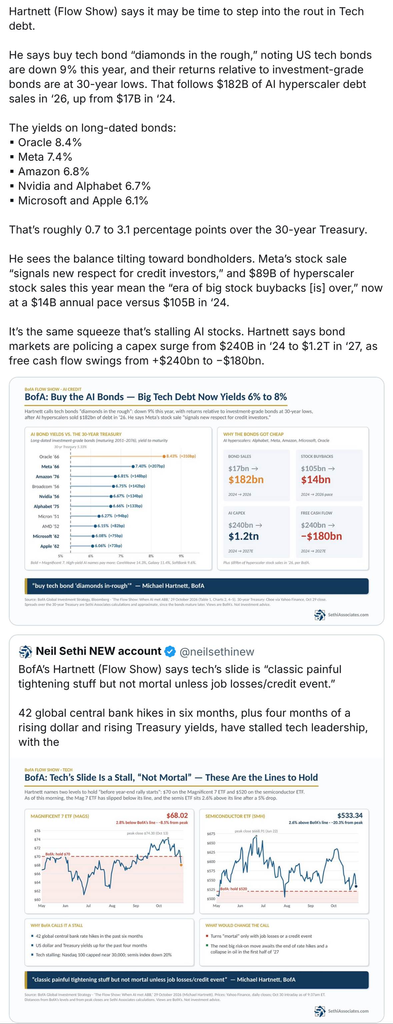
With Oracle tapping the market again, Hartnett also says it may be time to step into the rout in tech debt, with long-dated Oracle bonds yielding 8.4% (see my X post below).
On the upside, cyclicals led as oil fell, with Howmet Aerospace ($HWM) (+6.9%), CBRE Group ($CBRE) (+6.1%), Pentair ($PNR) (+6.5%), CRH ($CRH) (+6.4%), DoorDash ($DASH) (+6.2%) and Sherwin-Williams ($SHW) (+5.9%) all up more than 5%, and homebuilders such as PulteGroup ($PHM) (+5.3%) and NVR ($NVR) (+5.1%) and other rate-sensitive stocks benefited from lower yields. Marriott International ($MAR) (+4.3%) beat expectations and raised its outlook as US bookings surged (Bloomberg). Financials also gained, with Wells Fargo ($WFC) up 3.0%. Oil producers fell with crude, including APA ($APA) (-7.6%), Occidental Petroleum ($OXY) (-5.1%), Exxon Mobil ($XOM) (-4.0%) and Chevron ($CVX) (-3.3%).
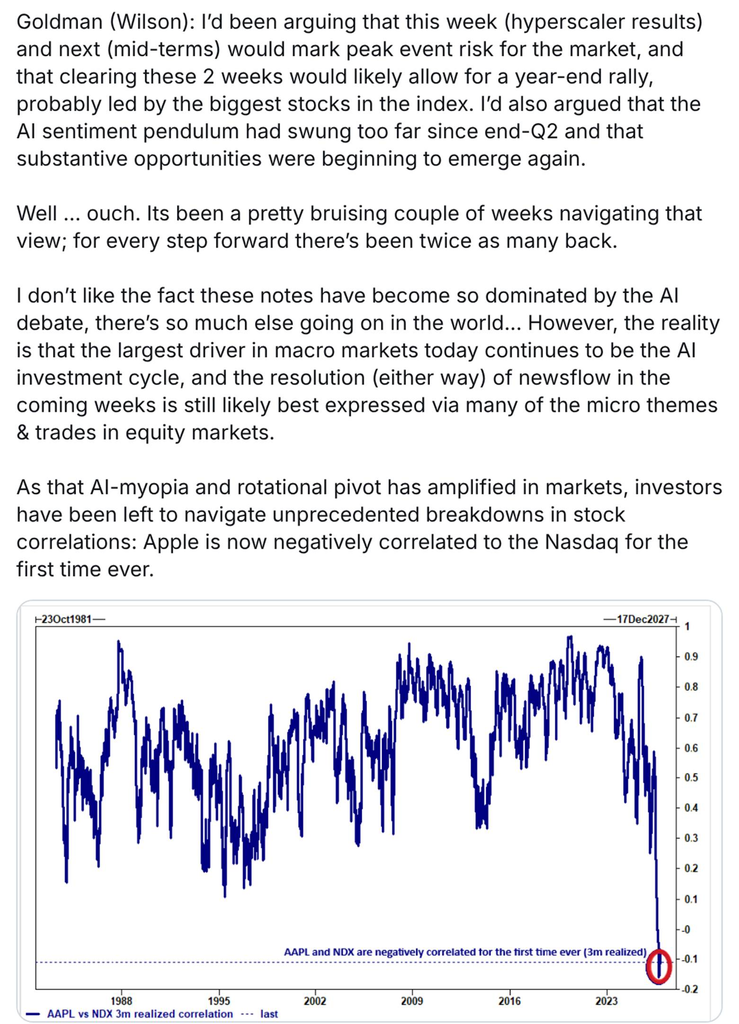
Among the megacaps, Microsoft ($MSFT) was lower by 2.8%, as were Apple ($AAPL) 1.5%, Nvidia ($NVDA) 1.3%, Meta Platforms ($META) 1.3% and Alphabet ($GOOGL) 0.3%. Amazon ($AMZN) though rose 2.2% after Phillip Securities upgraded it to Buy with a $330 price target, per Briefing.com. As mentioned Kass took quick profits on the hyperscaler longs he bought Friday (Scaling Down) and called covering his Apple short Friday a mistake (Mea Culpa). Ahead of Apple’s report, Goldman’s Wilson noted Apple is now negatively correlated to the Nasdaq for the first time ever (see my X post below).
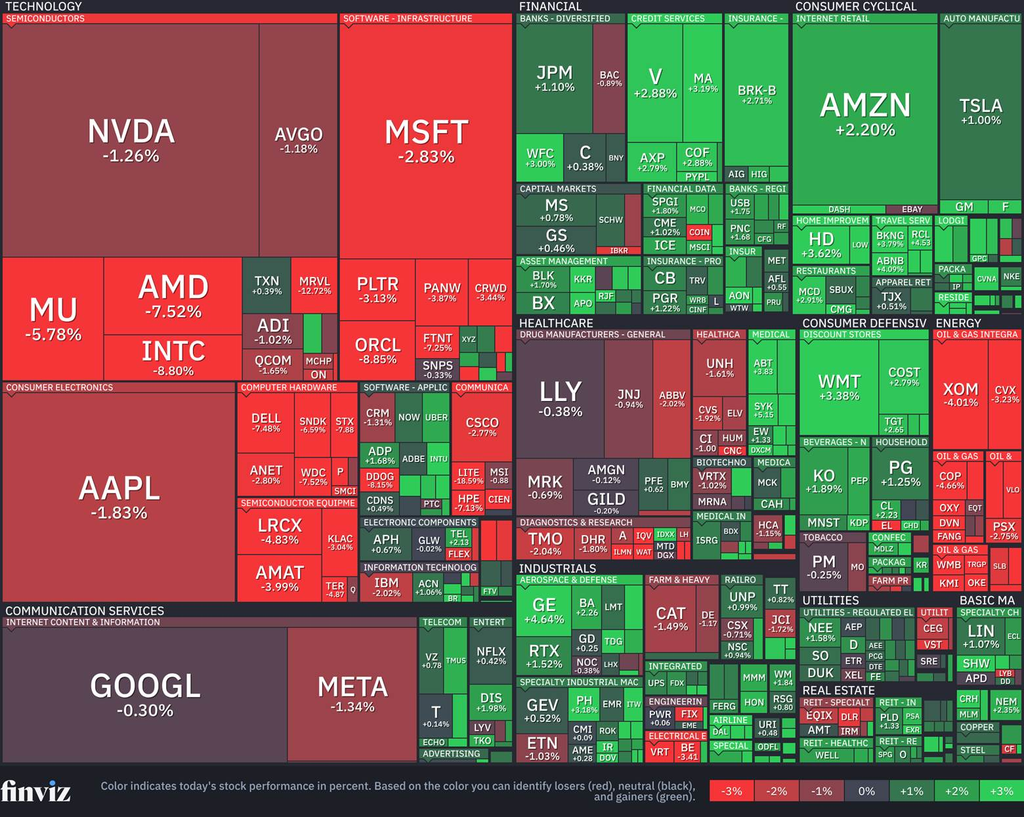
Again, despite the down day, the number of large SPX winners (up over 3%) jumped to 93 from 35 Friday, while large losers (down over 3%) fell to 51 from 89.
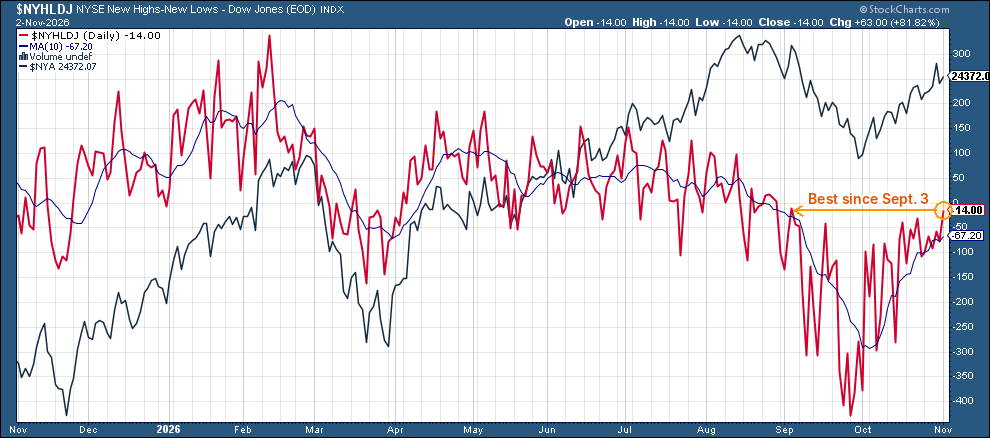
52-week highs minus lows improved to -14 on the NYSE from -77 Friday, the best reading since September 3, and to -265 on the Nasdaq from -392, still the 46th straight negative session for the Nasdaq.
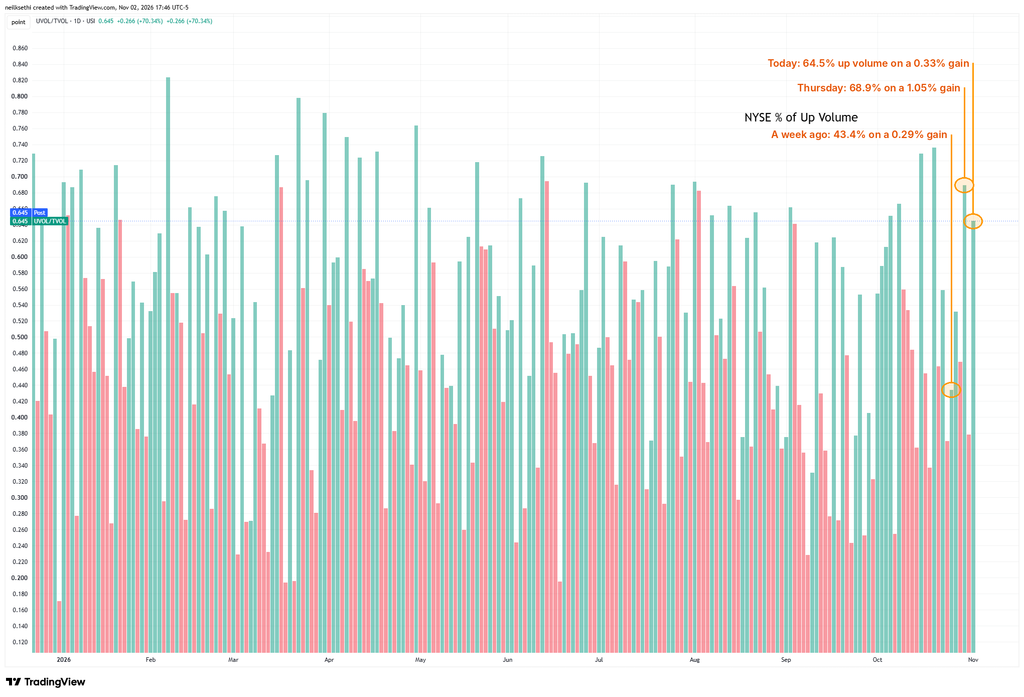
NYSE positive volume was a strong 64.5% on a 0.33% gain, almost as good as Thursday’s 68.9% on a 1.05% gain and well above the 43.4% a week ago on a 0.29% gain.
Some other stock-specific commentary from TheStreet Pro:
- Bob Lang — Chart of the Day: Palantir Is Not Immune From the Selling
- Stephen Guilfoyle —
- James “Rev Shark” DePorre — This Biotech Got Hit on a Competitor’s Good News. Here’s Why I’m Adding
A Look At The Charts
Note on all charts the colored lines are moving averages (the average price over the lookback period — days on the daily charts, weeks on the weekly charts):
20 = green
50 = purple
100 = blue
200 = brown
Exception is monthly charts where blue is 10-month moving average and brown is 20-month moving average.
MACD = Moving average convergence/divergence line, a measure of momentum that compares longer term and shorter term momentum to gauge if a move is strengthening or weakening. This is probably my favorite individual indicator.
RSI = Relative Strength Index (basically what it sounds like) = measures the strength of the move comparing gains to losses over the given lookback window (I use the standard 14 periods).
SPX
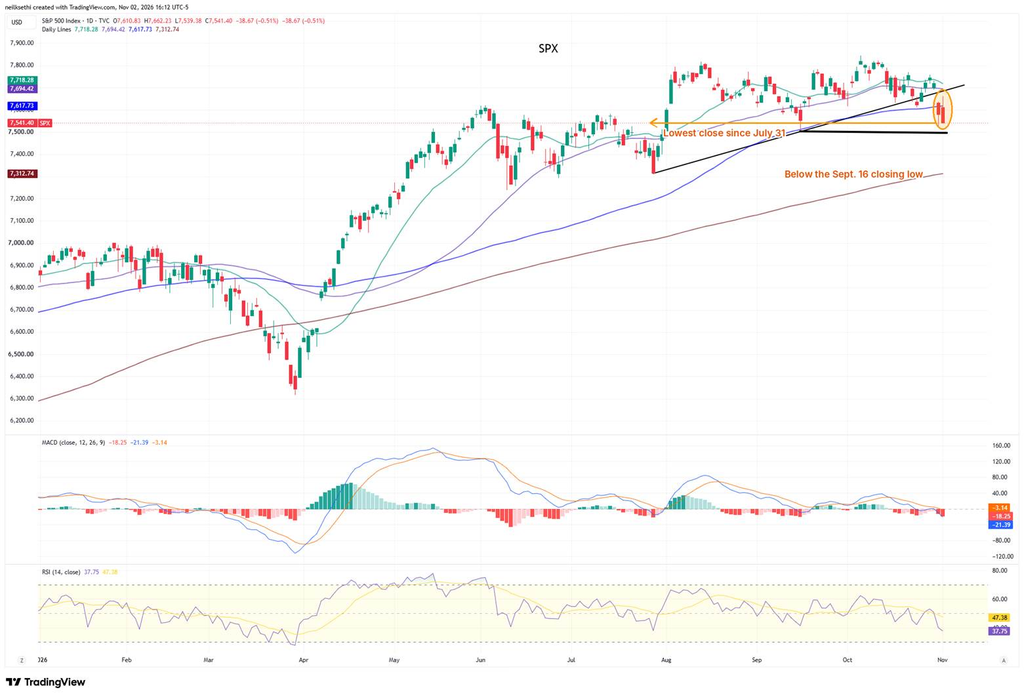
The SPX fell 0.51% to 7,541.40, a third straight decline to its lowest close since July 31, closing below its September 16 closing low (7,551.81), although the intraday September low (7,507.77) held (today’s low was 7,539.38). It’s now below its 20-, 50- and 100-DMAs, about 3.1% above the 200-DMA (7,313). The MACD is in “go short” positioning, and the RSI is at 38.
With the September closing low giving way, I took off half of my SPY position. I’ll take off the other half if it breaks the intraday low.
Nasdaq Composite
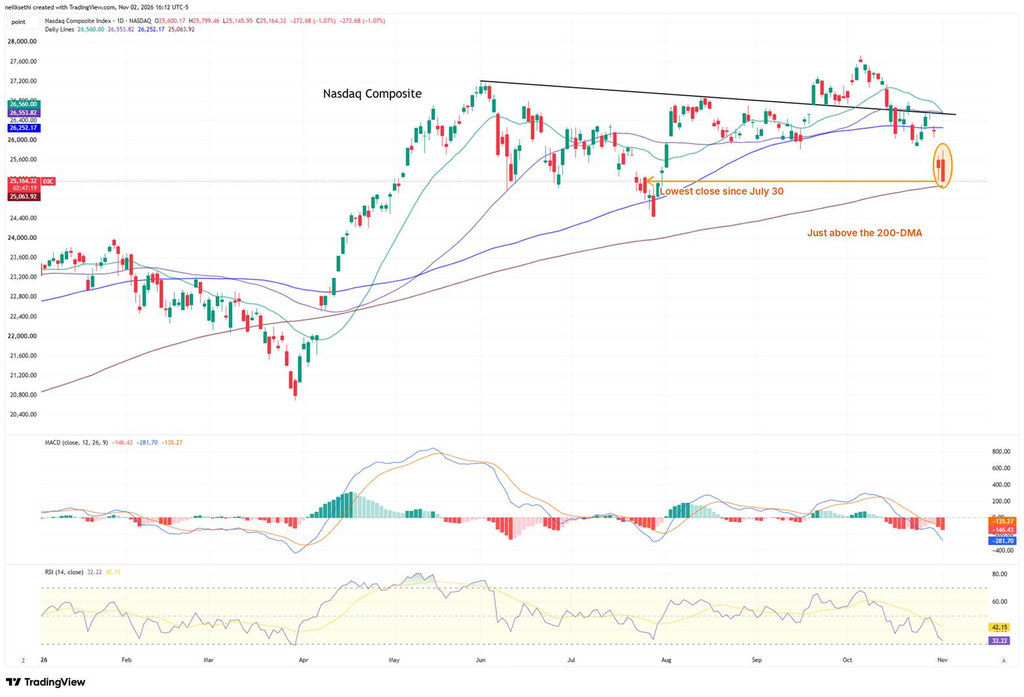
The Nasdaq Composite fell 1.07% to 25,164.32, its lowest close since July 30, 8.8% below its October 6 record and just 0.4% above its 200-DMA (25,064). The MACD remains in “go short” positioning, and the RSI is at 32.
The Nasdaq-100 ($QQQ)
The Nasdaq-100 fell 1.39% to 27,989.82, its lowest close since July 29 and 10.4% below its October 6 record, closing in correction territory, just 0.2% above its 200-DMA (27,940).
As I noted, I’ve been selling bounces until it reclaims its 50-DMA (29,770), but with it now sitting on its 200-DMA, I bought some QQQ with a stop 1% below it. The MACD is in “go short” positioning, and the RSI is at 32 so this is just a trade for now looking for a bounce.
The Russell 2000 ($IWM)
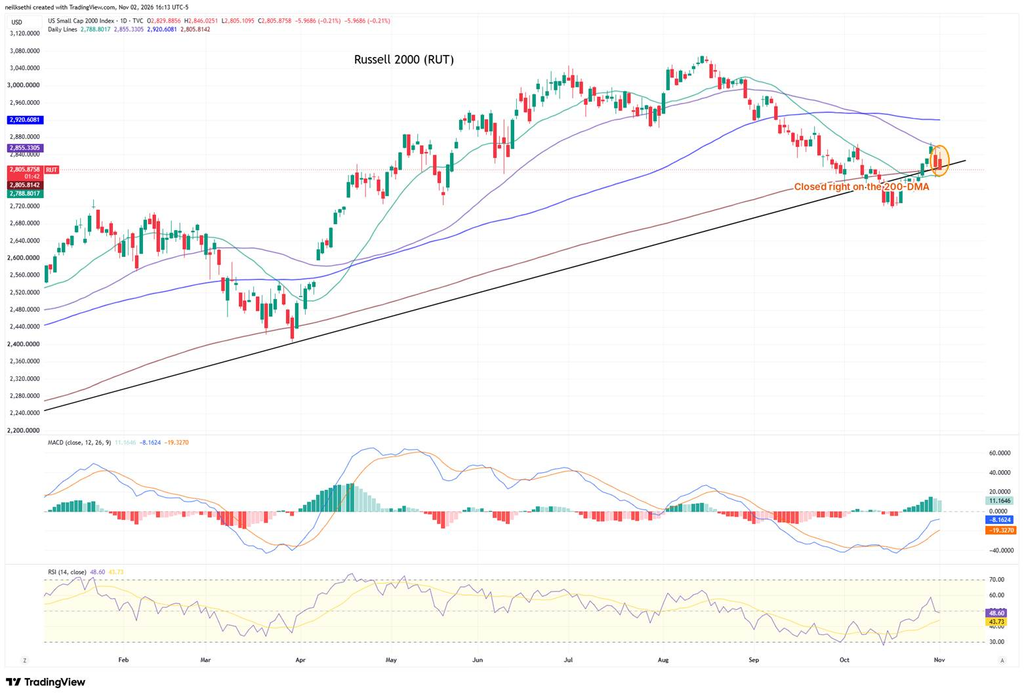
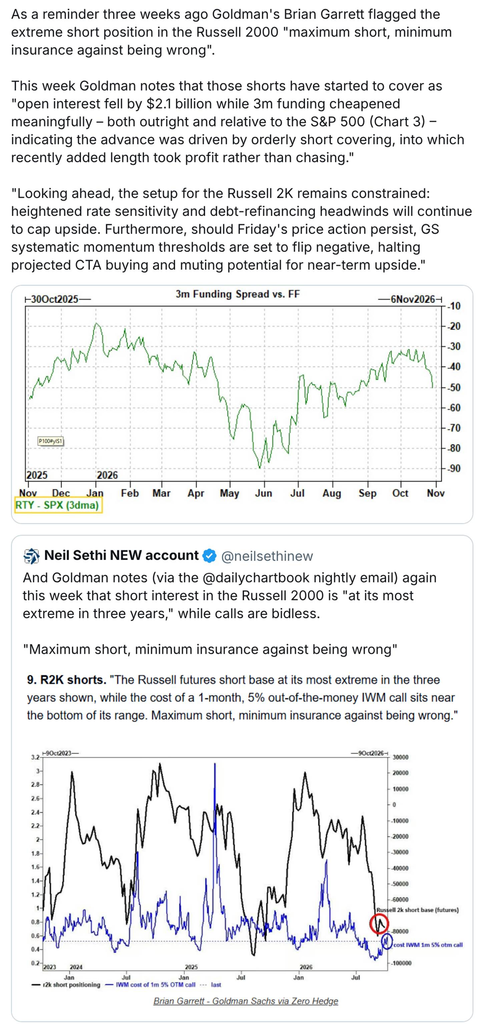
The Russell 2000 slipped 0.21% to 2,805.88, finishing right on its 200-DMA (2,805.81) after failing again below its 50-DMA (2,855). The MACD remains in “cover shorts” positioning, and the RSI is at 49. Goldman notes the extreme short position in the Russell 2000 that its desk flagged three weeks ago has started to cover in an orderly way, though it says the setup “remains constrained” (see my X post below).
I’m holding my IWM position for now. Would like to see it break over that 50-DMA though.
The equal-weighted SPX ($RSP)
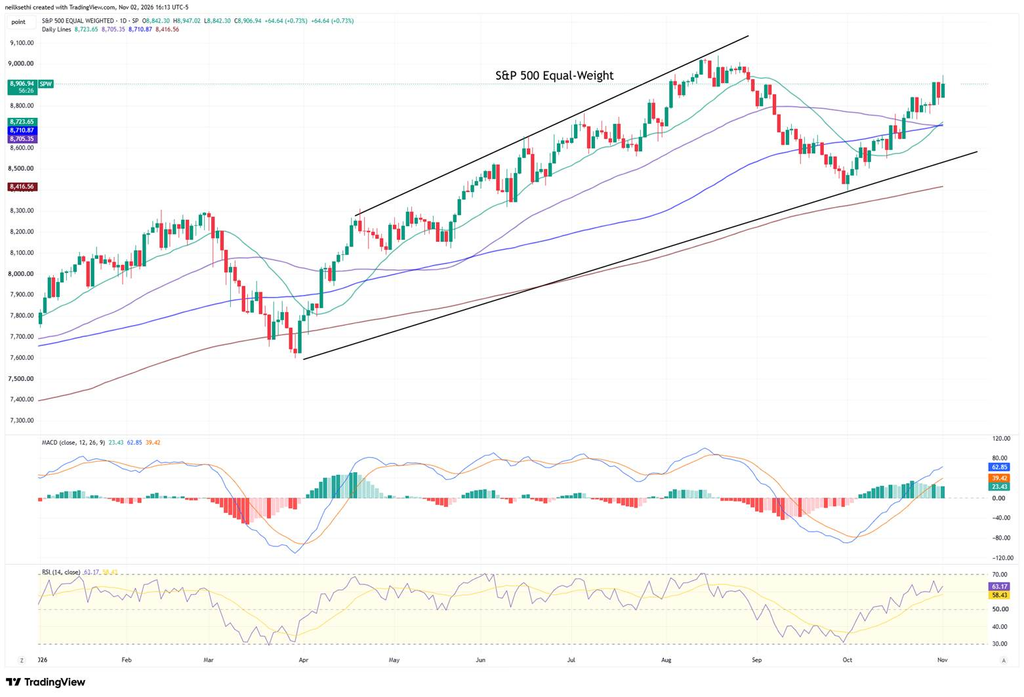
The equal-weighted SPX rose 0.73% to 8,906.94, beating the cap-weighted index by more than a point for a third straight session, and remains above all its moving averages, with the MACD in “buy longs” positioning and the RSI at 63.
The 2-year Treasury
The 2-year yield was unchanged (including post-market) at 4.594%, about 71bp above the EFFR (3.88%).
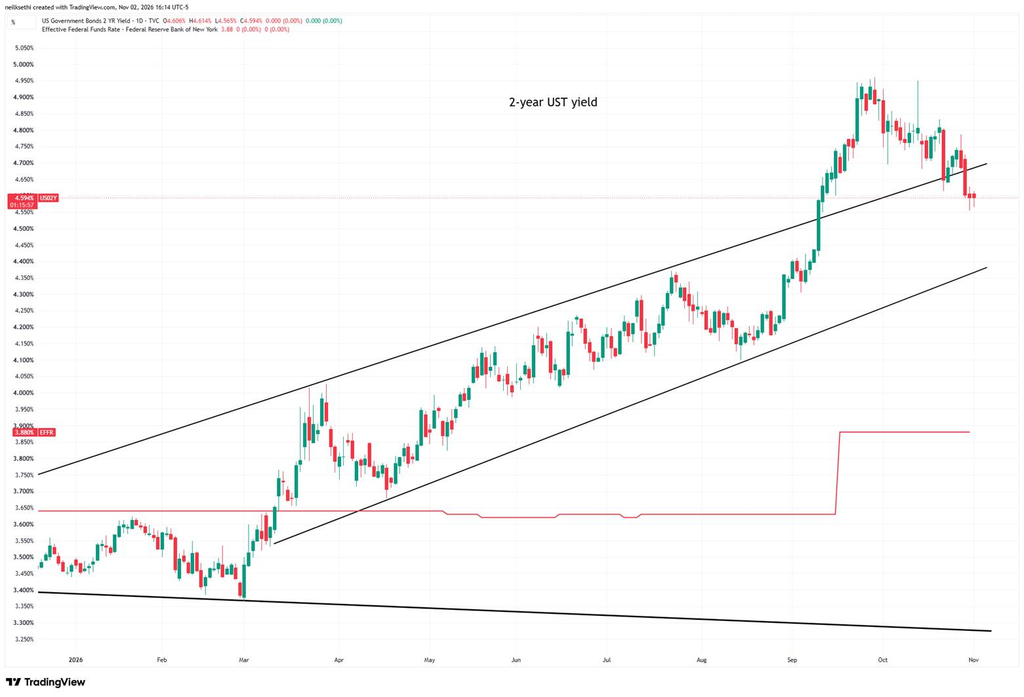
Fed rate hike expectations were little changed from Friday (a 72% chance of a December hike and 58 basis points priced through December 2027), per CME FedWatch.
10-year yields
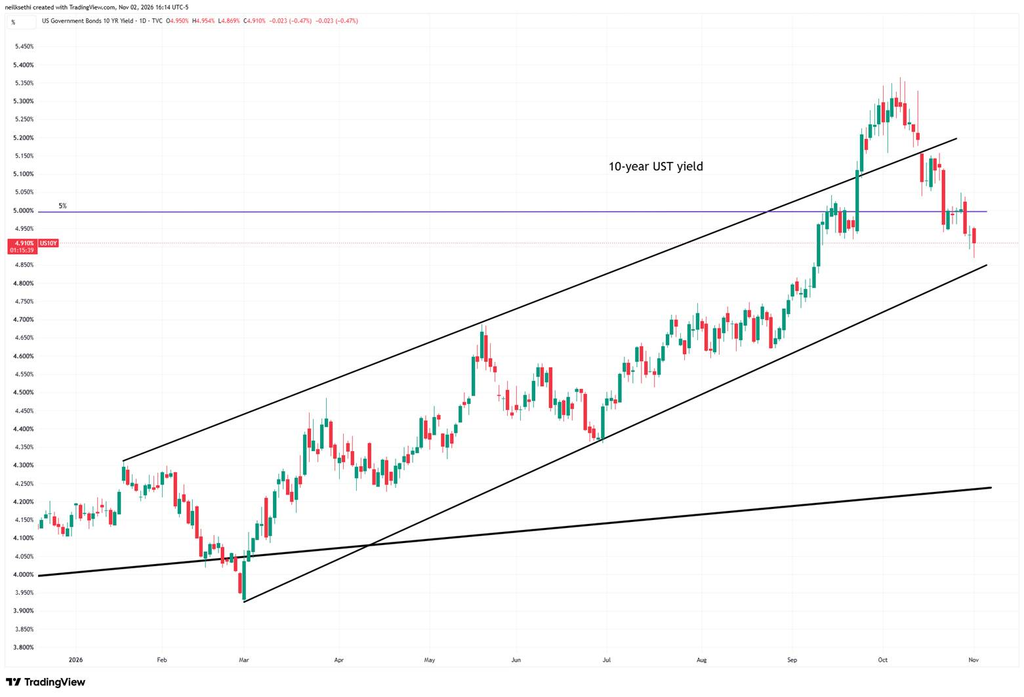
The 10-year yield fell 2.3 basis points (including post-market) to 4.912%, its lowest close since September 9.
30-year yields
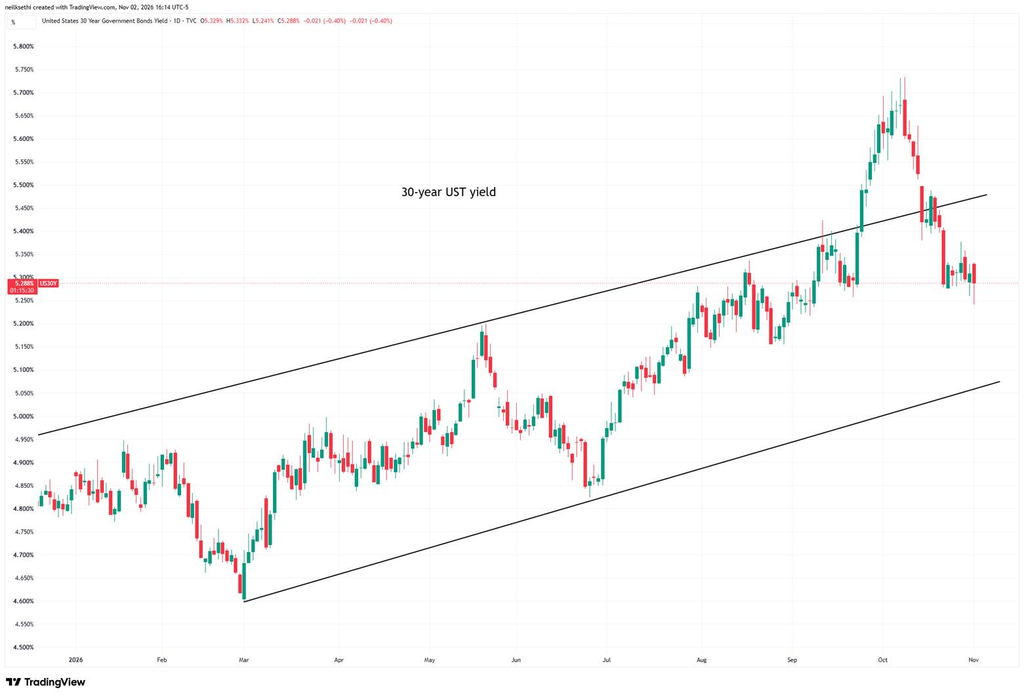
The 30-year yield fell 2.1 basis points (including post-market) to 5.288%, ahead of Wednesday’s refunding announcement, where some on the Street expect cuts to 20- and 30-year auction sizes (more here: Mo’ Bills Mo’ Problems?).
VIX
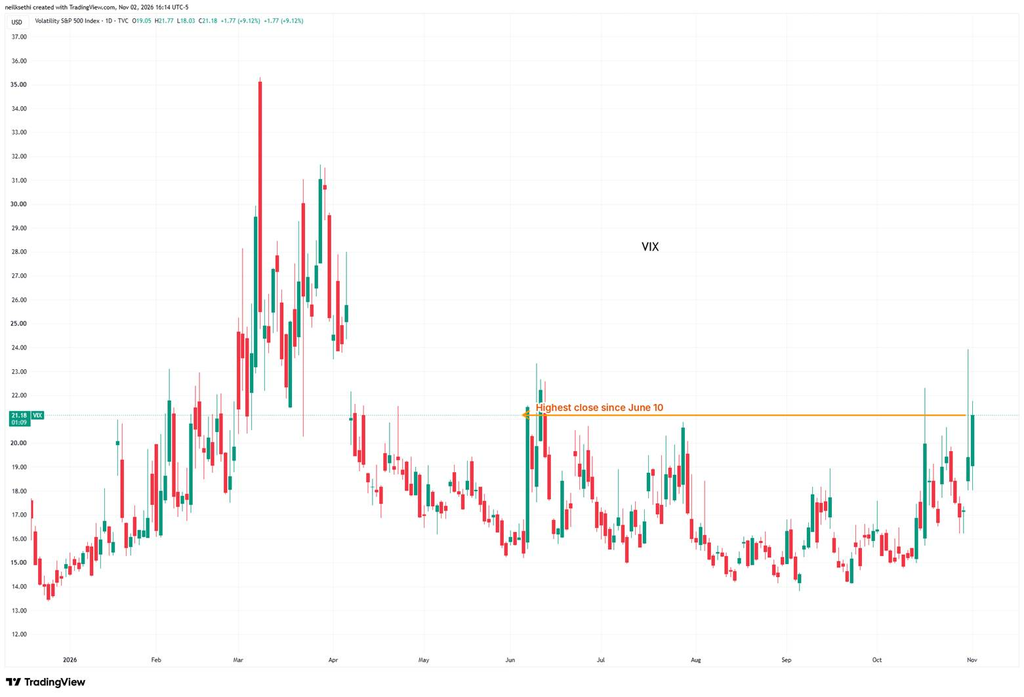
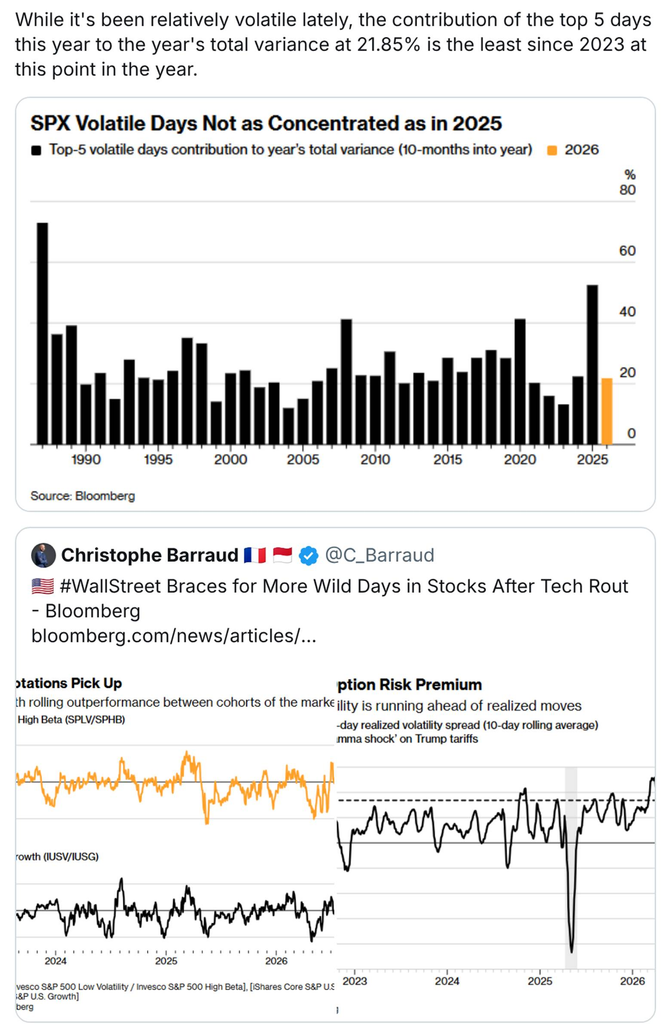
The VIX rose 9.12% to 21.18, its highest close since June 10, even with the S&P 500 down just 0.5%. That implies a daily move of about 1.33% over the next 30 days.
The VVIX
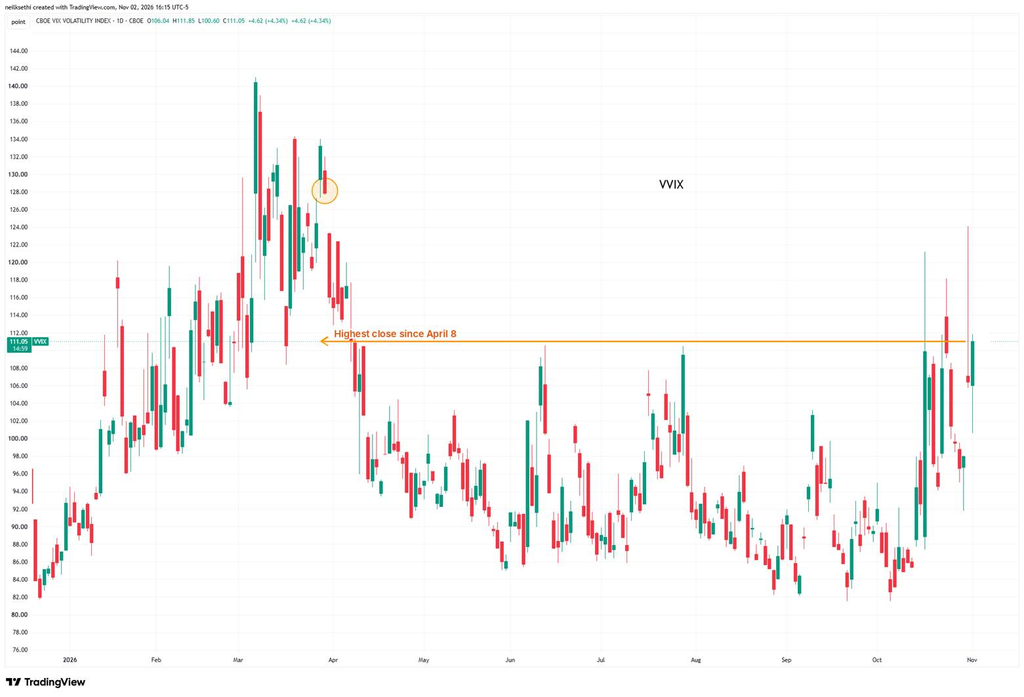
The VVIX (the VIX of the VIX) rose 4.34% to 111.05, its highest close since April 8. The current level is consistent with “elevated” daily moves in the VIX over the next 30 days (historically, normal is 80-100, although we haven’t been below 80 since July 2024), and it’s above the 100 level flagged by Charlie McElligott as indicating higher stress.
1-day VIX
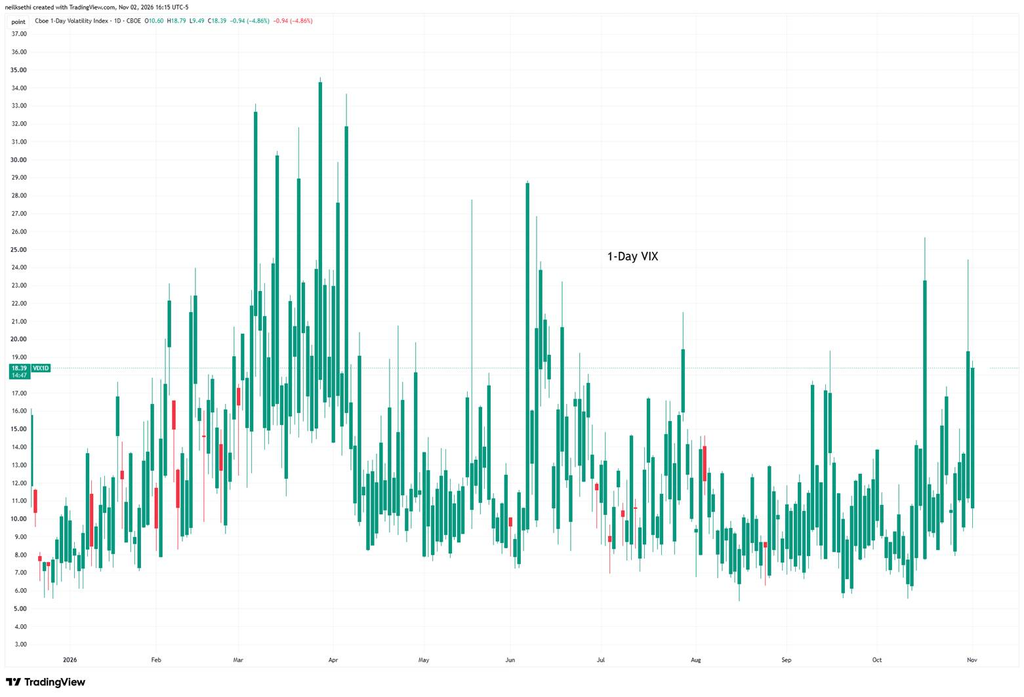
Friday’s 1-day VIX reading (19.33), the second-highest Friday close since June, implied a move of about 1.22% for Monday, and the SPX came in well under that at 0.51%. The 1-day VIX eased 4.86% to 18.39, implying a move of about 1.16% for Election Day.
WTI futures (/CL)
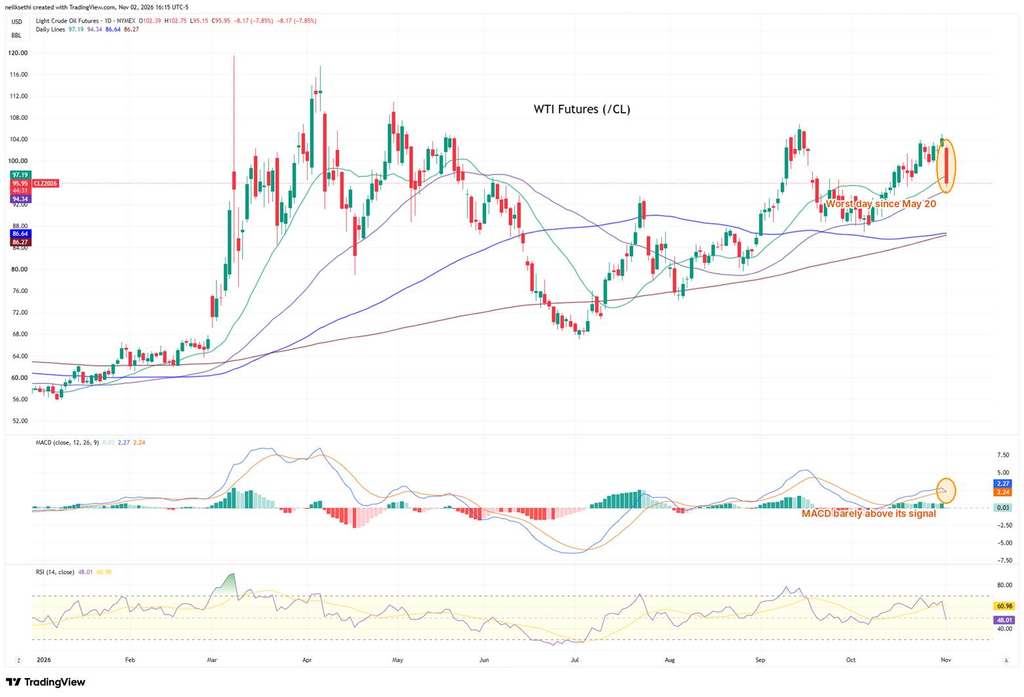
WTI futures, which TradingView has at December currently, fell 7.85% (including post-market) to $95.95, their worst day since May 20, after Iran’s Supreme Leader reportedly authorized talks with the US. That took them back below their 20-DMA ($97.19) to just above their 50-DMA ($94.34). The MACD is barely holding “buy longs” positioning, and the RSI is at 48.
DXY
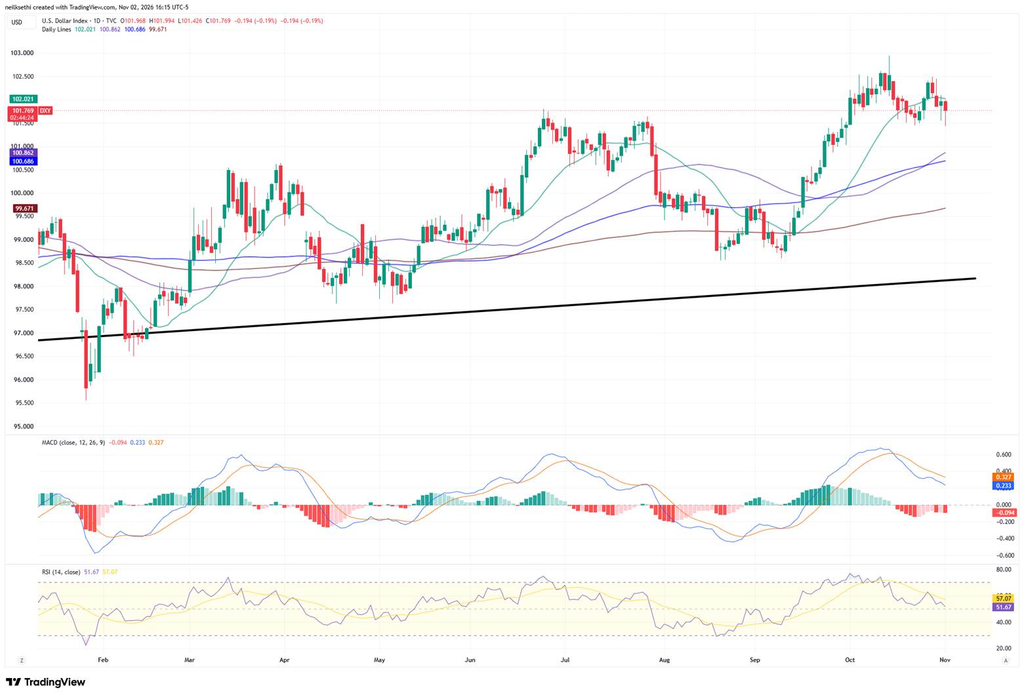
The DXY dollar index (which is fixed weighted with a heavy — 57% — allocation to the euro) fell 0.19% to 101.769, below its 20-DMA (102.022). The MACD remains in “sell longs” positioning, and the RSI is at 52.
Gold futures (/GC)
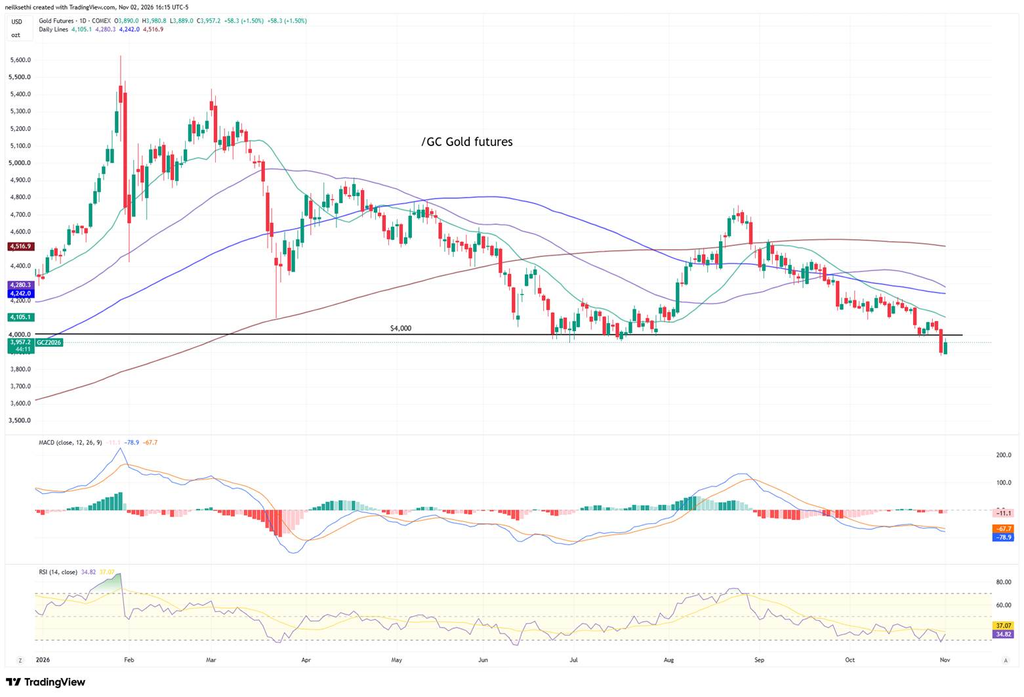
Gold futures rebounded 1.50% (including post-market) to $3,957.20 after Friday’s worst day since September 28 but remain below all their moving averages, with the MACD in “go short” positioning and the RSI at 35. Doug Kass added to his GLD long premarket and was out of it by mid-morning (Gold Gone).
US copper futures (/HG)
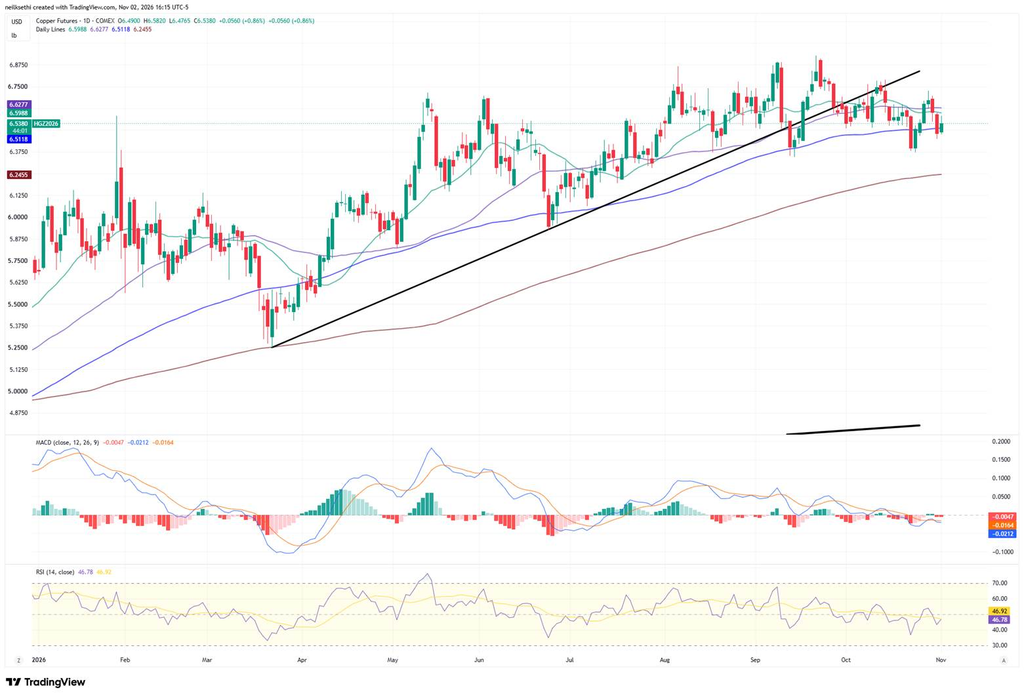
Copper futures rose 0.86% (including post-market) to $6.538, back above their 100-DMA (6.512) but below their 20- and 50-DMAs. The MACD is in “go short” positioning, and the RSI is at 47.
US natural gas futures (/NG)
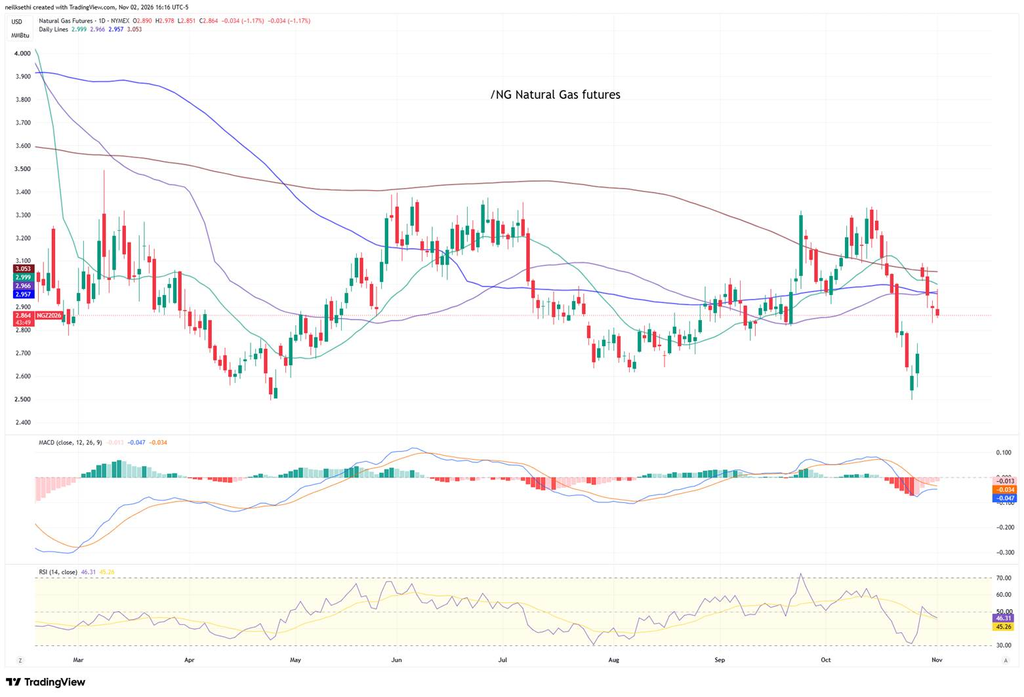
Natural gas futures fell 1.17% (including post-market) to $2.864, still filling Wednesday’s “roll gap.” The MACD is in “go short” positioning, and the RSI is at 46.
Bitcoin futures
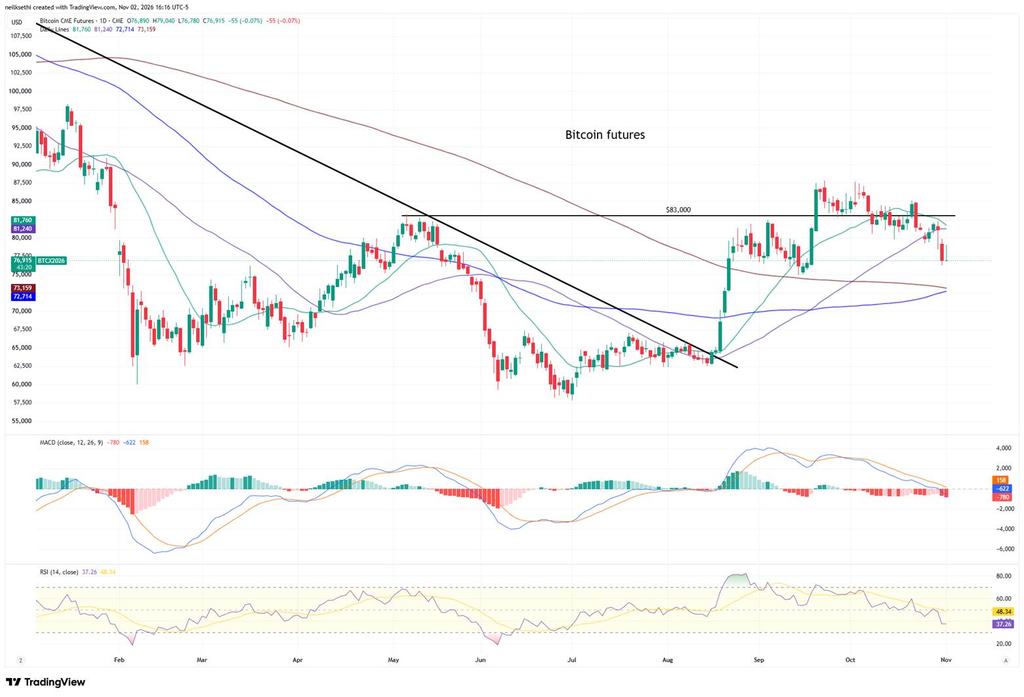
Bitcoin futures were little changed at $76,915, below $80,000 and their 50-DMA ($81,240). The MACD is in “go short” positioning, and the RSI is at 37.
More From TheStreet Pro
- Helene Meisler — Tech Stock Performance Has Blinded Investors to the Rest of the Stock Market
- James “Rev Shark” DePorre — IBD Says Go to Cash. I’m Looking for Rotation.
- Stephen Guilfoyle — Anatomy of a Meltdown
- Peter Tchir — Market Looks Weak and There Is Risk to the Downside
- Bob Byrne — Trump Says Democrats Mean Another 1929. He Said Much the Same in 2020, and Stocks Rose 79%
- Bret Jensen — Top-3 Takeaways After October Leads to Market Correction
- Bob Lang — Charting the Markets: The S&P 500 Is Following a Script
- Chris Versace —
- Doug Kass —
And From Me If You Missed It
- The Week Ahead — Apple, Midterms and Jobs Test a Market on Edge
- Manufacturing PMIs and Apple Earnings Kick Off a Packed Week
- Mo’ Bills Mo’ Problems?
- S&P Manufacturing PMI Eases from 52-Month High but Prices Rise the Most Since 2022
- ISM Manufacturing Accelerates, Production Hits Highest Since 2021
- Borrowing Update
Miscellaneous
Wrap-Up — Oil Gets Relief, Tech Doesn’t
As noted at the top, I said Friday (Chip Rout Sends Nasdaq to Worst Month Since March 2025),
A lot of damage has been done, but I don’t think we’ve reached levels that I would say mean more than a bounce is likely. But after a session like Friday’s, some sort of bounce wouldn’t be unusual on a Monday (although there’s a reason they call it “Turnaround Tuesday”).
And Sunday (The Week Ahead — Apple, Midterms and Jobs Test a Market on Edge) I noted that while my AI and Tech positioning was “dramatically reduced, although definitely not eliminated,” and I was “ready to step back in when the price action dictates,” there were quite a few reasons to think, despite Deutsche Bank’s return to a constructive outlook on Tech, that there may be more to go in the selloff.
It turns out both were right, as we got the bounce, but also the selloff – all in one day!
So that keeps me “watching and waiting” on Tech as I mentioned, but also adding to areas that are continuing to see strength. As I have said in the past “we have to take what the market gives us.”
Early indications are that the market is going to sell the news on Apple, just adding to Tech’s misery of late. Otherwise tomorrow will be an odd sort of session with focus likely all day on the election. But as we won’t get any real feedback on the results until well into the evening, I’ll be interested to see how things go. We also get AMD after the close.
As always, let’s see what we get and go from there.
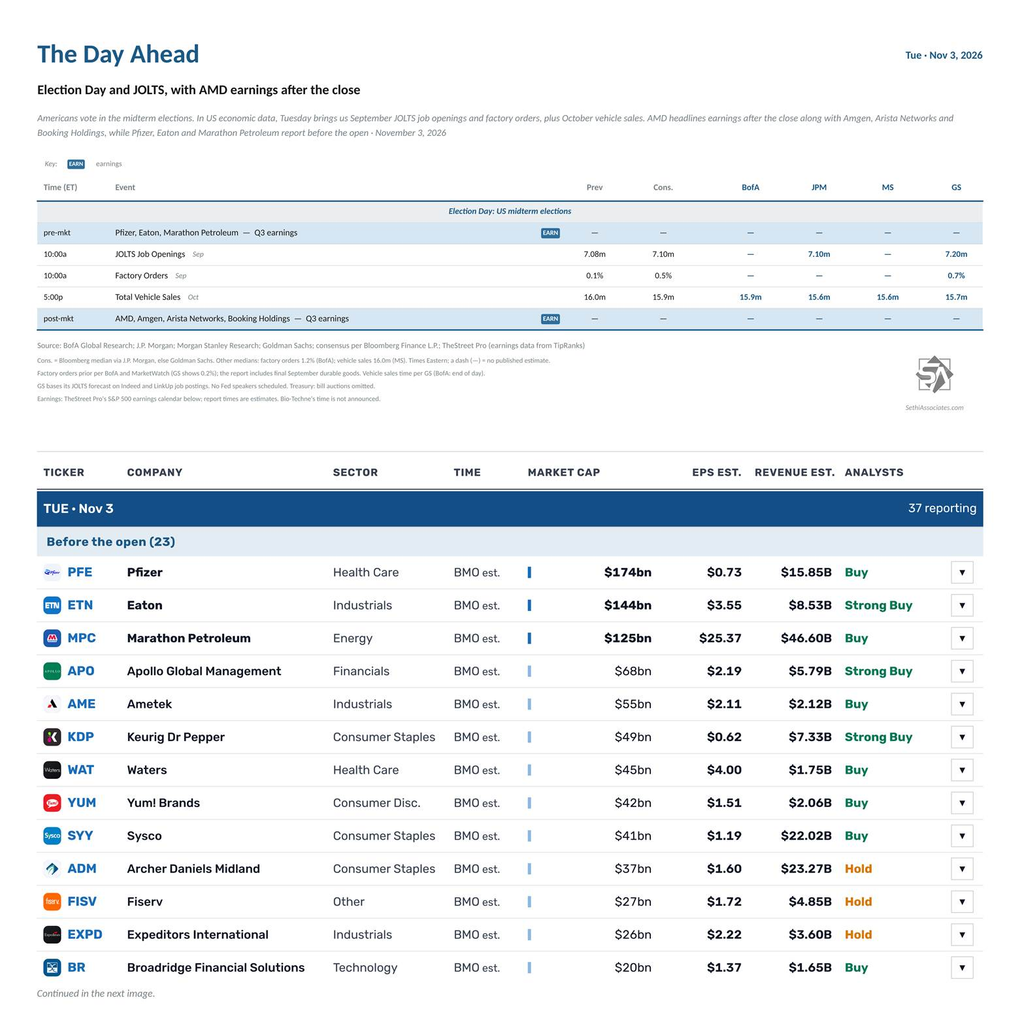
The Day Ahead — Election Day
It’s Election Day, with Americans voting in the midterm elections (all 435 House seats, 35 Senate seats and 36 governorships are on the ballot).
In US economic data, Tuesday brings us September JOLTS job openings and factory orders (which include final durable goods), and October vehicle sales.
There are no Fed speakers scheduled, although the Global Research Forum on International Macroeconomics and Finance, organized by the Fed, ECB and New York Fed, begins in Washington (through November 4), so there may very well be media interviews.
There are no non-Bill (>1yr in maturity) US Treasury auctions this week.
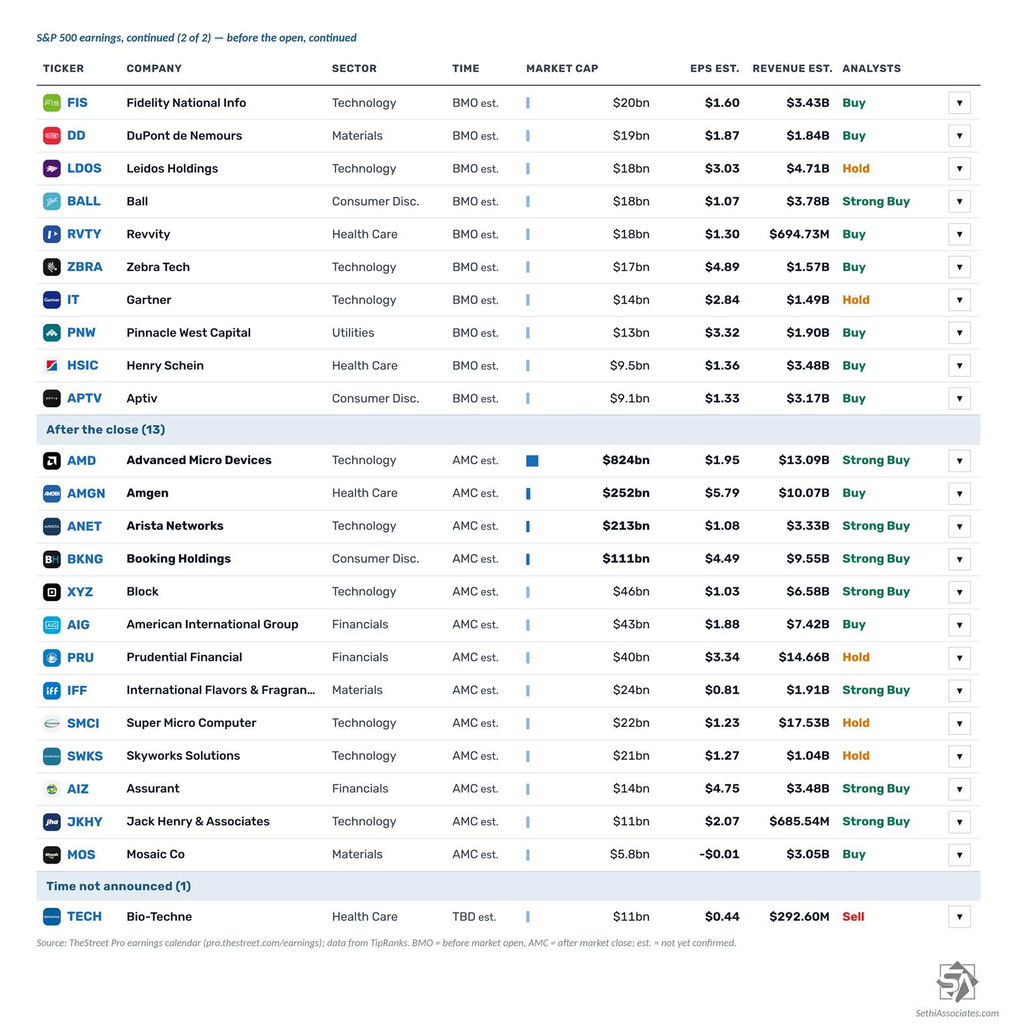
37 S&P 500 components report, seven of them with market caps over $100bn:
After the close: AMD ($AMD), Amgen ($AMGN), Arista Networks ($ANET), Booking Holdings ($BKNG), Block ($XYZ), AIG ($AIG), Prudential Financial ($PRU), International Flavors & Fragrances ($IFF), Super Micro Computer ($SMCI), Skyworks Solutions ($SWKS), Assurant ($AIZ), Jack Henry & Associates ($JKHY) and Mosaic ($MOS)
Before the open: Pfizer ($PFE), Eaton ($ETN), Marathon Petroleum ($MPC), Apollo Global Management ($APO), Ametek ($AME), Keurig Dr Pepper ($KDP), Waters ($WAT), Yum! Brands ($YUM), Sysco ($SYY), Archer-Daniels-Midland ($ADM), Fiserv ($FISV), Expeditors International ($EXPD), Broadridge Financial ($BR), Fidelity National Information Services ($FIS), DuPont ($DD), Leidos ($LDOS), Ball ($BALL), Revvity ($RVTY), Zebra Technologies ($ZBRA), Gartner ($IT), Pinnacle West ($PNW), Henry Schein ($HSIC) and Aptiv ($APTV)
Time not announced: Bio-Techne ($TECH)
Outside the S&P 500, Shopify ($SHOP), Energy Transfer ($ET), Ferrari ($RACE), Bayer ($BAYRY) and Intesa Sanpaolo ($ISNPY) report.
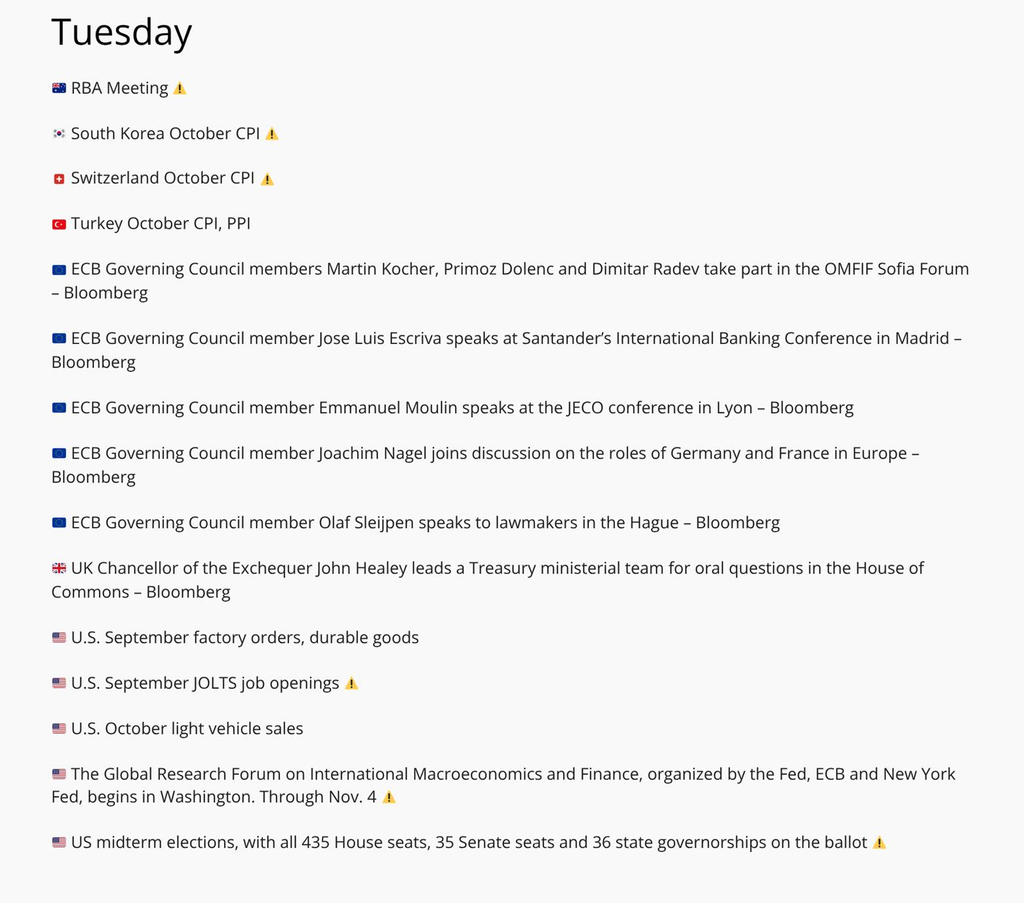
Ex-US highlights include the Reserve Bank of Australia’s decision (10:30pm ET Monday; Deutsche Bank expects a hold), October CPI from Switzerland, South Korea and Turkey (plus Turkey PPI), New Zealand’s Q3 labor force survey, Japan’s October monetary base and France’s September budget balance. ECB Governing Council members Kocher, Dolenc, Radev, Escriva, Moulin, Nagel and Sleijpen speak, as do the Bank of Canada’s Macklem and Rogers, and UK Chancellor of the Exchequer Healey takes oral questions in the House of Commons.
Japanese markets are closed for Culture Day.
From Christophe Barraud’s international Week Ahead rundown:
At the time of publication, in terms of securities mentioned, Sethi was long AAPL, AMZN, BKNG, CVX, ET, ETN, GOOGL, MSFT, NVDA, PLTR, QQQ, SPY, XOM, IWM, RSP, CPER and numerous Treasury ETFs and short AMD, MRVL and DELL. In the last 24 hours Sethi added QQQ and sold and shorted MRVL.