A Fair Criticism Deserves a Response

Subscriber jryan (below) delivered some reasonable comments and criticism yesterday in the Comments Section. 

Basically he said he is “getting sick of reading about cannabis and Fin TV commentary” — and he wants more (long) stock suggestions, etc.  

I wanted to respond in the first column of the day. 

* Few longs have represented value to me as I have been unduly negative for a lengthy period of time. I take ownership of that.

* The stocks that I have owned have recently been Staples ($KO, $PEP, $PG and $KMB), selected cannabis names and some others. The consumer nondurable stocks have been fine recently (and I have taken profits in them). We shall see about cannabis — a speculative sector and my focus has been intermediate-term based on the improved likelihood of rescheduling and other factors clearly delineated in my Diary.

*As to the CNBC constructive criticism. I point these out not only as an advocate of the retail viewer that should see timestamps (panelists taking ownership) and observe better company interviews, but so they can evaluate the merits and process of the panelists’ recommendations and become better-informed investors through more hard-hitting interviews (that serve more than as a marketing tool of companies). 

* But the criticism directed to Fin TV also is intended to highlight investment recommendations from panelists and guests that I strongly disagree with. Choosing stocks to avoid (in that FIN TV criticism) can be as valuable or even more valuable than choosing stocks to buy. Consider my negative comments towards $BA, $BABA, $META, $UBER, $NFLX, $RDDT, $TTAN, $DIS, $CLF, $MRNA and $UNH (a few years back) etc. that were mostly confidently and strenuously recommended on CNBC. 

* My “More Tales From Nvidia” series is intended to deliver the idea that the functionality, productivity and ROIC on the enormous capital spend may disappoint the many and multitude of optimists on AI. I have felt that my contrarian and non herd-like observations were valuable in a backdrop of near-universal bullishness (that is readily and frequently available from the buy/sell sides, panelists and guests). My view was that dwelling on “More Tales” had statistical value in that over 40% of the S&P is comprised of large-cap tech.   

* As to specific AI beneficiaries, I have admitted (often) of missing $MSFT and $GOOGL. The valuation on $AAPL seems foolish to me — the shares have prospered and I have been wrong.  But the others ($META, $AMZN and even $NVDA) have not set the world on fire this year. As to memory and chip stocks, they have been “the world’s fair” up until the summer but awful since late June. Not only do I think these companies are “overearning,” but the volatility is not for me and not consistent and doesn’t conform with my appetite for risk. 

*  The financial stocks were quite strong until early summer. I repeatedly cautioned not to embrace banks, brokers and private equity shares (I successfully shorted $BX, $KKR and $APOL since then). Viewed by panelists as perhaps the best “value play,” financials have been dismal over the last four months.  We avoided this decline (in $C, $JPM, $BAC, $GS, $MS et al).

* The stocks that I have been short in the AI sphere have been terrific (to the downside) — $ORCL and $CRWV. (Avoiding them as longs has also been a valuable contribution.) My recent foray into shorting NVDA was profitable also. 

* As to my preoccupation with CNBC I suggest taking the number of words written about FIN TV and divide it by the number of words written on other subjects daily. You will find my criticism is dwarfed by my other columns. In the scheme of things my criticism is de minimis. 

* Finally, to jryan I say there are many other contributors that actively recommend longs and provide a valuable service.

All this said I am imperfect.

I take ownership of my mistakes.

The transparency of my Diary exposes my blemishes. 

I believe jryan has some good points and I will purposefully look for more long ideas in the future. 

I truly appreciate jryan’s comments and I have tried to respond to his concerns:

jryan

Just a thought. There used to be a lot of different investment ideas, stock suggestions etc., but all it seems to be now is cannabis and CNBC commentary, which I don’t watch anyway. Kind of getting sick of it, especially the cannabis info, is it ever going to pay off? Likely, but it will be quite a while from today, if ever. But at least it’s easier to scroll through the commentary and use less time.

Position: Long KO (VS), PG (VS), KMB (VS), MSOS common (VL) and calls (VS), VRNO (VS), GLAS (S), GTBIF (S), TRLV (VS), CURLF (VS); Short AAPL (S)


More on the Anthropic IPO

I am sure a lot will be learned about the Anthropic S-1 over the next few days. 

But among the most (worrisome) big-picture issues is the amount of insider selling the IPO allows for (including right at the time of the IPO) without a lockup.

If the insiders and investors who know the most about the company are in a rush to sell, why would anyone be in a rush to buy? 

This reminds me of the CoreWeave ($CRWV) executive who claimed that the selling in CRWV’s shares was irrational, while he and every other member of senior management had sold hand over fist.

The whole structure, governance, financials, opacity, selling, valuation, the whole deal just smacks of hubris and arrogance. There is an underlying expectation that the greater fools continue to line up, nod in bovine agreement, and eat the slop they are fed by the VCs et al:

Oh in there is this line in there too. Just classic:

Position: None

AI’s Math Problem: $8.5 Trillion Needed, $3.6 Trillion Expected

Also catching headlines today: Bloomberg picked up a Gartner analysis from earlier this month showing a yawning gap between its forecasts for AI spending and AI revenue.

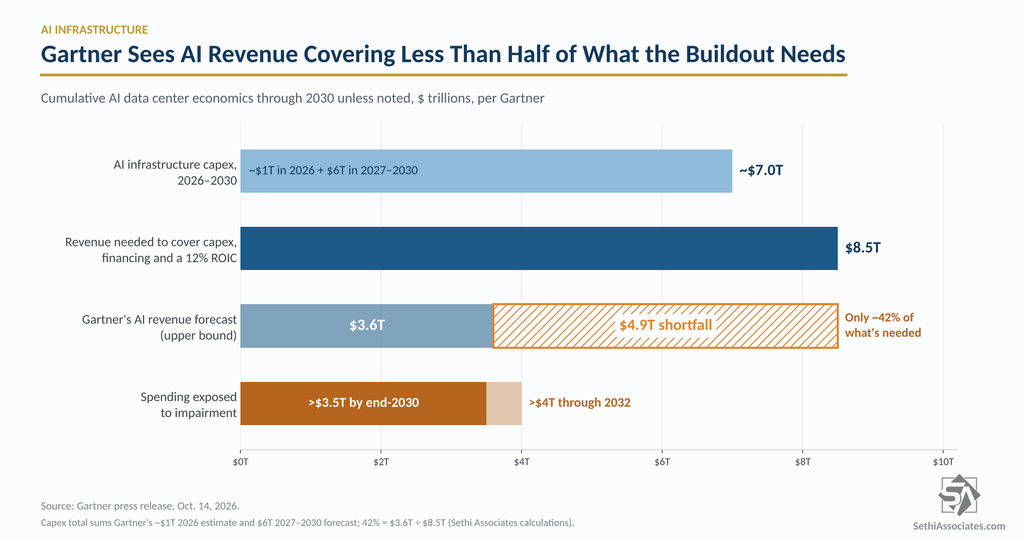
Gartner expects AI providers to spend nearly $1 trillion on AI infrastructure this year and another $6 trillion from 2027 through 2030.

Covering that spending, plus financing costs and a 12% return on invested capital, would take a cumulative $8.5 trillion in revenue through 2030. Gartner though forecasts no more than $3.6 trillion in enterprise and consumer AI revenue attributable to those data centers, about 42% of what’s needed. That leaves a roughly $4.9 trillion revenue gap, and more than $3.5 trillion of AI infrastructure spending exposed to impairment by the end of 2030, rising to more than $4 trillion through 2032. Gartner doesn’t expect that 12% return to be reached until the end of 2032 at the earliest.

The cloud math is no kinder. Gartner sees spending on AI-optimized infrastructure-as-a-service (IaaS) growing from $66 billion in 2027 to $174 billion in 2030. “The growth in spending on AI-optimized IaaS will be too low for most AI compute providers to recover their AI investments before the current generation of AI semiconductors is replaced,” said Gartner analyst Will Sommer. By my math, even that 2030 figure is only about 12% of the roughly $1.5 trillion a year Gartner expects AI providers to spend on infrastructure from 2027 through 2030.

Neoclouds are the most exposed. As Gartner notes, Microsoft ($MSFT), Alphabet ($GOOGL) and Amazon ($AMZN) have diversified revenue that could sustain AI spending for years, while specialists like CoreWeave ($CRWV) and Nebius Group ($NBIS) need returns soon.

Gartner predicts more than 80% of neocloud providers will cease independent operations by 2030. “All of them want to be the full-stack. They can’t all be,” Sommer told Bloomberg. “For every dollar that’s spent on compute, only a fraction of that is going to the owners of compute.”

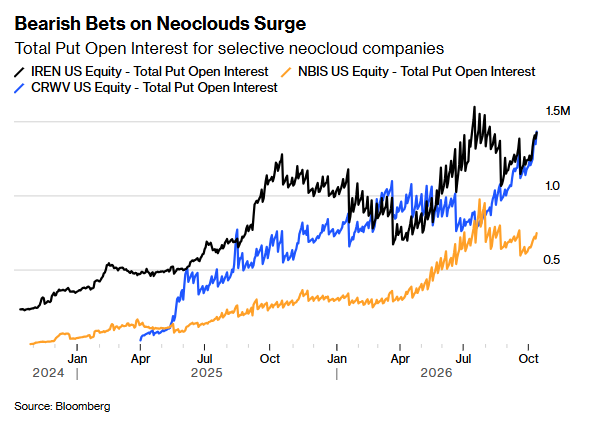
The options market is starting to brace for that. Put open interest in CoreWeave, Nebius and IREN ($IREN) has climbed sharply this year, per Bloomberg.

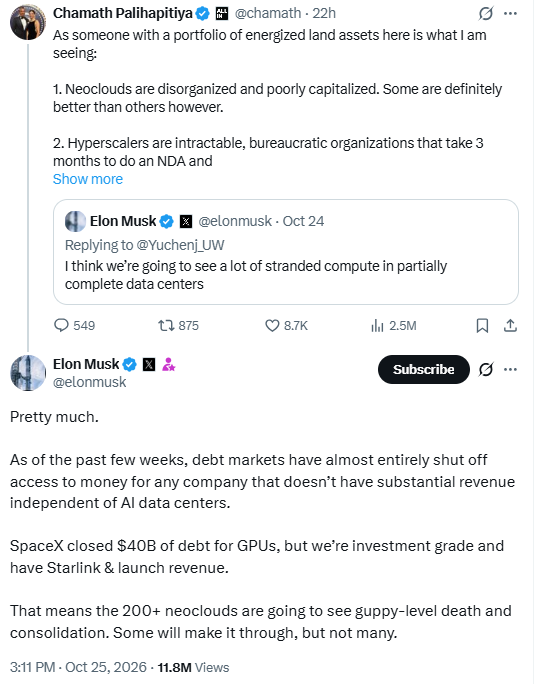
“Debt markets have almost entirely shut off access to money for any company that doesn’t have substantial revenue independent of AI data centers…That means the 200+ neoclouds are going to see guppy-level death and consolidation.” —SpaceX CEO Elon Musk in a tweet yesterday, in which he also said his company had secured $40 billion in debt financing.

More Tales From Nvidia: On Chip Pricing (Issue #265!)

Anthropic token pricing still needs to halve to match OpenAI.

Anthropic has a non-differentiated product, so it seems inevitable. And OpenAI is still at a big premium to open source. Something tells me this all keeps going down, by a lot!

—

Strap in, the rest of the “More”  is a long one. 

Two parts. 

First on compute prices, then on the coming depreciation bolus and its implications.

Nvidia ($NVDA) and the tech bros are all in lock step with the talking points. Not too different from the political parties who distribute talking points to the media, which nods in bovine agreement, and just repeats them, without thinking, or even caring, due to whatever agenda they personally have. Now the talking point, out of desperation, is “the price of compute is going up.” Here is the latest propaganda, from Nvidia, and echoed by one of the VCs, and this is now all over the place:

This is terribly misleading. Spot is a tiny (and apparently manipulated) market, and the data itself spotty (pun intended) at best. There are anecdotal stories that Nvidia pressures their smaller partners to hold spot rates up (on the surface at least as discounting and other terms will not be captured by these charts if the data is even real to begin with). This may be done to present the notion that chips and equipment are somehow not depreciating assets, such that they can be used as collateral for financing deals. Anyone speculating on chips or lending against chips on the basis of incomplete and misleading spot compute price data deserves to lose their money. 

Power is actually the binding constraint for compute. This is why the quoted price for compute, including for older parts, has gone up in theory. Power is the marginal constraint for the marginal market.

But underneath it all the chips and hardware are depreciating like they always do, which is rapidly. It should not be too hard to understand that the price of compute could go up due to power being a constraint, while the underlying hardware is still depreciating. Think of it this way, if the chips and equipment were removed, and sold on the open market, and needed to be placed elsewhere, what value would it have? The value of this stuff is independent of what the price of in place compute with power can be sold for.

But thinking would ruin another Hail Mary story, I guess. It is interesting that power is the marginal constraint, but nobody is talking about paying 100x PE for the local utility company. 

Then, of course, nearly all of the revenue in the space is actually on LT contracts, so CoreWeave ($CRWV) et al do not benefit from spot. The credit markets realize this at least. I think spot compute is generally sold by smaller marginal players.

But apparently, one of the big investors in the space does not realize that, or just dissembled, or both. Here is the big cheese at Blackstone ($BX) echoing the spot compute price talking point: 

Also, elevated spot pricing will not materially help the CoreWeave’s of the world to sign contracts for new business at higher prices, because big customers do not need CoreWeave to build capacity for them. If the price for compute was set at a level to yield more than a minor return, big players would just build it themselves. The only reason they use CoreWeave to begin with, is CoreWeave basically gives it away, as is evidenced by their lack of P&L and their balance sheet. This is why they report earnings before expenses, and sell their own stock like crazy. 

If I remember correctly Blackstone was piling into real estate at the peak in 2008 and also telling us how wonderful the fundamentals were. Bailed out by the Fed, so history repeats. But something tells me this time around the Fed no longer has the dry powder it used to, and Fed Chair Warsh is less inclined to resort to the same money-printing shenanigans.

Spot compute will have to head the way of token prices, in my view. A significant portion of the demand side for spot compute also comes from the aforementioned VC startups that seemingly account for 70-80% of demand, many of whom will likely cease to exist, and before that happens, will have to meaningfully slow their burn rates. 

There is excess stuff everywhere as well. There was the story that emerged last week with regard to Amazon ($AMZN) sitting on racks of components and servers in warehouses, with no place to put them. And now this story about companies with so many excess GPUs, they sit idle half of the time:

https://venturebeat.com/infrastructure/ai-bubble-update-79-of-companies-say-their-gpus-sit-idle-at-least-half-the-time-yet-most-plan-new-ai-platforms

At any rate, look who agrees with me about the power issue and the price of spot compute, as well as a glut of equipment and chips sitting idle which will be stranded. Chamath Palihapitiya, and Elon Musk of all people! Musk actually indirectly makes my point that the value of chips and equipment are independent of the price of compute quite clear when he talks about if anything is missing, the compute does not work. See the tweets to follow.

“This is a fuller list of the limitations of supercomputer buildout. If anything is missing, however seemingly trivial, the compute doesn’t work.”

I guess Musk is chiming in because he believes he has all the power lined up that he needs. Again, this is part of why is Amazon holding on to a bunch of chips and servers in warehouses. There has been massive forward buying of chips and equipment, that are sitting around doing nothing. This is what Musk is referring to as stranded capacity.

Anyway, spot compute is a tiny market and misleading. The real issue is power. The demand for spot compute is coming from garbage VC startups that won’t be around much longer either. Underneath it all, the chips and equipment are still depreciating rapidly like they always do. The intrinsic value of the chip has nothing to do with spot compute price. And spot compute price, if we even can get accurate data, will soon follow token prices for a variety of reasons. More supply is coming on line regardless, and the demand is coming from a lot of garbage companies that will not be around. End of day, the chips and equipment follow a normal depreciation curve, and using spot compute to suggest otherwise is B.S. 

Then CoreWeave at al do not benefit from spot anyway, because their biz is on LT contract. The credit markets, at least, understand this.

Live by the sword, die by the sword with the spot compute charts, that are sketchy at best to begin with. We know where the price of spot compute is going to go next. And you never own these types of stocks when you almost know the 2bd derivative of this stuff is about to go the other way, and then the whole thing will head down. You buy when the data is close to bottoming, not topping.

At any rate, it seems like an ugly situation is on the come for a variety of reasons:

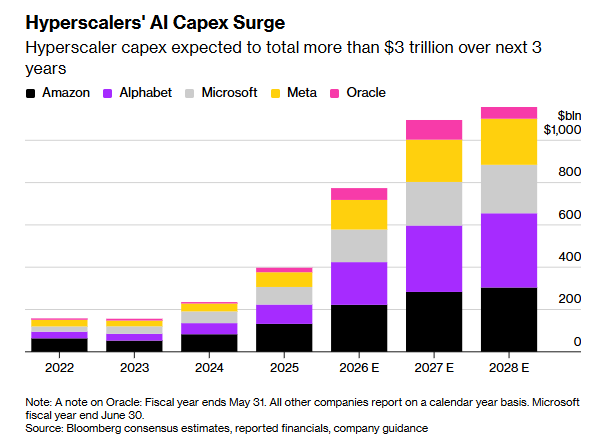
On a related note, below is another great chart and analysis on the amount of depreciation on the come for the big hyperscalers.

Think of all the profits needed to cover the coming increase in depreciation. The amount of depreciation expense that will hit by 2029 exceeds their current combined operating profits. But reality is you can already see this from looking at the balance sheets and cash flow statements.  Meta ($META) and Amazon are already cash flow negative. Nvidia earnings are not all they are cracked up to be either, as cash flow tells a different story due to all the money that keeps going out the door as they continue to function as the central bank of Nvidia and lender of last resort to keep buying their own revenue.

Per the chart, as usual the sell-side models at the individual company level are all B.S.

They do not flow enough depreciation into the P&L going forward.

They make up too much revenue on the come in the future.

Then they assume much too high of a margin on that revenue, especially given all the capacity coming on line, that will have to be sold.

It is all made-up crap.

Nobody can win now. There is too much capacity that has been put in place. Prices will have to be cut massively to sell the capacity. Think of the amount of revenue needed to absorb all of this. We are probably at multiples of world GDP at this point.

The whole earnings growth story that has been driving these companies, and equities overall (which is really just these companies), forget about it. With this much depreciation on the come, it is quite challenging for earnings to grow. Stagnant earnings, frankly, would be a good outcome relative to what might actually happen.

Post Script

Apollo’s Torsten Slok warns about the ROIC failure of AI:

And more…

Position: None

Upside, Downside Movers in the Morning

Upside

– $XNCR +32% (Phase 1 XmAb819 kidney-cancer data showed a 45.5% confirmed response rate and 82% six-month PFS at the proposed Phase 3 dose)

– $RENT +30% (no clear fresh catalyst identified; unusually heavy premarket volume extends Friday’s surge)

– $SGRY +24% (report of late-stage talks for Bon Secours Mercy Health to acquire a controlling stake at about $20 a share)

– $RRC +11% (EQT agreed to acquire it in a 0.987-share all-stock deal)

– $MACI +10% (shareholders approved the Everli business combination)

– $ROST +3.4% (UBS upgrades to Buy)

– $AVBP +3.3% (initial Phase 1 ARR-217 data showed a 44.8% response rate in colorectal cancer at the selected dose)

– $TSLA +2.3% (Barclays upgrades to Overweight, citing improving auto fundamentals, robotaxi momentum and potential SpaceX-combination upside)

Downside

– $XP -48%, $STNE -39%, $PAGS -32%, $BBD -30%, $ITUB -26%, $NU -26% (Brazil-linked financials plunge after leftist incumbent Lula won the presidential election over Flávio Bolsonaro)

– $BAK -34%, $PBR -19%, $VALE -4.9% (Brazil commodity names fall on the election shock and policy-risk repricing)

– $MRNA -8.1% (sell-the-news unwind continues after Phase 3 melanoma-vaccine data, with expectations elevated following the prior rally)

– $EQT -6.8% (falls as the acquirer in the all-stock purchase of RRC)

– $EFX -3.5% (RBC downgrades to Sector Perform on mortgage weakness concerns)

– $NTAP 3.0% (Guggenheim initiates coverage at Neutral)

– $CRWV -2.2%, $IREN -2.0% (neoclouds fall after SpaceX closed a $40B debt raise to buy Nvidia GPUs, signaling a large captive AI-compute build)