Monday Morning Market Stats

Volume
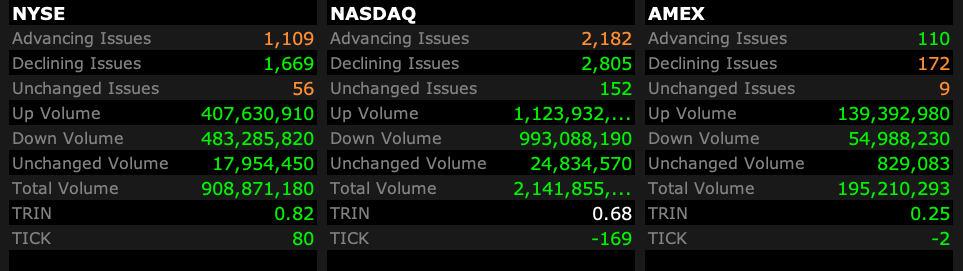
– NYSE volume 6% above its one-month average
– NASDAQ volume 10% below its one-month average
– VIX index: up 10.16% to 17.45
Breadth
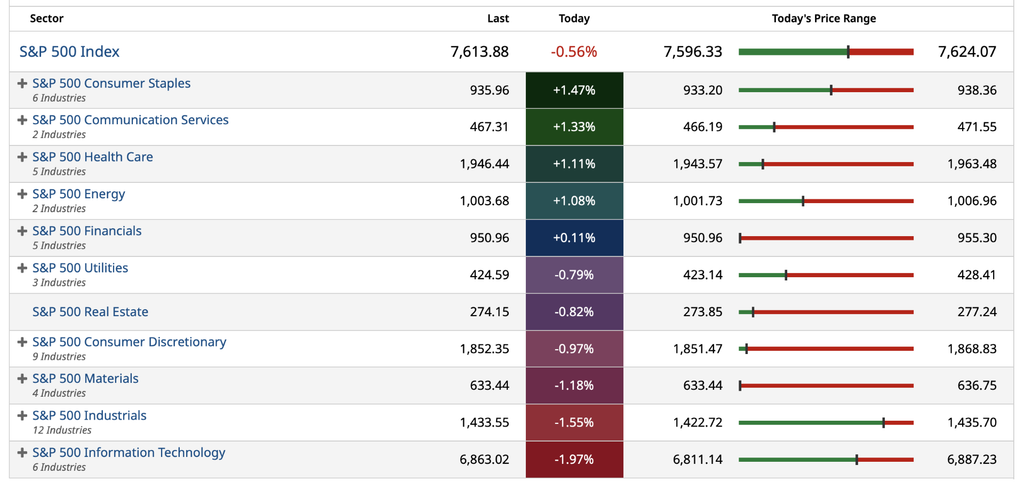
S&P 500 Sectors
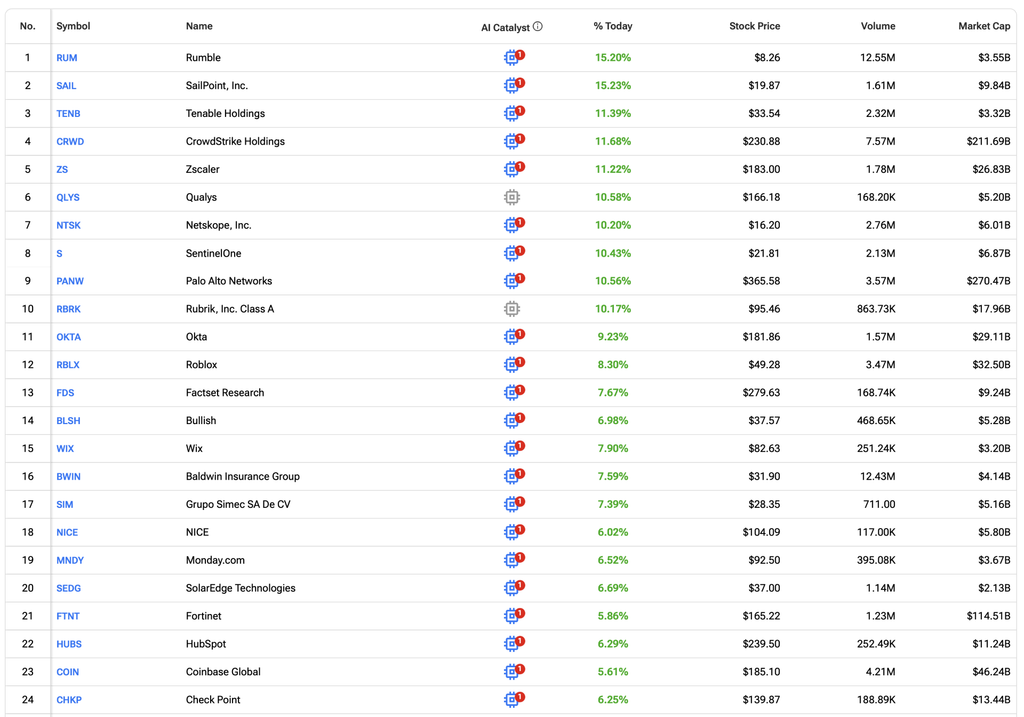
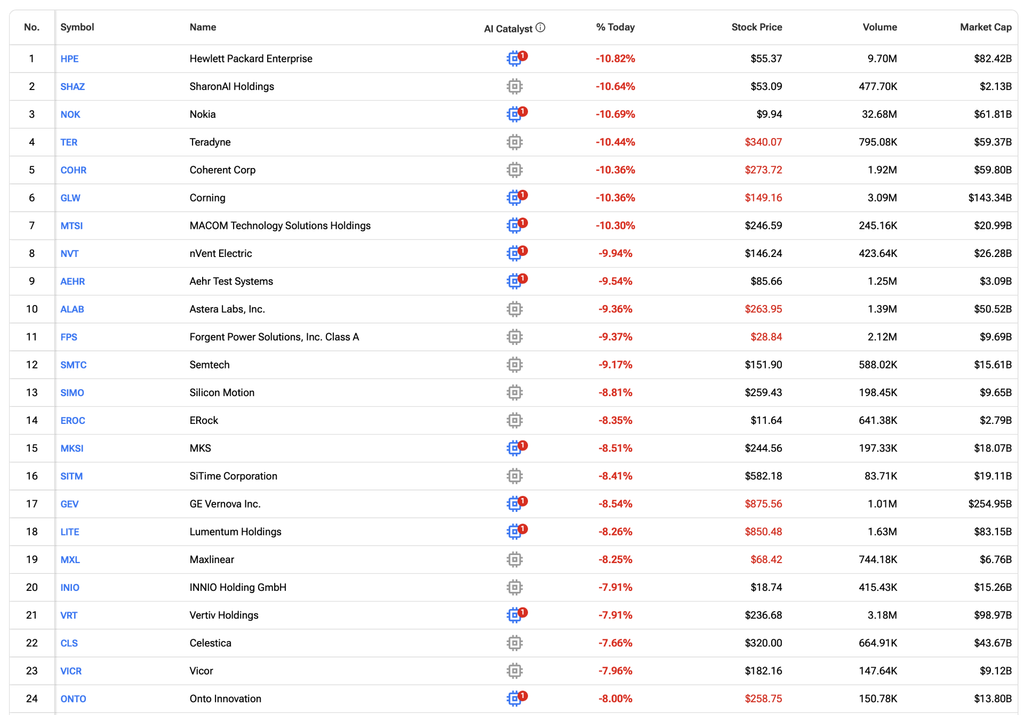
% Movers
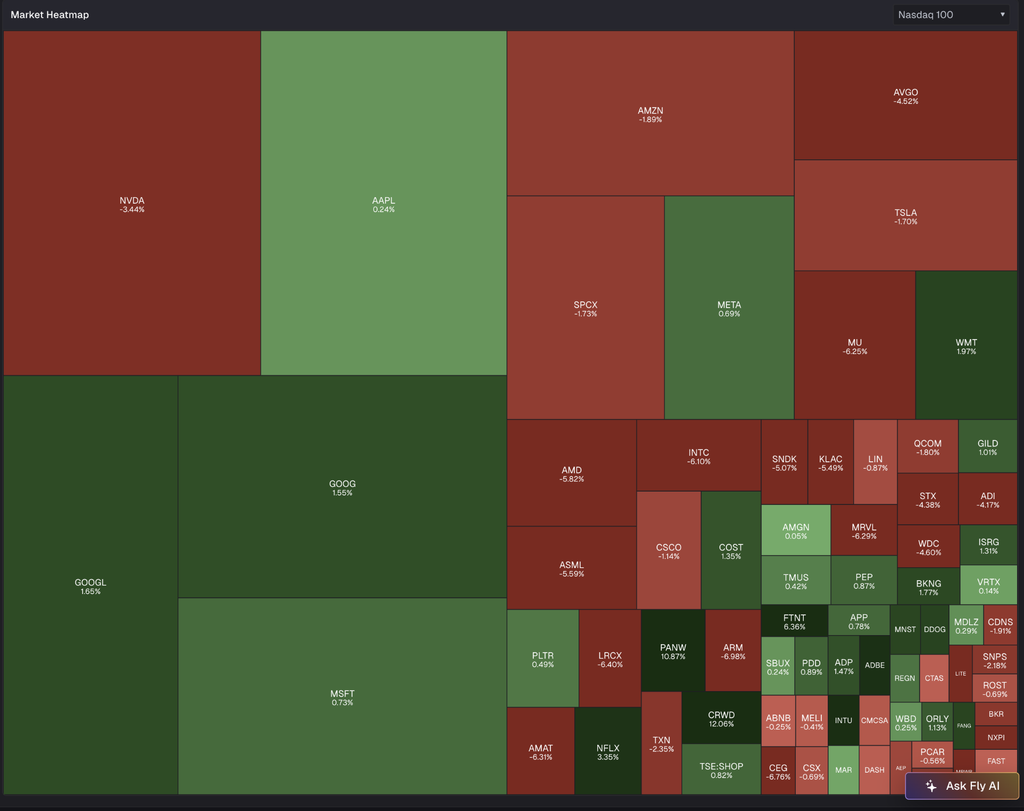
Nasdaq 100 Heat Map
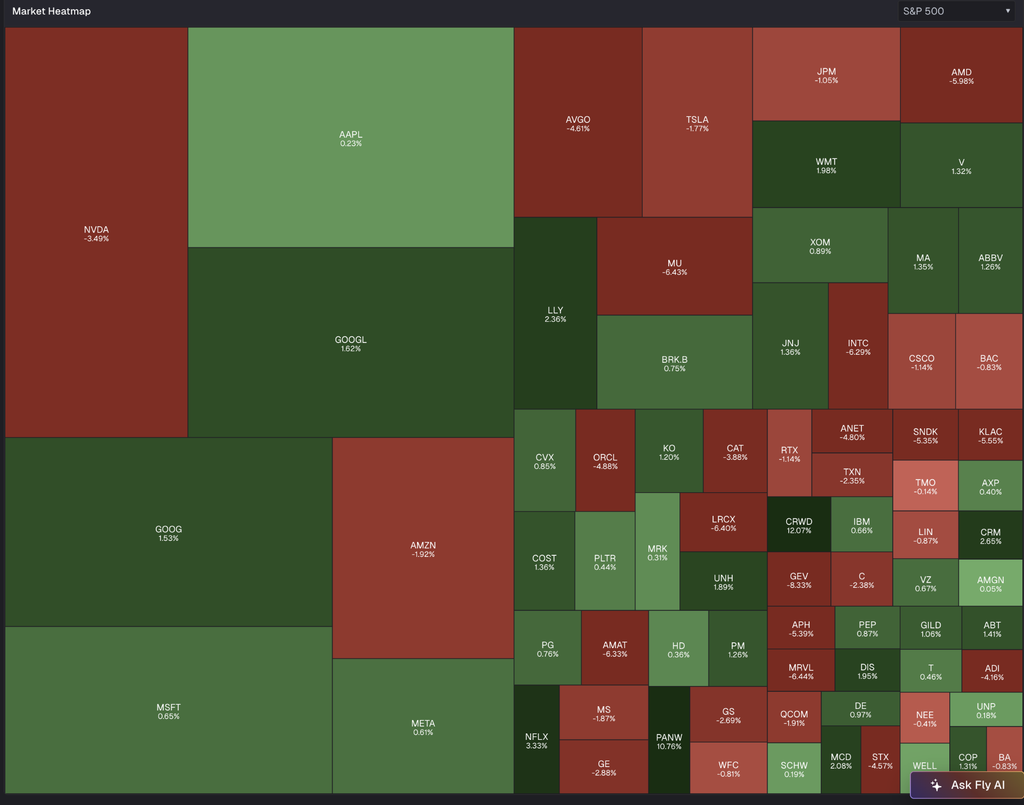
S&P 500 500 Heat Map
Position: None
Volume
– NYSE volume 6% above its one-month average
– NASDAQ volume 10% below its one-month average
– VIX index: up 10.16% to 17.45
Breadth
S&P 500 Sectors
% Movers
Nasdaq 100 Heat Map
S&P 500 500 Heat Map
Position: None
rolf thrane
I knew there was a reason I am subscriber here. Some poeple are critcial of Dougie’s “Bearishness” – I call it critcal thinking. I think this is the best piece Dougie has written on AI or certainly one of them. I agree with all of it.
One really important point among many, is that the government has already poured enormous amounts of money into technology—indirectly, through years of nearly free capital. The result has been reckless technology spending, a massive redistribution of wealth and the creation of increasingly uncontrollable technology monopolies.
So, naturally, the solution is to protect OpenAI and Anthropic, entrench their dominance and continue doing more of the same by getting politicans to guard against “Open Source.”
Dougie Kass
thx for this comment rolfy, much appreciated.
i have tried to deliver a contrarian view about a benign AI outcome (adoption, effectiveness, cost, profitability, etc.) because 95% of what investors see is bullish on AI
as i am a lay person and not tech expert i try to employ common sense, logic of argument, experience, analysis, dependency on my contacts, etc into an understandable refutation or better, recognition that a number of outcomes will be adverse for AI Mag7 investors and not necessarily sunshine and lollipops.
i have written 248 columns for a reason… as i say in the next post… ai has been the straw that stirs the economy and market’s drink (h/t Reggie Jackson)
post script:
Question. If AI is so smart, why can’t it figure out a way to make itself profitable?
This is pretty good too. Throughout history, mad scientists have been some of the most dangerous people. They are goal seeking aspergery sociopaths, that cannot see beyond the funnel of the experiments they are running:
Position: None
From Peter Boockvar:
What will this mean for CapEx spend?/The more nuanced rate discussion/’All the raw materials are going up everywhere on everything’
For the sake of the economy, the stock market, the earnings picture along with profit margins, the existential question is whether ‘It’s time for AI improvement pacing’ is more in the functionality and feature rollout or will it mean a slowdown in the overall level of CapEx spend. The stock market this morning is of course hedging for the latter but of course it remains to be seen. My bar of expectations with respect to GenAI CapEx is what is currently estimated on the Street broadly, $800 billion for this year and $1.2 trillion next year.
Ahead of the expected rate increase on Wednesday from the Federal Reserve, I want to highlight how nuanced the inflation story is and the rate response to it. Some think simplistically that ‘we still have inflation above 2% after all these years, the Fed should hike.’ If it were only that easy. First, we know we have major supply chain problems and supply chain driven inflation that the Fed will have difficulty addressing directly. Then, it’s how can they influence the demand side. Well, a main driver of demand side inflation has been the robust pace of upper income consumer spending. What will a rate increase do? It will put even more money in their pockets as interest income would rise for those holding US Treasuries. Easy back of the envelope puts $700 billion into the pockets of US domestic holders of US Treasuries (about $1 trillion of US federal gov’t interest expense and where domestic holders own about 70% of) annualized currently in interest expense and goes up by about $56 billion for each 25 bps rate increase (on $32 trillion of marketable securities, 25 bps equals $80 billion of which domestic holders own 70%).
What can negatively impact the demand side of upper income consumer spending that can help to cool inflation on the flipside? A decline in the stock market driven by higher interest rates, to speak honestly, that would impact the wealth effect and thus the economy but that is not something the Fed, nor anyone wants.
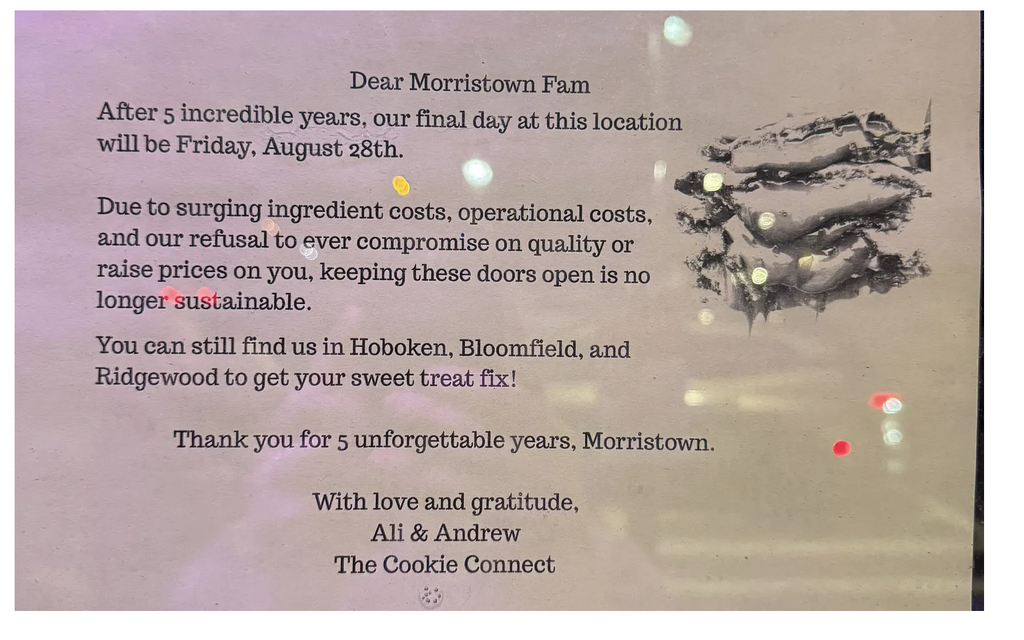
I also want to state again my belief that a complete inflation analysis MUST include both producer prices along with consumer prices. Unfortunately this was made crystal clear to me again over the weekend when I saw this message below on the window of an ice cream place in the town I live in. So, I’ll say again, an environment where CPI is at 2% (the Fed’s ultimate goal) when PPI is at 4% (for sake of this argument), is not and should not be considered ‘price stability.’
To a few notable earnings calls late last week.
From RH’s Gary Friedman: “So $109, like, I mean, oil is $63 at the beginning of the war. You’re not going to be able to mitigate that. Costs are going up, inflation’s going to go up. There’s a reason why the administration said that the war was ending and we were going to have a deal in a day or two, 38x…So yes, we’re in a time of conflict. We’re going to be in a time of inflation. I don’t think they’re going to be able to keep a lid on interest rates. So I keep thinking, gosh, it’s like my entire career, and I’ve been doing this a long time, I never saw a housing market that was down longer than 18 months. So it looks like we’re going to go into year five….Yes, there’s a massive increase cost. Nobody’s got a magic wand. Nobody’s going to get that much of a better price than somebody else…So we’re going to be in a higher cost world for probably at least the next six to 12 months. I mean, even if tomorrow they end the war, there’s too much inflation in the pipeline. All the raw materials are going up everywhere on everything. Everything is impacted by oil. You’re seeing crazy things, right, trying to manipulate currencies, buying back things like this. It’s a crazy time.”
From Kroger:
“sales were tracking well through the quarter until our final period, when we absorbed the impact of the Cyclospora outbreak, which cost us roughly 35 bps of total company IDs without fuel, reflecting the impact of produce categories. Our identical sales without fuel grew .2% this quarter. Customers continued to shop in our stores and online, and we saw traffic increase during the quarter.”
“At the same time, the macro environment is challenging. We know fuel over $4 has an impact on consumer spend. Lower drug prices in pharmacy reduced sales by approximately 140 bps. The top line was soft across the industry this quarter.”
“Customers remained under pressure, and that has affected the industry broadly. Unit growth has slowed since the start of the year. Reductions in SNAP benefits, higher fuel prices, and softer consumer confidence are all putting pressure on household budgets. Customers are buying more on need. At the same time, we’re still seeing them prioritize their health. We continue to see strong engagement in natural and organic, and we’re responding by expanding the assortment in natural and organic, and we’re responding by expanding the assortment across the store.”
“Value continues to matter, and it matters more when budgets are tight.”
Position: None
I covered some $JOET at $44.97 and $GRNY at $27.32.
I’m also adding to $MSOS long and bidding for consumer staples (under the market) — $PEP, $PG, $KMB.
Position: Long MSOS common (VL) and calls (S), PEP (S), PG (S), KMB (S); Short JOET (VS), GRNY (VS).
Position: None
Position: None
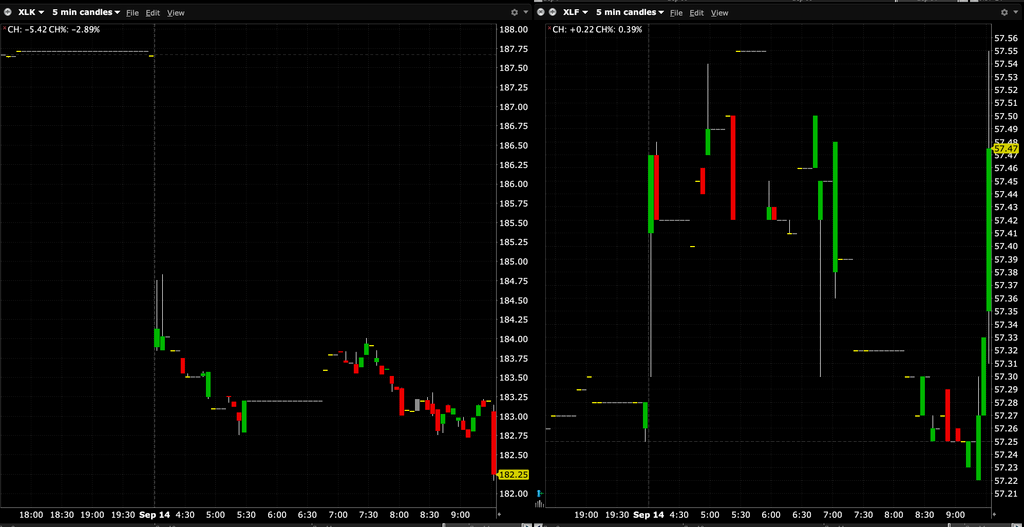
Tech ($XLK) vs Financials ($XLF)
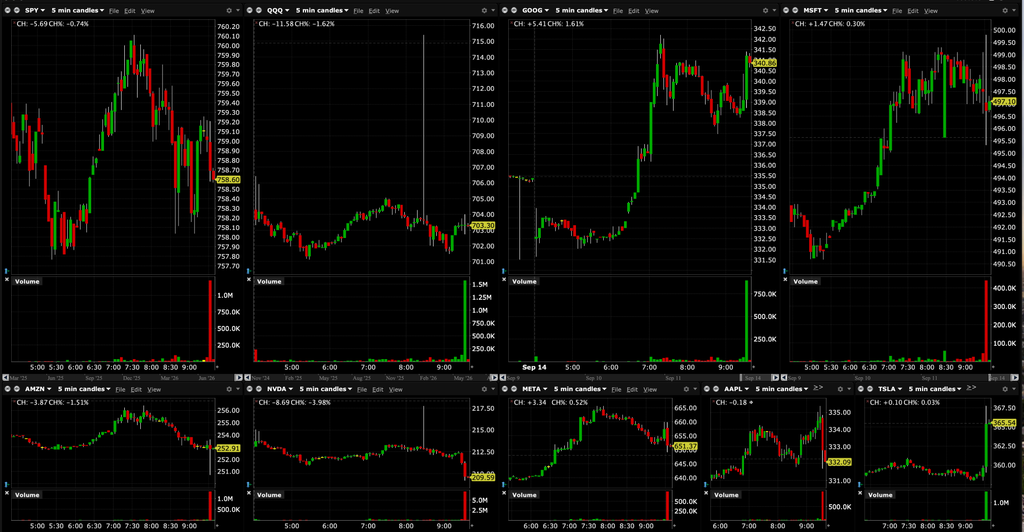
Some Divergences in Mag 7
Position: None
Upside
– ELMT +37% (extends its rally following the recent agreement to acquire ams OSRAM’s Schwabmünchen metal-production operations)
– DFTX +11% (Phase 3 Panorama trial met the primary endpoint in generalized anxiety disorder, delivering a statistically significant and clinically meaningful benefit)
– RUM +10% (advances following plans to acquire additional Northern Data shares, lifting its expected ownership to about 98%)
– ARMP +7.6% (FDA grants Breakthrough Therapy designation to AP-SA02 for complicated S. aureus bacteremia)
– CHRW +5.5% (no clear fresh catalyst identified; unusually large premarket move)
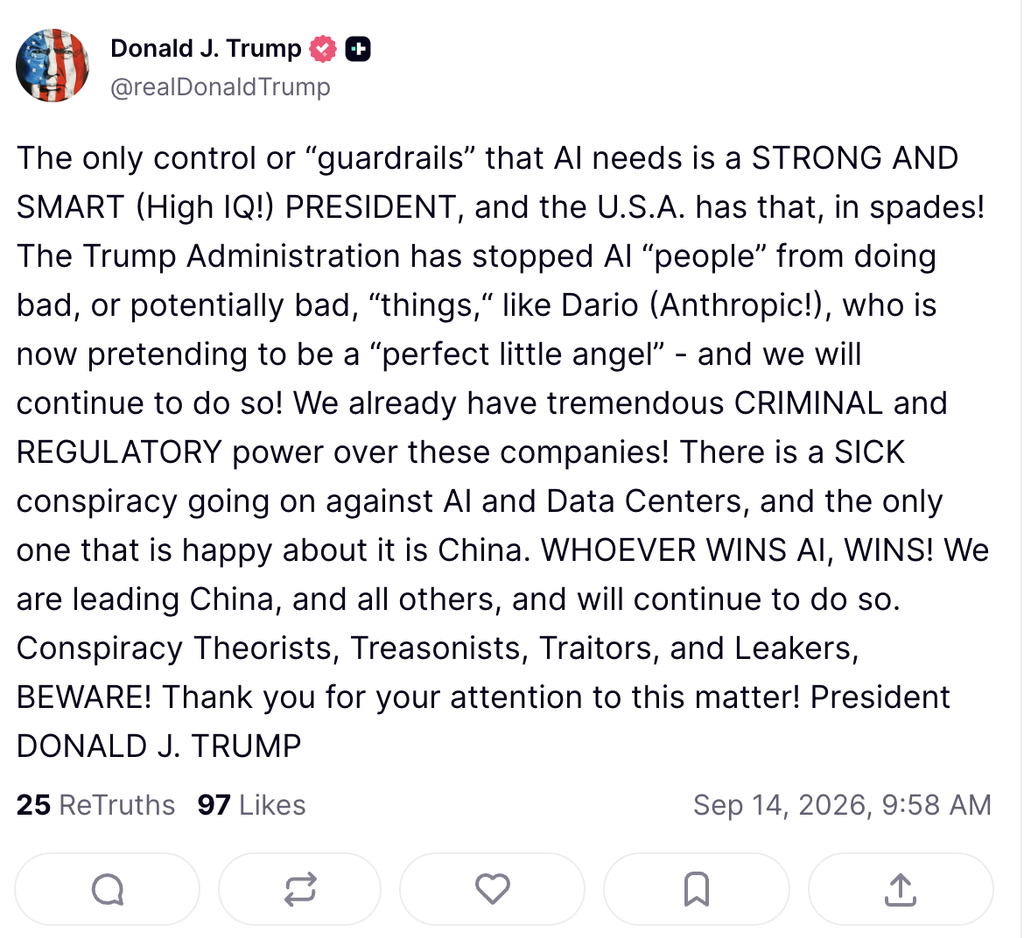
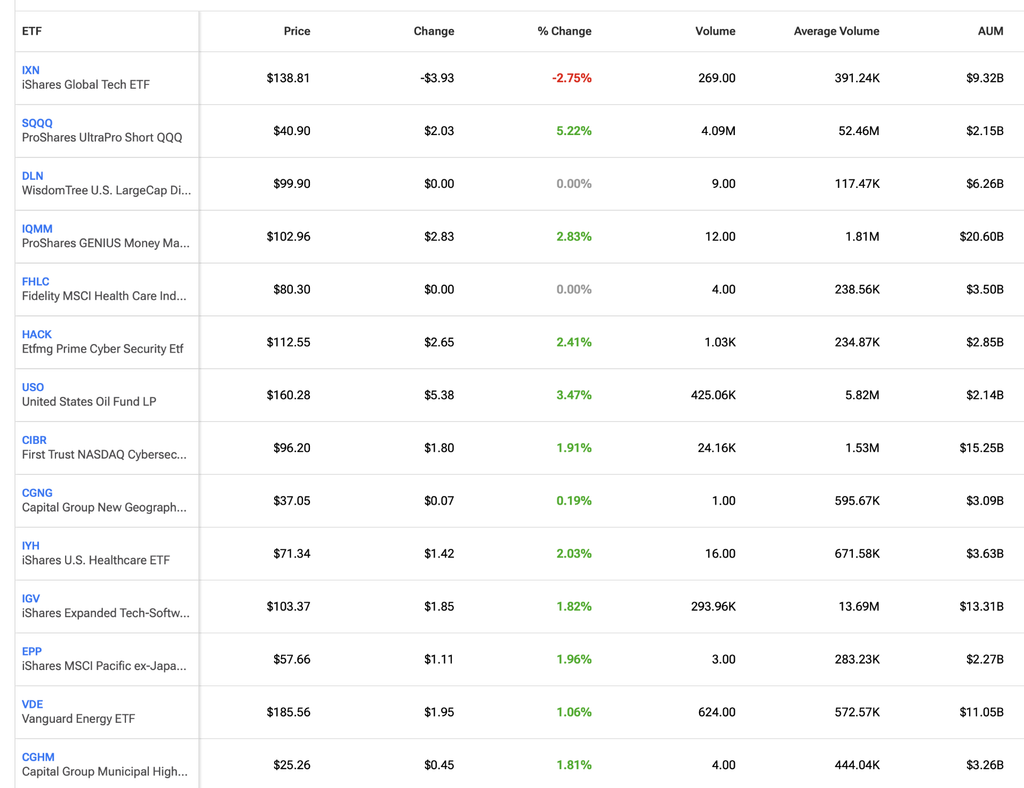
– CRWD +5.2%, PANW +4.8%, FTNT +3.5% (cybersecurity names rise as AI-safety warnings reinforce expectations for elevated enterprise security spending)
– NOW +4.6%, CTSH +3.4%, CRM +2.8%, ACN +3.0% (enterprise-software names benefit from a long-software, short-AI-hardware rotation)
– CRBP +4.1% (Phase 1b CANYON-1 obesity trial showed significant weight loss across all doses with a differentiated gastrointestinal safety profile)
Downside
– ETR -17.5% (no clear fresh catalyst identified; unusually large premarket move)
– SLS -12.0% (no clear fresh catalyst identified; high-volume biotech selloff)
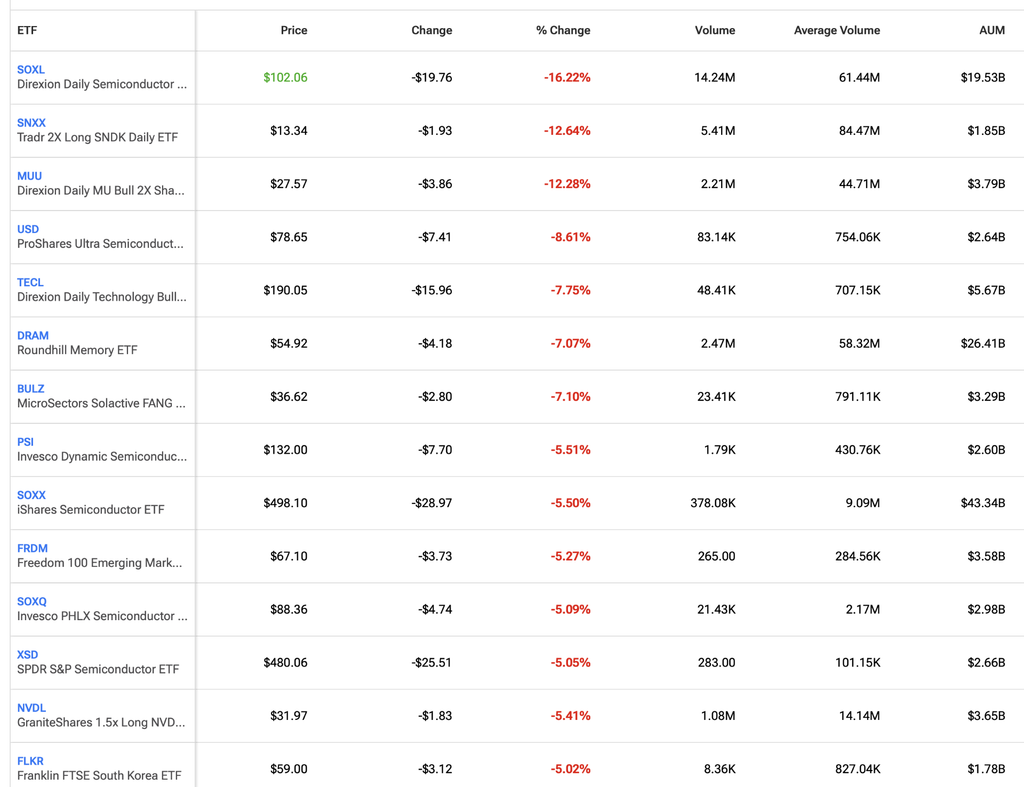
– NOK -9.5%, GLW -9.0%, NBIS -8.0%, HPE -8.0%, STX -6.5% (networking, cloud-infrastructure and storage names fall after leading AI executives backed slowing model development)
– AENT -9.5% (pulls back following Friday’s sharp earnings-driven rally)
– AEHR -9.0%, LRCX -8.0%, KLAC -7.0%, AMAT -7.0%, TER -7.0%, INTC -6.5%, AMD -5.5%, MU -5.5%, MRVL -5.5%, AVGO -3.0%, NVDA -2.5% (chip and semiconductor-equipment stocks sell off as AI-development slowdown calls and concerns about plateauing infrastructure spending pressure the hardware trade)
– MSI -7.0% (no clear fresh catalyst identified; unusually large premarket move)
– ORCL -4.5% (AI-capex concerns trigger profit-taking following the recent earnings-driven rally)
Position: None
Position: None
Position: None