NOW Down, EBAY Up: Upside, Downside Movers in the Morning

Upside

– $GKOS +16% (record Q3 sales and a large FY revenue-guidance raise topped expectations)

– $INSM +14% (BRINSUPRI revenue grew 29% sequentially and guidance was raised for both BRINSUPRI and ARIKAYCE)

– $NCLH +12% (Q3 results topped guidance and the FY EBITDA and EPS outlooks were raised)

– $CVNA +8.4% (large Q3 revenue beat and accelerating retail-unit growth outweighed an EPS miss)

– $CMG +8.3% (Q3 comparable sales beat expectations despite a modest profit miss)

– $DASH +6.9% (record GOV, revenue and net income alongside an agreed $17B acquisition of CART)

– $LITE +6.9% (MRVL is reportedly in advanced acquisition talks, with a deal potentially announced next week)

– $EBAY +6.1% (Q3 revenue and GMV growth accelerated, reinforcing improving marketplace momentum)

– $HII +5.6% (record Q3 revenue, $32.4B of contract awards and higher FY shipbuilding-revenue guidance)

– $LLY +5.1% (annual revenue guidance topped expectations)

– $NVS +3.2% (2026 core operating-income guidance was raised despite a drug-trial write-down)

– $RCL +3.5%, CCL +3.0% (cruise names rise after NCLH beat and raised its FY outlook)

– $MSFT +1.1% (strong cash flow and cloud guidance signaled better returns from heavy AI investment)

Downside

– FTNT -27% (headline beat and raised guidance failed to offset sharply slowing product growth and concerns the refresh cycle is fading)

– NOW -19% (strong topline results were overshadowed by softer forward cRPO expectations and unfavorable renewal phasing)

– HLN -14% (Q3 organic sales missed and FY organic-growth guidance was cut to around 2.5%)

– OSK -13% (quarter missed and FY revenue and EPS guidance were cut as fire-truck production problems persisted)

– MRVL -12% (reported talks to acquire LITE sparked concerns over deal cost and execution risk)

– $CAT -11% (quarter beat, but the margin outlook and durability of AI-infrastructure demand fell short of elevated expectations)

– $GOOGL -11% (Q3 profit and revenue missed as softer search advertising and surging AI spending intensified cash-burn concerns)

– $EGO -10% (2026 gold-production guidance was cut and cost outlooks were raised amid a slower Skouries ramp)

– $CTSH -10% (Q3 beat, but the FY revenue-growth outlook narrowed and Q4 growth guidance disappointed)

– $SCI -8.9% (Q3 earnings missed and guidance was cut)

– $ZS -7.1%, $OKTA -7.5%, $PANW -6.8%, $RBRK -6.8%, $CRWD -6.8%, $SAIL -8.0% (cybersecurity names fall on FTNT’s product-growth slowdown and refresh-cycle concerns)

– $NBIS -6.7%, $CRWV -6.4%, $STRL -6.6% (AI-infrastructure names retreat as $GOOGL’s spending surge renews concerns about monetization and cash returns)

– $HUBS -6.5%, $TEAM -6.9%, $CRM -5.8%, $TYL -5.8%, $WDAY -6.1% (enterprise-software names weaken after NOW’s forward cRPO and renewal outlook disappointed)


SoFI Up, HSBC Down: Upside, Downside Movers in the Morning

Upside

– $MFIC +23% (ARCC agrees to acquire it for $10.88 per share in cash and stock, valuing the transaction at about $2.6B)

– $INIO +14% (record Q3 results and FY26 revenue and EBITDA outlooks were raised)

– $CLS +12% (Q3 beat, FY26 outlook raised and initial 2027 guidance called for 90% revenue growth on accelerating AI-infrastructure demand)

– $SOFI +11% (record Q3 revenue and EBITDA, strong member growth and a raised FY26 outlook)

– $FER +9.9% (no clear fresh catalyst identified; unusually large, liquid move ahead of 9M results after the U.S. close)

– $RCL +5.3% (Q3 beat, bookings remained strong and the full-year profit outlook was raised)

– $CRDO +4.3%, $SKHY +3.2%, $COHR +2.7%, $AMKR +3.6%, $LITE +2.6%, $AVGO +2.9% (AI-chip and optical-connectivity names rise as the CLS outlook reinforces accelerating hyperscaler demand)

– $JCI +4.3% (Q4 beat and the FY27 profit outlook topped expectations)

– $SPGI +3.8% (FY26 outlook raised and a strategic review of Capital IQ businesses was launched)

– $NBIS +3.7%, BE +3.3%, CRWV +3.6%, VRT +2.2% (AI-infrastructure names gain after CLS said customer demand forecasts continue strengthening into 2027 and 2028)

– $NCLH +2.2%, CCL +2.7% (cruise peers rise after RCL beat expectations and raised its full-year profit outlook)

– $CDNS +1.8% (Q3 beat, FY outlook raised, backlog reached a record $8.2B and a $2.5B buyback was added)

– UPS +1.8% (Q3 beat and FY26 revenue and profit forecasts were raised as shipment mix and cost reductions improved)

Downside

– $XYL -8.5% (Q3 update disappointed, with investors focusing on softer revenue expectations)

– $WSO -8.3% (Q3 profit missed expectations)

– $HSBC -6.7% (Q3 revenue and pretax profit missed expectations, outweighing a new $1B buyback)

– $HLT -4.4% (Q3 earnings beat, but revenue missed and the raised RevPAR outlook was not enough for elevated expectations)

– $SHW -3.8% (Q3 results and outlook disappointed as housing-linked demand remained soft)

– $ONON -3.3% (no clear fresh catalyst identified; unusually large, high-volume premarket decline)

– $MAR -2.0% (hotel peer slips in sympathy with HLT after its revenue miss)

AI’s Math Problem: $8.5 Trillion Needed, $3.6 Trillion Expected

Also catching headlines today: Bloomberg picked up a Gartner analysis from earlier this month showing a yawning gap between its forecasts for AI spending and AI revenue.

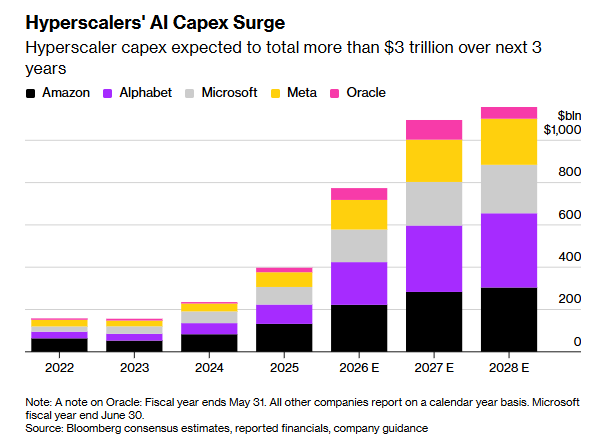
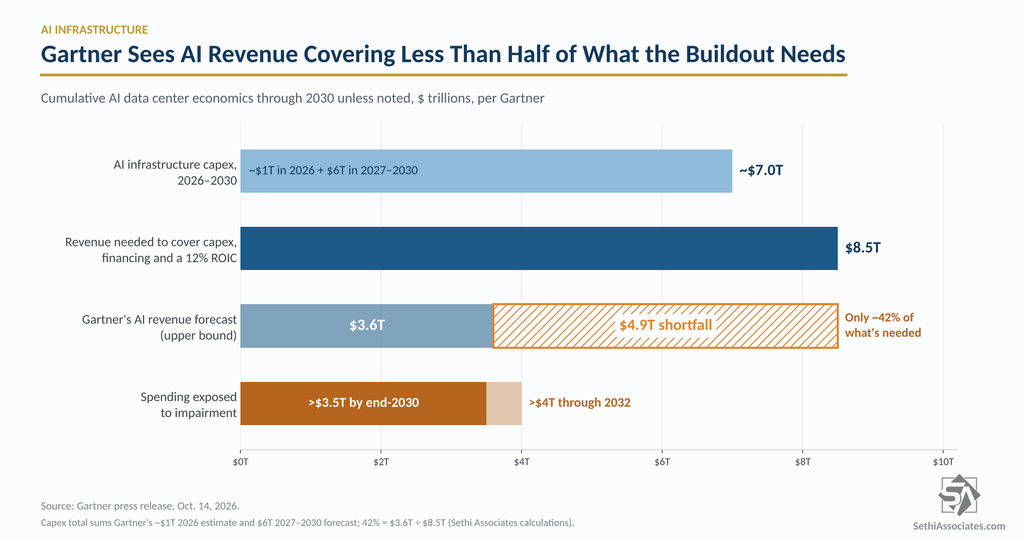
Gartner expects AI providers to spend nearly $1 trillion on AI infrastructure this year and another $6 trillion from 2027 through 2030.

Covering that spending, plus financing costs and a 12% return on invested capital, would take a cumulative $8.5 trillion in revenue through 2030. Gartner though forecasts no more than $3.6 trillion in enterprise and consumer AI revenue attributable to those data centers, about 42% of what’s needed. That leaves a roughly $4.9 trillion revenue gap, and more than $3.5 trillion of AI infrastructure spending exposed to impairment by the end of 2030, rising to more than $4 trillion through 2032. Gartner doesn’t expect that 12% return to be reached until the end of 2032 at the earliest.

The cloud math is no kinder. Gartner sees spending on AI-optimized infrastructure-as-a-service (IaaS) growing from $66 billion in 2027 to $174 billion in 2030. “The growth in spending on AI-optimized IaaS will be too low for most AI compute providers to recover their AI investments before the current generation of AI semiconductors is replaced,” said Gartner analyst Will Sommer. By my math, even that 2030 figure is only about 12% of the roughly $1.5 trillion a year Gartner expects AI providers to spend on infrastructure from 2027 through 2030.

Neoclouds are the most exposed. As Gartner notes, Microsoft ($MSFT), Alphabet ($GOOGL) and Amazon ($AMZN) have diversified revenue that could sustain AI spending for years, while specialists like CoreWeave ($CRWV) and Nebius Group ($NBIS) need returns soon.

Gartner predicts more than 80% of neocloud providers will cease independent operations by 2030. “All of them want to be the full-stack. They can’t all be,” Sommer told Bloomberg. “For every dollar that’s spent on compute, only a fraction of that is going to the owners of compute.”

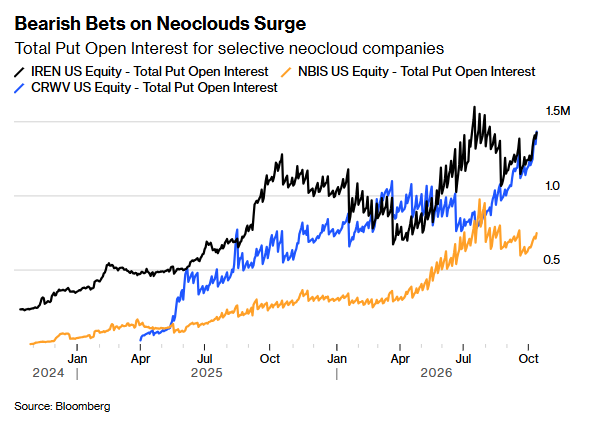
The options market is starting to brace for that. Put open interest in CoreWeave, Nebius and IREN ($IREN) has climbed sharply this year, per Bloomberg.

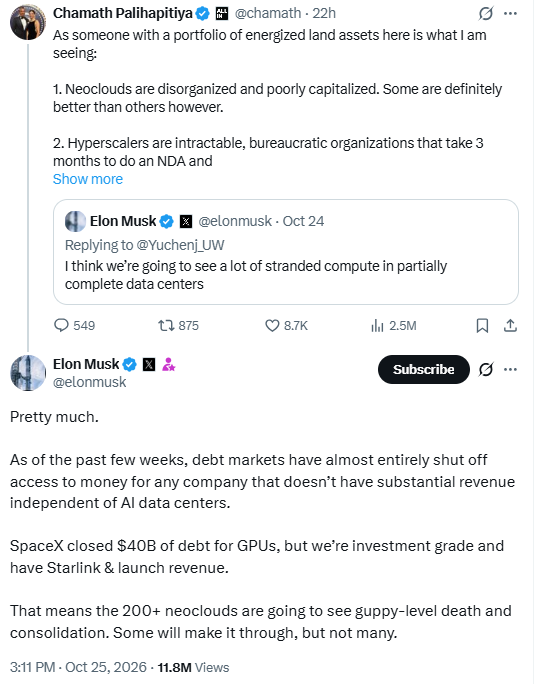
“Debt markets have almost entirely shut off access to money for any company that doesn’t have substantial revenue independent of AI data centers…That means the 200+ neoclouds are going to see guppy-level death and consolidation.” —SpaceX CEO Elon Musk in a tweet yesterday, in which he also said his company had secured $40 billion in debt financing.