Alphabet’s Record Plunge Drags Down Tech as the Rest of the Market Rallies


Quick Summary
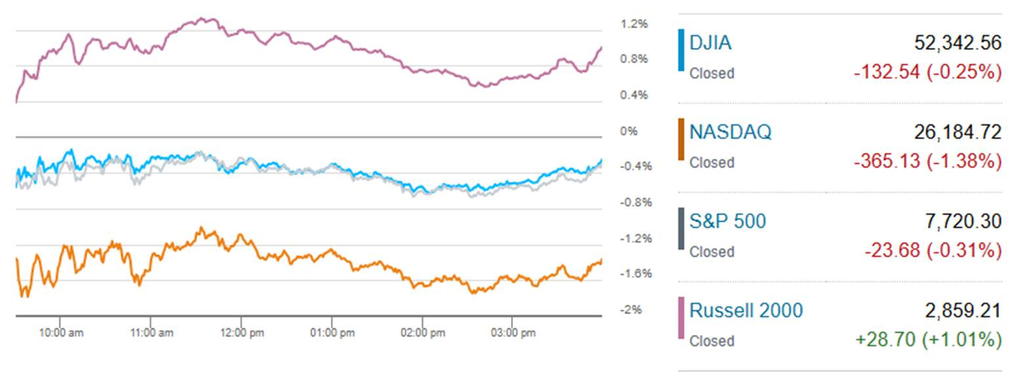
- US equity indices were split all session. The Russell 2000 (+1.0%) rose for a fourth straight day, and the equal-weight S&P 500 gained 1.2%, its largest gain in two weeks, even as the Nasdaq (-1.4%), S&P 500 (-0.3%) and Dow Jones Industrial Average (-0.3%) snapped three-day winning streaks. All four hit their lows around 2:30pm ET on a report that a tanker had been struck in the Strait, per Doug Kass (Reason for Market Drop?), before recovering into the close.
- Alphabet ($GOOGL) fell 12.6% for its worst day on record, eclipsing its 11.6% drop in 2020 and erasing about half a trillion dollars in market value, per the WSJ, after third-quarter search revenue fell short and free cash flow turned negative (more here: Alphabet Drops on Earnings Miss, Cash Flows Turn Negative). That along with Microsoft’s ($MSFT) lower-than-expected capex guide saw a basket of AI winners fall 2.7%, per Bloomberg.
- Under the surface, though, it was a broad rally. More than 400 S&P 500 components rose and the equal-weighted S&P 500 outperformed the cap-weighted index by 1.5 percentage points.
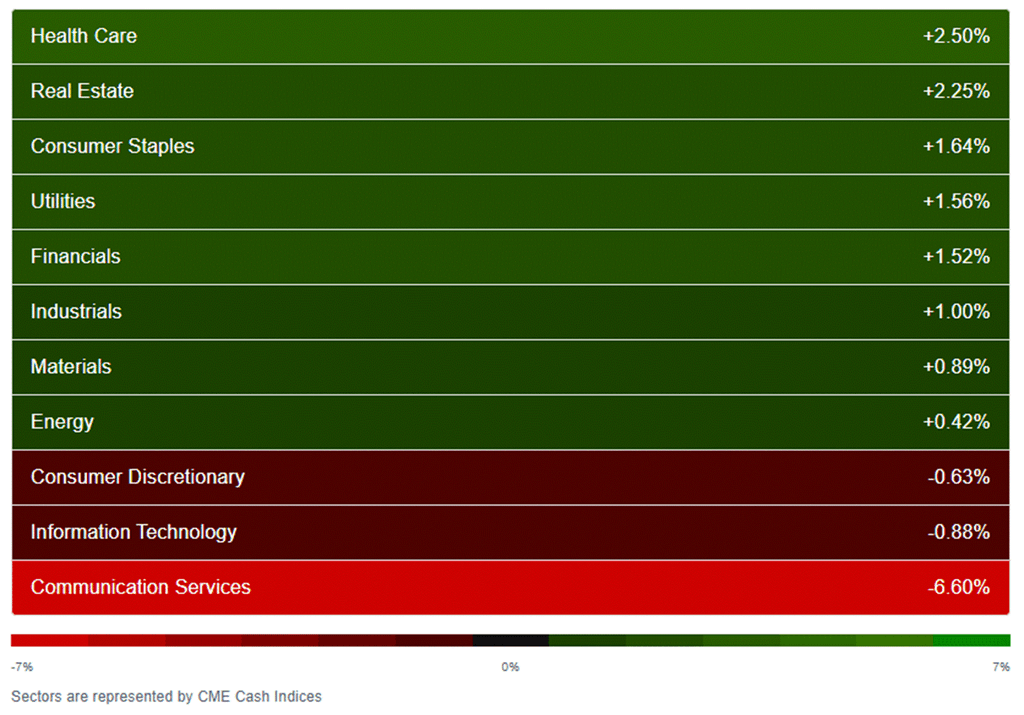
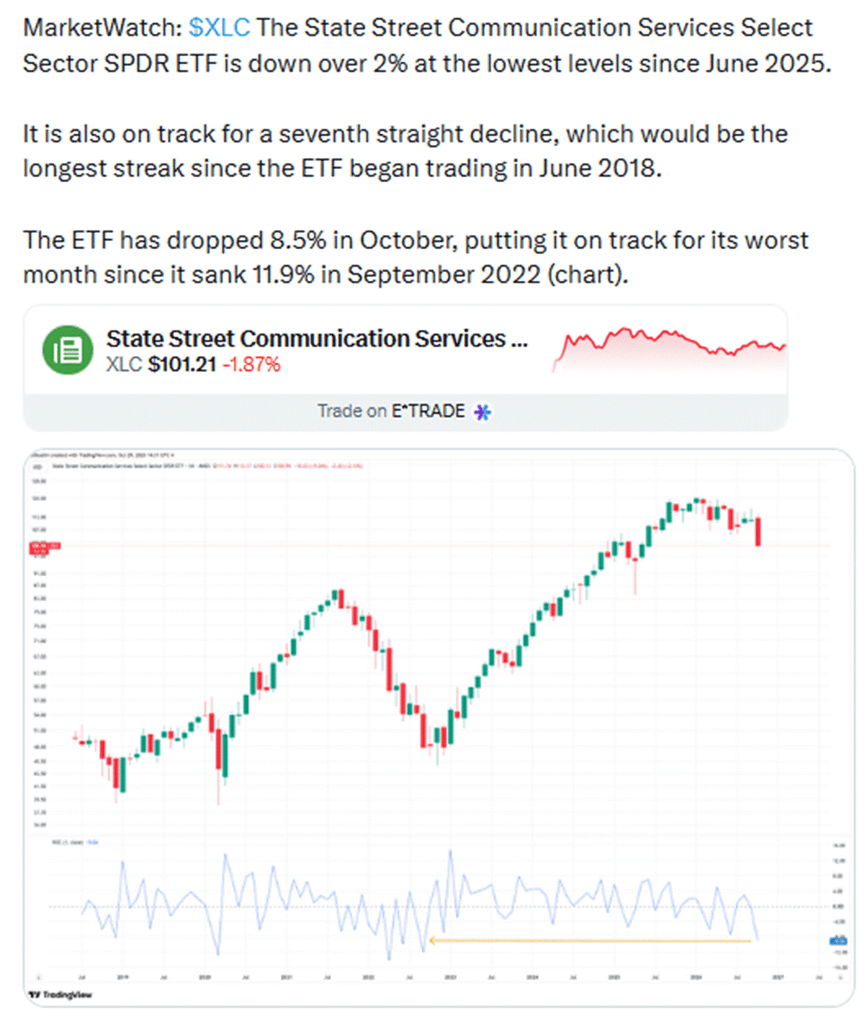
- Eight of 11 sectors rose, led by Health Care (+2.50%) and Real Estate (+2.25%), while Communication Services (-6.60%), Tech (-0.88%) and Consumer Discretionary (-0.63%) fell. It was a record seventh consecutive session lower for an ETF which tracks the Communications Services sector. Consumer Staples (+1.64%) in contrast snapped a four-day losing streak.
- Data showed the economy picking up speed. Q3 GDP grew 3.37% annualized, the fastest since Q3 2025 and above the 3.2% consensus (more here: Q3 GDP Beats on Strong Consumers and Equipment Spending). Inflation remained elevated though with September core PCE prices rising 0.3% (0.317% unrounded), the most since February, lifting the annual rate to 3.12%, in line with expectations, which dragged on real consumer spending and incomes (more here: Inflation Remains Elevated as Real Spending Stalls). Initial jobless claims edged down to 194,000, with the four-week average the lowest since 1969 (more here: Jobless Claims Refuse to Budge as Four-Week Average Hits Lowest Since 1969).
- Treasuries rallied, led by the front end. 2-year yields were down 8 basis points including the after-hours session to 4.60% and 10-year yields fell back under 5%. Fed rate hike expectations also eased, with December now a 74% chance of a hike from 83% Wednesday, per CME FedWatch and rate hike expectations through the end of next year falling under three hikes. A $44 billion 7-year auction saw domestic buyers pick up the slack from softer foreign demand (more here: 7-Year Auction: Foreign Demand Stays Soft but Domestic Demand Steps Up).
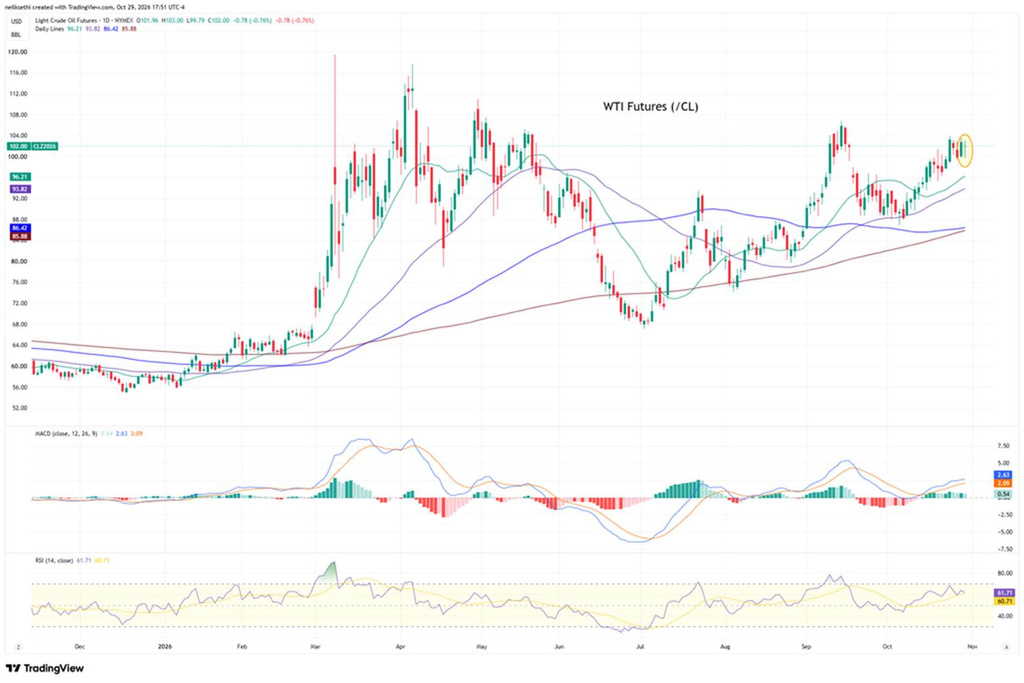
- WTI slipped 0.8% to about $102 a barrel as traders parsed conflicting signals on the direction of US military strategy in Iran, per Bloomberg. The ECB left rates unchanged, a decision overshadowed by President Christine Lagarde’s announcement that she’ll step down early (more here: Lagarde to Leave ECB Early, Adding to Leadership Turnover).
- After the close, Amazon ($AMZN) fell about 6.5% after missing on the top and bottom lines as its cash burn accelerated (more here: Amazon Shares Down as Cash Burn Accelerates), while Intel ($INTC) sank nearly 20% on a weak fourth-quarter forecast (more here: Intel Sinks as PC Slump, Supply Snags Swamp 78% Data Center Surge). Rev Shark asks whether Amazon’s stumble will push the rotation further.
- Friday brings a lighter day with just the Q3 Employment Cost Index in terms of notable economic data, although we will get our first Fed speakers since the FOMC meeting (Daly and Musalem), the Bank of Japan will have a policy decision overnight (a hold is widely expected) and we’ll get results from Exxon Mobil ($XOM), Chevron ($CVX) and AbbVie ($ABBV).
Schwab
Market Commentary
Equities:
- “The sorting has begun, as tech companies are now solely being judged on their AI spending, which is bound to create winners and losers. We are now getting to see who is spending rationally on AI and who is not,” said Richard Reyle at Questar Capital Partners.
- “I think we’re in a better, more stable place in October and heading into November in the tech trade than we were in August and September. But that said, I think investors are becoming much more selective,” said Art Hogan, chief market strategist at B. Riley Wealth Management. “I think we’re in an environment where there’s less concern and negativity over tech writ large, but I think specifically, you can certainly get announcements from individual players that will move the needle.”
- Thursday’s price action was a “microcosm” of what the stock market has experienced for much of October, with concerns about the AI trade weighing on technology and communication services while leaving other areas relatively unscathed, said Chris Larkin at E*Trade from Morgan Stanley.
- “It was another strong round of economic data that shows ongoing inflationary pressures and growth split between the AI buildout and consumption,” said Ian Lyngen at BMO Capital Markets.
Bonds/Fed:
- AI is still the major theme for activity, but economic resilience is still a broad-based story, according to Eli Nir and Oscar Munoz at TD Securities. “Couple that with the AI-led inflationary pressures, and it’s clear why the Fed both upgraded its growth assessment and remained acutely focused on their inflation mandate,” they added.
- White House National Economic Council Director Kevin Hassett hinted that he expected the Fed would raise rates if inflation figures for this month are elevated. “If October comes out really high, then I think the Fed would probably appropriately act,” he told Bloomberg Television.
Stock and Sector Breakdown
Schwab
In contrast with Wednesday and Thursday when the spread between the top and bottom performing sectors was under 1.5%, today there was a more than 9% spread. Eight of 11 rose, led by Health Care (+2.50%), Real Estate (+2.25%), Consumer Staples (+1.64%), Utilities (+1.56%) and Financials (+1.52%), with Industrials (+1.00%), Materials (+0.89%) and Energy (+0.42%) also higher.
To the downside, Communication Services (-6.60%) was dragged down by Alphabet, while Tech (-0.88%) — its 10th straight session in the top two or bottom two sectors — and Consumer Discretionary (-0.63%) also fell. Staples snapped a four-day losing streak. Bob Lang noted that hiding out in healthcare has been profitable.
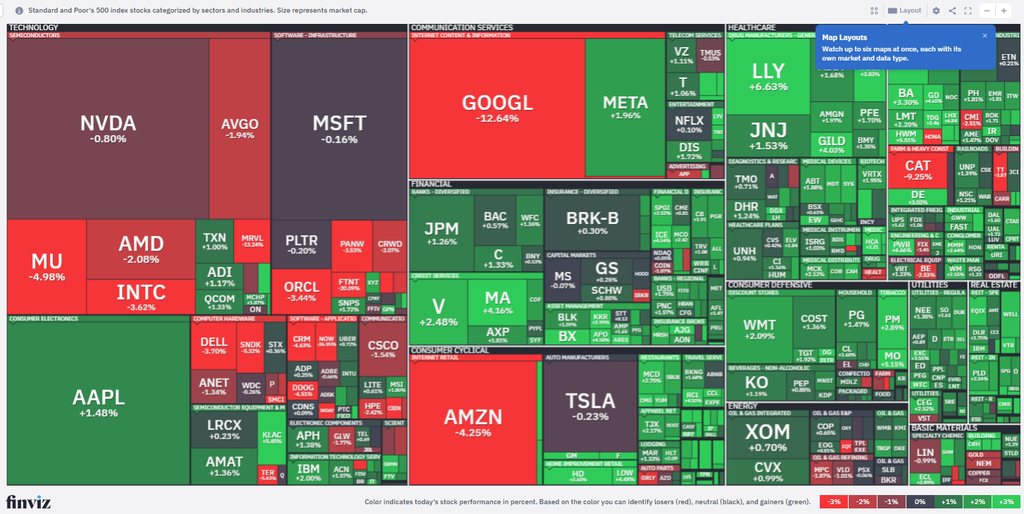
Gen Digital ($GEN) (+15.8%) was the best performer in the S&P 500 after a beat-and-raise quarter that drew a reiterated Buy rating at Evercore ISI (TipRanks). ServiceNow ($NOW) (-27.0%) was the worst as investors looked past a modest EPS miss to its fourth-quarter guidance for 18.5% growth in current remaining performance obligations, below the 19.8% Street forecast (TipRanks).
Alphabet ($GOOGL) (-12.6%) had its worst day on record after third-quarter results disappointed, with core search revenue falling short in part because of the popularity of less-profitable “AI mode” searches, per the WSJ. Chris Versace is trimming the Portfolio’s Alphabet price target, Doug Kass argued that Google’s investors had let their guard down, and Ed Ponsi opened a small GOOG position at $280, seeing good support near $271.
Microsoft ($MSFT) (-0.2%) reversed an early gain even as it drew blowout demand for a $25 billion bond sale, per Bloomberg. Stephen Guilfoyle updated his Microsoft price target after the bond sale, Chris Versace set a new Microsoft price target on its $33 billion cloud update, and Rev Shark looked at why the two hyperscalers had the same growth but different outcomes. Neoclouds CoreWeave ($CRWV) (-5.0%) and Nebius Group ($NBIS) (-5.7%) also fell.
Other AI names slid too. Marvell Technology ($MRVL) (-13.2%) fell after Bloomberg reported it’s in advanced talks to buy Lumentum ($LITE) (+0.6%) (Chris Versace: This Holding Comes Under Pressure Following Acquisition Report). Fortinet ($FTNT) (-20.1%) sank even after a third-quarter beat and raised guidance as product revenue slowed (TipRanks). Memory and test names gave back some of their recent gains, with Teradyne ($TER) down 5.4%, Sandisk ($SNDK) 5.3% and Micron Technology ($MU) 5.0%, and the Philadelphia Semiconductor Index (SOX) fell 1.4%, snapping a four-day winning streak. Amazon ($AMZN) fell 4.2% ahead of its report.
Earnings drove most of the rest. Carvana ($CVNA) (+15.7%) jumped after a strong third quarter that led Morgan Stanley to make it a Top Pick, per Doug Kass (From The Street of Dreams). Norwegian Cruise Line ($NCLH) (+13.5%), defense names Huntington Ingalls ($HII) (+13.2%), Textron ($TXT) (+11.7%) and L3Harris Technologies ($LHX) (+6.8%), and Eli Lilly ($LLY) (+6.6%), which crushed estimates and raised its sales guidance (TipRanks), also rallied on their reports. Peer Merck ($MRK) (+3.8%) also rose. Ed Ponsi says the beat gives it appeal as a long-term investment. Chipotle Mexican Grill ($CMG) (+8.9%) extended its after-hours gain.
On the downside, Caterpillar ($CAT) (-9.3%) was a big drag on the Dow Jones Industrial Average as analysts cut price targets (TipRanks) after its construction business disappointed, while Honeywell Aerospace ($HONA) (-9.6%), Baxter International ($BAX) (-7.7%), Cognizant Technology Solutions ($CTSH) (-5.8%) and Bunge ($BG) (-4.7%) fell on their results.
Bloomberg also reported that Anthropic is SpaceX’s largest single customer, accounting for more than a third of the third-quarter revenue of SpaceX ($SPCX) (-0.9%).
After the close, beyond Amazon and Intel, Twilio ($TWLO) fell about 18%, Reddit ($RDDT) about 17% after saying it plans to limit access for logged-out users, and Stryker ($SYK) and Illumina ($ILMN) about 12% each. Starbucks ($SBUX) slipped about 2% even though its US sales rose faster than expected, Coinbase Global ($COIN) fell about 2% after returning to profitability on lower revenue (Bloomberg), and Mondelez ($MDLZ) rose about 4%. After-hours moves are as of about 5:45pm ET.
The number of large SPX winners (up over 3%) jumped to 75 from 33 Wednesday, while large losers (down over 3%) rose to 26 from 23.
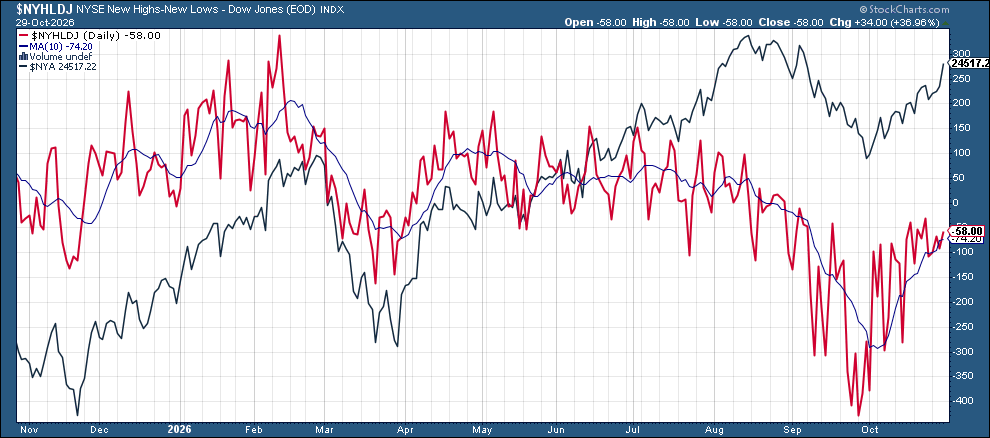
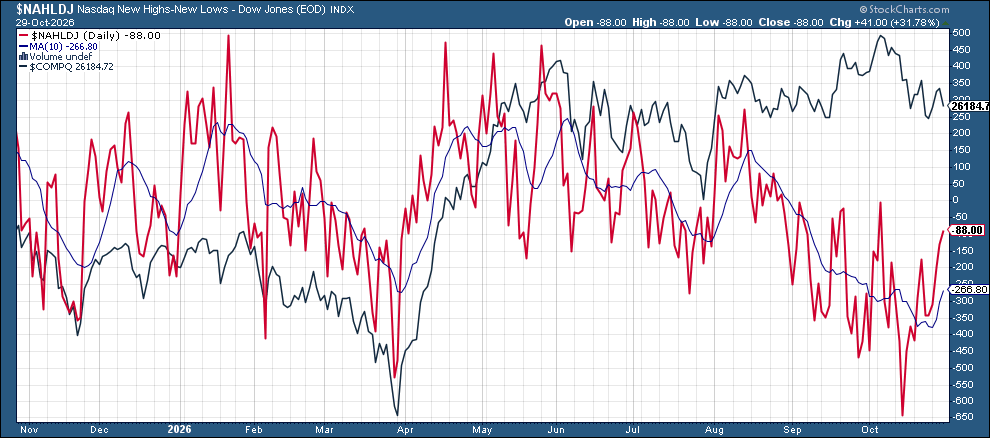
52-week highs minus lows, though, improved to -58 on the NYSE (which gained 1.05% on the day) and to -88 on the Nasdaq, the best since the start of the month, despite its 1.38% loss. That’s still the 44th straight negative session for the Nasdaq, surpassing the 43-session stretch that ended April 22, 2025.
Some other stock-specific commentary from TheStreet Pro:
James “Rev Shark” DePorre — 10 Stocks to Watch as the Rotation Builds: Mag 7 names are being sold, “and that is good news for the rest of the market.”
Stephen Guilfoyle — Trimming This Small-Cap Biotech on Strength as We Eye the Chart
A Look At The Charts
Note on all charts the colored lines are moving averages (the average price over the lookback period — days on the daily charts, weeks on the weekly charts):
20 = green
50 = purple
100 = blue
200 = brown
Exception is monthly charts where blue is 10-month moving average and brown is 20-month moving average.
MACD = Moving average convergence/divergence line, a measure of momentum that compares longer term and shorter term momentum to gauge if a move is strengthening or weakening. This is probably my favorite individual indicator.
RSI = Relative Strength Index (basically what it sounds like) = measures the strength of the move comparing gains to losses over the given lookback window (I use the standard 14 periods).
SPX
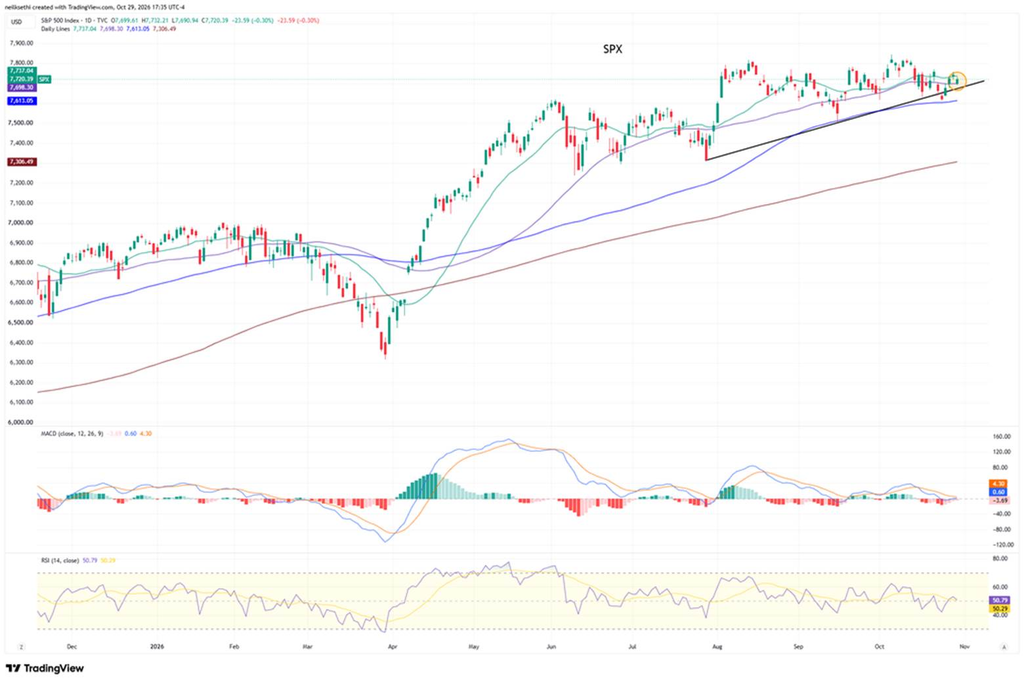
The SPX slipped 0.30% to 7,720.39, snapping a three-day winning streak and closing back below its 20-DMA (7,737) but holding above its 50-DMA (7,698) and the trendline from the July low (circled). The MACD remains in “sell longs” positioning (but it is close to flipping), and the RSI is at 51.
Nasdaq Composite
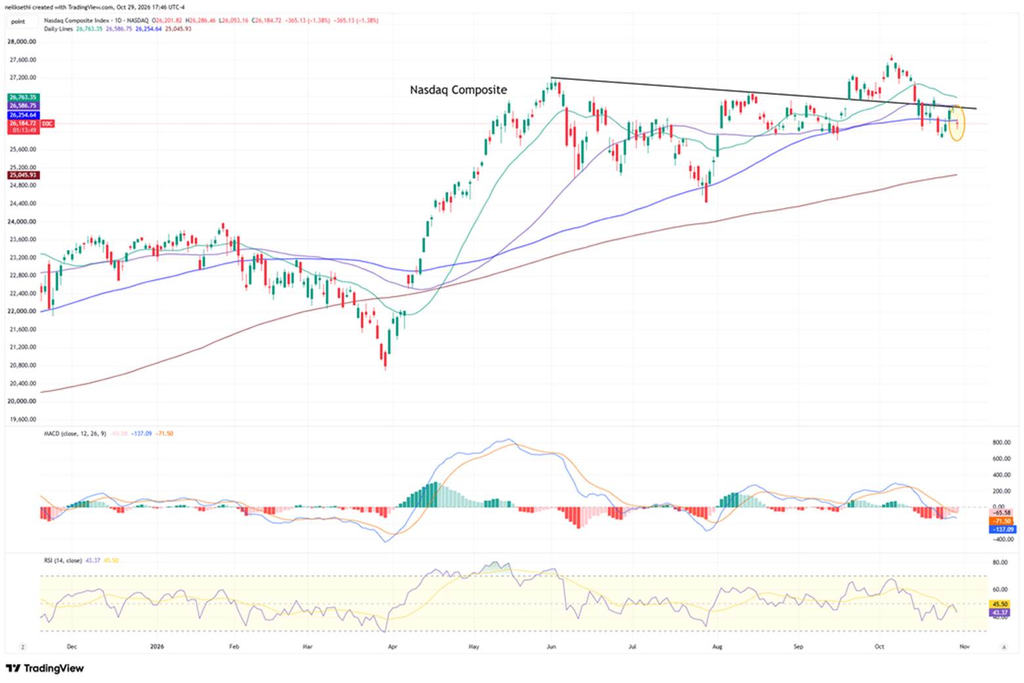
The Nasdaq Composite fell 1.38% to 26,184.72, closing back below its 100-DMA (26,255) after failing to clear its 50-DMA (26,587) and the downtrend line from the June high (circled). The MACD remains in “sell longs” positioning, and the RSI is at 43.
The Nasdaq-100 ($QQQ)
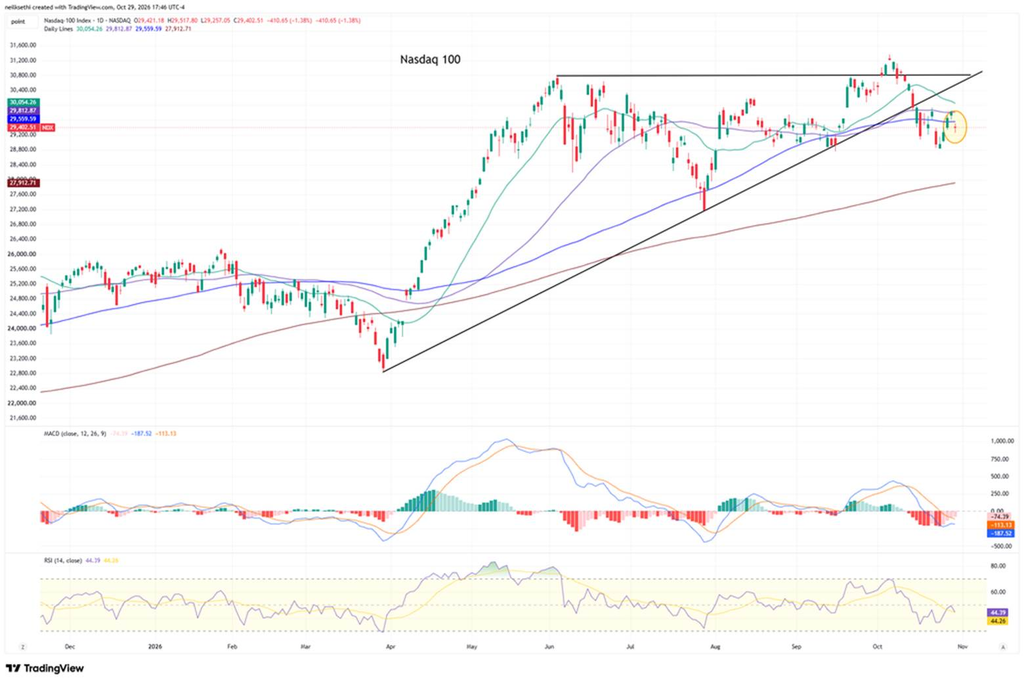
The Nasdaq-100 fell 1.38% to 29,402.51 after closing right at its 50-DMA (29,813) Wednesday. As I noted, I’d sell bounces until it reclaims that level, and it was turned back there (circled), falling below its 100-DMA (29,560). The MACD remains in “sell longs” positioning, and the RSI is at 44.
The Russell 2000 ($IWM)
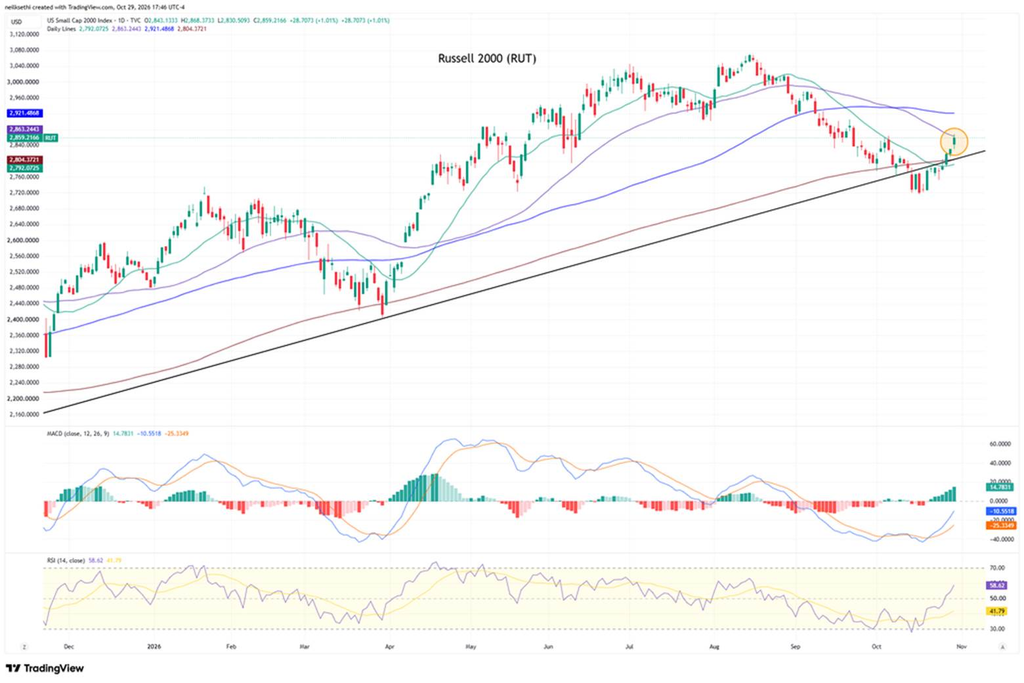
The Russell 2000 rose 1.01% to 2,859.22 for a fourth straight gain, running up to its 50-DMA (2,863) (circled) and further above its 200-DMA (2,804), 20-DMA (2,792) and the uptrend line from last year’s low. The MACD remains in “cover shorts” positioning, and the RSI is at 59.
The equal-weighted SPX ($RSP)
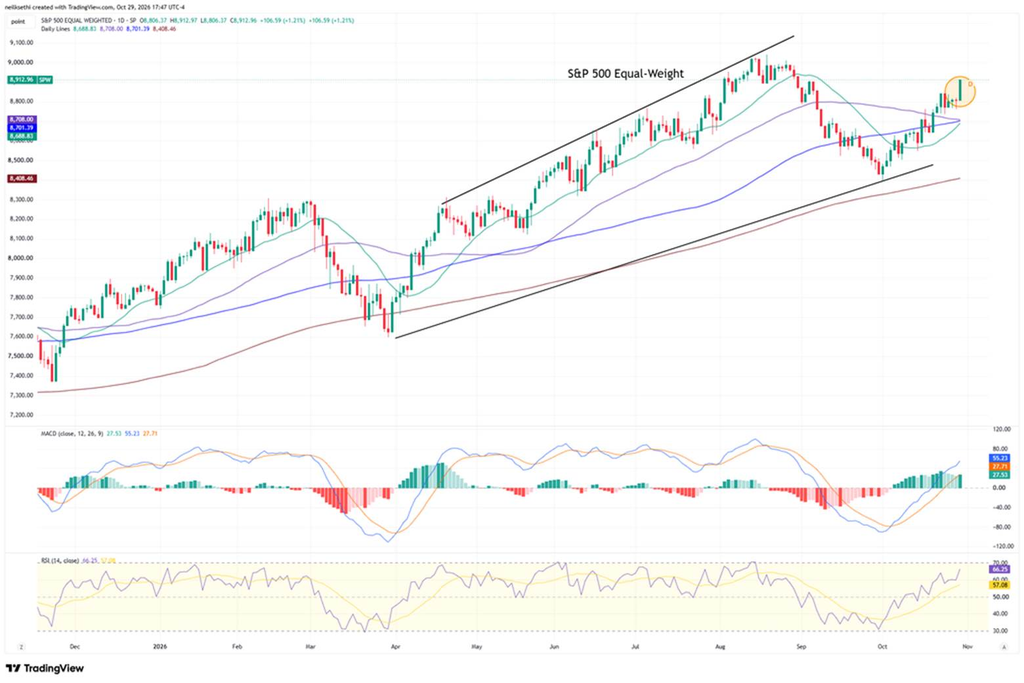
The equal-weighted SPX rose 1.21% to 8,912.96, its best day in two weeks, outperforming the cap-weighted index by 1.5 percentage points. It remains above all its moving averages, with the MACD in “buy longs” positioning and the RSI at 66.
The 2-year Treasury
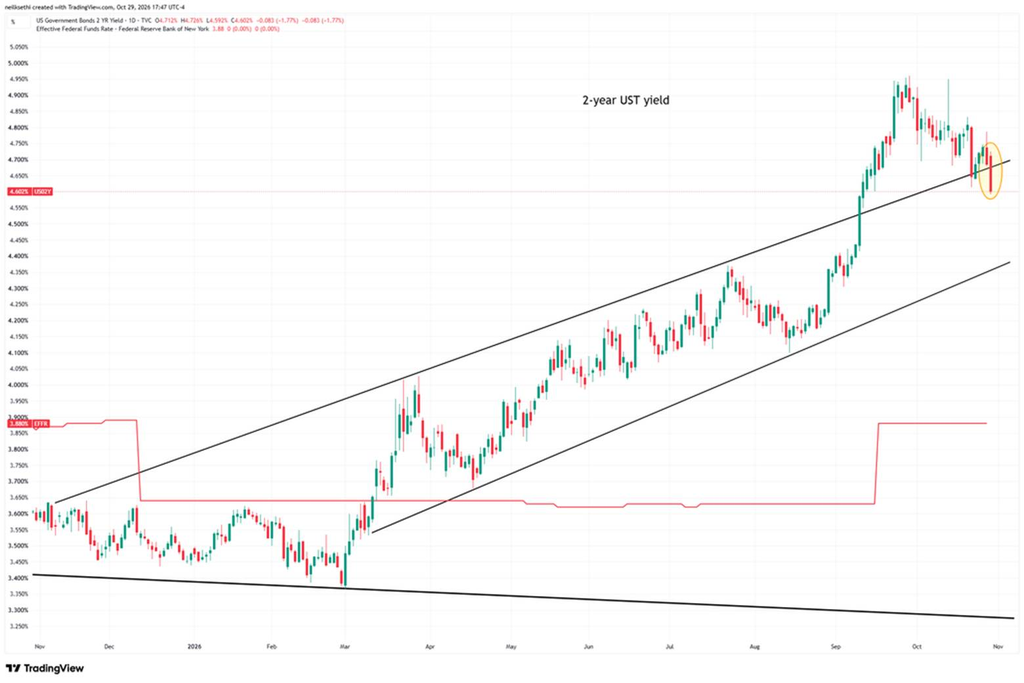
The 2-year yield fell 8.3 basis points (including post-market) to 4.602%, breaking back below the top of its old channel (circled), which had been acting as support. That leaves it about 72bp above the EFFR (3.88%). It was the lowest close since September 10.
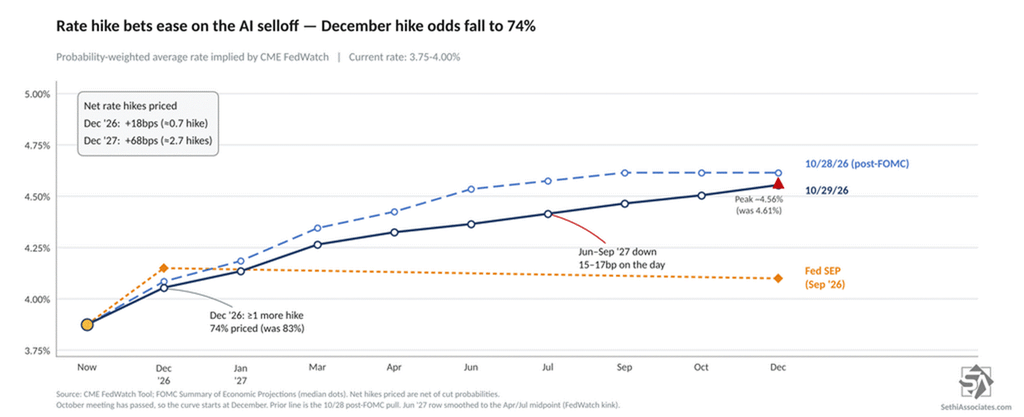
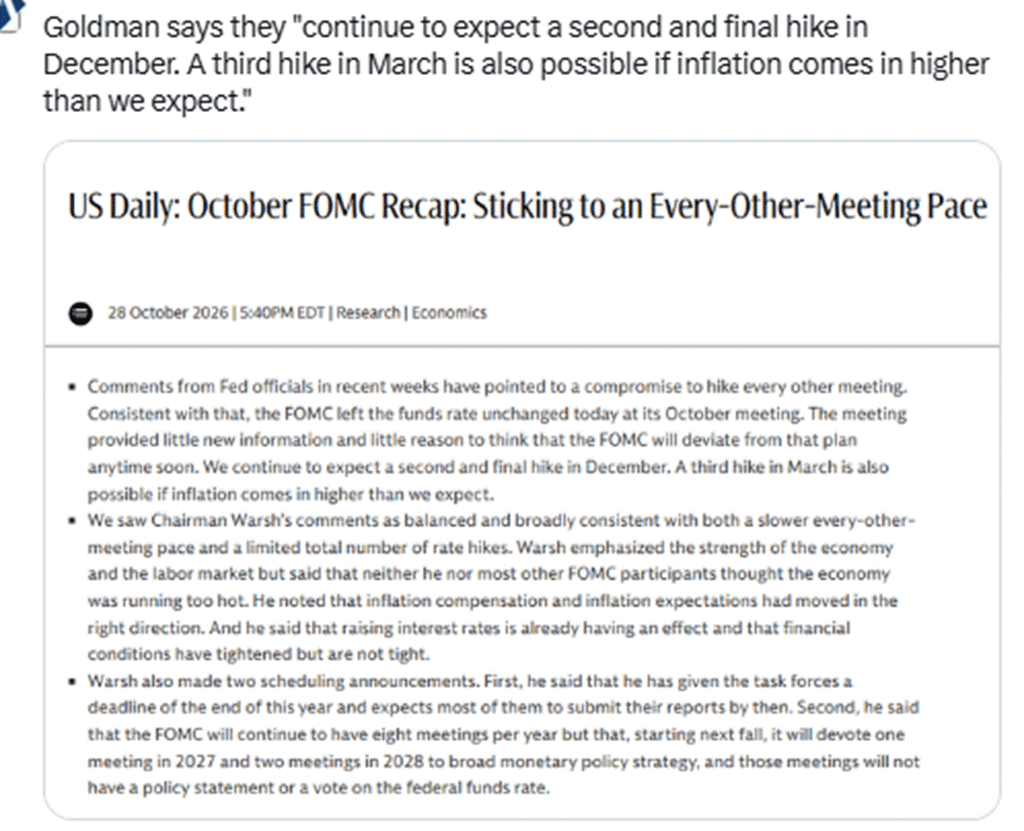
Fed rate hike expectations continued to follow the AI trade falling back. December is now a 74% chance of a hike from 83%, with 18 basis points of hikes priced by December 2026 (from 21bp) and 68 basis points through December 2027 (less than three hikes), from 74bp, per CME FedWatch.
10-year yields
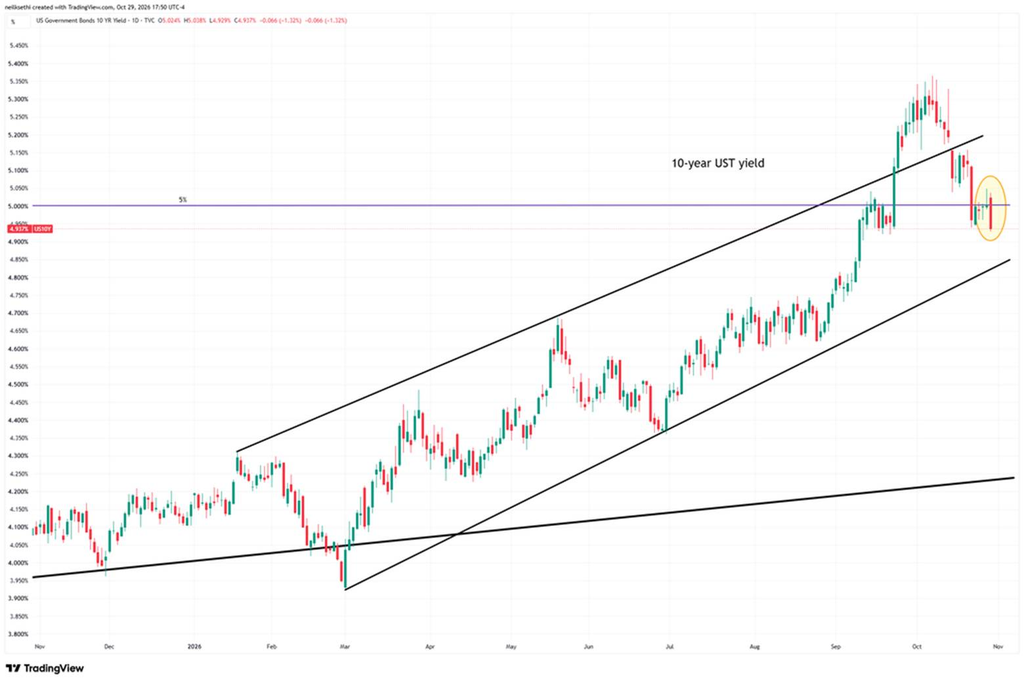
The 10-year yield fell 6.6 basis points (including post-market) to 4.937%, back below 5% (circled) after two closes above it. It was the lowest close since September 17.
30-year yields
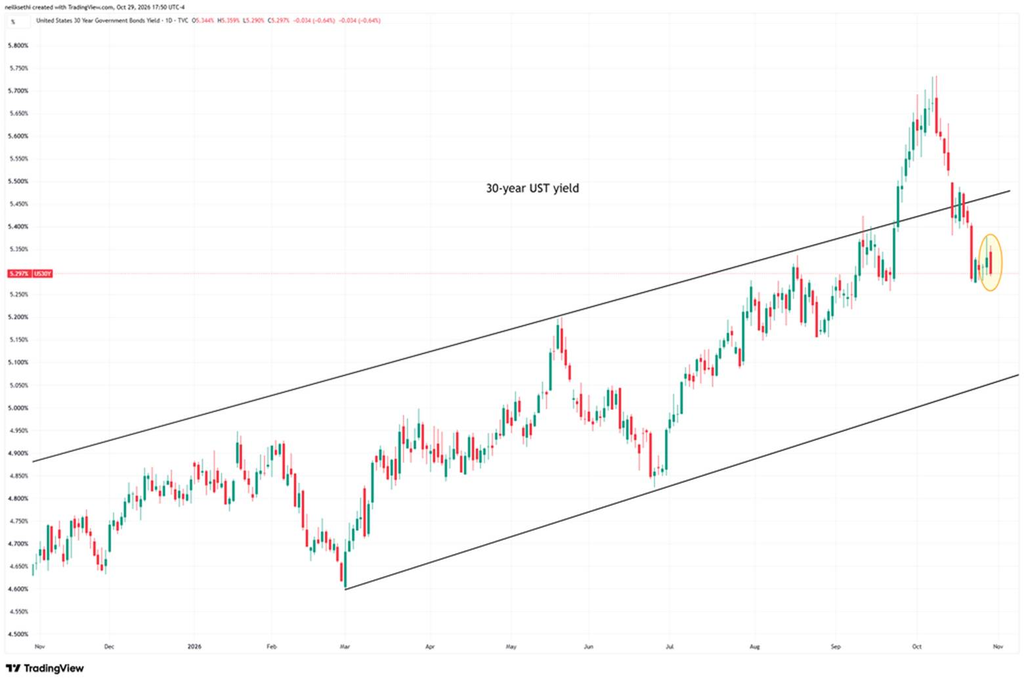
The 30-year yield fell 3.4 basis points (including post-market) to 5.297%, as the curve steepened with the front end leading the rally.
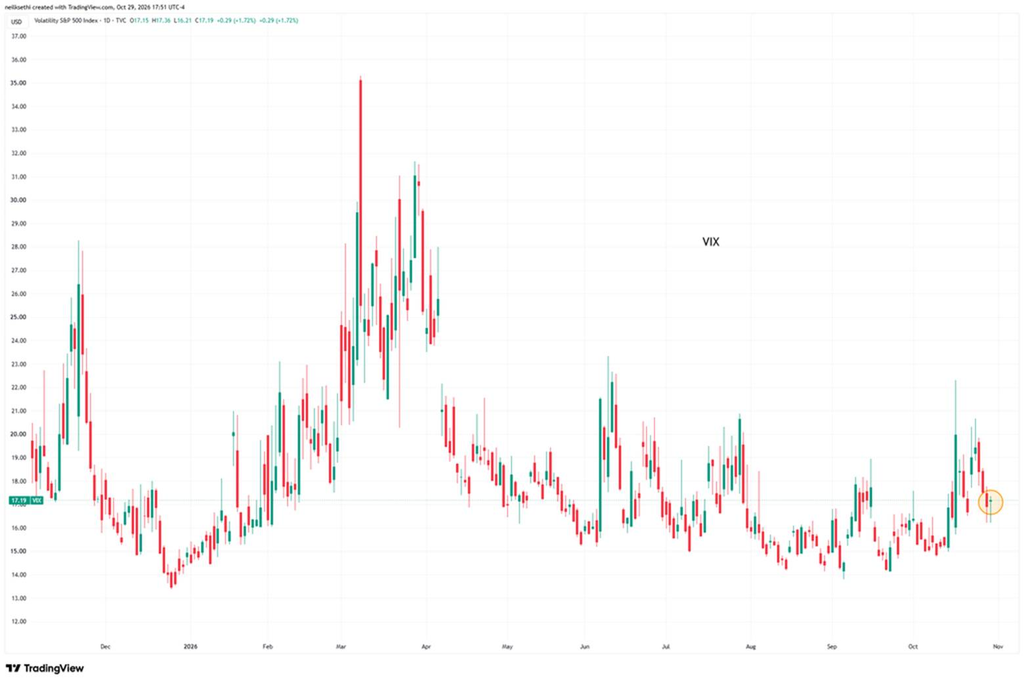
VIX
Despite the declines, the VIX hardly moved, rising 1.72% to 17.19, which implies a daily move of about 1.08% over the next 30 days.
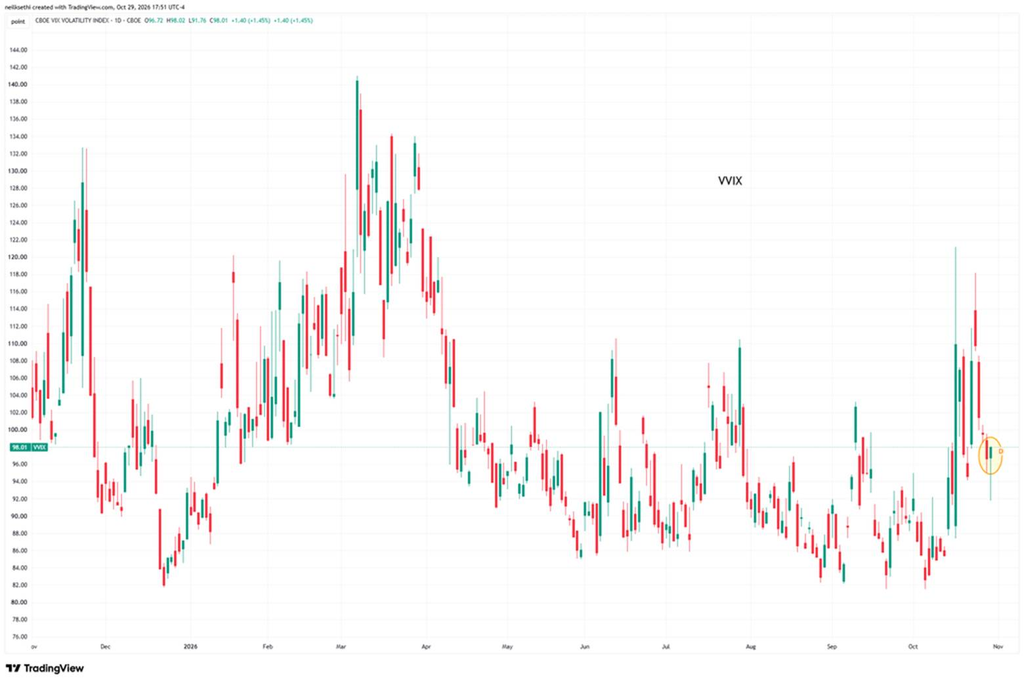
The VVIX
The VVIX (the VIX of the VIX) also little changed at 98.01, a third straight close below 100. The current level is consistent with “moderate” daily moves in the VIX over the next 30 days (historically, normal is 80-100, although we haven’t been below 80 since July 2024), but it’s moved back toward the 100 level flagged by Charlie McElligott as indicating higher stress.
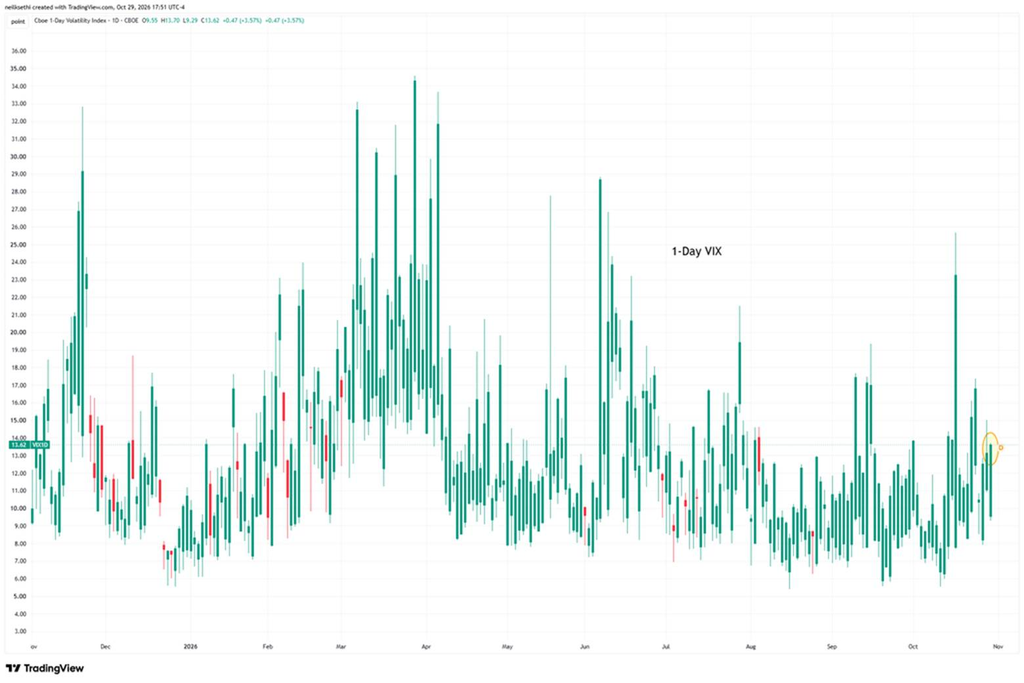
1-day VIX
The 1-day VIX rose 3.57% to 13.62. Wednesday’s level (13.15) implied a move of about 0.83% for Thursday, and the SPX came in under that at 0.30%. Tonight’s reading implies a move of about 0.86% for Friday.
WTI futures (/CL)
WTI futures, which TradingView has at December currently, fell 0.76% (including post-market) to $102.00. They remain above all their moving averages, with the MACD in “buy longs” positioning and the RSI at 62.
DXY
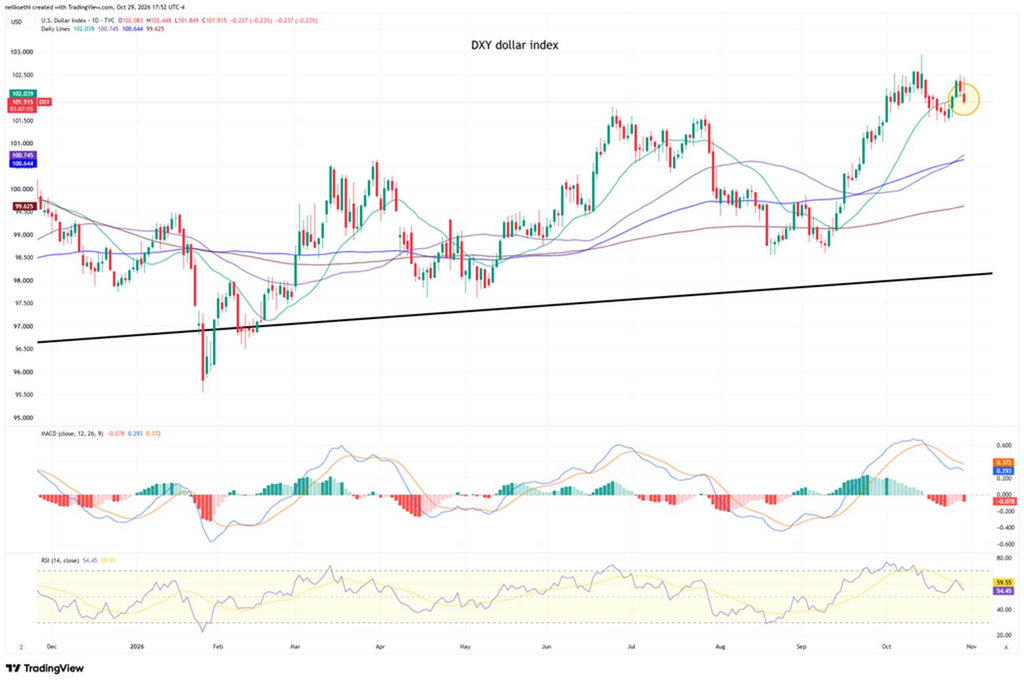
The DXY dollar index (which is fixed weighted with a heavy — 57% — allocation to the euro) fell 0.23% to 101.915, a second straight decline, slipping back below its 20-DMA (102.039) (circled). The MACD remains in “sell longs” positioning, and the RSI is at 54.
Gold futures (/GC)
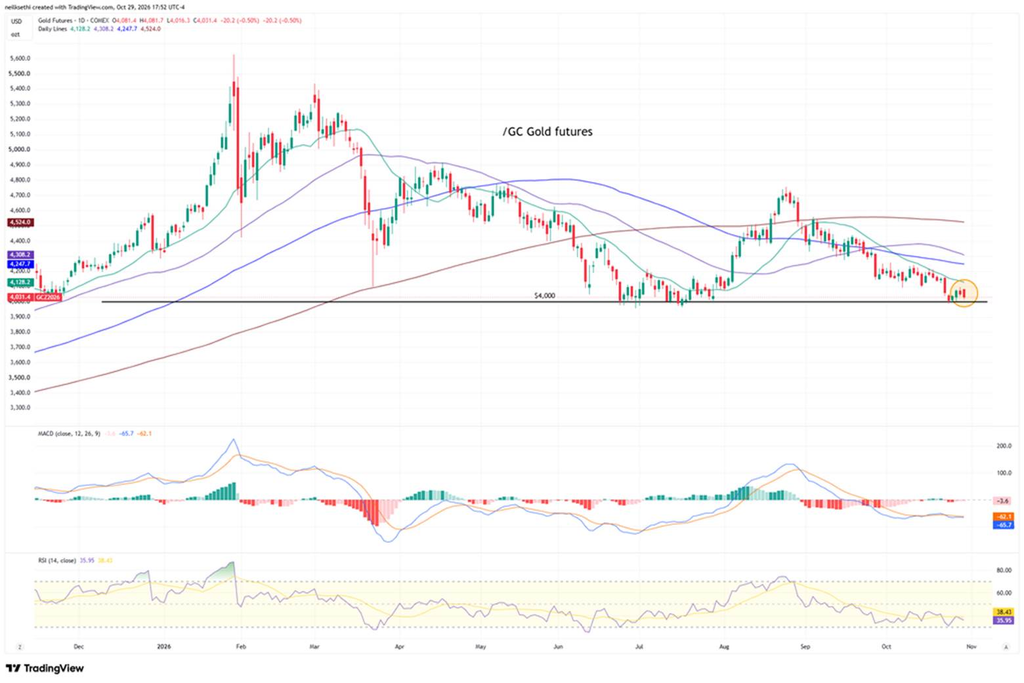
Gold futures fell 0.50% (including post-market) to $4,031.40, a second straight decline, but held above $4,000 again (low of $4,016.30). They remain below all their moving averages, with the MACD in “sell longs” positioning and the RSI at 36. Doug Kass, though, bought a very small GLD position and later added to it.
US copper futures (/HG)
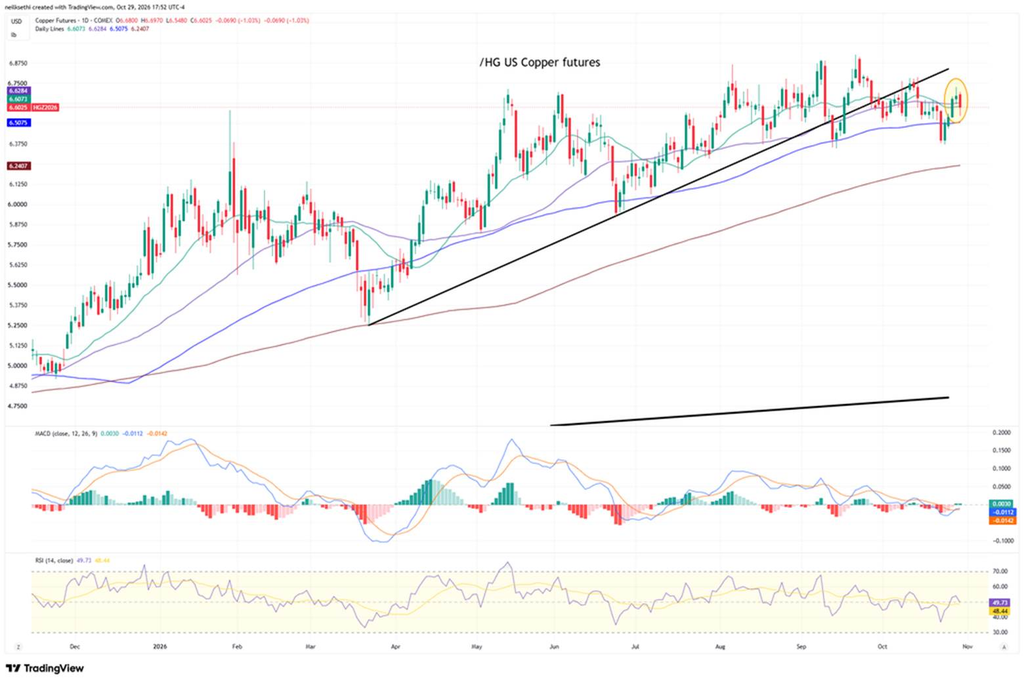
Copper futures fell 1.03% (including post-market) to $6.6025, slipping back below their 20-DMA (6.6073) and 50-DMA (6.6284) but holding above their 100-DMA (6.5075) (circled). The MACD is in “cover shorts” positioning, and the RSI is at 50.
US natural gas futures (/NG)
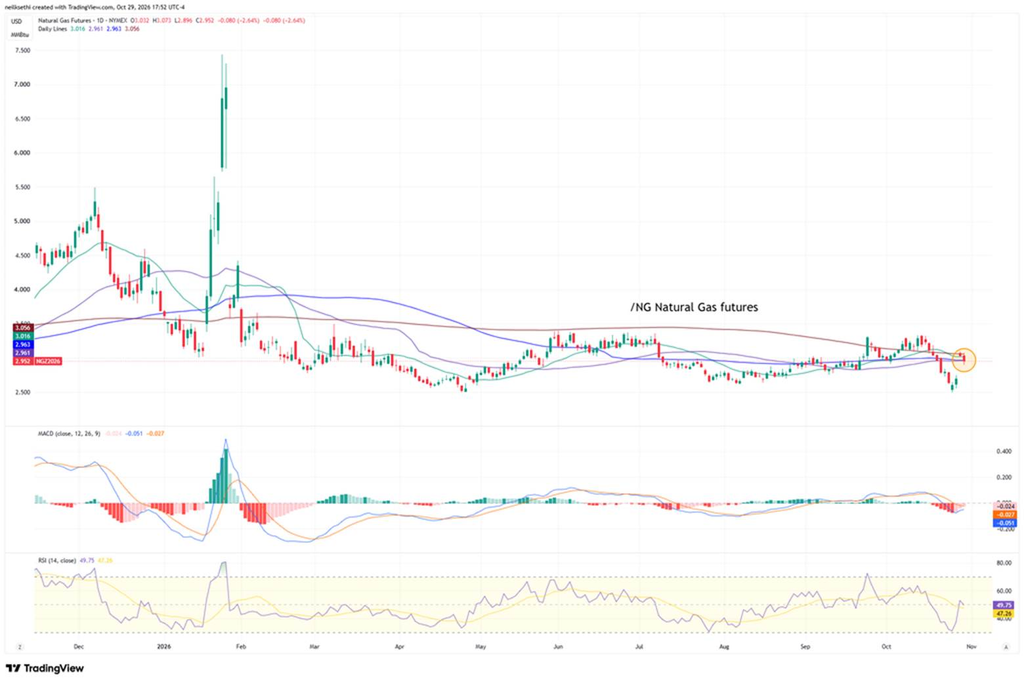
Natural gas futures fell 2.64% (including post-market) to $2.952, starting to fill Wednesday’s “roll gap” and slipping back below their 20-DMA (3.016) and 200-DMA (3.056) to just under their 50- and 100-DMAs (circled). The MACD is in “sell longs” positioning, and the RSI is at 50.
Bitcoin futures
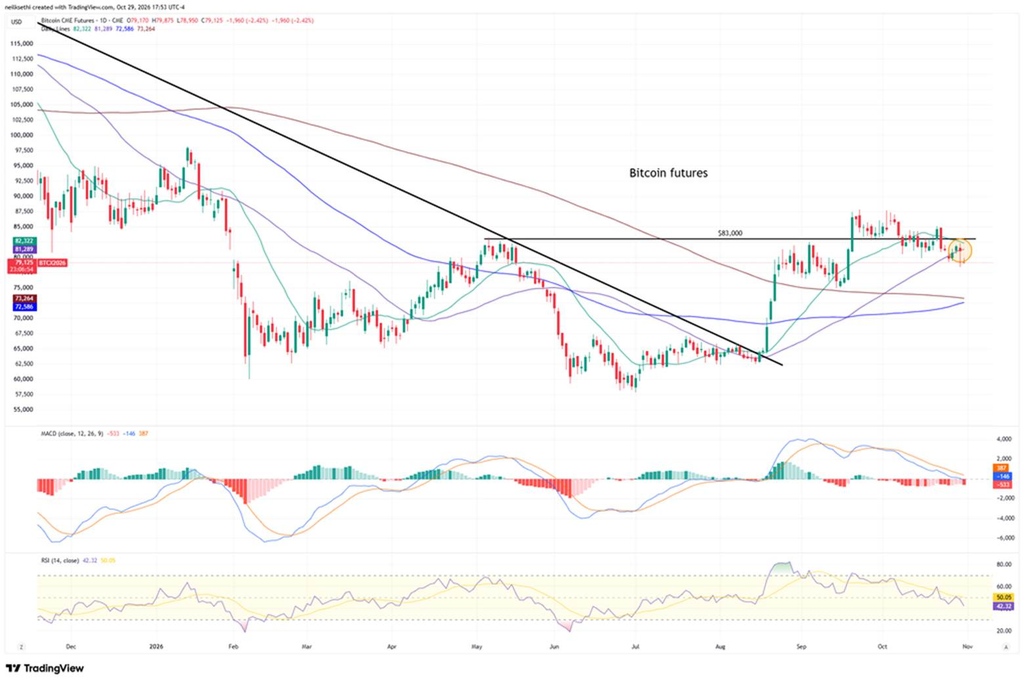
Bitcoin futures fell 2.42% to $79,125, turned back at their 20-DMA ($82,322) and 50-DMA ($81,289) (circled) and back below $80,000, further below the $83,000 level that had been support. The MACD remains in “sell longs” positioning, and the RSI is at 42.
More From TheStreet Pro
Helene Meisler — The Bull Camp Is Shrinking. The Bear Camp Has Plenty of Empty Cabins.
Stephen Guilfoyle — Alphabet Miss, Why Fed Shouldn’t Raise Rates, All Eyes on Amazon
Chris Versace —
- Microsoft Stuns, Google Sinks, Oracle Offers Hope: 8 Key Items Shaping the Stock Market Thursday
- Collecting Your Questions for Our Next Set of Office Hours
Doug Kass —
- Understanding My Trading Moves
- There Is No Gold in Them Thar Hills
- Tech (XLK) Vs. Financials (XLF) Vs. Heath Care (XLV)
- Boockvar on GDP, Income/Spending/Savings
- Boockvar on Fed Policy, Earnings
- Howling About an Economy Running Hot
And From Me If You Missed It
- Thursday’s Schedule: GDP and Amazon Headline Another Busy Day
- Q3 GDP Trackers Cluster Near 3.3%, but GDPNow’s History Says Watch for an Upside Miss
- Lagarde to Leave ECB Early, Adding to Leadership Turnover
- Jobless Claims Refuse to Budge as Four-Week Average Hits Lowest Since 1969
- Japan’s Treasury Buying Nearly Dries Up as America’s Allies Pull Back
- Q3 GDP Beats on Strong Consumers and Equipment Spending
- Retail Investors Remain Cautious
- Inflation Remains Elevated as Real Spending Stalls
- 7-Year Auction: Foreign Demand Stays Soft but Domestic Demand Steps Up
- Intel Sinks as PC Slump, Supply Snags Swamp 78% Data Center Surge
- Amazon Shares Down as Cash Burn Accelerates
Miscellaneous
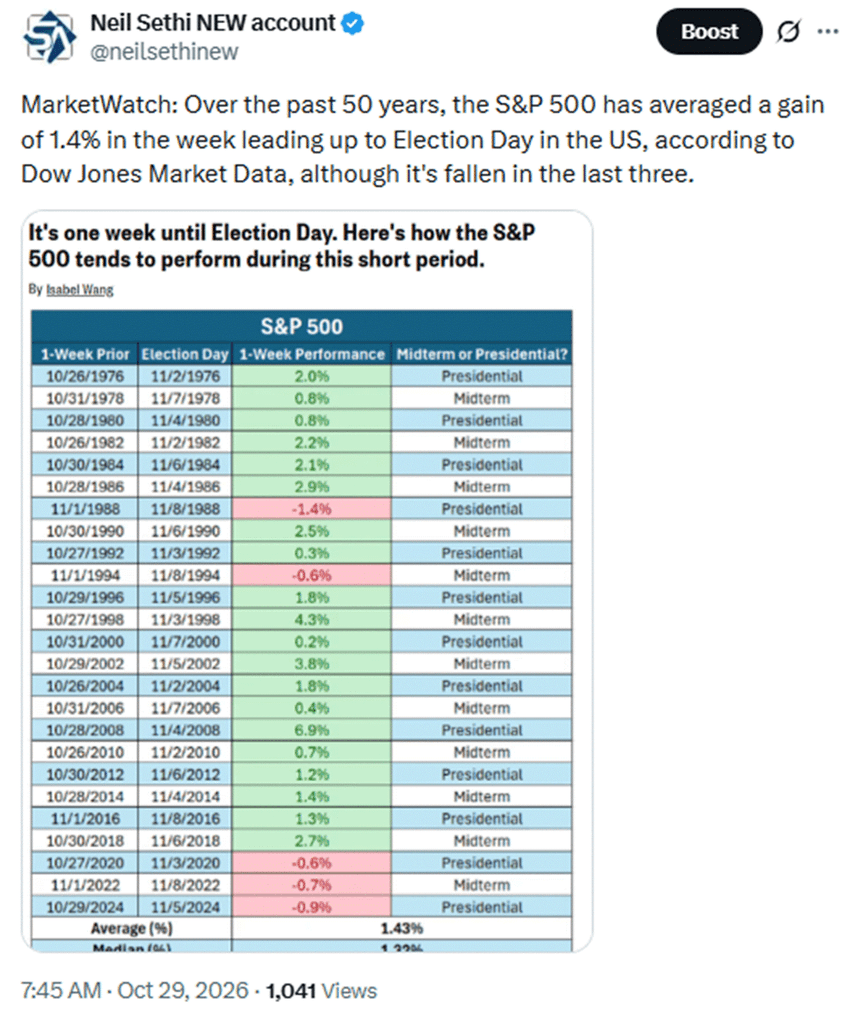
Wrap-Up — The Bounce Gets Sold
I said yesterday:
And now we’ve got four days of gains for the AI beneficiaries, led by chip stocks, and four days of losses for Staples. But, again, other sectors haven’t suffered the way Staples has (at least in terms of being down), and breadth improved today, with eight of 11 sectors up versus six Tuesday, even as rates edged higher again at the long end.
So far it’s still a bounce, but it’s been a good trade for those who caught it. We’ll figure out in the next week or two whether it’s more than that. …
Alphabet ($GOOGL) also looks to be a drag on the indices tomorrow unless it turns itself around.
And it turned out that Alphabet would be more than a drag on the indices. Along with the lower-than-expected capex guide from Microsoft ($MSFT), disappointing construction numbers from Caterpillar ($CAT) and the other notables mentioned earlier, it instigated a broad pivot away from not only the AI beneficiaries but also most of Tech.
However, that broadening trade I mentioned continued to gain steam, with the average company making solid gains, as evidenced by the equal-weighted S&P 500’s best day in two weeks (+1.2% vs. -0.3% for the cap-weighted index).
With Amazon ($AMZN) and Intel ($INTC) sharply lower after hours, it looks like we’re likely in for another day of this on Friday. As always, let’s see what we get and go from there.
The Day Ahead — A Step Down into the Weekend
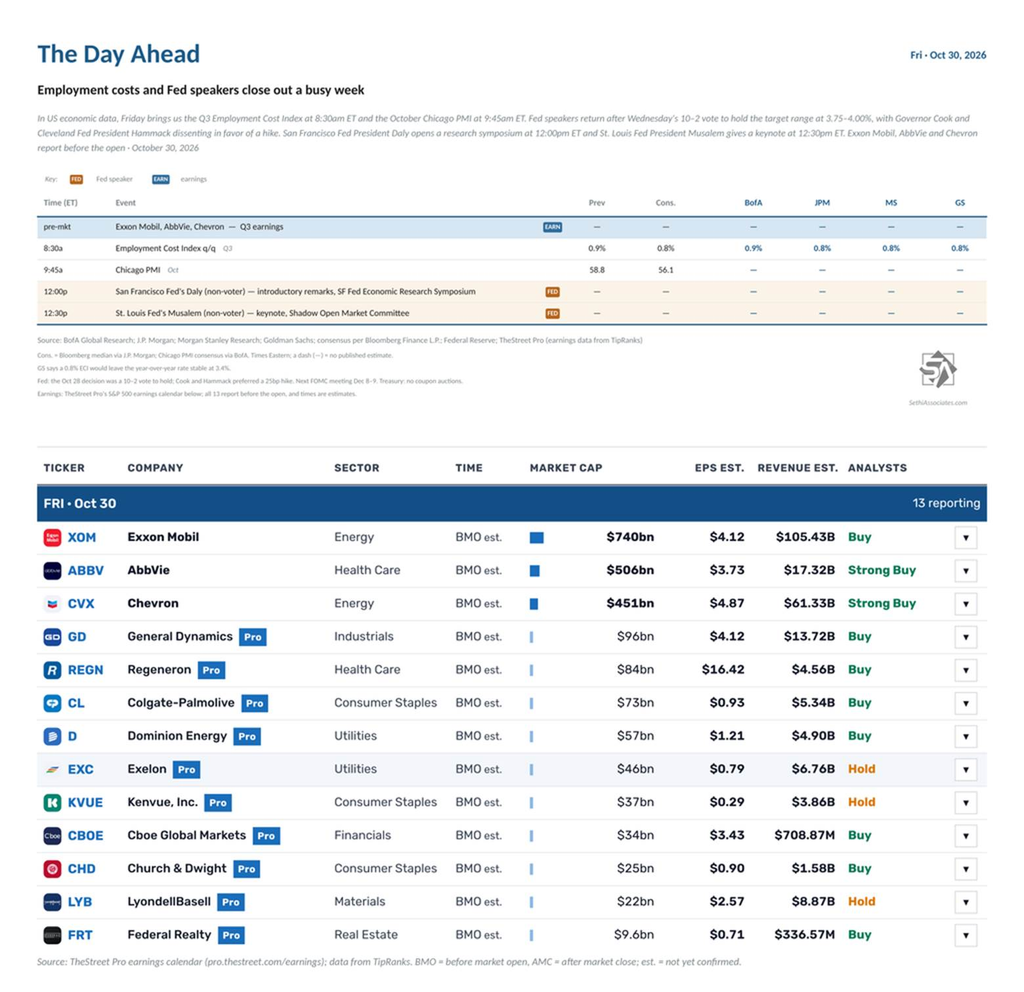
In US economic data, Friday brings us the Q3 Employment Cost Index (the Fed’s preferred wage inflation metric) and the October Chicago PMI.
Fed speakers return after Wednesday’s 10-2 decision to hold the fed funds target range at 3.75%-4%, with Governor Cook and Cleveland Fed President Hammack dissenting in favor of a 25bp hike. San Francisco Fed President Daly gives introductory remarks at the San Francisco Fed’s Economic Research Symposium at 12pm ET, and St. Louis Fed President Musalem delivers a keynote address at the Shadow Open Market Committee meeting at 12:30pm ET.
There are no non-Bill (>1yr in maturity) US Treasury auctions.
13 S&P 500 components report, all before the open, three of them with market caps over $100bn:
Before the open: Exxon Mobil ($XOM), AbbVie ($ABBV), Chevron ($CVX), General Dynamics ($GD), Regeneron ($REGN), Colgate-Palmolive ($CL), Dominion Energy ($D), Exelon ($EXC), Kenvue ($KVUE), Cboe Global Markets ($CBOE), Church & Dwight ($CHD), LyondellBasell ($LYB) and Federal Realty ($FRT)
Outside the US, AstraZeneca ($AZN), Sanofi ($SNY) and BP ($BP) report.
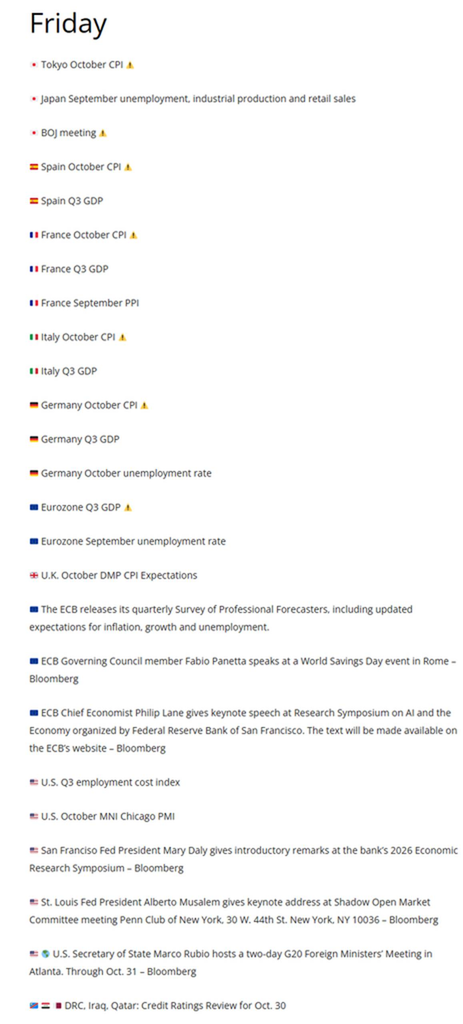
Ex-US is a busier day, with highlights including a decision from the Bank of Japan, Japan October Tokyo CPI, September jobless rate, job-to-applicant ratio, retail sales, industrial production and housing starts, UK October Lloyds Business Barometer, the ECB Survey of Professional Forecasters, Germany October CPI, unemployment claims rate, Q3 GDP and September import price index, France October CPI, Q3 GDP, private sector payrolls, September consumer spending and PPI, Italy Q3 GDP and October CPI, Eurozone Q3 GDP and September unemployment rate, Spain October CPI and Canada August GDP. The G20 foreign ministers also meet in Atlanta (through October 31).
From Christophe Barraud’s international Week Ahead rundown:
At the time of publication, in terms of securities mentioned, Sethi was long AMZN, BAX, CTSH, CVX, GOOGL, MSFT, SPCX, SPY, XOM, IWM, RSP, CPER and numerous Treasury ETFs. In the last 24 hours Sethi sold his positions in INTC, NOW, and MRVL.