The Calm Before the Storm


Enjoy The Silence
All I ever wanted
All I ever needed
Is here in my arms
Words are very unnecessary
They can only do harm
Vows are spoken
To be broken
Feelings are intense
Words are trivial
Pleasures remain
So does the pain
Words are meaningless
And forgettable
– Martin Lee Gore (Depeche Mode), 1990
The Pause
For a third consecutive night, U.S. forces continued their pause on offensive operations inside Iran’s borders. For a third consecutive night, Iranian forces held off launching anything towards U.S. military bases in the Middle East. The U.S. military had been set to increase the pace and intensity of said offensive operations on Friday. The accelerated pace of these attacks was to have lasted roughly two weeks or so. Instead, the U.S. put a temporary halt to operations in order to allow for renewed diplomatic efforts to bring about a peaceful resolution to the conflict to take place. Or so, we’re told.
The New York Times reported that the president and his advisers may have made that decision, at least partly due to a declining inventory of air defense interceptors. That’s the Patriot missile (among others) for those not familiar with military jargon. The MIM-104 Patriot is a RTX ($RTX) designed mobile surface to air missile system primarily manufactured by RTX, Lockheed Martin ($LMT) and Boeing ($BA). The supposed reduced inventory could also be in reference to the Aegis missile defense system, which is primarily used by U.S. Navy vessels when fired upon. The Aegis is a Lockheed Martin designed program. The projectiles are primarily an RTX product. Boeing is also a technical contributor of note.
Both the Patriot and the Aegis are direct descendants of President Reagan’s “Star Wars” defense initiative that was mocked by the mainstream media at the time. Admiral Brad Cooper, who is in command in the region, reportedly believes that the U.S. forces can cope with declining inventories of interceptors by countering with an increase in the pace, intensity and precision of U.S. operations. That said, the risk to U.S. personnel and to U.S. allies, would obviously rise.
Financial markets have reacted favorably to the pause in the fighting as one might have expected. WTI Crude is trading with an $85 handle (per barrel) overnight after peaking above $101 on Thursday evening. The U.S. Ten-Year Note pays a rough 4.64% at last glance after yielding almost 4.72% late last week. U.S. equity index futures are trading sharply higher overnight as well.
The Peace Effort
As U.S. and Iranian forces get this chance to reset, the U.S. naval blockade on Iranian ports remains in place, so there will be no relief for an Iranian economy already in ruins. Peace talks are now centered on mediators from Oman who are acting as a “go-between” and visited Tehran over the weekend. Part of the reason for this pause by the U.S. was to allow for the safe passage of the Omani delegation. That said, the delegation left Tehran and hostilities did not resume.
The optimistic take would be that if an agreement could be reached, that civilian vessels could resume transiting the Strait of Hormuz without risking missile and drone attacks from Iranian forces. The Financial Times quotes Iranian foreign ministry spokesperson Esmaeil Baghaei as saying the talks with the Omani team were “constructive” and that “progress” had been made. Local Iranian media reported Baghaei as commenting that, “The two sides exchanged views on shared principles and operational mechanisms for the management of safe transit through the Strait of Hormuz, while respecting the sovereign rights of the two littoral states.”
Readers are reminded that the U.S. and Iran had both signed a memorandum of understanding on June 17 that would have extended the April ceasefire by two months. During that time, Iran had agreed to gradually reopen the Strait to commercial vessels without charging tolls or fees. That deal broke down when Iranian forces almost immediately violated the deal and kept violating the deal that their own government had agreed to. Obviously, even if the Omanis can find a middle ground, I believe U.S. forces cannot trust the Iranian military to respect the wishes of the Iranian government.
Market Focus
Last week, Alphabet ($GOOGL), Intel ($INTC) and Tesla ($TSLA) kicked off the first week of “big tech” earnings. Despite excellent headline numbers (not from Tesla, obviously) regarding sales, the explosion in capital spending is what Wall Street focused on. This week, in addition to the peace process and the Fed’s expected policy decision this Wednesday, the focus on the AI-up spend will continue as Meta Platforms ($META), Amazon ($AMZN) and Microsoft ($MSFT) report.
The Week That Was
The S&P 500 posted a second consecutive losing week, as did the Nasdaq Composite, through the penultimate week of July. That was also the third losing week in five for the U.S. equity markets two major indexes. This is how the past week went across the market…
- The S&P 500 gained just 0.05% on Friday but lost 0.61% for the week.
- The Nasdaq Composite gave up 0.64% on Friday and a nasty 2.13% for the week.
- The Nasdaq 100 surrendered 1.15% on Friday and 1.62% for the week.
- The Russell 2000 lost 0.35% on Friday and 1.09% on the week.
- The S&P Small Cap 600 gave back just 0.03% on Friday but also 0.84% for the week.
- The S&P Midcap 400 added 0.39% on Friday and just 0.23% for the week.
- The Dow Transports gave up 0.45% on Friday and 1.09% for the week.
- The Philly Semis closed down a sharp 4.25% on Friday but gained 1.24% for the week.
- The KBW Bank Index stacked on 0.44% on Friday but lost 0.31% for the week. On Friday, perhaps counter to what readers might have expected, 10 of the 11 S&P sector SPDR ETFs closed out the session in the green. Overall, the defensive sectors outperformed for the day, with the REITs ($XLRE) in the lead. Technology ($XLK) was the lone sector SPDR to close in the red for the day.
For the week, eight of the 11 S&P sector SPDR ETFs finished in the green, which was also perhaps, moderately surprising. Cyclicals ruled the week with energy ($XLE) out in front for obvious reasons. The Discretionaries ($XLY) had an awful week with Tesla ($TSLA) leading auto stocks lower.
Week Ahead
After a weekend pause in U.S. military operations inside Iran, the markets have quite a lot to point to for direction this week.
- The Geopolitical: The situation in and around Iran continues to be difficult for investors to read into. The US has paused offensive military operations inside Iran. Does that mean that some kind of peace deal or ceasefire is imminent? We have been misled on just how close a deal was so many times, we can really trust any headline that falls short of a comprehensive agreement. In the meantime, the US naval blockade of Iranian ports is ongoing and the Houthi Rebels in Yemen continue to threaten the Red Sea as well as Saudi Arabia.
- Macro: This will be a moderately heavy macroeconomic week coming up for economists, investors and traders. The week kicks off with June durable goods orders this morning. Tomorrow, the Conference Board will release the consumer confidence survey for July. The University of Michigan will revise its July survey for consumer sentiment this Friday, which is similar. In my circles, the CB survey is a slightly bigger deal than the U of M survey.
Thursday will be the big day for data this week. That morning, we’ll get our first look at Q2 gross domestic product, as well as June personal income and personal spending as well as the June personal consumption expenditure price index. This index was more closely watched than was the monthly consumer price index data by the Yellen and Powell Feds.
- The Federal Reserve: The Fed will enter the new week still in its media blackout period. That ends Wednesday afternoon, when after a two-day policy meeting, the FOMC releases its latest official statement. Still new Fed Chair Kevin Warsh will hold his second post-statement press conference a half hour later. There will be no release for economic projections this week. Those are a quarterly publication with the next release due in September. I do not have any Fed speakers on my radar for later this week just yet.
- Earnings: Second-quarter earnings season continues to heat up this week. Capital spending will certainly be in focus for investors. On Tuesday morning, Boeing ($BA), Coca-Cola ($KO) and United Parcel Service ($UPS) will report, followed by Ford Motor ($F), KLA Corp ($KLAC), and Visa ($V) that afternoon. Come Wednesday morning, we’ll hear from General Dynamics ($GD), Humana ($HUM) and SoFi Technologies ($SOFI). That afternoon, Arm Holdings ($ARM), Lam Research ($LRCX), Meta Platforms ($META) and Microsoft ($MSFT) will all step to the plate. Thursday will bring results from Mastercard ($MA), Amazon ($AMZN), and Apple ($AAPL). On Friday, oil giants Chevron ($CVX) and Exxon Mobil ($XOM) will post their results.
- Events: This Friday, the Black Hat USA Conference will kick off in Las Vegas. A number of high-profile tech firm’s are expected to present. These firms will include Nvidia ($NVDA), CrowdStrike ($CRWD), Microsoft, SentinelOne ($S) and IBM’s ($IBM) Red Hat.
The Chart
Readers will see that the S&P 500 needs to make an attempt at regaining its 50-day simple moving average and 21-day exponential moving average in order to keep the now expanded shape of the Ascending Triangle pattern of bullish continuance intact.
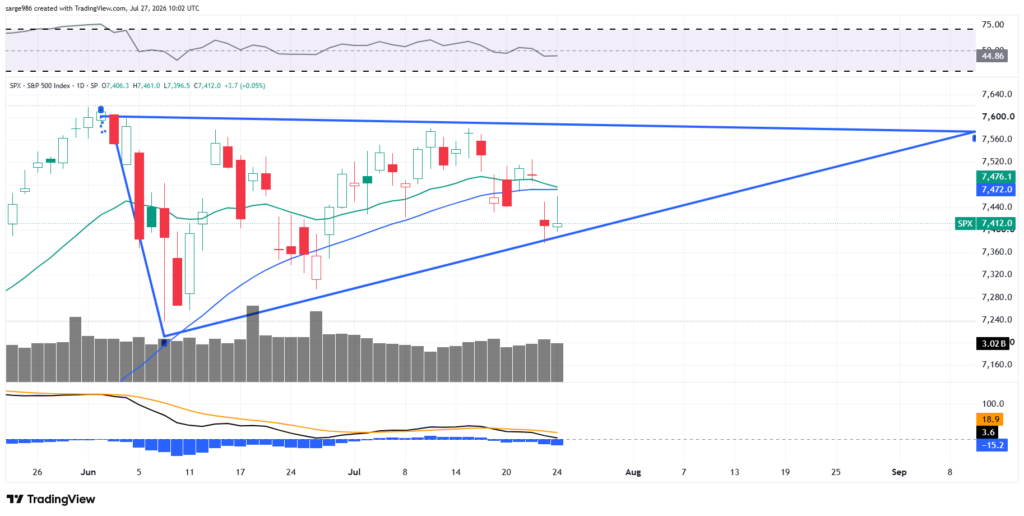
Something along the lines of what occurred after those lines cracked in late June would get that done. Relative Strength is close to neutral. The daily moving average convergence divergence had taken on a more bearish posture last week. The development of that indicator as we enter the new week will likely be my technical focus for now.
Earnings
As of July 24, according to FactSet, for the second quarter, Wall Street now sees blended (results and expectations) an incredible year-over-year earnings growth rate for the S&P 500 of 37.9%, up more than “just” sharply from 24.7% last week. Wall Street also sees revenue growth of 13.2%, up significantly from 12.8% one week ago. With 27% of S&P 500 companies having already reported for the season, 86% have beaten earnings expectations, while 80% have beaten revenue expectations.
For the full year of 2026, the street now looks for earnings growth of 27.3%, up from 24.5% last week, and up from 14.7% about three months ago. This would come on revenue growth of 11%, up from 10.9% last week and up from 7.7% almost three months ago. The outlook for the third quarter is also very positive. Third quarter S&P 500 earnings growth is now estimated at 27.3% year over year, up from 27% last week.
At the moment, the energy, communication services and technology sectors are projected to have grown Q2 earnings by an absolutely jaw-dropping 128.2%, 112.4%% and 64.6% respectively. Just one sector, health care (at an ugly -17.8%) is currently projected to have suffered a Q2 earnings contraction.
Valuation
Still using data provided by FactSet, the S&P 500 ended last week trading at 20.1-times 12 months’ forward-looking earnings, down from 20.3-times last week and down from 21.6 times a rough three months ago. This is still well above the five-year average of 19.9 times for the index as well as being well above its 10-year average of 19 times.
The S&P 500 also ended last week trading at 27.5-times trailing twelve months’ earnings, down from 27.6 times just one week ago, and also above levels that the index reached more than two months back. This also stands well above the five-year (24.4 times) and ten-year (23.5 times) averages for the index.
Only three of the 11 sectors are now trading below their five-year average valuations, down from four sectors one week ago. Eight sectors, led by the Industrials (25.0 times) are trading at a premium to their five-year average valuation.
Fed Funds Futures
Fed Funds futures trading in Chicago are currently pricing in an 69% probability (down from 86% a week ago) for no change to be made to the current target range (3.5% to 3.75) for the Fed Funds Rate at the culmination of the next FOMC policy meeting this Wednesday. There is no visible chance for a rate cut at the moment, but there is now a 31% likelihood being priced in for a rate hike being factored for.
There are no rate cuts fully priced in at any point in the future looking out towards year’s end 2027, though there is now a minority probability being priced in as early as July of 2027. There is still a rate hike priced in (77% probability) for Sept. 16 of this year. That likelihood rises to 90% if given the rest of the calendar year 2026.
Economics (All Times Eastern)
08:30 – Durable Goods Orders (June): Expecting 1.6% m/m, Last -4.5% m/m.
08:30 – ex-Transportation (June): Expecting 0.9% m/m, Last 1.3% m/m.
08:30 – ex-Defense (June): Expecting 1.7% m/m, Last -4.6% m/m.
08:30 – Core Capital Goods (June): Expecting 1.4% m/m, Last 1.6% m/m.
10:00 – ISM Manufacturing Index (July): Expecting -1, Last 0.
The Fed (All Times Eastern)
Fed Blackout Period.
Today’s Earnings Highlights (Consensus EPS Expectations)
After the Close: CDNS (2.06), NUE (4.53)
At the time of publication, Guilfole was long SOFI, AMZN, MSFT, NVDA, CRWD, IBM, RTX, LMT , INTC equity.
Correction: An earlier version of this column included a few events that previously occurred, as one read pointed out. We regret any confusion this has caused.
