A Hawkish Fed Does Little To Soothe Markets

Quick Summary
- Per the morning update, US equities started the Wednesday session modestly higher as a much stronger than expected retail sales report dampened any concerns about U.S. consumers and bond yields and oil prices softened as they awaited the main event of the day in the FOMC decision.
- Indices would mostly hold those gains into the decision, but things would start to deteriorate from there after the Fed hiked for the first time since 2023 in a unanimous decision that saw nearly all of the participants looking for another hike in 2026 (and the median seeing two more in 2027).
- Equities would start to slip following the release, but it wasn’t until the Warsh press conference that things would really start to move to the downside as Warsh doubled and tripled down on the need to bring inflation lower more quickly. “Inflation is too high and has been for too long,” Warsh said in his opening remarks. “Our decision comes at a time when the American economy appears to be strengthening.”
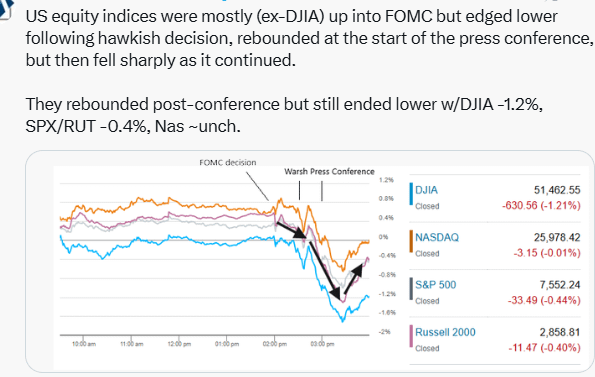
- While equities would rebound afterward they would still close lower for the 7th time in 8 session for the S&P 500, with the Dow Jones Industrial Average -1.2% (its lowest close since June), the S&P 500 and Russell 2000 -0.4%, and the Nasdaq roughly flat. Much more on the Fed in the yields section.
- Despite the hawkish Fed, the 10-year yield closed back above 5%, its highest since July 2007.
- Breadth stayed weak — just 3 of 11 sectors were higher, none by more than 0.1%.
Market Commentary
Fed:
- Most members of the Fed’s rate-setting committee see two hikes this year, according to the summary of economic projections, said Kay Haigh, global head and CIO of Fixed Income and Liquidity Solutions at Goldman Sachs Asset Management, in emailed comments. But Fed officials “likely skip October’s meeting given its proximity to the midterm elections,” Haigh said. (MarketWatch)
- “The debate now shifts from whether rates will rise again to how many hikes lie ahead,” said Seema Shah at Principal Asset Management. “The unanimous vote shows that rising energy prices and stubborn inflation have brought even the doves on board, making a one-and-done move highly unlikely.” (BBG)
- “The Fed’s interest rate hike today is likely to be followed by at least one more later this year, probably in December,” said Stephen Brown at Capital Economics. “We judge that Fed officials are underestimating the potential for the unemployment rate to decline, so we are sticking with our forecast for a third hike in 2027 as well.” (BBG)
- “Chairman Warsh and the rest of the committee are building a strong reputation through their laser focus on defeating inflation,” said Jeff Roach at LPL Financial. “Given the current economic circumstances, the committee delivered what was needed. Going forward, the inflation debate will likely center on the magnitude of improvement as geopolitical conflicts wane.” (BBG)
- “Warsh’s press conference was coherent, confident and consistently hawkish without coming across as crazily so,” said Krishna Guha at Evercore. “But there was one aspect that disturbed us and we think disturbed the bond market – his characterization of the rate increase as ‘removing a dose of accommodation’.”“That comment risks unmooring our sense of how far the Fed chair thinks rates might need to go,” Guha added. (BBG)
- Stephanie Roth, chief economist at Wolfe Research, says on Bloomberg TV of Warsh’s press conference, “It was a hawkish one.” She calls attention to this line in particular: Today’s action starts to show we are serious about this. And we will deliver on the price stability objective, and as the statement said, we will do it on a timelier basis. This is “certainly not a one and done” rate hike, given that, she said. And this is why markets are reacting.
- Neil Dutta at Renaissance Macro commented: If you “remove a dose of accommodation” it implies that you don’t believe policy to be restrictive. That implies there is more work to do. (BBG)
- Bloomberg Economics’ Anna Wong: “Warsh likely didn’t submit his view to the dot plot, but it doesn’t really matter whether he’s a hawk or a dove: Even if he had wanted to hold rates, he would have been outvoted. The dot plot suggests the majority of the committee sees this as the start of a new but shallow hiking cycle. Our main takeaway from the updated SEP is that the FOMC’s reaction function has shifted in a hawkish direction. That’s consistent with a recalibration to return inflation to the 2% target as possible. We think the economic trade-off from this hike – and any more to come – is poor. Hiking rates won’t do much to reduce supply-driven inflation shocks, while it poses greater risks to financial conditions and the labor market. In contrast to the dot plot, we still expect September’s rate hike to be the only one this year.”
Equities:
- “The hawkish tone of the press conference” drove markets lower, said Jeff Schulze, head investment strategist at the Franklin Templeton Institute. “Warsh’s press conference closely echoed the hawkish tone of his Jackson Hole remarks, framing the hike as evidence that the committee is backing its words with action on returning inflation to target.”
Bonds:
- Will Compernolle, macro strategist at FHN Financial, noted that yields still aren’t that much higher than they were on Tuesday even if they are well off their intraday lows after they had fallen earlier in the session. “I think the market is content with this, and it shows the Fed has a credible resolve to bring inflation down to 2%,” he said. Yields, he added, are “within pretty narrow ranges all things considered” particularly among longer-term bonds. (WSJ)
- “While one 25-basis point hike isn’t likely to bring inflation down overnight, it could help to stabilize the bond market, which has a direct impact on borrowing costs,” Alex Guiliano at Resonate Wealth Partners said. (BBG)
Stock and Sector Breakdown:
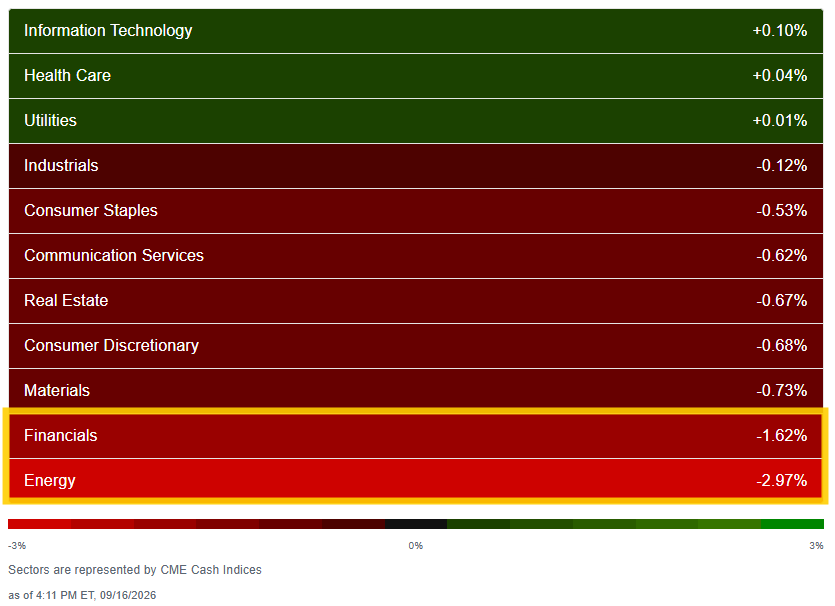
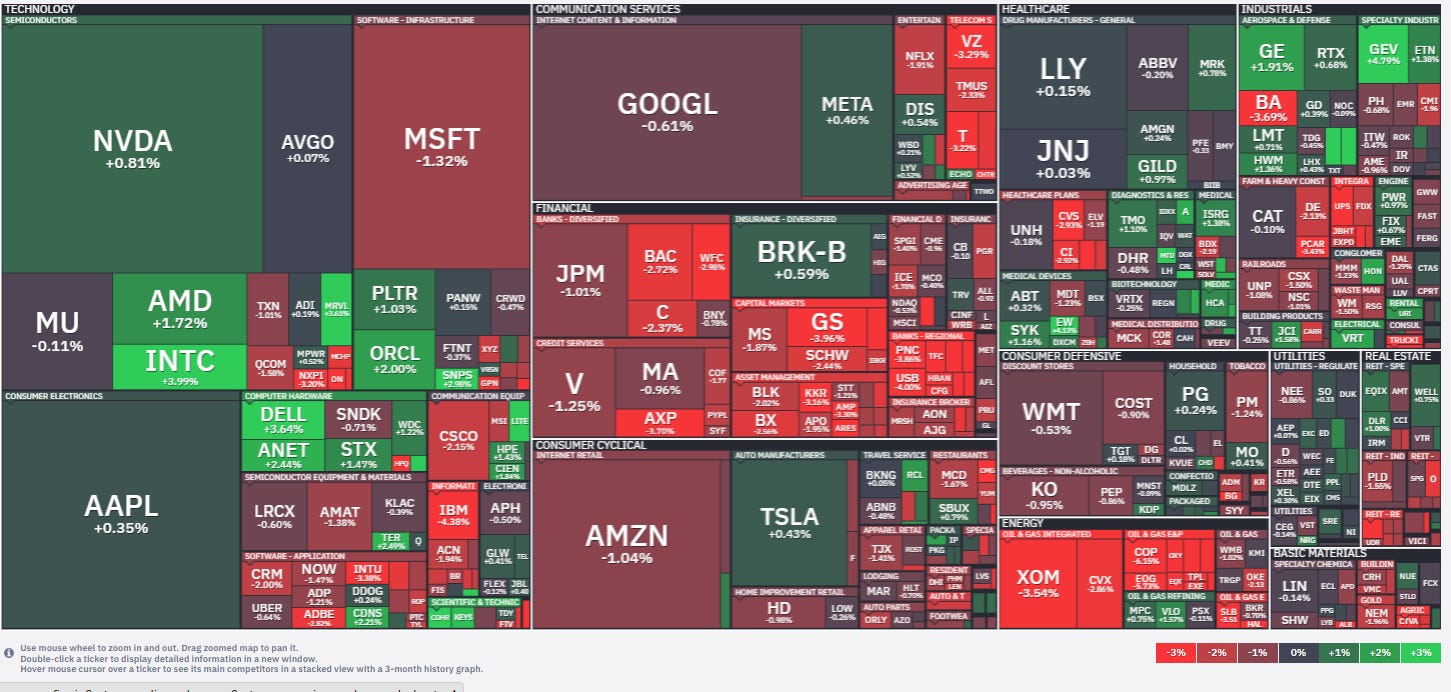
Sector breadth remained weak with just 3 of 11 sectors higher (third day with three or less), but none over +0.1%, although that was Tech which kept losses limited. Every red sector down more than that though with two (Financials and Energy) down over 1%.
The PHLX Semiconductor Index ($SOX) +0.6% finished higher but well below its session high after providing much of the market’s early leadership. Advanced Micro Devices ($AMD) +1.65% and Intel ($INTC) +4.0%) were notable gainers, with Intel supported by a Reuters report that SK Hynix Inc. ($SKHY) +0.02% is in exploratory talks with the company over potential chip fabrication capacity at Intel’s delayed Ohio project. LumentonHoldings ($LITE) +9.6% led all S&P 500 stocks advancing in sympathy with the broader fiber optic connectivity space following aggressive multi-year financial targets released by industry peer Ciena Corporation ($CIEN).
On the other hand, Microsoft ($MSFT) -1.4% and IBM ($IBM) -4.3% among the DJIA’s laggards, and J.B. Hunt Transport ($JBHT) -13.3% led the S&P 500 to the downside after warning that higher fuel costs and a lag in passing those costs through to customers will create a meaningful third-quarter earnings headwind. Axon ($AXON) +6.0%) though recovered some ground following yesterday’s sharp retreat.
The financials sector was one of the day’s most pronounced laggards and weakened further as Treasury yields climbed following the Fed decision. Banking stocks bore the brunt of the selling, leaving the Invesco KBW Bank ETF ($KBWB) down -2.9%. Crypto-related names were another source of weakness after the Clarity Act failed to advance in the Senate yesterday, with Coinbase Global ($COIN) -4.4% and Robinhood Markets ($HOOD) -5.5% extending their recent declines.
In after hours Amazon ($AMZN) was granted warrants to purchase up to $340 million worth of Generac ($GNRC) stock, sending shares of the backup power provider soaring more than 40% in extended trading on Wednesday.
[Note: chart uses futures prices.]
The number of large SPX winners (up over 3%) dropped down to 13 from ~20 Tuesday, ~55 Monday, while the number of large losers (down over 3%) rose to ~55 from ~30 Tuesday but down from ~65 Monday.
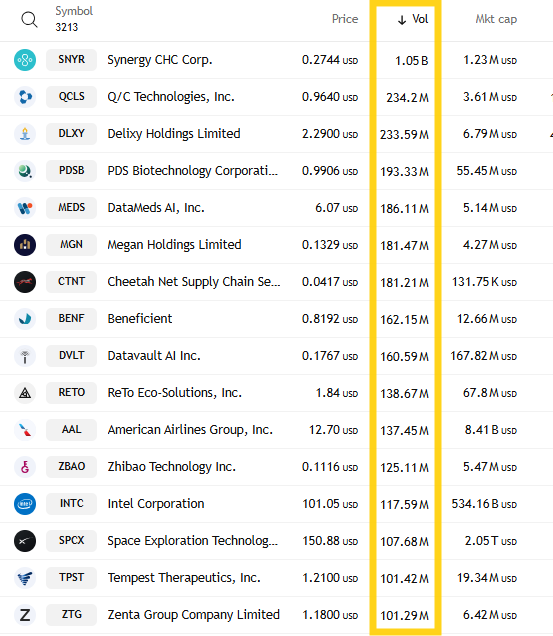
One interesting data point from today is speculation surged on the Nasdaq. I’ve been keeping an eye on it but we hadn’t had a day with more than a half dozen stocks trading more than 100 million shares or a single stock above around 300 million but today we had 16 trade 100 million shares and one stock at over 1 billion.
Not sure it signals anything, but the day traders were back today after a long absence.
Some stock-specific commentary from TheStreet Pro today:
- Stephen Guilfoyle – I’m Adding to This $10K Portfolio Stock, Shedding Some of Another
- Peter Tchir – Diesel Export Ban May Be Good for U.S.; Fed Predictions; My 3 Energy Stocks
- Ed Ponsi – When Value Meets a Great Chart: Why This Stock Offers the Best of Both Worlds
- Bob Lang – Chart of the Day: Costco Hits Firm Buying Level
A Look At The Charts
Note on all charts the colored lines are moving averages (the average price over the lookback period (days on the daily charts, weeks on the weekly charts)):
20 = green
50 = purple
100 = blue
200 = brownException is monthly charts where blue is 10-month moving average and brown is 20-month moving average.
MACD = Moving average convergence/divergence line, a measure of momentum that compares longer term and shorter term momentum to gauge if a move is strengthening or weakening. This is probably my favorite individual indicator (it’s also the favorite of Katie Stockton, a very fine technician).
RSI = Relative Strength Index (basically what it sounds like) = measures the strength of the move comparing gains to losses over the given lookback window (I use the standard 14 periods).
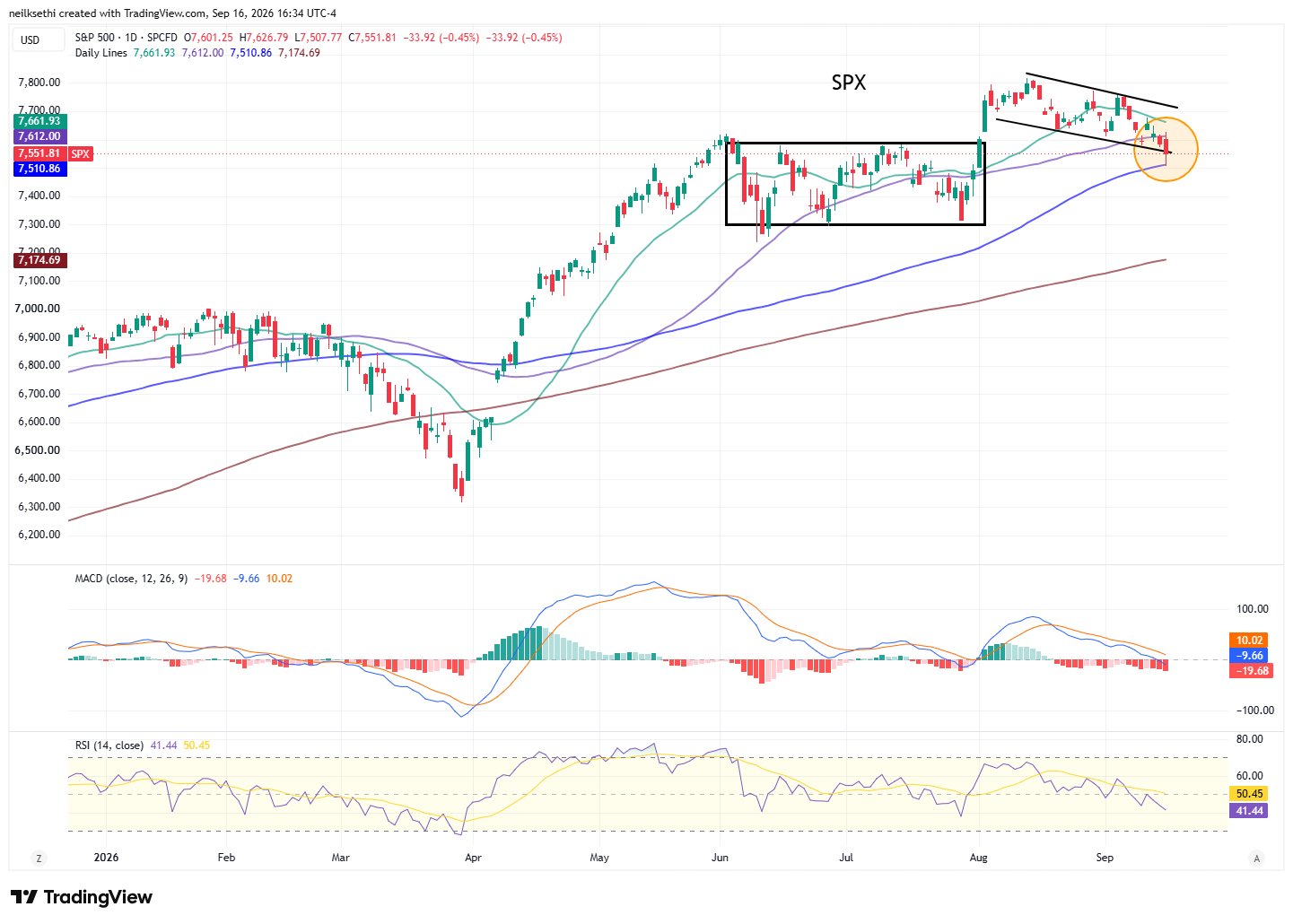
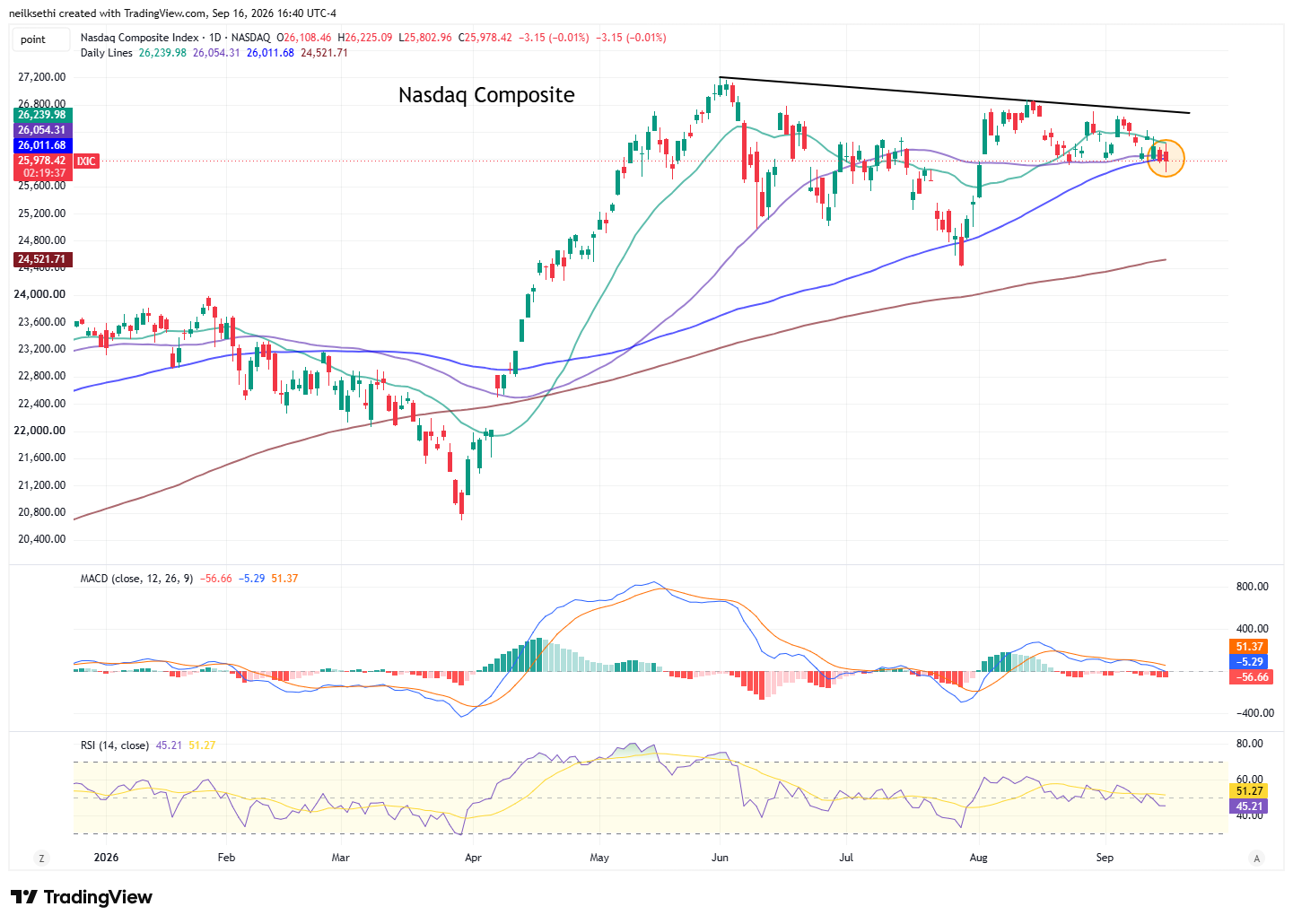
SPX fell to the 100-DMA but was able to bounce there. That said, the daily MACD remains in “sell longs” positioning, and RSI is near 40. I had said a breach of 7575 would see me sell, and I did, but then added some back at the 100-DMA.
While I wouldn’t necessarily buy into such a poor technical situation, the thinking is the FOMC decision either acts as a clearing event and we can move higher or we break the 100-DMA, then I sell with a small loss until things stabilize.
That thinking is similar to what was shared by Chris Versace in his article this afternoon:
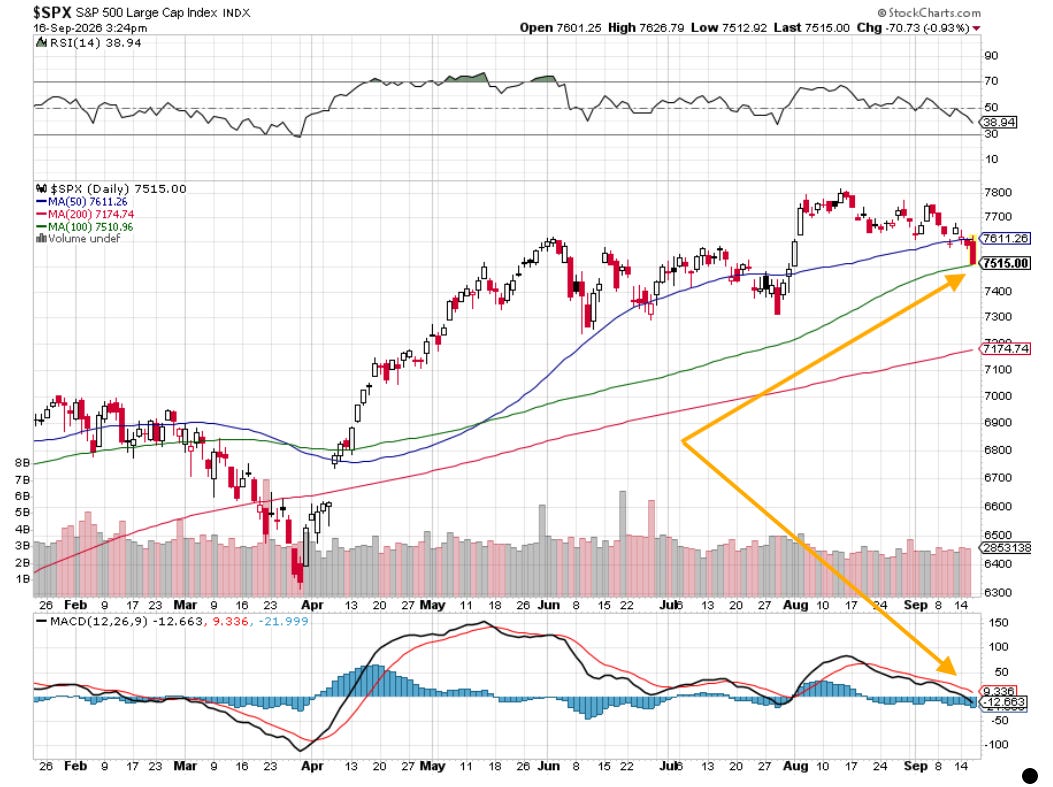
we are watching the S&P 500’s technical setup and whether is bounces off its 100-day moving average at 7510.95 or moves below it. We also will want to watch the subsequent testing of that level to determine if it is one of support or if it becomes one of resistance.
We’ll also be watching the S&P’s MACD indicator closely and as well as those levels for the Nasdaq Composite and our holdings. Our suspicion is we will have the opportunity to pick up shares at better prices, but there could be some uncertainty and incremental pain to get there.
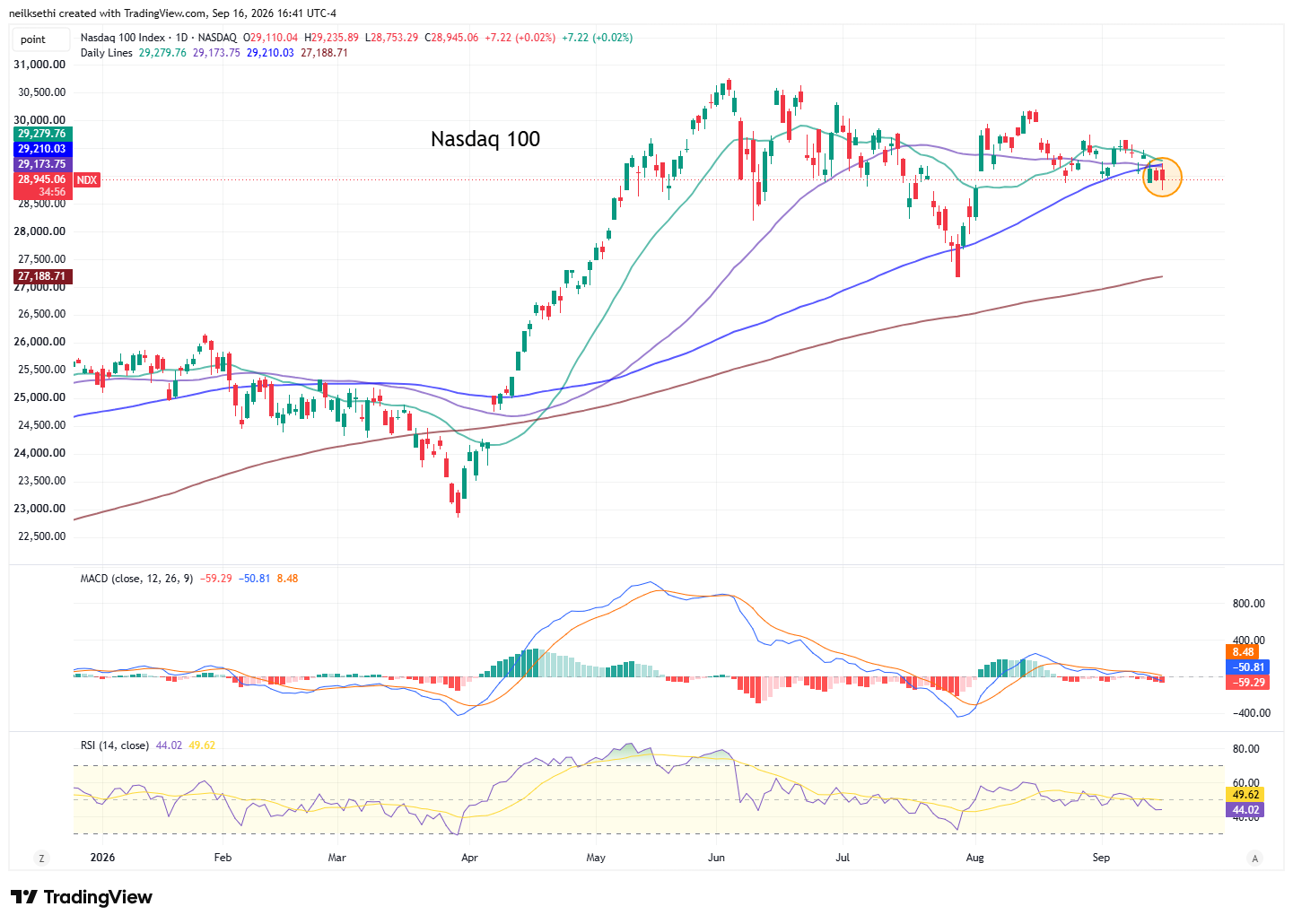
Nasdaq Composite I’m a little less positive on but it seems to be hanging in there, I just sold half my position in the QQQ (Nasdaq-100). I will buy it back on strength or sell the rest on a break of today’s low.
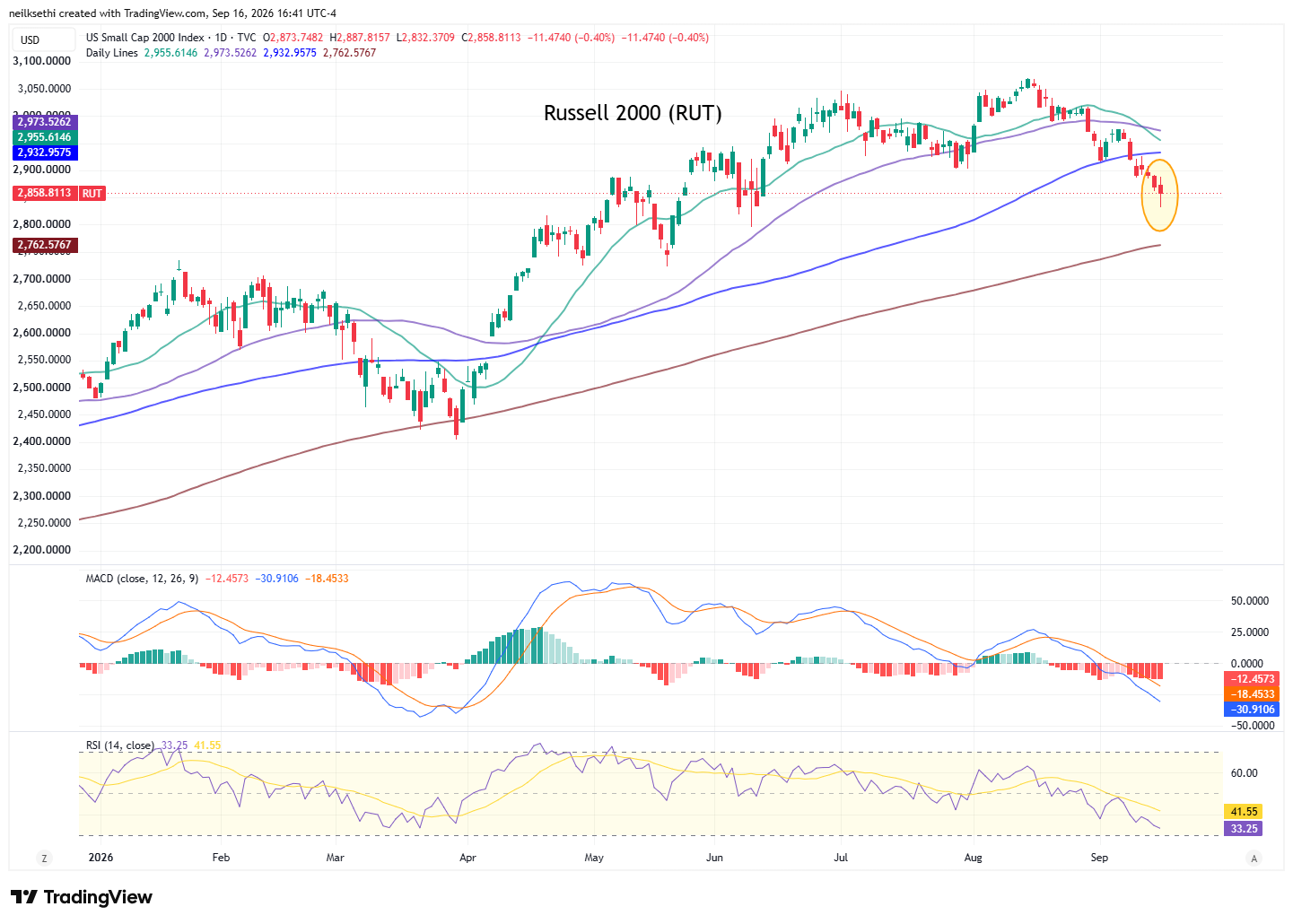
The Russell 2000 (RUT) I said last Wednesday was “much more problematic,” and that remains the case. As mentioned early last week its MACD is now in “go short” positioning, and its RSI is now below 40. As I said Wednesday “I am not long this index, but … I’d be out until it at least recovered the 100-DMA.” 200-DMA is a fair bit away, but that might provide a good place to buy as it served as a floor in March.
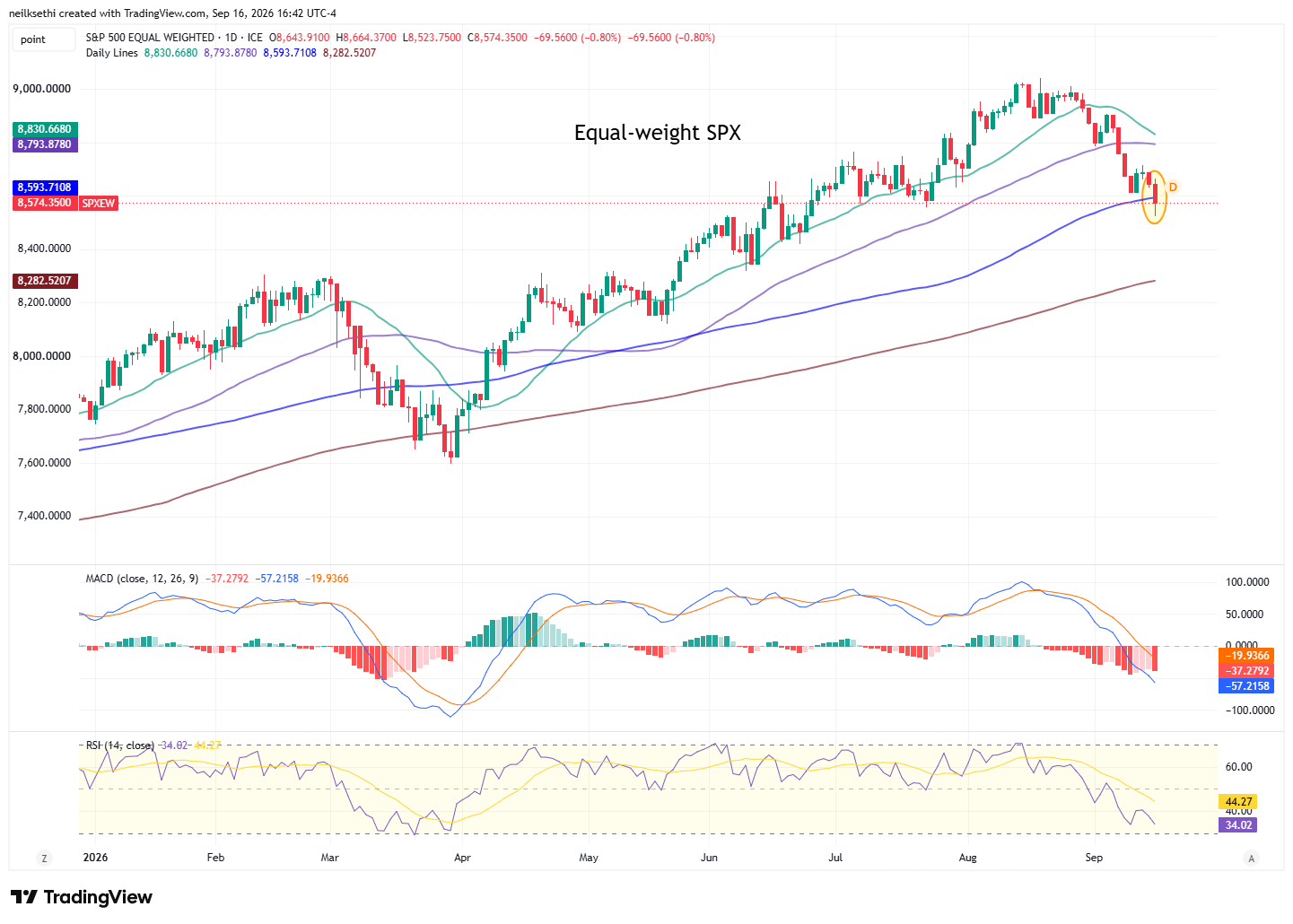
The equal-weighted SPX is back to concerning. I mentioned early last week “I did take off most of my holdings in ($RSP) for now. I’ll be looking for a tradeable bottom to form.” I had thought we might be seeing that, but no dice, as it broke the lows and now the 100-DMA. Daily MACD and RSI are very weak.
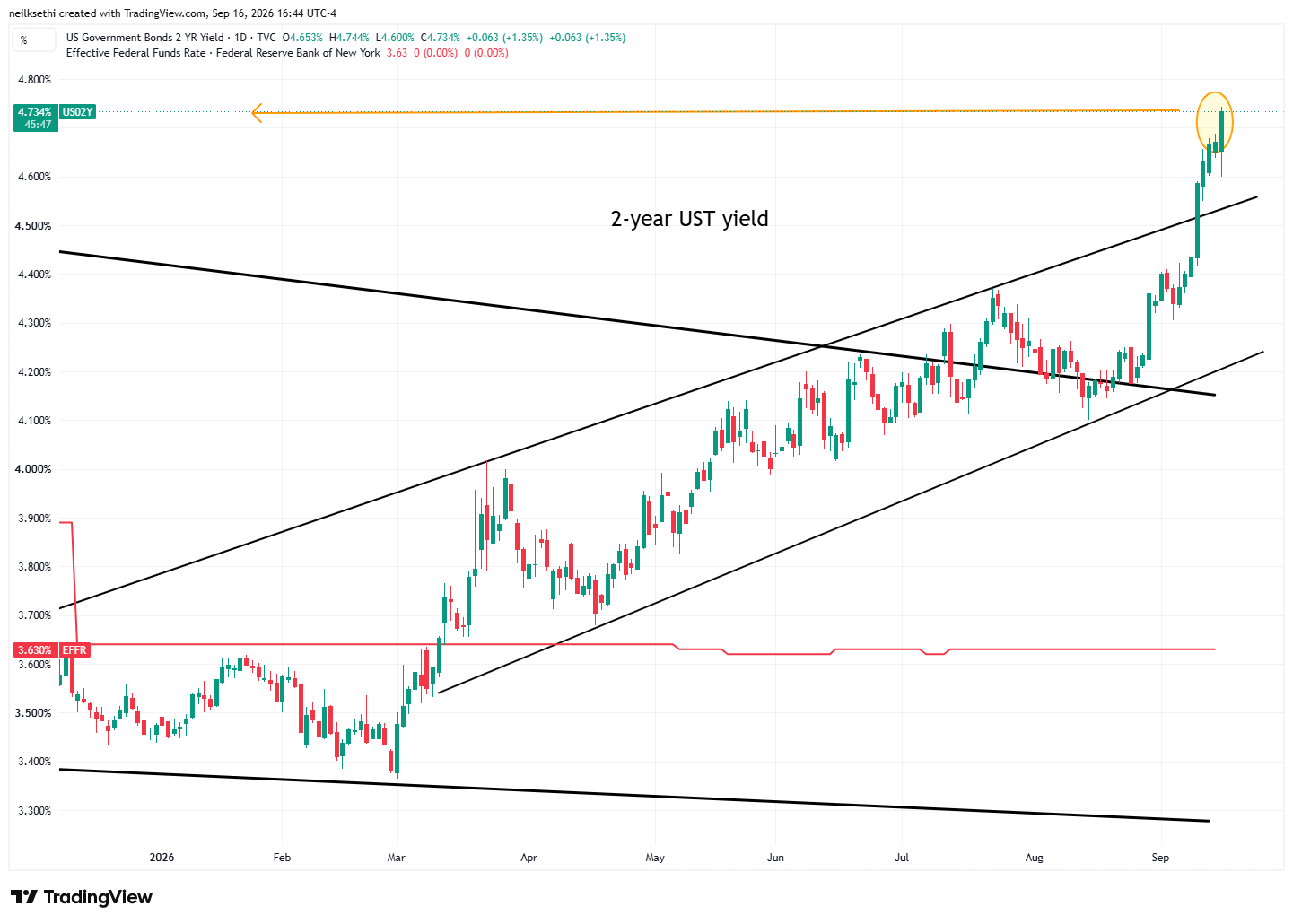
Treasury yields bear flattened with the shorter end moving higher while the long end saw smaller moves (bearish because it implies Fed rate hikes):
The 2-year Treasury yield jumped six basis points as the Fed came in more hawkish than expected, an impressive feat given how bearish expectations already were (more on that below). It ended at 4.73%, the highest close since July 2024, and now just about at the top of my 2026 range. It’s now well above its trend channel, which I had said Friday was “signaling either it’s breaking out or it’s become extended and is in need of a pullback.” I had said “so far seems like the former,” and now we know that was the case. Still, I’ll likely be picking some up tomorrow.
It is still ~95 basis points above the Effective Fed Funds rate (red line which hasn’t yet reflected the rate hike on the chart), still screaming for rate hikes. That’s the furthest above the EFFR since November 2022 when the Fed was in the middle of its historic tightening campaign.
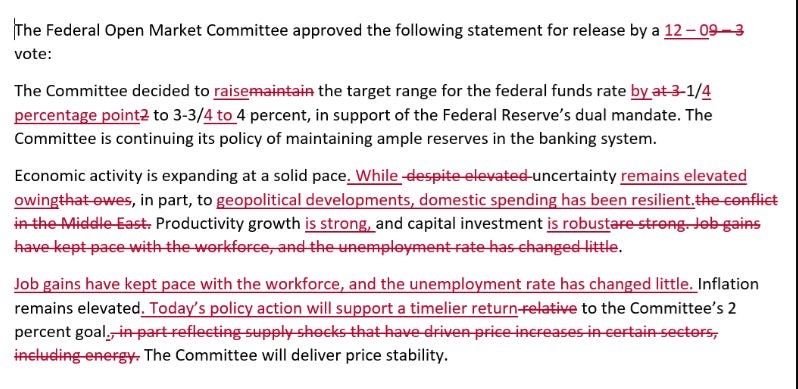
In terms of the FOMC decision, as noted it was more hawkish than expected with a 25 basis point increase and no dissents. Estimates for the economy were upgraded as were those for inflation.
On the former (economy) the newly truncated statement stuffed in no less than five references to a solid economy: “resilient spending,” “strong productivity,” “robust capital investment,” “job gains have kept pace,” and “unemployment has changed little.”
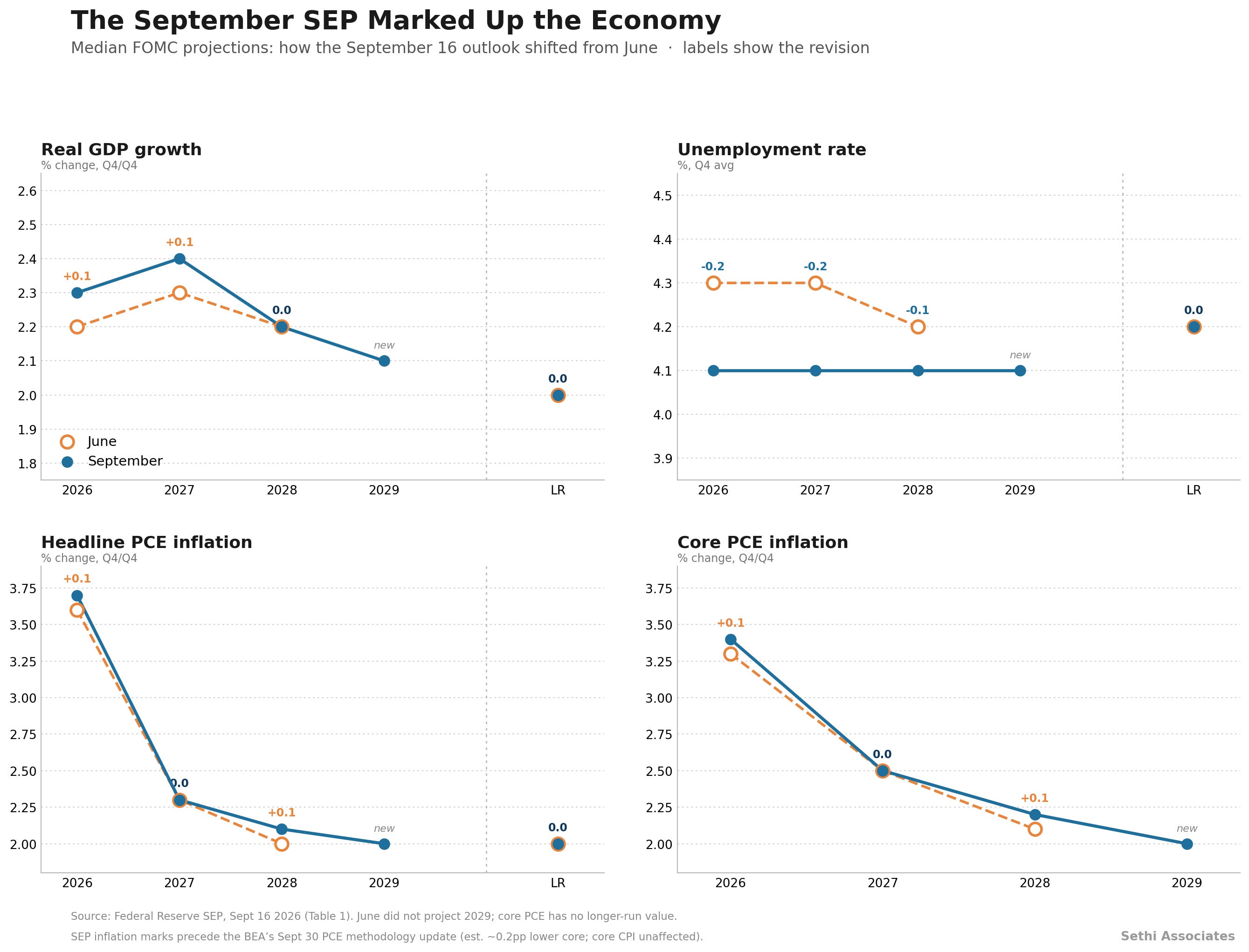
The Summary of Economic Projections (SEP) similarly saw estimates for GDP rise and unemployment fall. On inflation, estimates for core PCE rose. Chair Warsh as noted at the top summed it up: “Inflation is too high and has been for too long,” Warsh said in his opening remarks. “Our decision comes at a time when the American economy appears to be strengthening.”
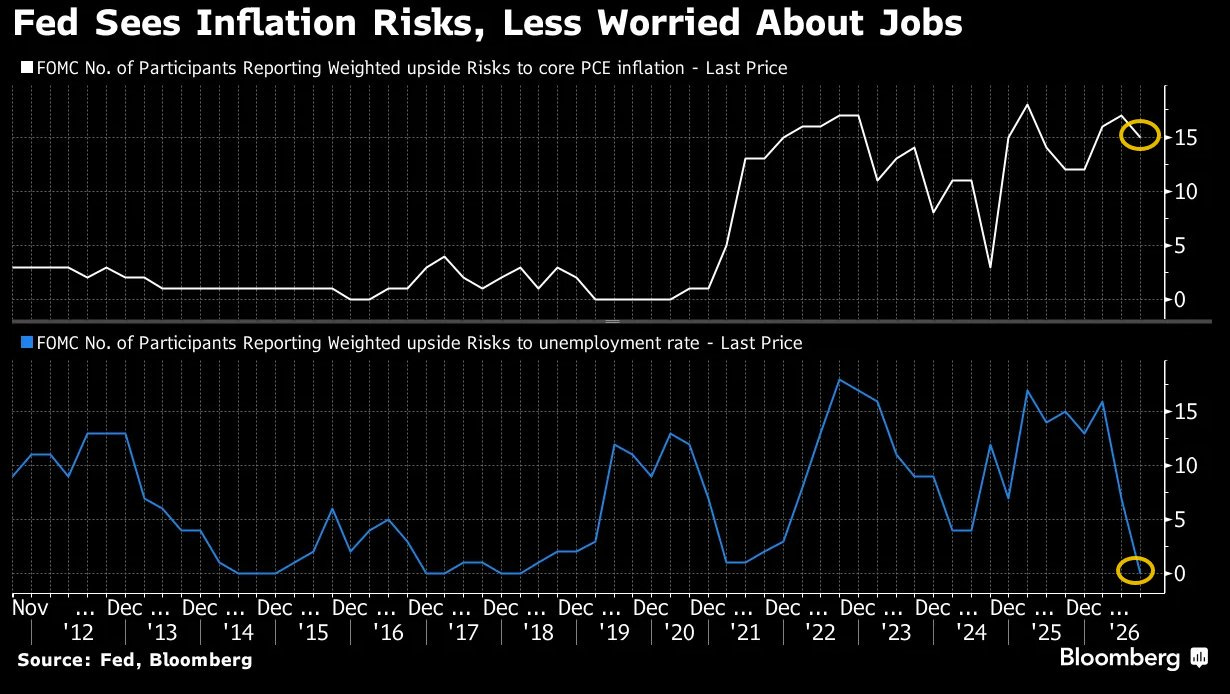
BBG noted that not a single Fed member sees upside risk to the unemployment rate while 15 of 19 see upside risk to core PCE inflation.
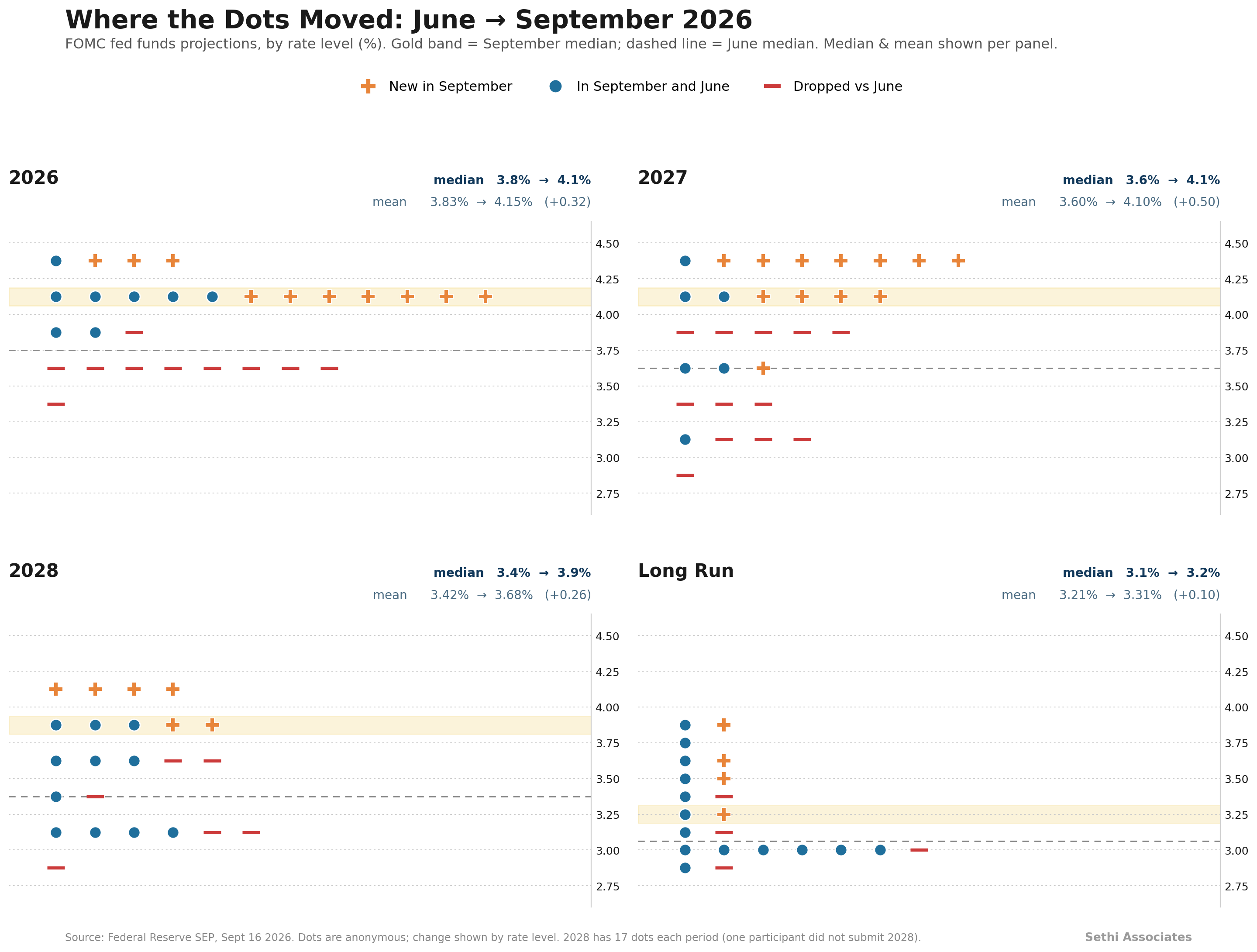
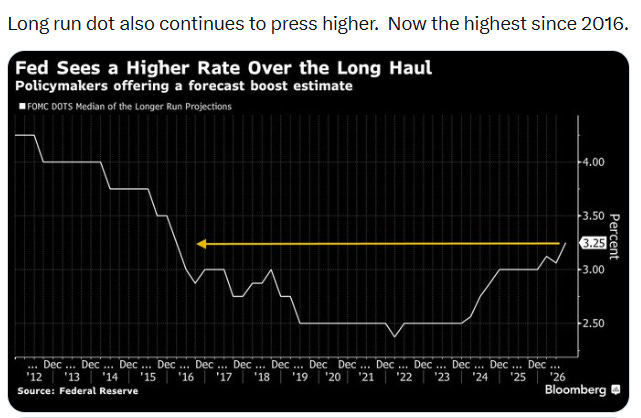
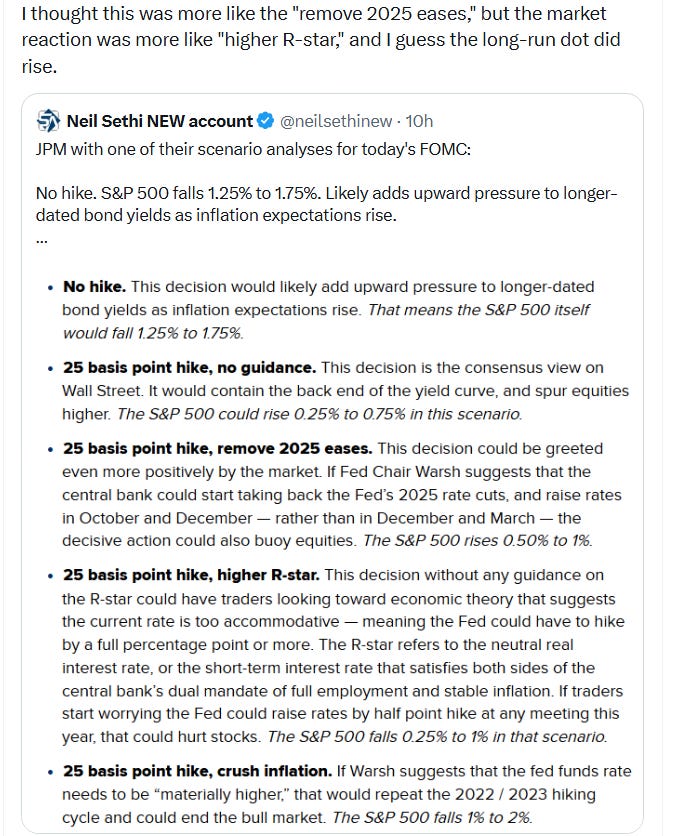
Following on from that assessment, 16 of the 18 dots see another rate hike this year (with four seeing two more), and the median dot was raised by two hikes through 2027 and 2028. In addition, the long run median dot rose to its highest since 2016.
Taking the averages of the dots gives a similar result although it is a hike lower for 2028 but eleven basis points higher for the long-run.
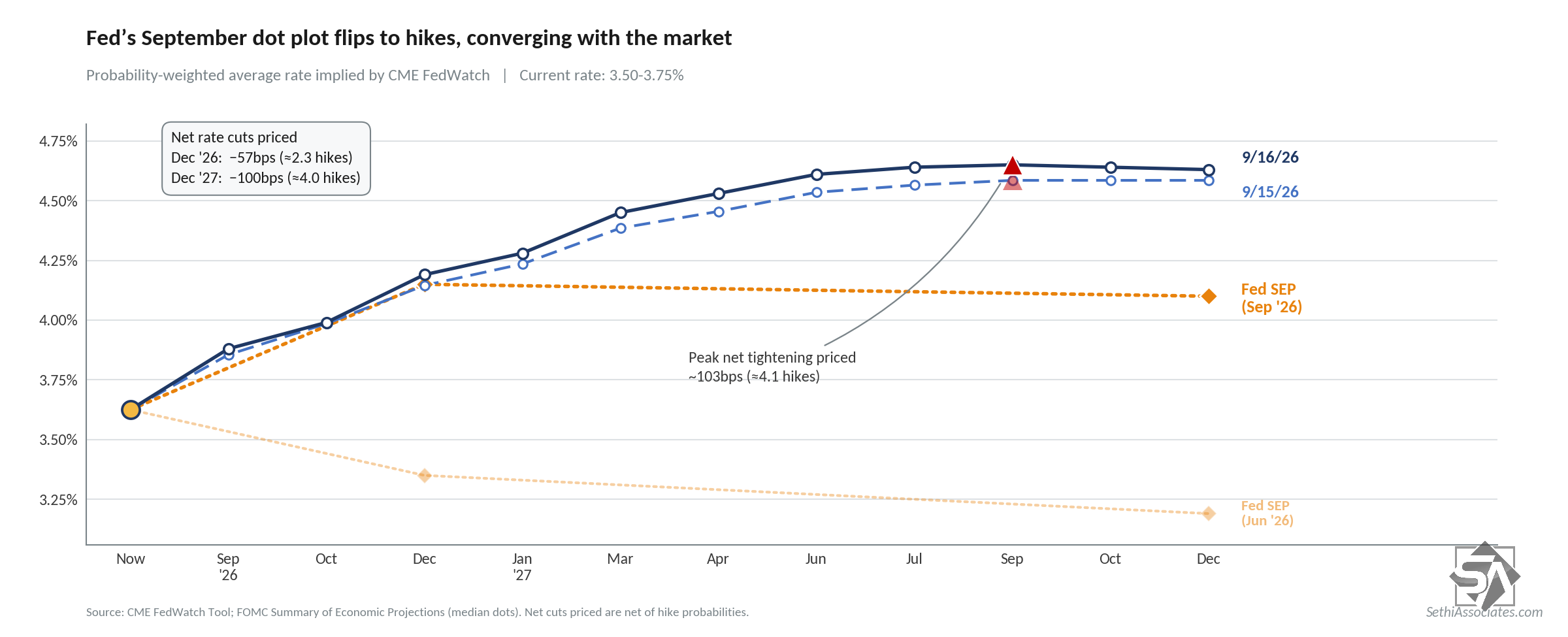
In terms of FOMC rate hike expectations from CME’s Fedwatch tool, markets see a roughly 50/50 chance of an October hike but a better than 100% chance of at least one hike by December with 31 basis points of additional tightening priced.
Through 2027 there’s another two rate hikes priced (assuming one more in 2026) with a total of 78 basis points of rate hikes priced through the end of 2027.
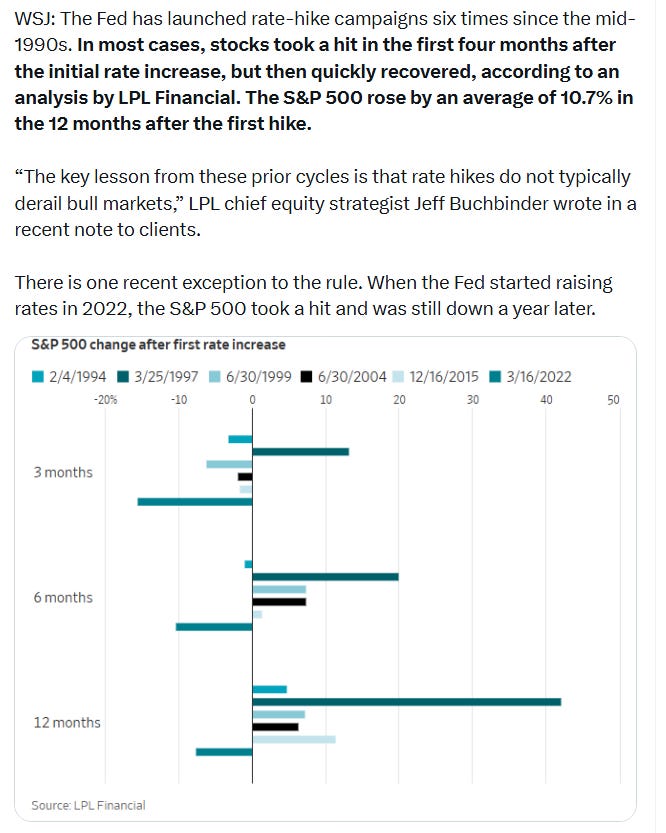
Some other Fed stuff from today:
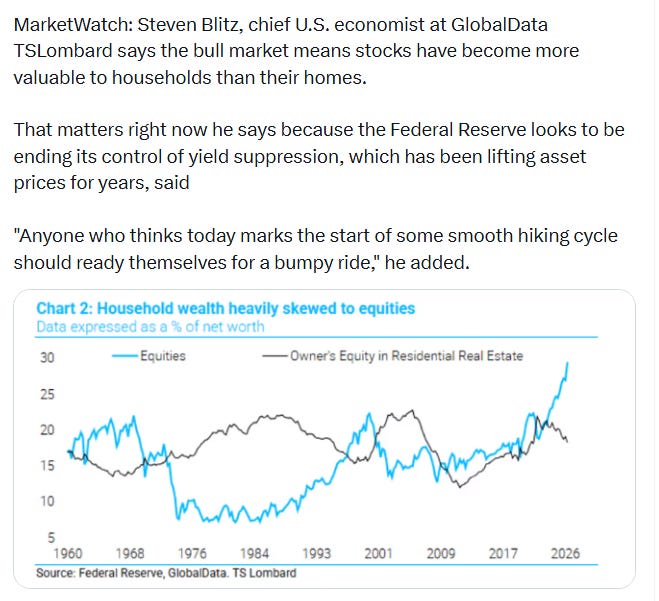
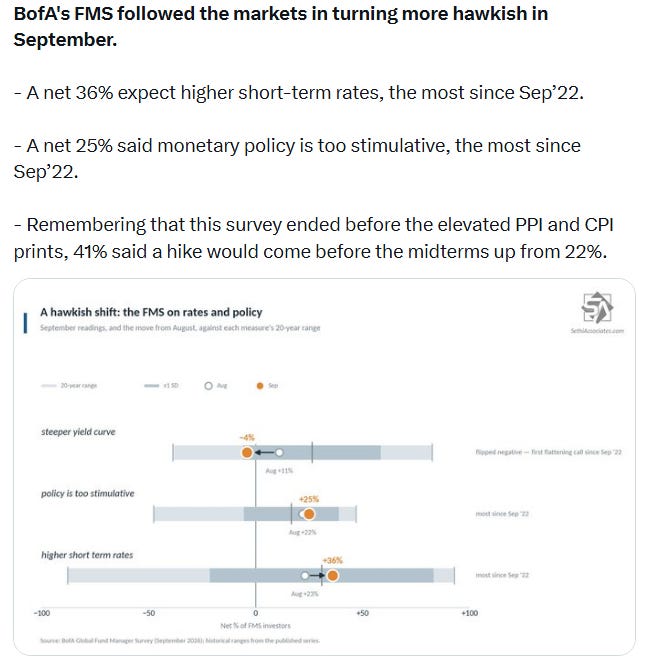
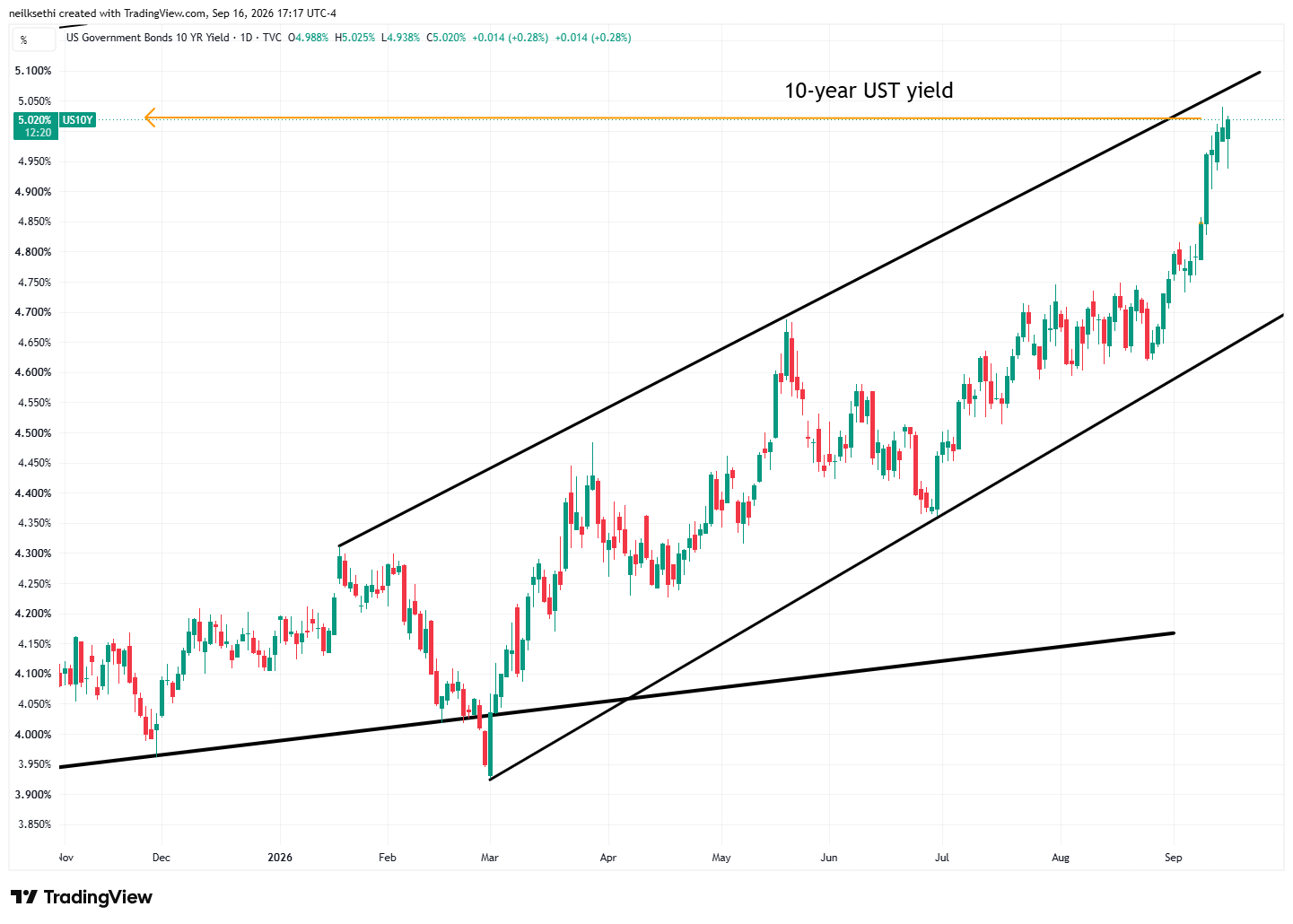
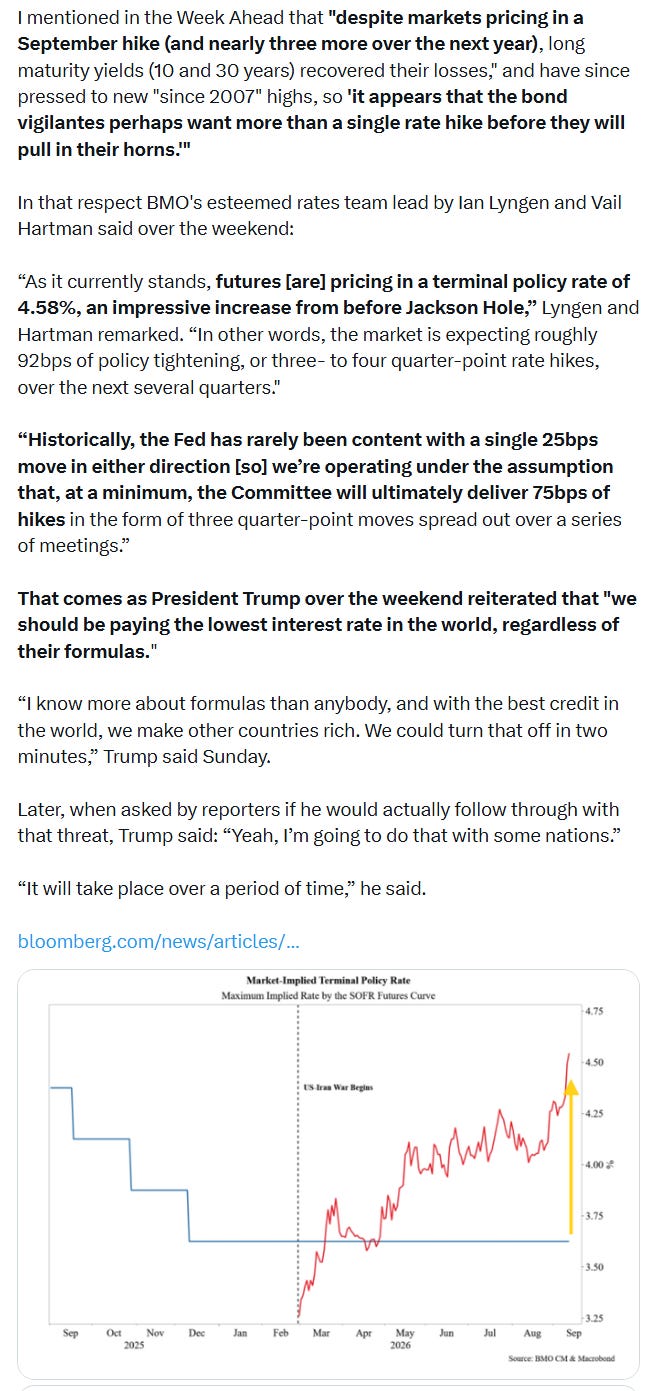
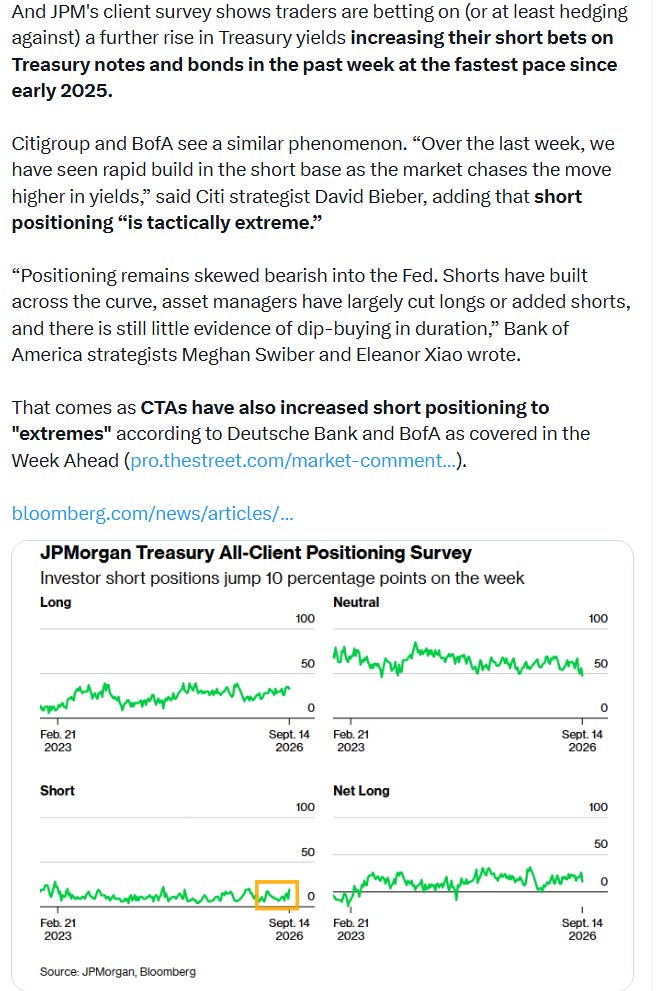
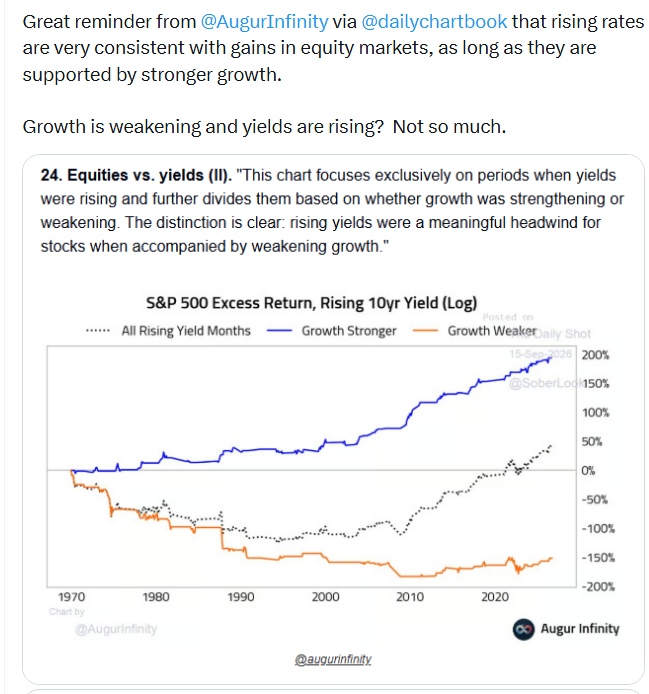
10-year yields recovered early losses to finish at 5.02% for the first time since 2007.
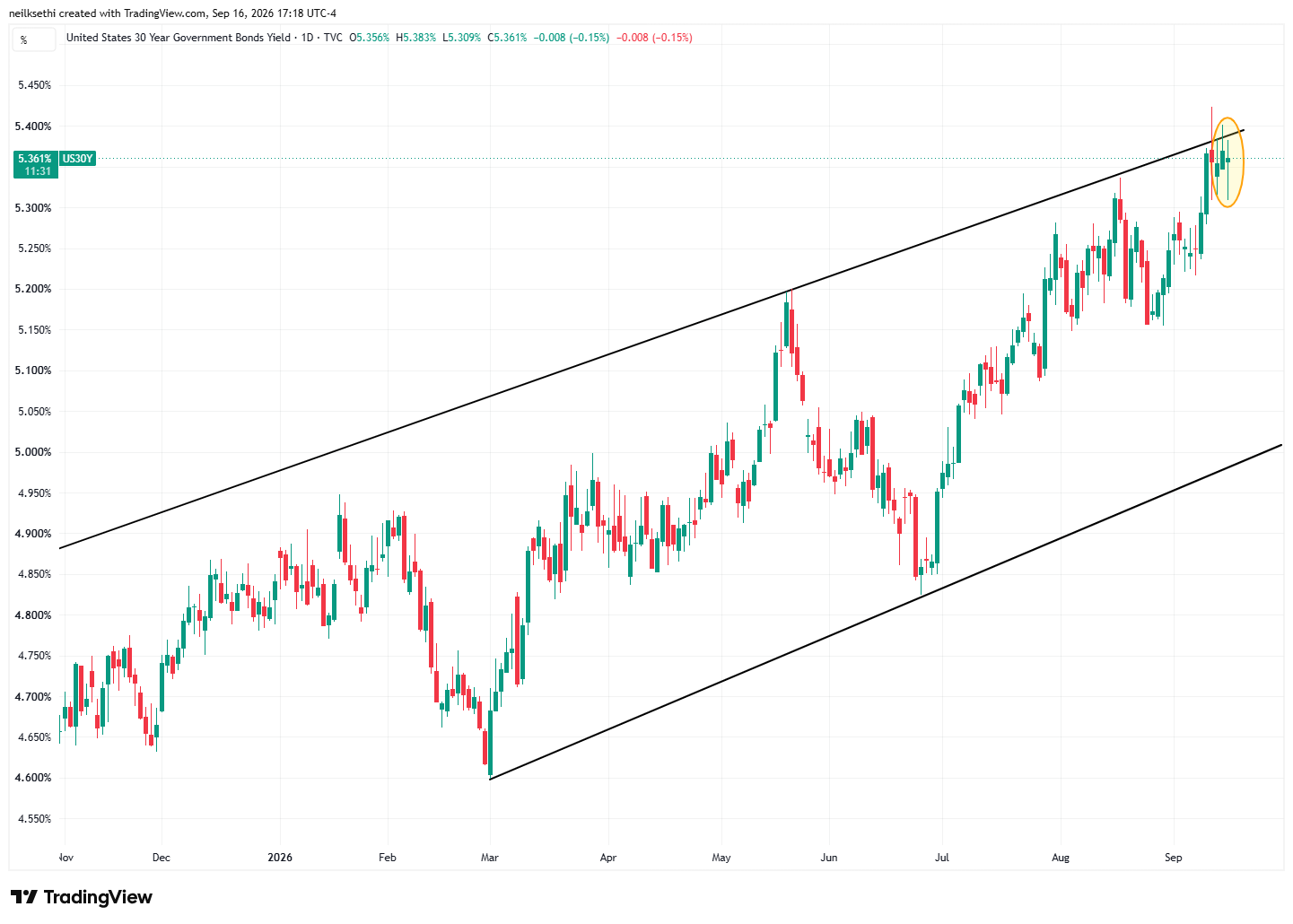
30-year yields almost got back all of their losses to finish at 5.36%, just a basis point below the highest close since 2007 (July) as well. It remains right at the top of its uptrend channel.
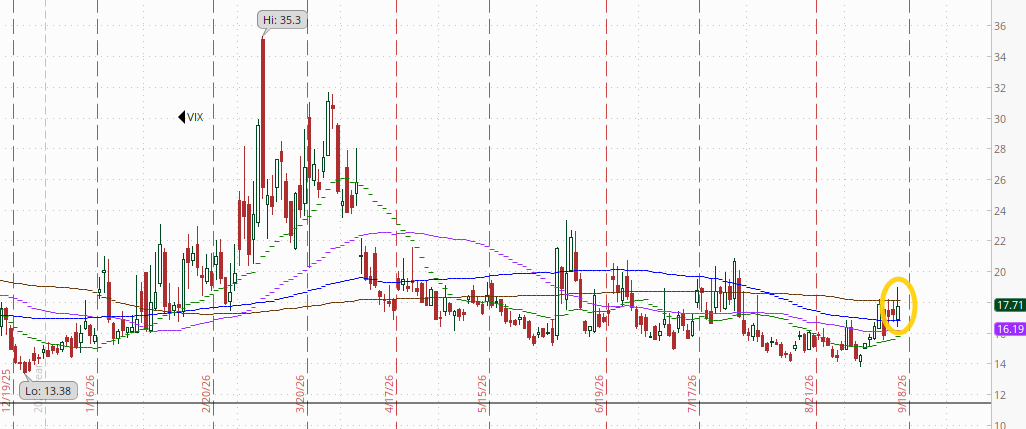
VIX at one point pushed above its 200-DMA but ended just below once again at 17.7. That’s consistent with ~1.10% average daily moves in the SPX over the next 30 days.
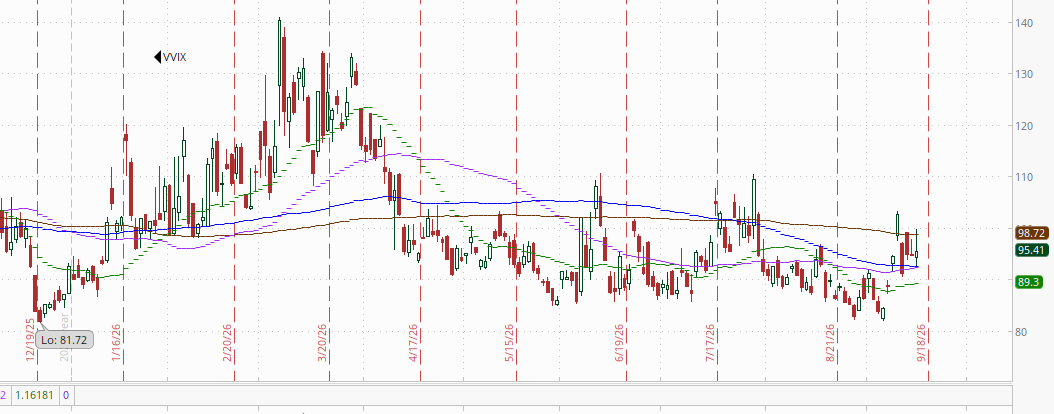
The VVIX (VIX of the VIX) was more subdued little changed at 95.4.
The current level is consistent with “moderate” daily moves in the VIX over the next 30 days (historically, normal is 80-100). Above 100 is the level flagged by Charlie McElligott as indicating higher stress.
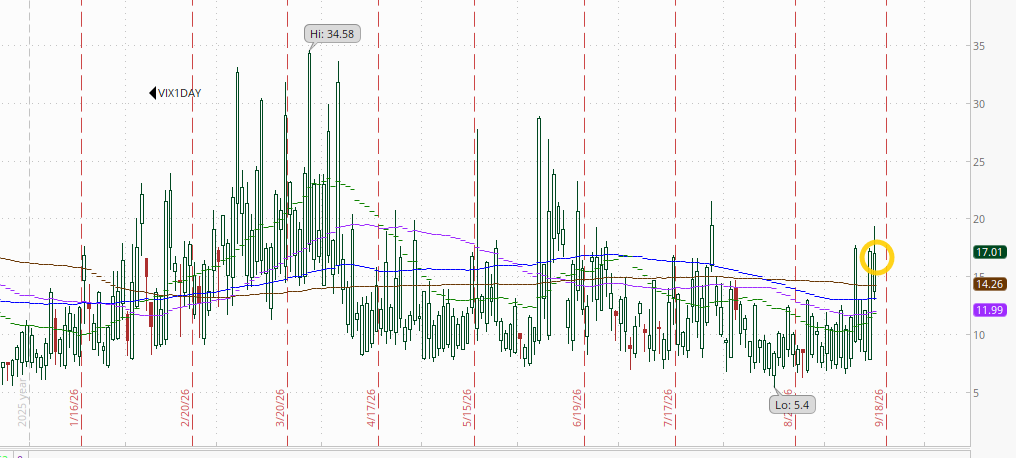
While the 1-day VIX ended little changed at 17.0 despite the FOMC moving to the rear-view mirror, meaning markets expect things to remain volatile in the short term. The current reading isconsistent with a move of 1.06% in the SPX next session.
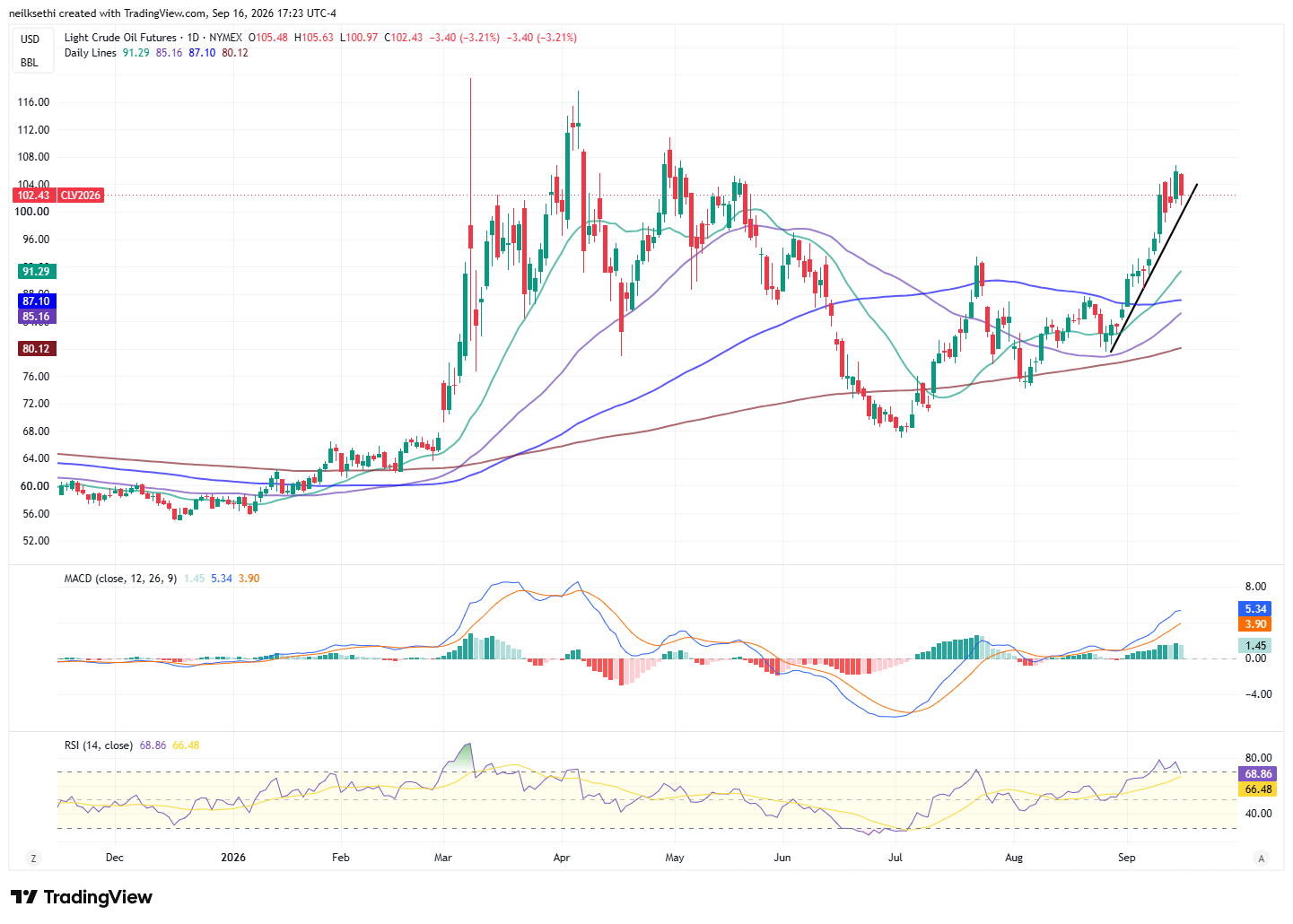
WTI (futures, /CL — per my morning note I am switching to futures to better align with what is reported in the media) fell back 3.2% but maintained their uptrend.
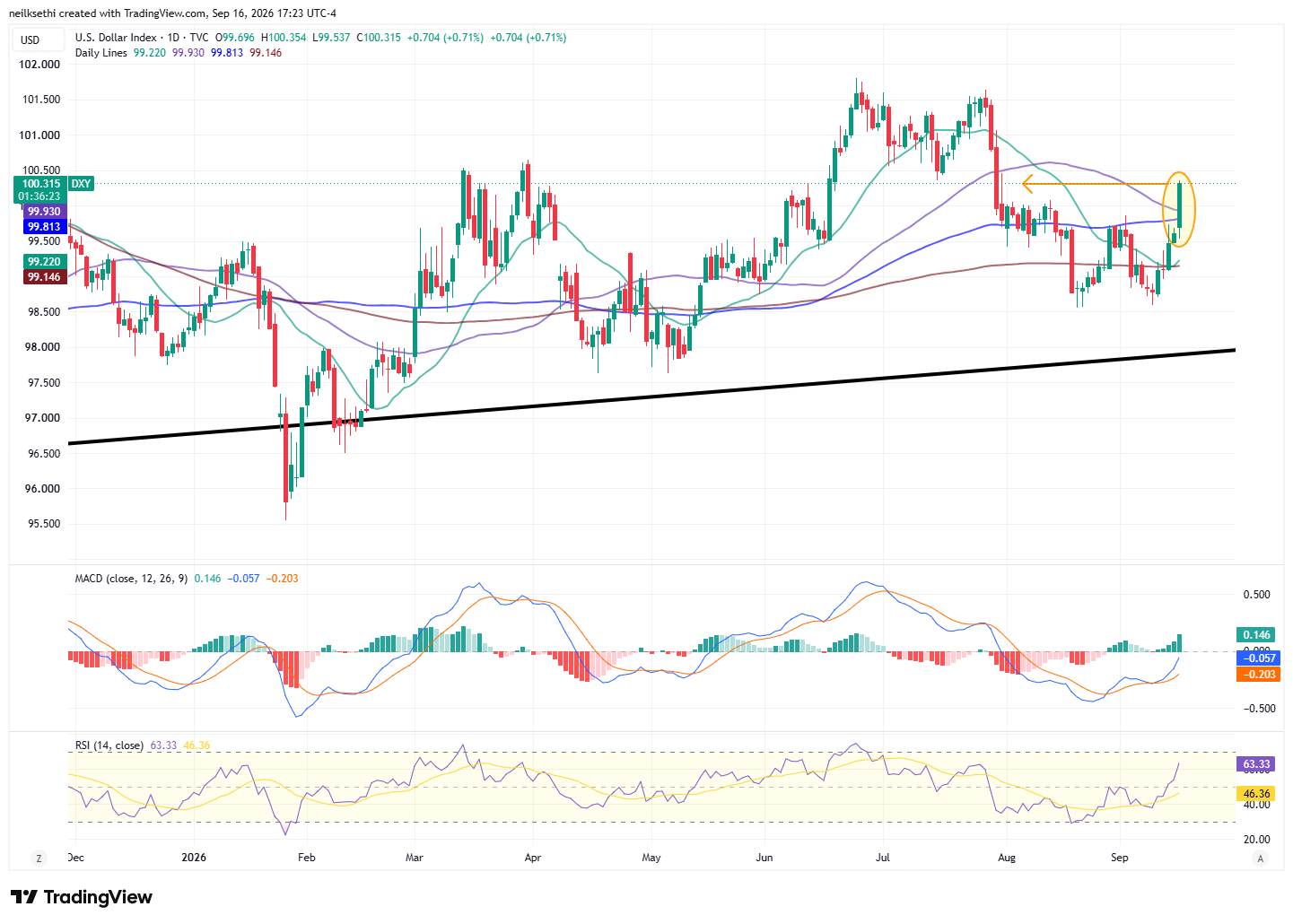
The DXY dollar index (which is fixed weighted with a heavy (57%) weighting vs the euro), shot right through the resistance area I have been noting, consistent with my statement Monday that “it will need another catalyst to get through that.” I did say yesterday “this likely moves a lot tomorrow.”
This opens up a run back up to the highs of the year. The daily MACD remains positive and the RSI is now above 60. As I said Tuesday “if it can get through the 100 level it could really run.”
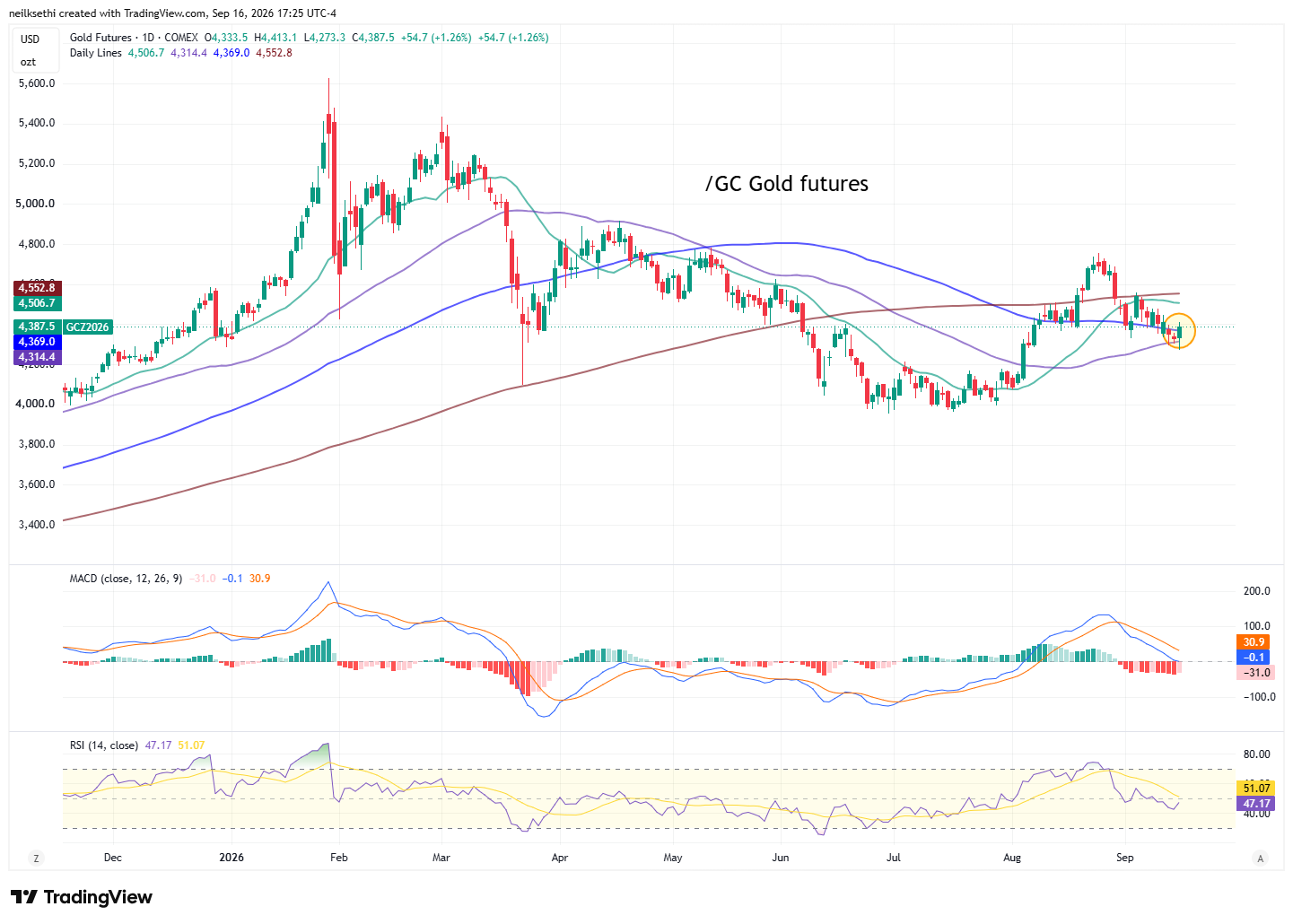
Gold futures (/GC) got a bounce despite the hawkish Fed getting back above the 100-DMA. The daily MACD remains negative and the RSI is under 50, so I’ll need at least another day of stabilization before stepping back in. As I said Tuesday “if it can continue to hold here and the technicals firm up, I may take a shot.”
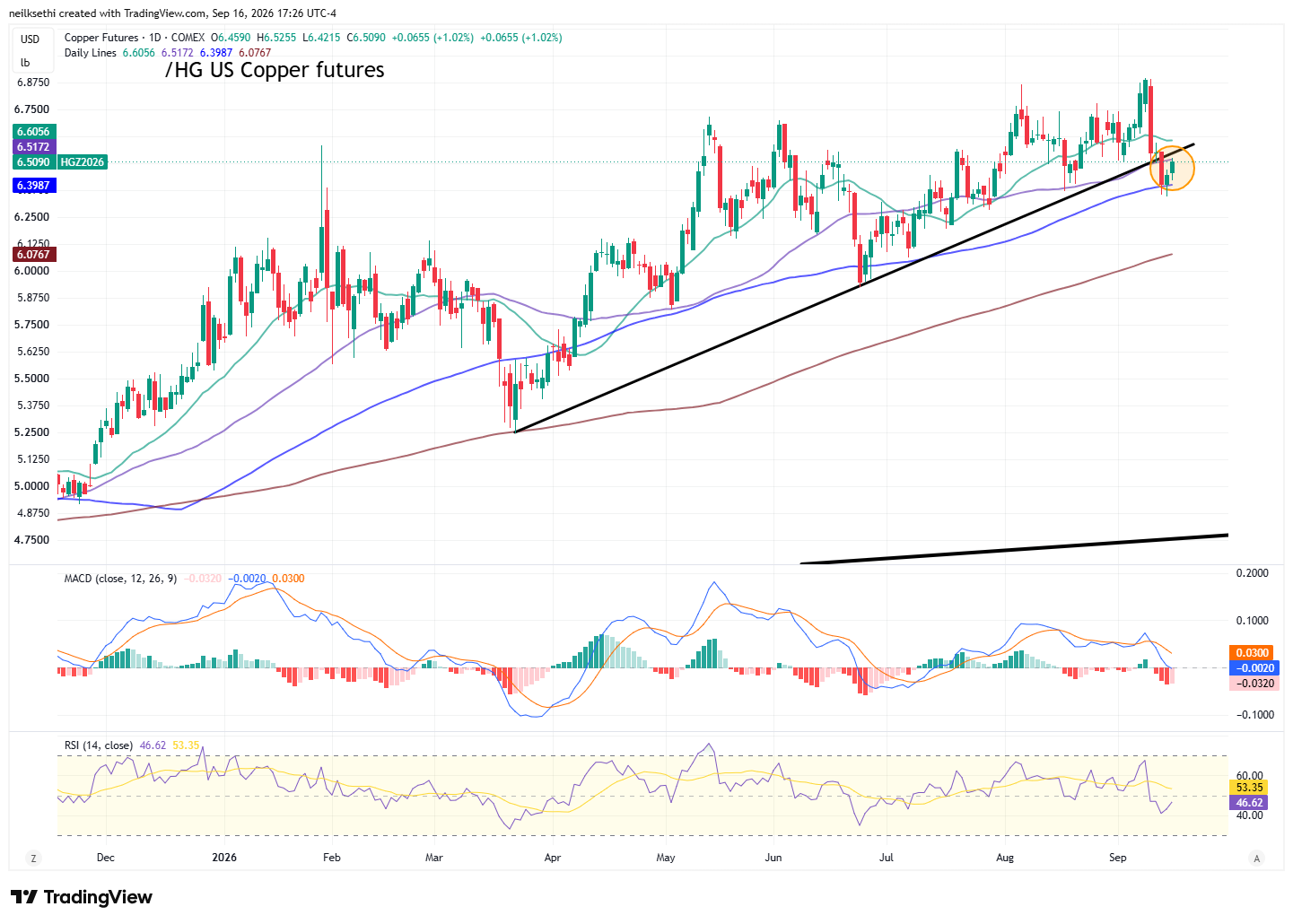
US copper futures (/HG) got a second day of bounce but now to the underside of support turned resistance. I’ll wait until it gets back over the 50-DMA and trendline before adding back what I took off.
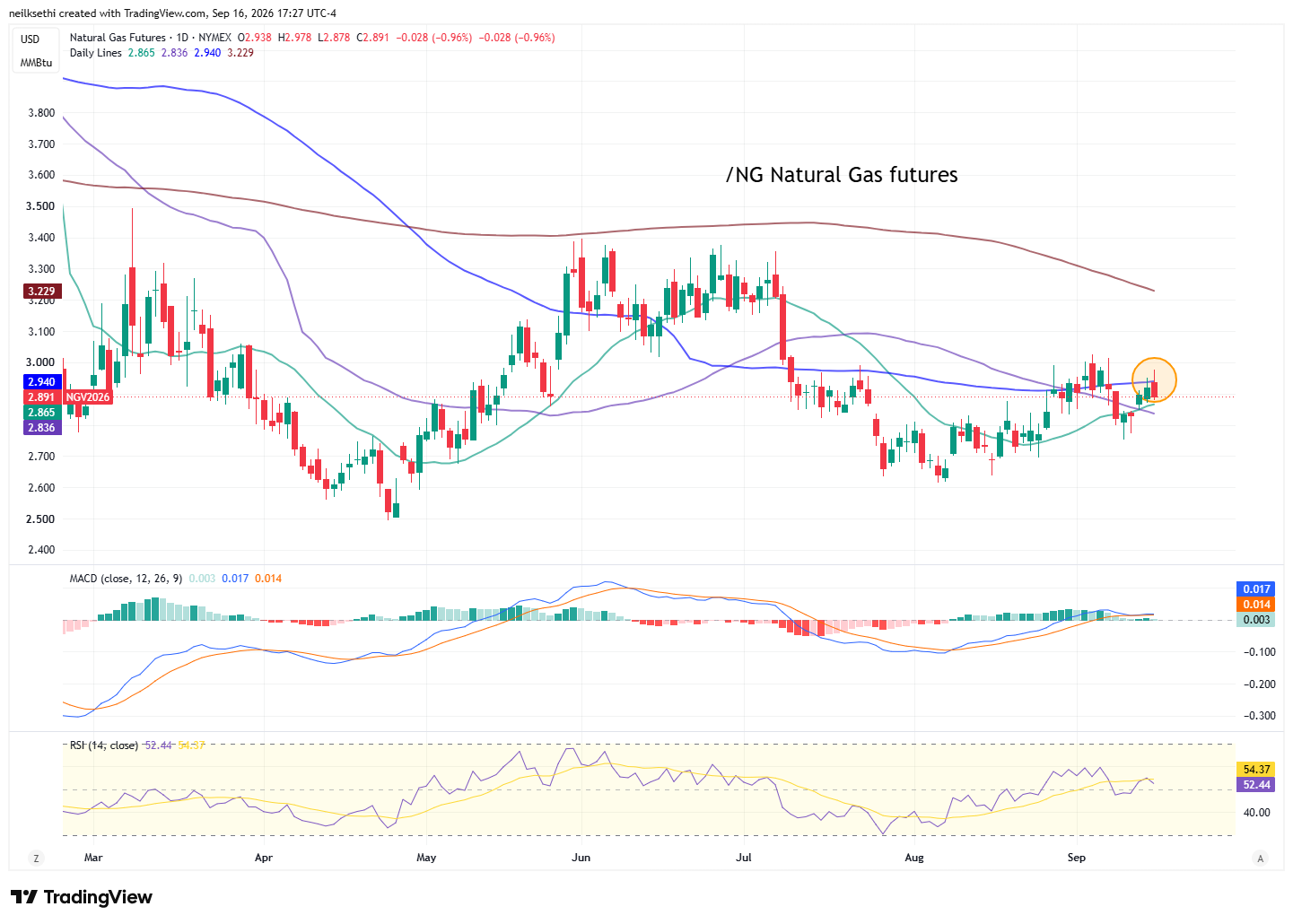
US natural gas futures (/NG) as noted last week “now back to trading in their range since the start of July.”
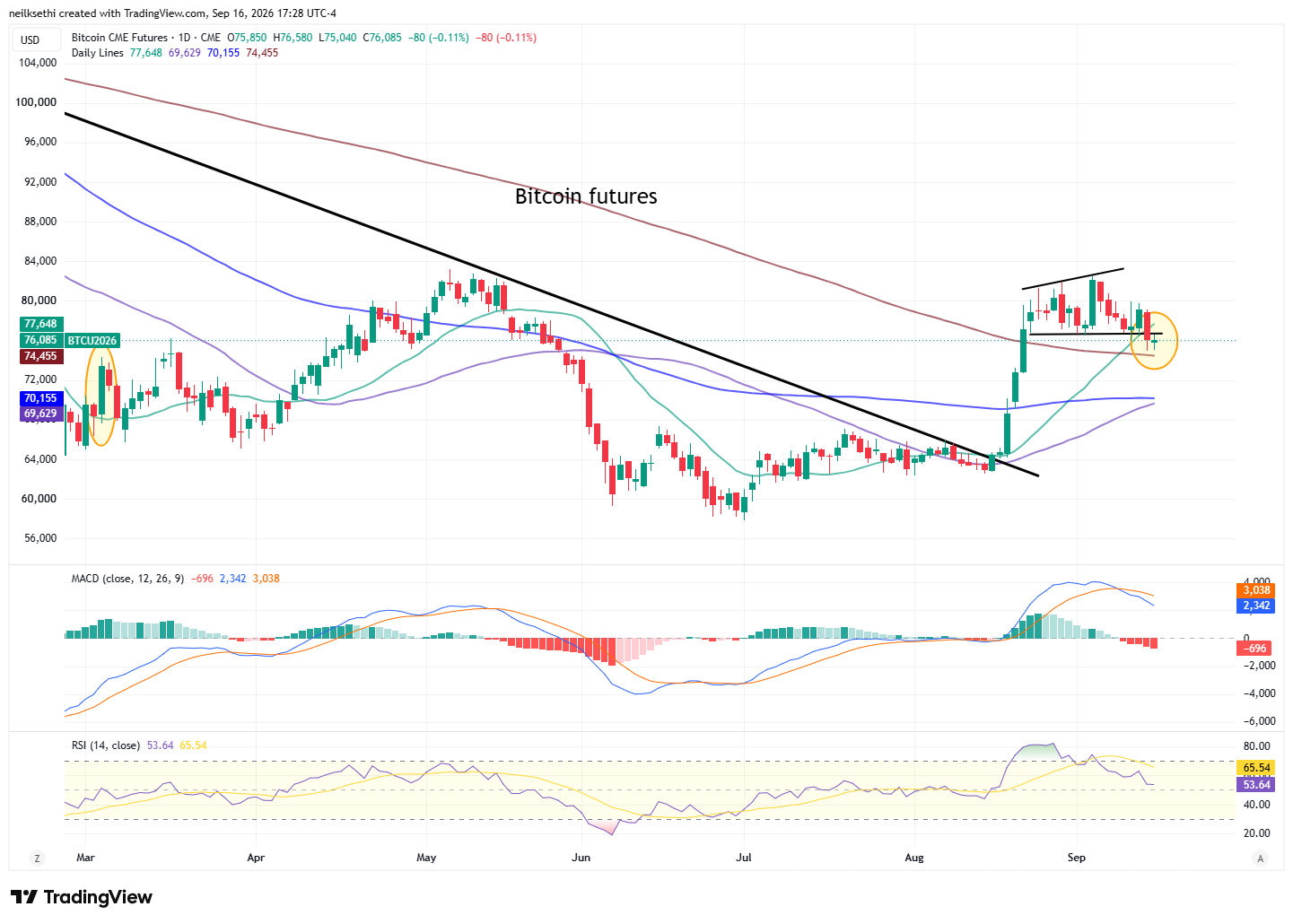
Bitcoin futures little changed. As I noted Tuesday “I had said I would sell if they broke the bottom of the bull flag, but they seemed to find support at the 200-DMA, so I trimmed a little but kept most of the position to see if they can regather strength. Daily technicals are deteriorating though so it won’t take much to convince me to exit and wait for a better reentry spot.”
More From TheStreet Pro:
- Chris Versace – Fed Delivers Expected Rate Hike. More on the Way?
- Stephen Guilfoyle – Federal Reserve Signals More Interest Rate Hikes Ahead
- James “Rev Shark” DePorre – Investors Knew Rate Hike Was Coming, Then Sold it Anyway
- Bret Jensen – Feeling Like It’s 2007 All Over Again
- Neil Sethi – Blowout Retail Sales Report Shows Consumers Continue to Consume & U.S. Homebuilder Sentiment Drops to Joint-Least Since 2022
Miscellaneous:
Wrap-Up – The Market Again Bends but Doesn’t Break
I noted yesterday:
And while we did get some bounceback in the AI names, the rest of the market fell back, not unexpected on a day that oil prices and bond yields are at or near multi-year (in some cases multi-decade) highs.
Equities are pressing against key support levels and downside pressures are building ahead of what can only be expected to be a volatile reaction no matter what we get with the FOMC tomorrow. One way or the other, tomorrow will serve as a near-term clearing event, and we should hopefully have a better grasp on where things are headed.
And while we did get the clearing event today, it seems markets are still not quite certain of what to make of it. We’re three years removed from the last hiking cycle, and this will be a much less aggressive affair than that one, so it’s really been since before the pandemic that markets have had to navigate something like this. It will take more than a day or two for them to find their feet.
Most disappointingly, despite Warsh’s best efforts, long term yields still did not seem satisfied (at least not enough to ease back). There’s not much more the Fed can do outside of actually buying the long end, so it will be up to the administration and market participants to decide where long-end yields should settle out. Personally, I have been incrementally adding, but there are many who wouldn’t touch long-term yields with a 10-foot pole seeing us in a new secular bull market for yields (bear market for bonds).
Regardless, markets overall are clearly still jumpy as judged by no softening in the 1-Day VIX, and we remain in that “fragile” situation not far from key support levels. Perhaps traders will have a more positive outlook after getting a chance to digest things. We’ll find out soon enough.
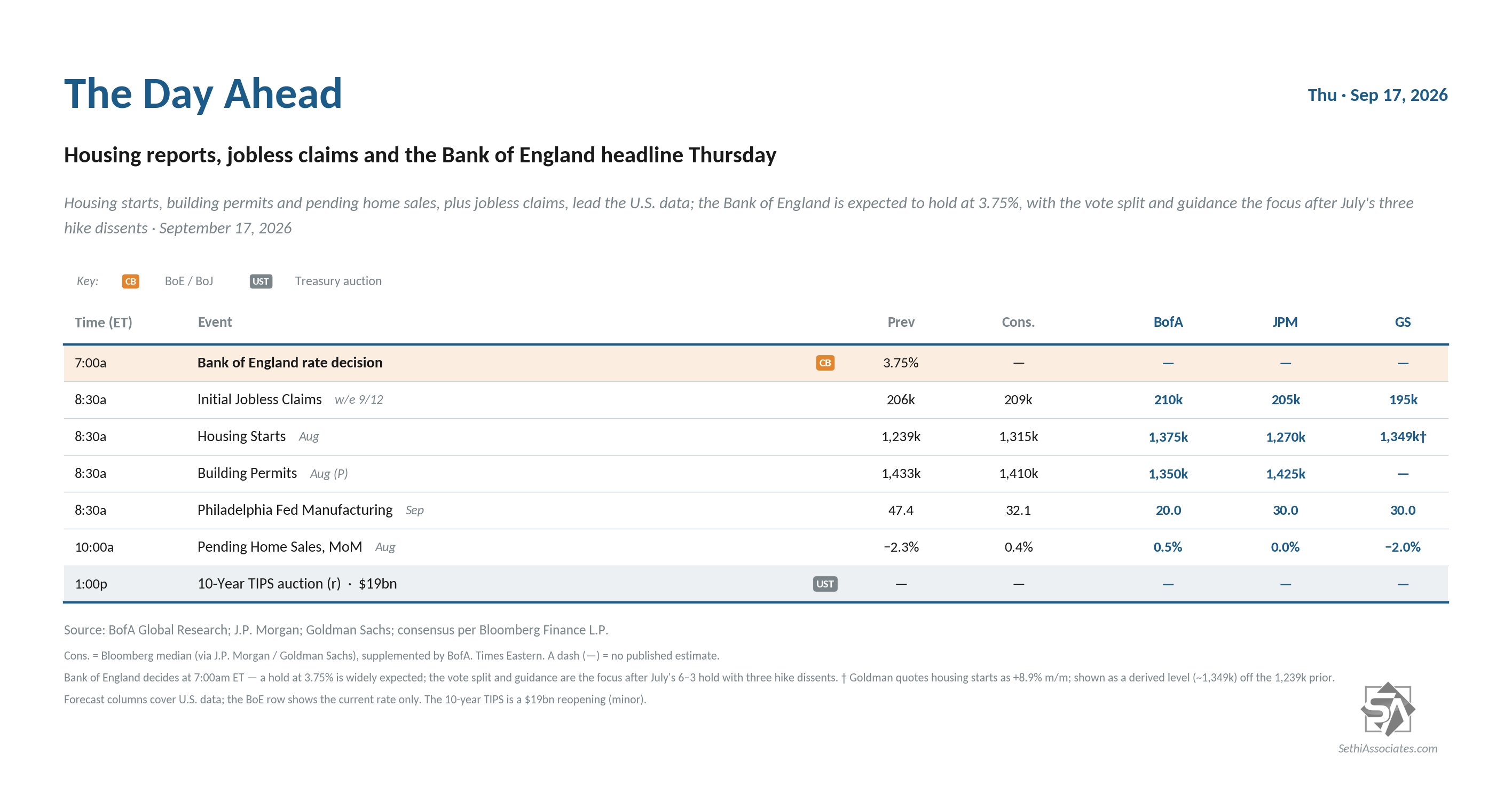
The Day Ahead – More Economic Reports and the Bank of England Highlight Thursday
US economic data remains on the heavy side with August housing starts/permits and pending home sales, a regional Fed survey, and weekly unemployment claims.
Fed speaking blackout continues until Friday morning.
Non-Bill (>1yr in maturity) US Treasury auctions resume but with a never commented on 10-year TIPS auction.
We do get our one SPX component reporting this week in Lennar ($LEN).
Ex-US highlight is the Bank of England policy decision. While a hold is widely expected, expectations for future hikes have jumped since the last meeting with now nearly five priced, which will likely only increase with the more hawkish Fed. We’ll see what Governor Bailey has to say about that.