Your ETFs Are Making an AI Bet, Whether You Like it or Not


There was a minute there, not long ago, when AI stocks were declared done and dusted.
But that changed following encouraging earnings reports from techs like Microsoft ($MSFT) and Amazon ($AMZN), which sent those stocks gapping higher on big volume. Other AI stocks, like Nvidia ($NVDA) and Meta ($META), followed along, sending the S&P 500 2.12% higher in the past month.
That’s good news if you’re holding these stocks. But the rebound should raise some red flags for investors holding what they believe is a diversified batch of index funds.
Making the AI Pie Higher
The earnings-driven rally didn’t just lift AI stock prices; it increased their weightings inside the funds that millions of people hold in retirement accounts.
Every time Nvidia, Microsoft or Meta outperforms the rest of the index, they automatically take up more room in your S&P 500 fund, your Nasdaq fund and your tech fund, whether or not you meant to increase your bet or you’re trying to diversify.
How AI Exposure Stays Hidden
An S&P 500 fund is an easy example of how some investors think they’re diversified, but may not be.
According to a July report from fund management company VanEck, “S&P 500 Concentration Risk: What to Know Now,” the S&P is now riddled with unintentional sector bets.
“AI-driven concentration has quietly pushed many client portfolios into large overweights to tech and semiconductors that advisors often catch after the fact,” VanEck analysts wrote.
But the dominance of tech and AI stocks in the S&P is becoming well known; the bigger problem is that AI exposure has made its way into a lot of funds where you wouldn’t necessarily expect it.
Here are some examples :
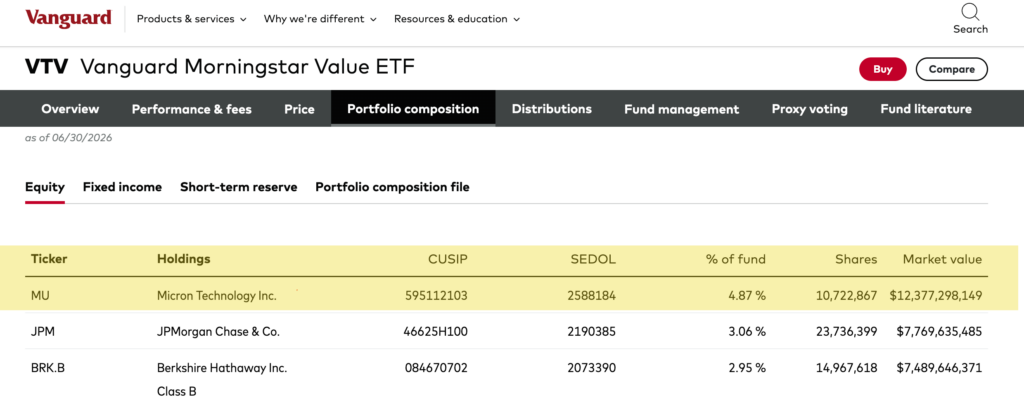
- Value fund: Micron ($MU) is the Vanguard Morningstar Value ETF’s ($VTV) top holding at about 4.9%. It was added based on traditional value screens, even though Micron’s earnings have been driven largely by AI-related memory-chip demand, not something typically associated with a value fund.
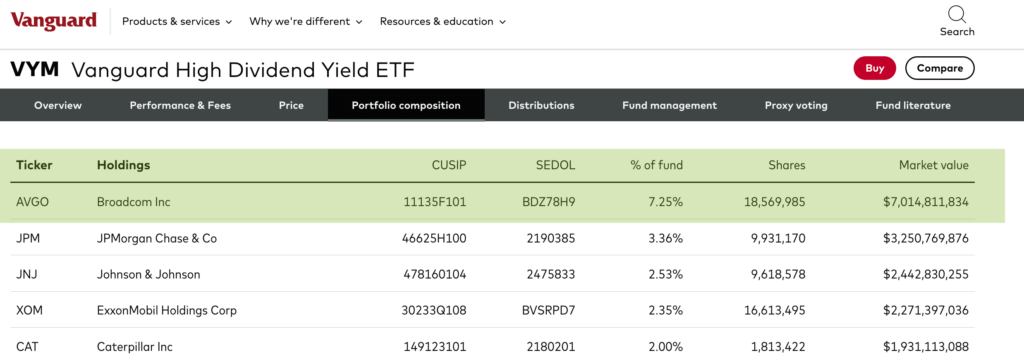
- Dividend fund: Broadcom ($AVGO) is the largest holding in the Vanguard High Dividend Yield ETF ($VYM) at about 7.3%. The stock has a 15-year track record of increasing its shareholder payout, although growth is increasingly coming from custom AI chips and AI networking, not the legacy chip business that built its dividend history.
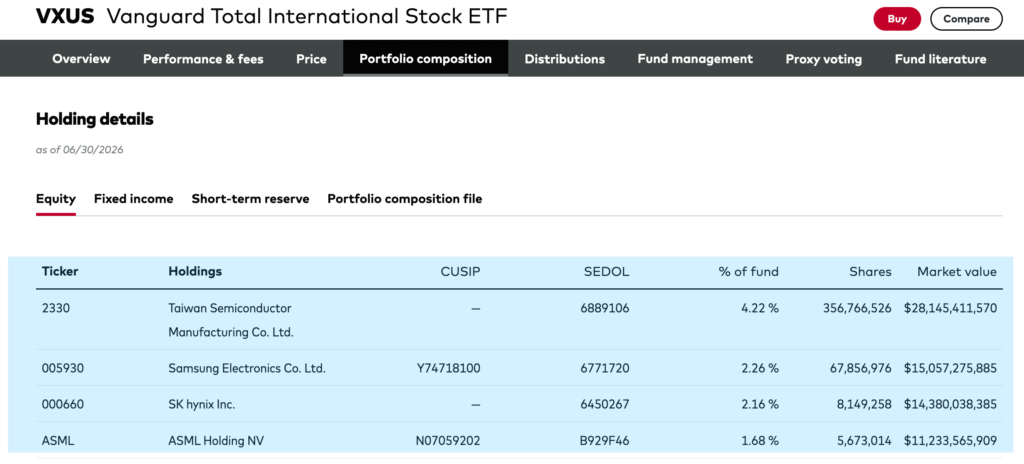
- International fund: The Vanguard Total International Stock ETF ($VXUS) holds sizeable shares of Taiwan Semiconductor ($TSM), Samsung Electronics, SK Hynix ($SKHY) and ASML ($ASML), meaning a “diversify abroad” allocation is basically concentrated in the same AI chip supply chain as U.S. tech funds.
- Target-date fund: Most major target-date series, such as Vanguard Target Retirement and Fidelity Freedom, build their U.S. equity sleeves on a total-market or S&P 500 index, so the same Nvidia/Microsoft/Apple concentration that shows up in ($SPY) or ($QQQ) runs straight through the “growth” portion of a 2050 or 2055 fund.
None of this means AI exposure is a mistake. After all, it’s been the single largest driver of index returns for the past three years. An investor who avoided AI entirely (which isn’t really possible, but work with me on this thought experiment) would have given up a big chunk of price appreciation during that time.
The question isn’t whether to own it, but whether your so-called diversified portfolio contains too much overlap and if your tech allocation is heavier than you know.
The S&P Workaround
There is a way to own the S&P 500 without overloading your portfolio with too heavy of an AI allocation, while also diversifying beyond large-cap U.S. equities.
The equal-weight S&P 500 index, which weights all 500 stocks the same rather than by size, is the standard alternative for investors who want index exposure without the concentration. You’d still have the usual gang of AI stocks, of course, but not in such large proportions.
