What Would a Blue-Wave Victory Mean for Asian Investors?

October was a brutal month for Asian equities. Virtually no market was spared.
What can we read into this broad selloff? The end of the year tends to be strong for stocks, but it will take a change in the narrative surrounding corporate debt levels and concerns about the profitability of Artificial Intelligence (AI) to turn things around.
And then we’ve got Tuesday’s elections. We’re likely set for a period of political stagnation in the U.S. Congress if the “blue wave” of Democratic victories manifests as the pollsters suggest.
I was a guest on the Money Talk podcast Tuesday with Peter Lewis. I dig into the implications on the show, aided and abetted by two U.S. experts, the veteran economist Barry Wood as well as Mark Michelson, the chairman of the Asia CEO Forum at IMA Asia.
You can find the episode of this show here on Spotify, should you for some reason want to listen to our dulcet tones.
Trump to Wash His Hands of ‘Losers’?
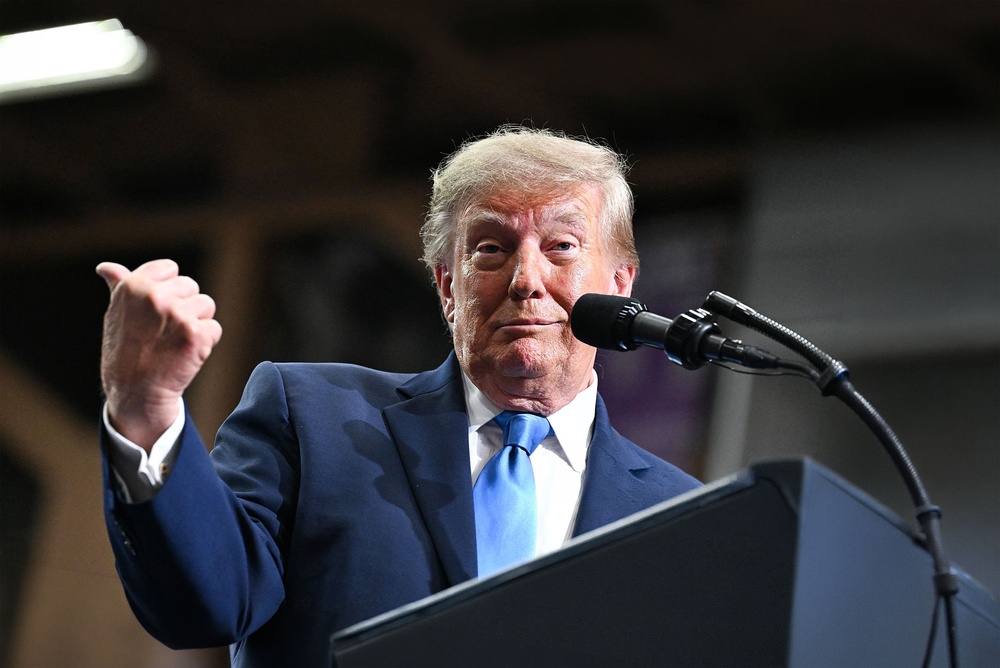
It was a vigorous conversation to say the least! One of my predictions is that U.S. President Donald Trump, who essentially only backs winners, will wash his hands of “losers” in these elections, and move on without putting up much of a fight. No January 6-style riots, no serious attempts to overturn the results. Trump was not on the ballot, after all, so he won’t take the results personally – even if he likely should.
It’s also possible Trump voters will come out who did not show up in polling, as has happened with Trump’s two presidential-election victories. More than likely, we will see Trump’s hands tied by opposition in one if not both chambers of Congress.
What do the results mean for investors in Asia? Well, a Democratic victory is likely a short-term headwind against stocks, and we may see some short-lived declines. It is likely, though, that markets will move higher heading into the new year.
Morgan Stanley’s head U.S. strategist, Mike Wilson, notes that the S&P 500 index may face a correction of around 9% from its last record high, down to 7,100. It’s at 7,571 as I write, up a slim 0.4% in early Tuesday trade.
After the “clearing event” of the midterm elections passes, he’s bullish about U.S. stocks, even against the backdrop of the conflict with Iran, and energy-supply disruption in the Middle East.
A 100% Record of Gains After Midterms
Wilson, in an interview with Bloomberg, pulls out a chart indicating that the S&P 500 is 100% positive six to 12 months after every midterm election since 1950.
Will we see Democratic pushback against AI? I say in the podcast that Democrats are certainly likely to make plenty of noise about regulating Artificial Intelligence, and I agree that it is foolish and dangerous to let the industry pretend to regulate itself. It will not. It only takes basic intelligence to work that out!
But it’s comical to see hearings on tech proceed. You have politicians who can probably barely manage their own email attempting to get their heads around cutting-edge science, the features of algorithms, autonomous workflows, multi-agent AI systems, toggleable “thinking,” generative healthcare, repository intelligence, quantum-AI hybridization, sovereign clouds …
I would expect plenty of “not in my back yard” knockback of data centers. It’s pretty easy and obvious to oppose a new AI “factory.” But by the same token, politicians do not want to be responsible for holding back an AI industry that promises true technological breakthrough. And who wants to be held to account if they stifle AI innovation, only to see China steal the momentum?
Speedbump for Asian Markets at Tough Time
So from the perspective of an Asian investor, these elections really represent a small speedbump. There’s already been an October correction that saw Indonesian stocks sell down 17.7%, in the form of the S&P Indonesia Broad Market Index. South Korean stocks, again looking at the S&P single-market index, corrected 16.6%. China was down 10.3%, Singapore off 7.6%, Taiwan down 6.4%, the Topix 150 in Japan off 3.8%.
It’s not been pretty. Indonesia has its own concerns, as I explain on October 22, contending with a potential double downgrade by index provider MSCI that would see it shifted from emerging-market to a “standalone market,” below even frontier-market status.
The rest of the turmoil has its roots in doubts surrounding an “AI bubble.” We have seen chipmakers sell down hard, with the Philadelphia Semiconductor Index down 21.9% since October 6, heading into Tuesday’s trade. While that captures U.S. chip stocks, the picture has been no different for the major Asian chipmakers.
Chipmakers Sell Down Hard
Taiwan Semiconductor Manufacturing Co. ($TSM) (TW:2330) is off 11.2% since October 6. SK Hynix ($SKHY) (KR:000660) is down 24.0% since October 2, with Samsung Electronics (KR:005930) giving back 20.5% in the same timeframe. That’s despite all three notching up record earnings and shocking profit margins, Hynix producing an 83% operating-profit margin at last count, and a net margin of 38%.
None of those companies really had anything of concern to report in their Q3 numbers. In fact, the companies have pre-sold next year’s production already, and Hynix says the structural shortage of chips will now last through 2030.
There is something of concern, however, in the figures released Friday from Kioxia Holdings ($KXIAY) (T:285A). The former Toshiba Memory unit, which at the chip-stock peak in June briefly became the largest company in Japan by market capitalization, gave a cautious forecast for its operating profit in the current quarter, indicating that prices for the NAND flash-memory products that it makes are leveling off.
It is likely, by the way, that Kioxia will sell U.S. shares to investors next year, much as Hynix did in July. The Tokyo-based company, listed in Japan in December 2024 by a Bain Capital-led consortium, is reportedly considering raising $10 billion with a Wall Street listing, likely in the June quarter after its fiscal year ends in March 2027.
The Big Concern in Kioxia’s Numbers
Kioxia says NAND flash memory prices rose in the mid-20% range for the quarter ending in September, down from a 70% increase the prior three months. Its ¥2.0 trillion ($12.7 billion) forecast for operating profit in the current quarter misses advance estimates of ¥2.35 trillion, causing the shares to plunge 24.3% on Friday and Monday.
There are some qualifiers. Kioxia may be being extra-cautious in its outlook. It also says it has sold all of its 2027 capacity. And customers brought forward sales that would normally have fallen into the December quarter into the numbers it just filed.
Kioxia also specializes purely in NAND and solid-state drives (SSDs). It does not make the DRAM chips that bolster the profits of the likes of Hynix and Samsung. Neither does it produce the high-performance High Bandwidth Memory (HBM) chips that act as the data superhighway for AI accelerators.
Tokyo’s markets are closed Tuesday for a public holiday. So we haven’t seen any rebound. But I indicated in my last column that any indication prices are slipping for NAND and DRAM chips would be a big concern, since they commoditized and do not normally experience the extremely fast price hikes we have seen this year.
As an indirect investor into most of these chipmakers via my largest holding, the Roundhill Memory ETF ($DRAM), I am particularly worried about the chip-price slowdown indicated by Kioxia.
Trump to Shift Focus to Summits?
We can also expect a temporary setback after these U.S. election results. I predict, though, that Trump will shift his focus to the November 18-19 APEC Summit in Shenzhen, just across the border from Hong Kong. The U.S. leader may meet with both Chinese President Xi Jinping and Russian President Vladimir Putin — apparently, two of Trump’s favorite people.
U.S. negotiators will also be looking at the G20 summit in Miami from December 10-12. With Xi almost certainly in attendance, it means Xi and Trump will have met in person five times since October 2025, when they first held a summit on the sidelines of the APEC summit in Busan, South Korea.
I’m betting the Trump team will have set their sights on a broader deal with China, hinted at by U.S. Treasury Secretary Scott Bessent in September during Xi’s state visit to Washington. The two-month extension of the trade-war truce on tariffs, pushing them through January 10, 2027, is designed to provide leverage during the Shenzhen and Miami meetings.
Will we see a “bigger deal, as opposed to a series of smaller things”? That’s where Bessent, and surely Trump, is holding out hope. If the midterm elections deal the Republication administration a blow, and deliver an antagonistic U.S. Congress, I expect to see Trump shift his attention to securing a “win” with a deal with China, and potentially Russia. I only hope he does not sell out U.S. allies like Taiwan and Ukraine in the process.
I hope and trust that markets can move past this October setback. I’m optimistic we are not in the early stages of a bubble explosion in AI stocks, but have instead experienced a resetting of expectations in October, clearing out what had become a very crowded trade.
There’s fear right now in chip and AI plays. I think chip stocks are solid holds for 2027, given that production has been pre-sold essentially all of next year. But last month has certainly shaken investor conviction in the Magnificent Seven, hyperscalers, chipmakers, the whole AI infrastructure call. I’m betting it can rebuild from this setback — but will pay the price on the likes of DRAM if I’m wrong.
At the time of publication, McMillan was long DRAM and TSM.
