Debunking the Core Bullish Argument That Strong EPS Equates to Strong Price Gains         

The investment mosaic is far more complicated than suggested by hosts, investment strategists, panelists and guests in the business media.

First-Level Thinking Vs Second-Level Thinking

Specifically, many distill the bullish argument to this: Since 2026 S&P EPS is expected to be about +20% (well above consensus expectations at the beginning of the year), the S&P price gains in 2026 should be about in line with that profit growth (or better). Candidly, that sort of distillation is the essence of “first-level thinking.”

First-level thinking is lazy, simplistic and superficial — it looks for simple formulas and easy answers.  To paraphrase Howard Marks:

  • First-level thinking says, “S&P EPS growth will be strong, let’s buy the market.”  
  • Second-level thinking says, “S&P EPS growth will be strong, but everyone knows it. Stocks are fairly or overpriced, let’s sell the market.” 

Most recent examples of when S&P EPS was better than expected and strong were in 2018 (+20.5% EPS growth, -6.6% decline in the S&P), 2006 (+16.7% EPS growth, +11.3% rise in the S&P), 2005 (+19.3% EPS growth, +8.8% rise in the S&P) and 2004 (+20.1% EPS growth, +4.2% rise in the S&P).

Going back, during the last 50 years — other 12-month periods with robust EPS growth and less-than-stellar to down S&P price include the years 1993, 1992, 1987, 1984, 1979 and others.

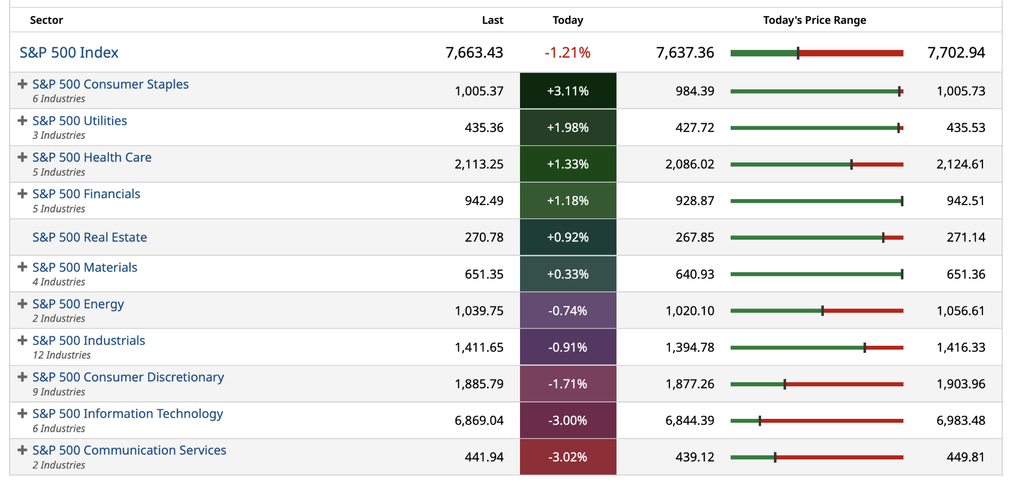
S&P 500 Index

Furthermore, I would argue that the backdrop of 2026-2027 offers unique market challenges relative to prior periods since 1975 (“it’s different this time”):

 *  High and rising inflation and interest rates.

*   A burgeoning deficit and U.S. debtload may be a permanent condition giving the general lack of discipline from both parties in Washington DC.

*   Improvisational geopolitical and fiscal policies that present threats to political and economic stability. 

*  Both parties are moving to extremes — the Republican party more to the right and the Democratic party to the left. With a possible Democratic congressional majority win in November, anti-corporate policy (higher corporate taxes, etc.) may be in the offing. 

*  Traditional valuation metrics in the 98%-tile and two standard deviations above the average.

* The AI capital spending spree and gains from investments have inflated S&P profit reports — as noted in my “More Tales From Nvidia” series an earnings reckoning may lie in the not too distant future. 

Bottom Line

Looking at any one variable (e.g. S&P EPS growth) to forecast S&P price is fatuous, simplistic, lazy and is contradicted by past investment returns data.

Stated simply, the correlation between S&P EPS growth and S&P price gains is a crutch and is not a reliable indicator.

The investment mosaic is far more complex than many present in the business media.

Position: Short SPY (VS)

Boockvar Wowed by Druckenmiller

From Peter Boockvar:

Wow

‘Wow’ was my reaction to reading Stan Druckenmiller’s opinion piece in the WSJ titled “Let the Bond Market Speak”, not in terms of the content as I agreed with everything he said but in the high profile, critical way he presented it. After all, he and Scott Bessent worked together for years. The piece also tells me again that Kevin Warsh is not on board either with the Treasury attempt to manipulate the long end of the yield curve. I say ‘again’ because Warsh himself has basically told us that he both wants the market to have more of a say in setting the cost of capital and he because we know he wants to shrink the size of the balance sheet and the Fed’s footprint in the market. And we know Warsh sat by the side of Druckenmiller for years prior to the new Fed Chair seat came available.

Here were some of the notable quotes from it in case you didn’t read it yet:

To the market’s immediate reaction with yields initially down and then right back up, “The market’s verdict was swift and correct: This wasn’t liquidity management, it was price management – and a mistake far larger than $4 billion suggests.”

“Treasury’s announcement gave the game away. It justified the larger operations as liquidity support in sectors with ‘consistent strong sponsorship from market participants,’ but strong sponsorship is the definition of a healthy, working market. There were no failed auctions, no dealer balance-sheet seizure, no forced unwinds, nothing resembling Treasurys in March 2020 or U.K. gilts in September 2022, the sort of genuine dysfunctional episodes that justify official action. Volatility was contained, and trading was orderly—not a malfunction but the machine doing its job.”

Believing that the long end wasn’t even fully pricing in where it should have been anyway, and that yields were actually “accommodative, not restrictive, of financial conditions” he said “The bond market wasn’t being a vigilante, as some would argue. It was being a pushover that had finally begun to clear its throat, and Treasury moved to quiet even that.”

Also this, “I have spent five decades trading on a simple premise: Markets aggregate information no committee possesses, and prices are how that information reaches decision makers. The long-term Treasury yield is the most important price in the world. It is also the only fiscal disciplinarian the U.S. has left.”

And the disease that is at the core of the problem, “Neither party will run on entitlement reform. Both have spent the past decade expanding commitments while ignoring arithmetic. Democracies don’t repair their finances because a budget office publishes a table. They repair them only when the cost of inaction becomes visible and immediate, when mortgage rates bite, when auctions tail, when the political price of a rising long bond finally exceeds the political price of touching spending.”

And to the real pushback against what Bessent did, “Every basis point of artificial yield suppression is a subsidy to procrastination. Suppressed long rates sugarcoat the interest-cost projections, shrink the apparent urgency, and let incumbents assure voters the debt is someone else’s problem. If Congress and the administration are unlikely to touch entitlements even with the market’s signal, they are certain not to touch them without one. Whatever this operation saves in basis points, it will cost multiples in delay.”

And to the timing of the operation, “Debt management that even appears to follow the political calendar spends the one asset that took two centuries to accumulate: the credibility of the Treasury market. That asset doesn’t regain its value so easily…Routine operations aren’t announced off-cycle, at double size, on the heels of the long bond’s hitting a two-decade high, with a signal that they can grow without limit. Judge an intervention by what it responds to. This one responded to a price, not to plumbing, which is exactly how the market read it, and why the effect evaporated within a day. You can’t buy your way out of a solvency conversation with liquidity tools. You can only postpone the conversation and raise the eventual price.”

Stan Druckenmiller’s bottom line, “Governments defending prices against fundamentals always lose. The only variable is how much they spend before conceding. The U.S. shouldn’t put itself on the wrong side of that trade, not with the most important price in the world, and not when that price is trying to say the one thing Washington most needs to hear: Let the bond market speak.”

https://www.wsj.com/opinion/let-the-bond-market-speak-81529d74

As I said, I agree with everything said here by Druckenmiller. I also argued last week that even if Bessent wanted to continue on this path, he picked a fight with a market that is much bigger than him and I’ll add that he’s not just pushing back against the US Treasury market but the JGB market too because we’ve seen over the past few years that what happens in the JGB market doesn’t stay in the JGB market.

I also want to highlight this, the experience of the Federal Reserve that has the true printing press and is never limited to raising money on one hand, to finance the purchases with the other. That printing capability when turned on we know too as QE. In March 2009 the Fed began with QE1 to further suppress long term interest rates after short rates were already at zero. They also engaged in the purchases of MBS as part of this. $300 billion of US Treasuries were bought (on top of $1.45 trillion of MBS and agency debt). What did long rates do in response, they went up instead of down.

QE2 was hinted at by Bernanke in August 2010 and after long term rates initially went down in response, when the purchases of $600 billion at $75 billion per month actually began that November and lasted until June 2011, long term rates again went up instead of down. It’s no coincidence that QE3 was called ‘QE Infinity’ rather than the Fed telling us what the end dates were for QE1 and QE2 which the market targeted.

Why did rates rise, against what the Fed wanted? Because the market priced in the believed reflationary nature of the operation.

Point is, just because a public official wants to push a price in a certain direction, the market will push back if they don’t believe the fundamentals support the move.

In the chart below, the white circle is around the time QE1 began and in red is around the August 2010 Bernanke QE2 speech.

Moving on.

Making anything that feeds into the building of a data center we know is a hot and needed product. Anyone producing it is doing well, company wise and country wise (think South Korea, Taiwan). Hong Kong too by the way as its July exports skyrocketed by 51% y/o/y and imports were higher by 41% driven by AI related products. Part of this though was easy comps too as last summer was still dealing with the aftermath of on and off tariffs sprayed around the world.

In Germany, the August IFO business confidence index was 88.8, up from 86.7 in the month before with both Expectations and the Current Assessment higher. IFO said succinctly and positively, “Despite another rise in energy prices, the Germany economy is recovering.”

Evidence that the manufacturing lift is global, “In manufacturing, the index rose noticeably.” Also, “In the service sector, the business climate improved” but, “While IT service providers were more confident about their future development, the situation in the transportation and logistics sector remains difficult.” The trade and construction components also rose.

Nothing market moving but the DAX is up .9%, bund yields are lower as is the euro after the recent bounce.

Positions: None.

Upside, Downside Movers in the Morning

Upside:

-KURA +12% (insider buys)

-RZLV +10% (selected by Google Cloud for blockchain data infrastructure)

-MAIR +7.0% (sells 90.1M Class A shares in $2.3B private placement at $24.97/shr)

-NVTS +6.0% (agrees to acquire AI data center power management company Claros for up to $232.8M in cash and stock deal)

-CAPR +5.6% (Oppenheimer Raised CAPR to Outperform from Perform, price target: $54)

-BE +5.1% (momentum)

-FOUR +4.1% (Wells Fargo Raised FOUR to Overweight from Equal Weight, price target: $59 from $55)

-VRT +3.2% (momentum)

-AMD +3.1% (Raymond James Raised AMD to Strong Buy from Outperform, price target: $641)

-DT +2.8% (Morgan Stanley Raised DT to Overweight from Equal Weight, price target: $65 from $58)

-CRWV +2.6% (signs collaboration with Rescale to add CoreWeave Cloud capacity to Rescale’s ecosystem for AI and simulation workloads)

Downside:

-DKS -18% (earnings, guidance)

-GRRR -9.5% (earnings, guidance)

-NKE -3.1% (lower in sympathy with DKS, Foot Locker business)

-VIPS -2.9% (earnings, guidance)

-NTR -2.0% (National Bank Cuts NTR to Sector Perform from Outperform, price target: $77)