Tweet of the Day

Positions: None
Positions: None
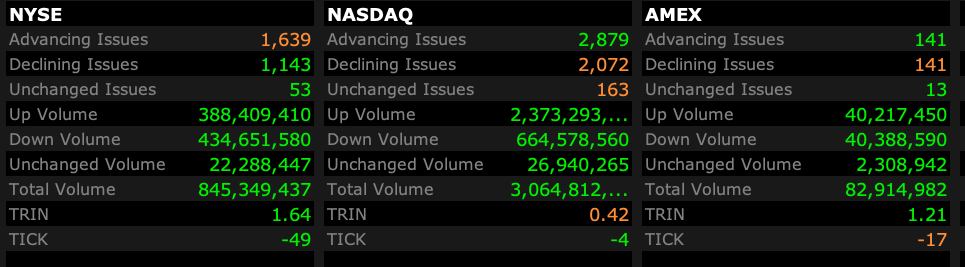
– NYSE volume 14% below its one-month average;
– Nasdaq volume 26% above its one-month average;
– VIX index: down 1.63% to 16.92
Positions: None.
* ARK’s Cathie Wood is touting $10 trillion of Starship revenue by 2020 after having loaded up in SpaceX’s shares…
I’m not superstitious about ya
But I can’t take no chance
I got me spinnin’, baby
You know I’m in a trance
‘Cause your love is better
Than any love I know
It’s like thunder and lightning
The way you love me is frightening
You better knock, knock on wood, baby
– Eddie Floyd , Knock On Wood
I no longer will watch Cathie Wood who is often platformed on Comedy Central (I mean CNBC!) and treated as credible without any pushback (despite having lost a record $13 billion in her ARKK ETF ($ARKK) for investors):
Short ARKK VS
The following is from Peter Boockvar:
In nominal terms, August retail sales were stronger than expected with the core rate of spend (ex autos, building materials, food and gasoline) rising 1.4% m/o/m, well better than the estimate of up .5% and follows a .4% drop in July.
Auto sales rose .6% m/o/m and by 1.7% y/o/y while the sales of building materials fell for a 2nd month, by .2%. After two months of declines, food/beverage sales rose .4% and sales at restaurants/bars were strong, rising by 1.2% m/o/m.
Elsewhere, online retail sales led the way and jumped 2.6% m/o/m and up 10.4% y/o/y. Sales gains of note were also seen in furniture, electronics (notwithstanding what MMM said), clothing, sporting goods, general merchandise which includes department stores, health/personal care, and misc which includes dollar stores, convenience stores, pet stores, etc…
Bottom line, retail sales were good, with some contribution from volume and the balance due to price.
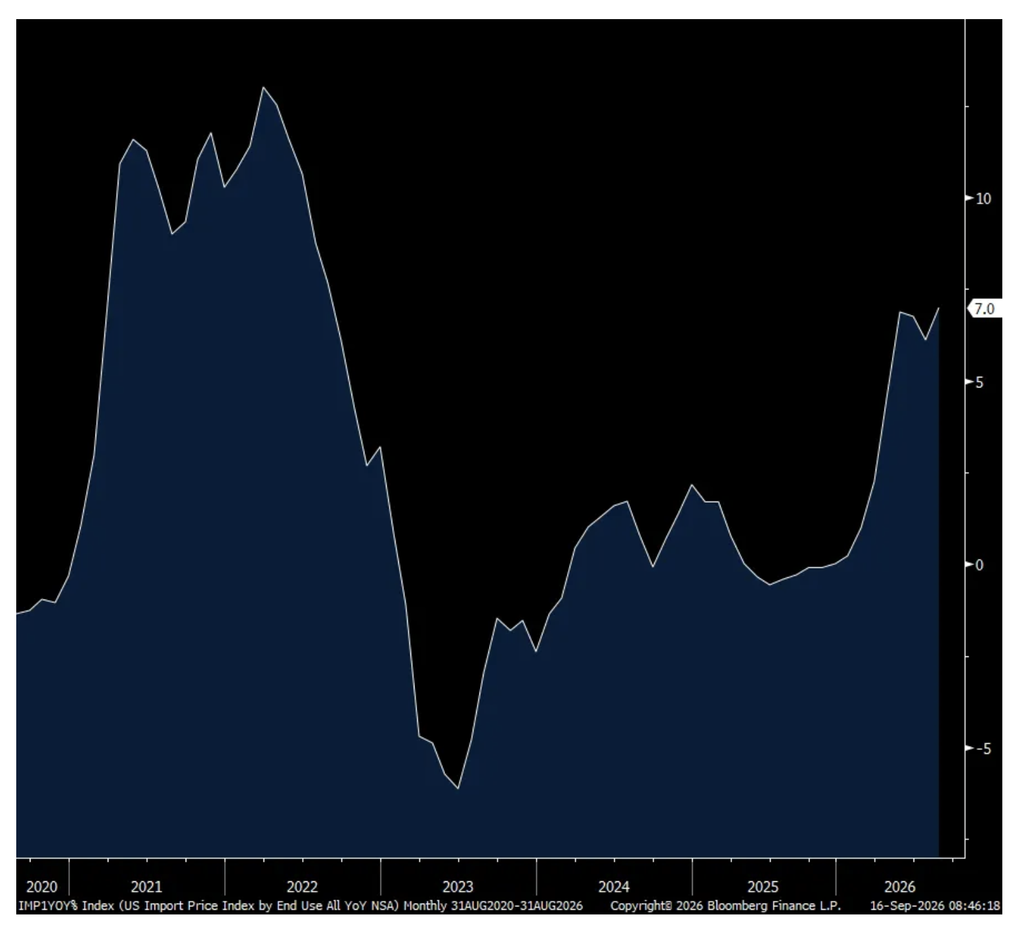
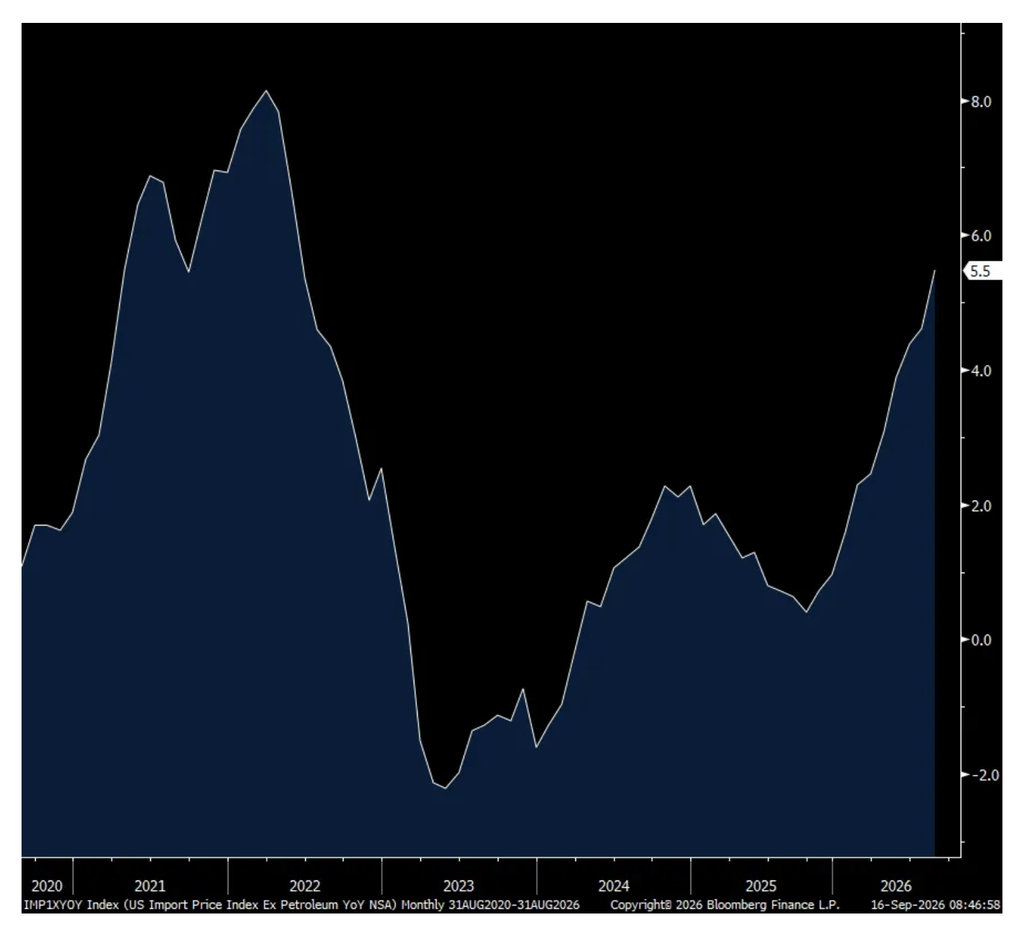
Inflation continues to rise with respect to import prices. They rose .7% m/o/m in August, two tenths more than expected and after a .3% drop in July. They are higher by 7% y/o/y. Ex petro saw prices jump by .8% m/o/m and 5.5% y/o/y. Taking out both fuel and food saw prices up by .8% m/o/m and 5.6% y/o/y.
The culprits in the rise in import prices outside of food and energy are from industrial supplies, up 2% m/o/m, capital goods up .9% and consumer goods ex autos higher by .5%. Auto import prices were flat.
Bottom line, I’m confident we have an inflation problem throughout the supply chain. I’m not confident that the Fed can do anything about it.
Import Prices y/o/y
Import Prices ex petro y/o/y
Position: None
* Ed Yardeni lowers his S&P forecast
* I have been challenging his optimism on twitter for months….
Strategist’s short term forecasts are always confidentally presented (Tom Lee and Ed Yardeni are good cases in point).
I call B.S. to their forecasts and confidence levels.
Positions: None.
The following is from Peter Boockvar:
I repeat my belief that I view today as more of a rate tweak more than anything as the bond market no longer waits around to the have the Fed set interest rates. It’s already been done.
Hat tip to my friend JJ Stanton for this stat yesterday, “Rolling 30d correlation: US 10Y vs WTI is the highest since 2019.”
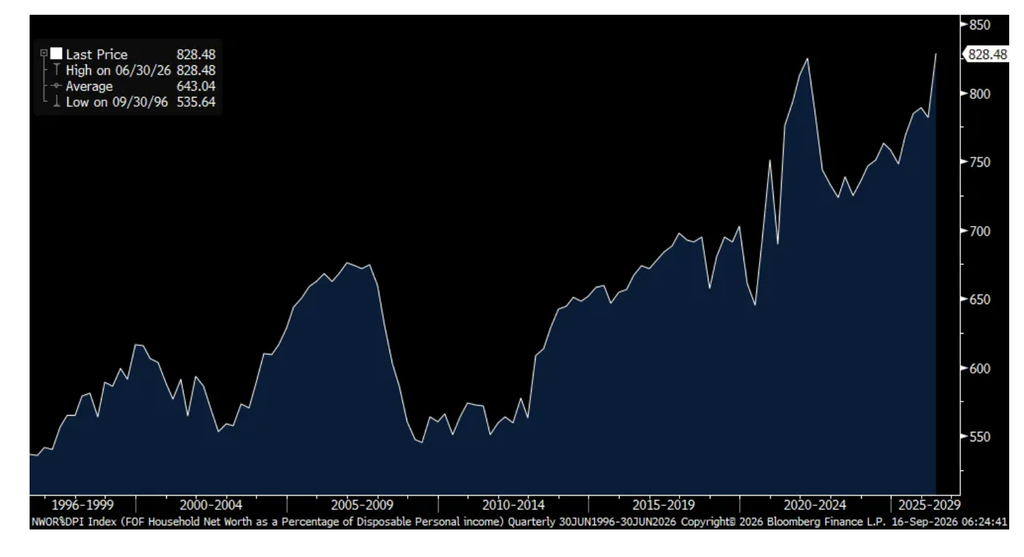
Something I touched upon the other day by highlighting the upper income consumer is a main source of economic growth and demand. By hiking interest rates the Fed is putting more money into their bank accounts via the money markets they own which now total almost $8 trillion. On the other hand, see the chart below (hat tip reminder to my friend David Rosenberg) of net worth as a percent of disposable income as of 6/30/26 in the quarterly Fed’s flow of funds data, it rose to a record high at 828%. You want to slow the demand side of upper income consumers in order to cool inflation? You reduce this ratio but of course that is something not anyone wants to see if it means asset prices fall. The better of course is that disposable income catches up.
Net Worth as % of Disposable Income as of 6/30/26
Who will get hurt from a rise in the fed funds rate? Those that pay SOFR+ on their loans via floating rate debt. Many included here are borrowers in all the private equity sponsored private credit loans. On Monday, Fitch updated its default rate data through August and it rose to 6.3% for the trailing 12 months, up from 6.1% in July and a record high for the short period they’ve been measuring this.
What’s so interesting is that we know the large software exposure is what created so much of the private credit angst a few months ago but according to Fitch, “The technology software sector continued to have the lowest default rate among the largest PCDR (private credit default rate) sectors at .6% in August, down from 1.2% in July 2026 and 2% in August 2025.”
Where the pain was? “Healthcare providers had the highest number of unique defaulters in the August TTM period.” It was at 9.9% and was joined by industrial and manufacturing with a similar default rate (and almost double the 5.2% default rate in August 2025). This was followed by consumer product companies at 8.7%, though down from 9.9% in July.
Bank CEO’s love to talk in nominal terms when discussing the rate of credit card spend they see. The CFO of Wells Fargo did it yesterday at the Barclays conference. “And I think when you look at the consumer side, I’ve stopped using this word resilient because it’s just strong. The activity levels have just been strong now consistently for a while. We see spend up across the debit and credit card products every week, year-on-year. Categories move around. Sometimes as oil or gas prices go up, it shifts a little bit in terms of the spending, but that’s still sort of like a 3% to 5% of spend depending on who you are. And so there’s still quite strong spending across the board, and it’s just not been changing really at all.”
Also, “We’re not seeing changes in delinquency trends that would sort of lead you to believe there’s more credit issues coming. Payment levels across the card space are quite high historically and not really changing. And I think as long as you’ve got the economy continuing to grow, call it 2%, 2.5% this year…you’ve got a really strong sort of employment picture with unemployment still quite low. You’ve got wages keeping up with inflation for the most part across most customer bases. And so it’s hard to see sort of what’s going to be the catalyst for that to change at this point.”
On the commercial side, they see “middle market type customers still being pretty cautious and prudent. We’re not seeing big increases in utilization across revolvers at this point.”
Dollar General spoke yesterday at the Goldman Sachs retailing conference and said this of note:
“What we’ve seen in this economy, and again not a surprise probably to anybody in this room, is we’ve seen a customer across all cohorts of income levels being somewhat distressed, especially in sustained inflation outside of gas prices, just basics. Then couple gas prices, and we’ve always said here at Dollar General for our core customer that anytime that gas price gets anywhere close to $4 and then crests $4 a gallon, the customer changes their shopping behavior, stays closer to home, normally shops more often, but buys less on each occasion. That’s exactly how that core customer is faring.”
“But the interesting thing with this economy, because of the other sustained headwinds of inflation over the years that have passed, even that middle to upper middle is acting more like a lower income shopper these days. And they have that same characteristic. That high income for us is that $100,000 plus crowd. I would tell you, we’re hearing more and more from them is I don’t feel like I’m higher income at $100,000 any longer because of all of the headwinds that I just mentioned.” I bolded to highlight.
Tech component inflation is negatively impacting the sales of consumer electronics according to MMMspeaking at a Morgan Stanley conference yesterday:
On consumer electronics, “we knew it was going to be weak, it has been weak. You see memory prices come up, devices are slow, PC’s, notebooks, tablets, phones – we know that was going to be down in the back end of the year.”
Anything touching data centers is of course strong. Elsewhere, “Auto is down about .5% on the build rate…We were up in Q2. We’re going to see some of that pressure here in the back end. But luckily, commercial vehicles, which we include in the auto portfolio was actually recovering pretty nicely.”
On pricing in response to inflation, “our agility on driving price is better. I think we’re more confident, we’re pushing it faster this year in responding to oil and the oil shock than we did last year responding to a tariff shock…So again, we’ll see a dollar-for-dollar offset on oil through price.” I bolded to emphasize.
With another rise in mortgage rates to around 7%, refi’s fell for a 4th straight week and by 8.8% w/o/w and by 65% y/o/y. Purchases were down .8% and by 19% y/o/y. The affordability noose unfortunately is getting tighter and the housing market needs lower prices in order to jumpstart more demand. That of course though disincentivizes the sellers and that’s the freeze going on in housing.
Ahead of the Bank of England meeting tomorrow where they are expected to keep rates unchanged, although you’ll see a bunch of dissents on that, August CPI rose 3.1% y/o/y as expected vs 2.9% in July. The core rate too was as forecasted at 2.6%, unchanged with July and again driven by services, up 3.4% y/o/y.
Price pressures are building on the wholesale side with PPI input costs up 6.1% y/o/y while output charges were higher by 3.7% y/o/y.
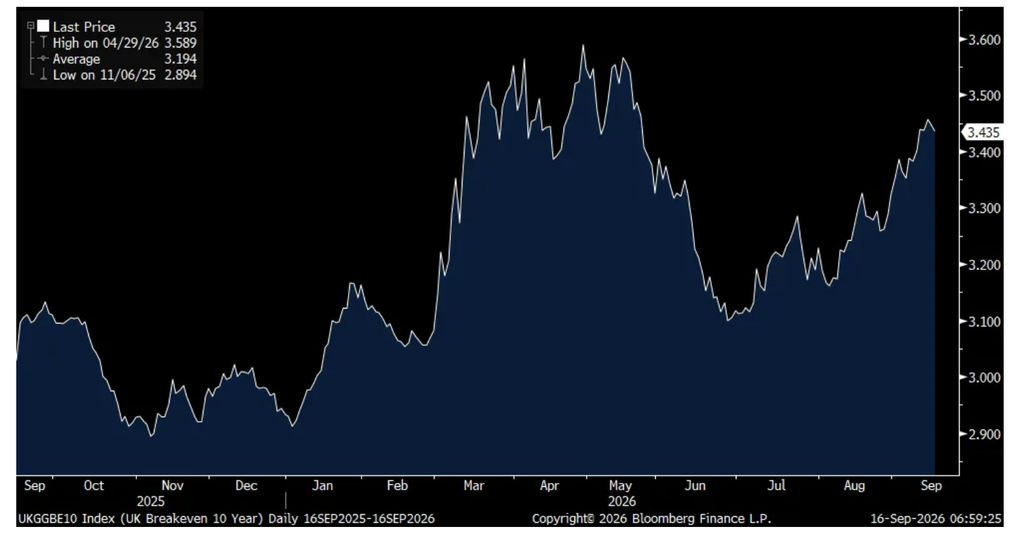
As there were no surprises, the 10 yr UK inflation breakeven is little changed at 3.44% and gilt yields are lower.
UK 10 yr Inflation Breakeven
Yesterday on CNBC, perma bull Dan Ives waxed enthusiastically about the new iPhone and Siri’s contribution.
I was going to respond in my Diary (but I got too busy!) that I have come to the exact opposite conclusion (I have a new 18 Pro Max).
The new phone functionalities suck – with little new:
Apple Finally Built a Smarter Siri. It Still Hasn’t Caught Up in the AI Race. – WSJ
Positions: Short AAPL VS.
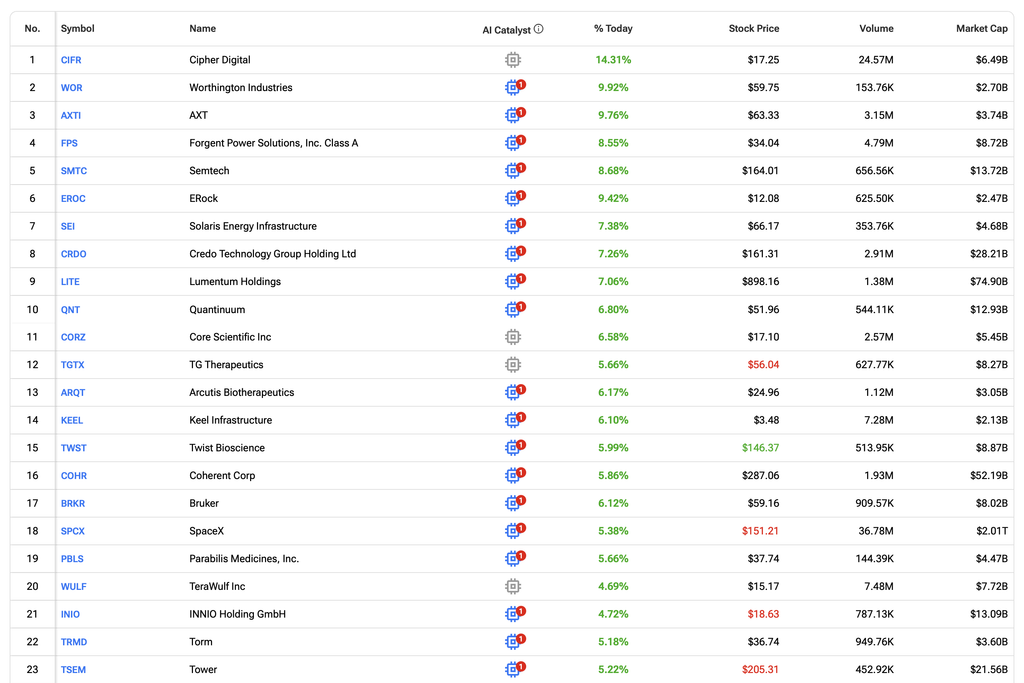
– MEDS +127% (acquires AI cancer-diagnostics laboratory and precision-oncology CRO businesses)
– TPST +39% (secures an exclusive option to license a clinical-stage CD7-targeted in-vivo CAR-T platform)
– YFOR +20% (reports estimated total assets of $38.0M and net assets of $25.2M as of June 30)
– WAFU +18% (AI intelligent-agent industrialization project passes review for a Hangzhou innovation program)
– LUXE +16% (Q4 sales and profitability improved, with top- and bottom-line growth expected to accelerate in FY27)
– JZXN +14% (AI intelligent-imaging platform advances through system validation toward commercial deployment)
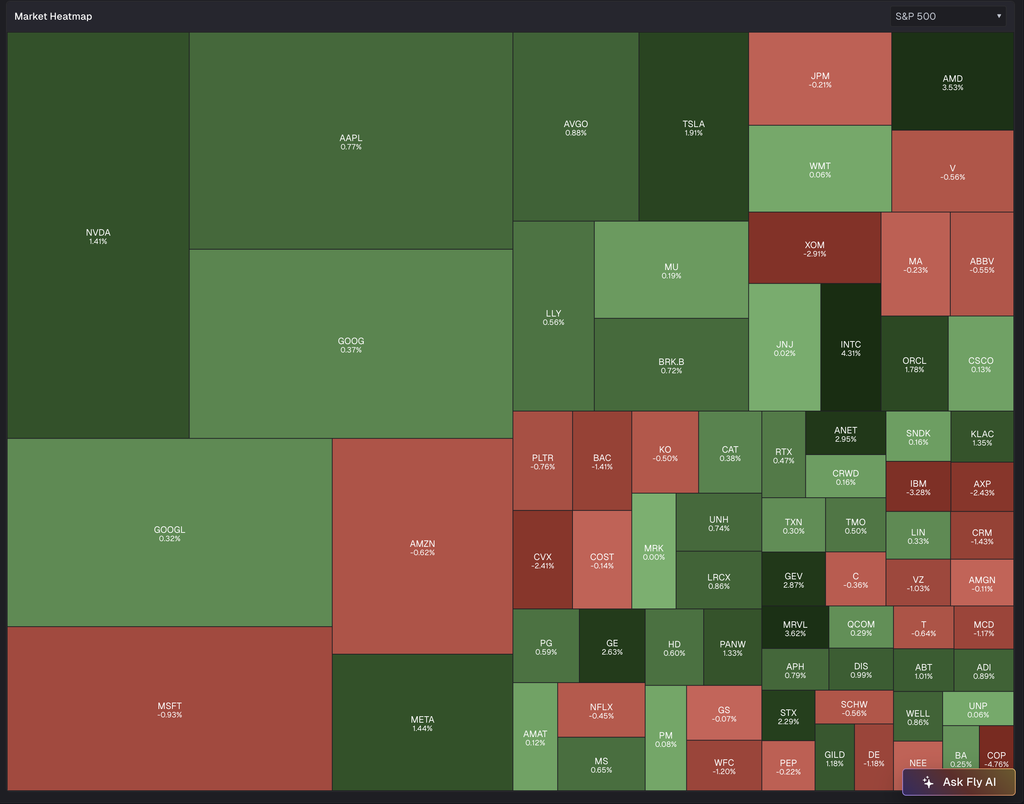
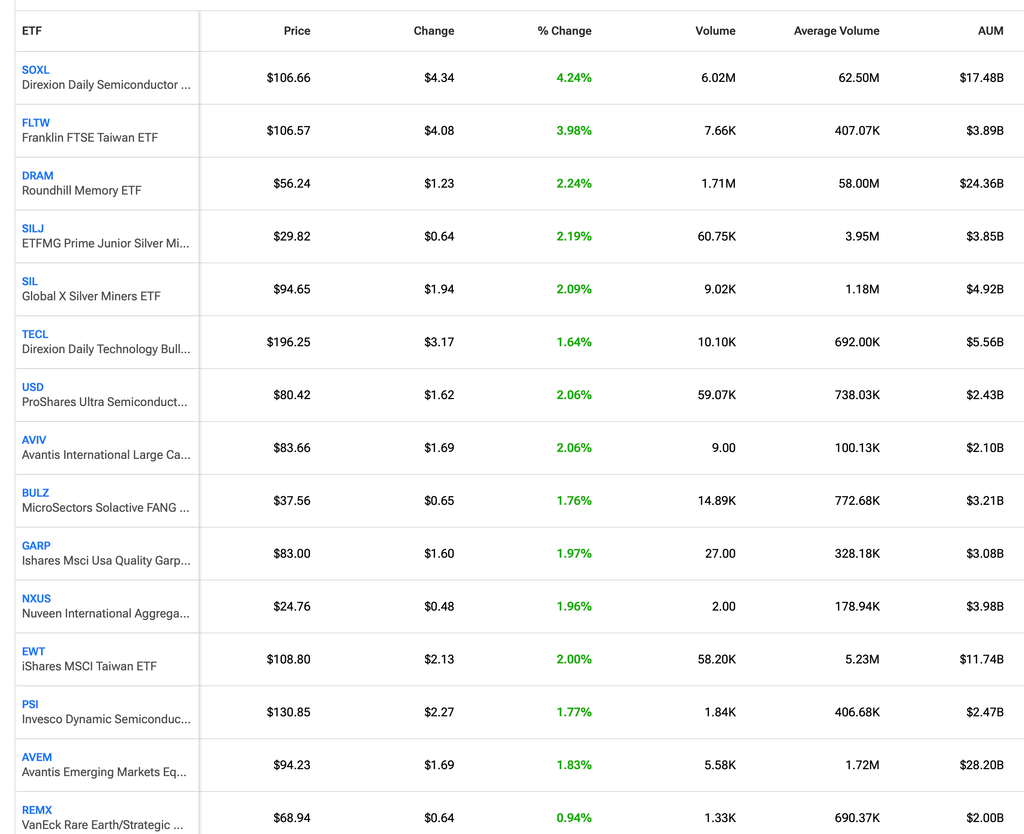
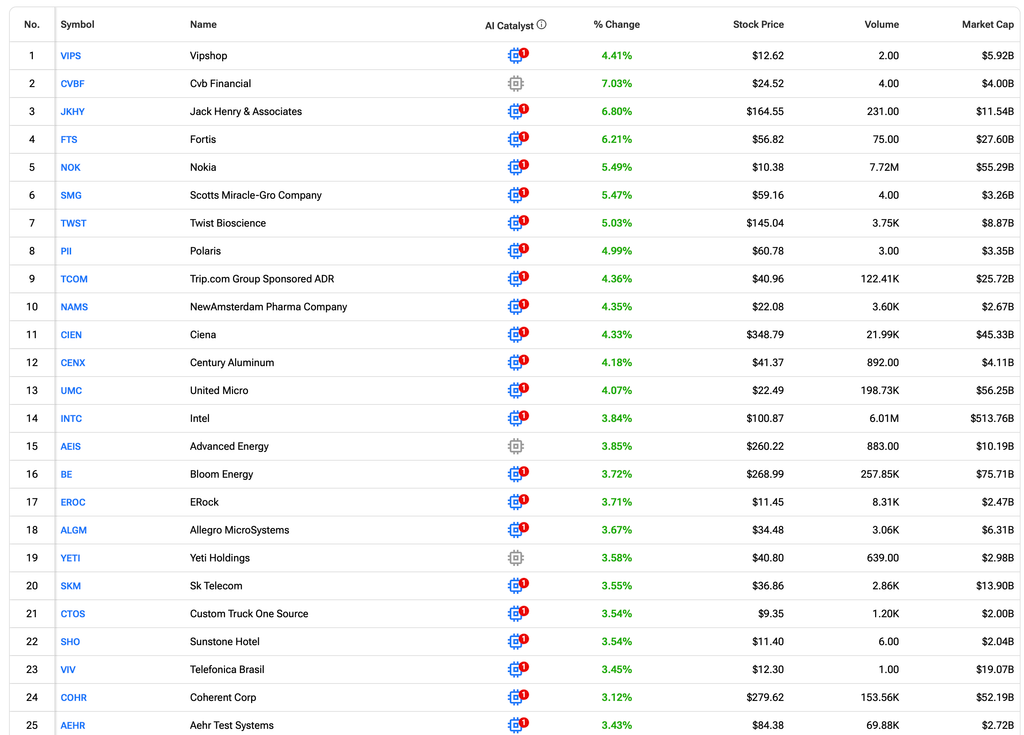
– CIEN +3.3%, COHR +3.1%, LITE +2.4%, MRVL +2.3%, DELL +2.5%, GLW +2.5% (AI-connectivity and data-center hardware names join a broader semiconductor rebound)
– INTC +3.5%, SKHY +33.3% (reported talks could bring memory-chip manufacturing to the U.S. through leased capacity or a joint venture)
– AMAT +1.9%, LRCX +2.1%, KLAC +2.1% (chip-equipment names gain on the prospective U.S. memory-capacity investment read-through)
– HCAI -20% ($2.75M registered direct offering adds equity supply)
– MYSZ -20% ($2.5M private placement creates dilution)
– CLLS -12% (extends weakness after Citizens downgrades to Market Perform)
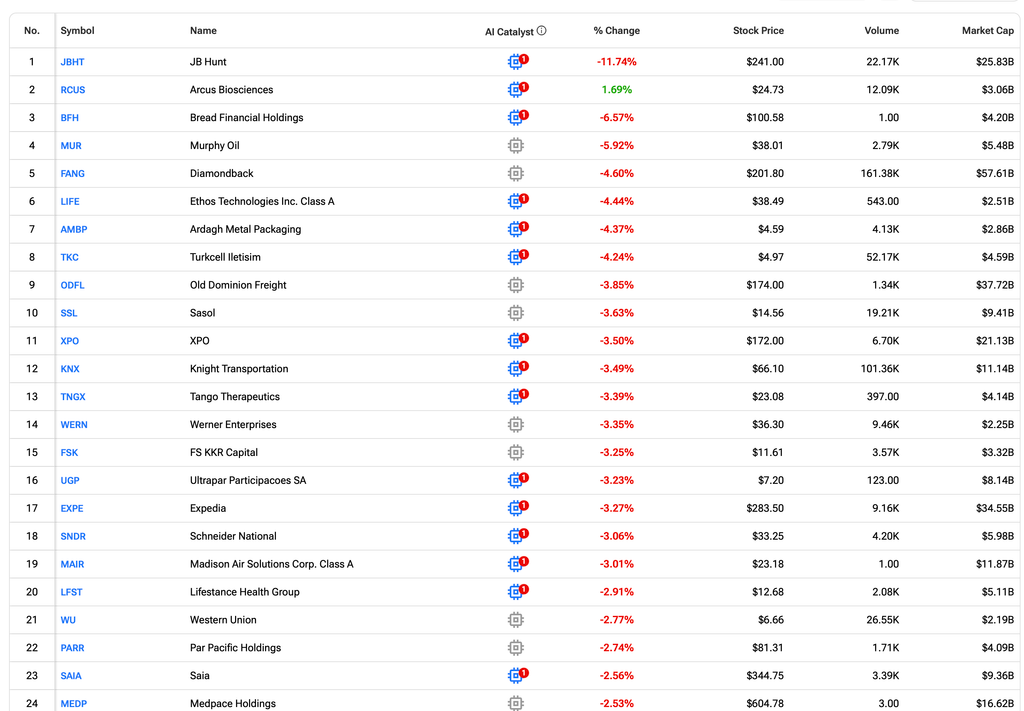
– JBHT -12% (conference comments indicated Q3 earnings could fall 5%-10% sequentially as purchased-transportation costs rise sharply)
– VEEA -4.6% (profit-taking after the prior session’s triple-digit surge)
– FANG -4.7%, EOG -2.1% (oil producers retreat as crude reverses lower; FANG also faces a newly reported 75,000-share director sale)
– EXPE -2.8% (European regulatory concerns focus on online-travel market concentration)
– SAIA -2.2%, ODFL -3.6% (freight peers fall on the JBHT cost-inflation and sequential-earnings read-through)
Source: TipRanks
Source: TipRanks