$100,000 Just Isn’t What It Used to Be

The following is from Peter Boockvar:
This day has finally come/”I don’t feel like I’m higher income at $100,000 any longer”
I repeat my belief that I view today as more of a rate tweak more than anything as the bond market no longer waits around to the have the Fed set interest rates. It’s already been done.
Hat tip to my friend JJ Stanton for this stat yesterday, “Rolling 30d correlation: US 10Y vs WTI is the highest since 2019.”
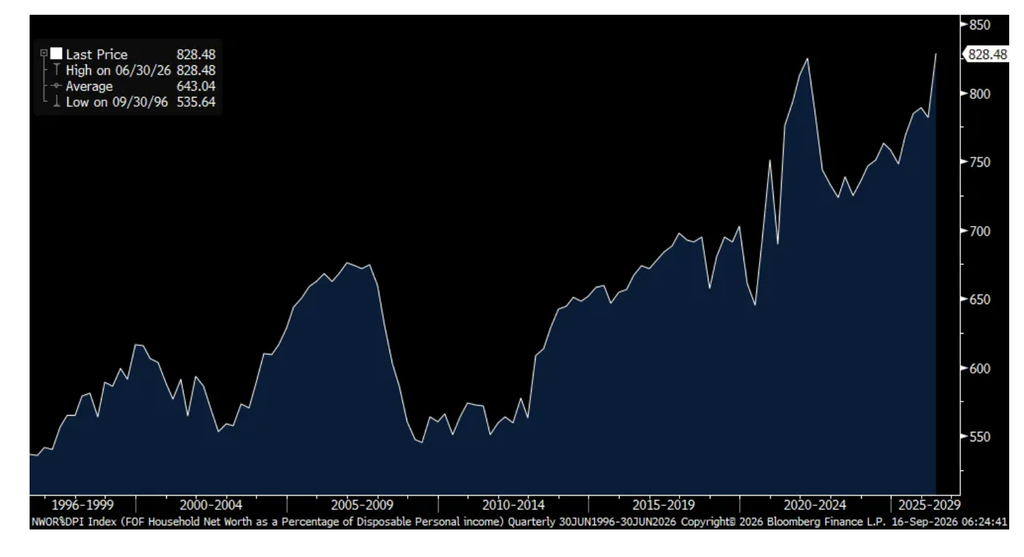
Something I touched upon the other day by highlighting the upper income consumer is a main source of economic growth and demand. By hiking interest rates the Fed is putting more money into their bank accounts via the money markets they own which now total almost $8 trillion. On the other hand, see the chart below (hat tip reminder to my friend David Rosenberg) of net worth as a percent of disposable income as of 6/30/26 in the quarterly Fed’s flow of funds data, it rose to a record high at 828%. You want to slow the demand side of upper income consumers in order to cool inflation? You reduce this ratio but of course that is something not anyone wants to see if it means asset prices fall. The better of course is that disposable income catches up.
Net Worth as % of Disposable Income as of 6/30/26
Who will get hurt from a rise in the fed funds rate? Those that pay SOFR+ on their loans via floating rate debt. Many included here are borrowers in all the private equity sponsored private credit loans. On Monday, Fitch updated its default rate data through August and it rose to 6.3% for the trailing 12 months, up from 6.1% in July and a record high for the short period they’ve been measuring this.
What’s so interesting is that we know the large software exposure is what created so much of the private credit angst a few months ago but according to Fitch, “The technology software sector continued to have the lowest default rate among the largest PCDR (private credit default rate) sectors at .6% in August, down from 1.2% in July 2026 and 2% in August 2025.”
Where the pain was? “Healthcare providers had the highest number of unique defaulters in the August TTM period.” It was at 9.9% and was joined by industrial and manufacturing with a similar default rate (and almost double the 5.2% default rate in August 2025). This was followed by consumer product companies at 8.7%, though down from 9.9% in July.
Bank CEO’s love to talk in nominal terms when discussing the rate of credit card spend they see. The CFO of Wells Fargo did it yesterday at the Barclays conference. “And I think when you look at the consumer side, I’ve stopped using this word resilient because it’s just strong. The activity levels have just been strong now consistently for a while. We see spend up across the debit and credit card products every week, year-on-year. Categories move around. Sometimes as oil or gas prices go up, it shifts a little bit in terms of the spending, but that’s still sort of like a 3% to 5% of spend depending on who you are. And so there’s still quite strong spending across the board, and it’s just not been changing really at all.”
Also, “We’re not seeing changes in delinquency trends that would sort of lead you to believe there’s more credit issues coming. Payment levels across the card space are quite high historically and not really changing. And I think as long as you’ve got the economy continuing to grow, call it 2%, 2.5% this year…you’ve got a really strong sort of employment picture with unemployment still quite low. You’ve got wages keeping up with inflation for the most part across most customer bases. And so it’s hard to see sort of what’s going to be the catalyst for that to change at this point.”
On the commercial side, they see “middle market type customers still being pretty cautious and prudent. We’re not seeing big increases in utilization across revolvers at this point.”
Dollar General spoke yesterday at the Goldman Sachs retailing conference and said this of note:
“What we’ve seen in this economy, and again not a surprise probably to anybody in this room, is we’ve seen a customer across all cohorts of income levels being somewhat distressed, especially in sustained inflation outside of gas prices, just basics. Then couple gas prices, and we’ve always said here at Dollar General for our core customer that anytime that gas price gets anywhere close to $4 and then crests $4 a gallon, the customer changes their shopping behavior, stays closer to home, normally shops more often, but buys less on each occasion. That’s exactly how that core customer is faring.”
“But the interesting thing with this economy, because of the other sustained headwinds of inflation over the years that have passed, even that middle to upper middle is acting more like a lower income shopper these days. And they have that same characteristic. That high income for us is that $100,000 plus crowd. I would tell you, we’re hearing more and more from them is I don’t feel like I’m higher income at $100,000 any longer because of all of the headwinds that I just mentioned.” I bolded to highlight.
Tech component inflation is negatively impacting the sales of consumer electronics according to MMMspeaking at a Morgan Stanley conference yesterday:
On consumer electronics, “we knew it was going to be weak, it has been weak. You see memory prices come up, devices are slow, PC’s, notebooks, tablets, phones – we know that was going to be down in the back end of the year.”
Anything touching data centers is of course strong. Elsewhere, “Auto is down about .5% on the build rate…We were up in Q2. We’re going to see some of that pressure here in the back end. But luckily, commercial vehicles, which we include in the auto portfolio was actually recovering pretty nicely.”
On pricing in response to inflation, “our agility on driving price is better. I think we’re more confident, we’re pushing it faster this year in responding to oil and the oil shock than we did last year responding to a tariff shock…So again, we’ll see a dollar-for-dollar offset on oil through price.” I bolded to emphasize.
With another rise in mortgage rates to around 7%, refi’s fell for a 4th straight week and by 8.8% w/o/w and by 65% y/o/y. Purchases were down .8% and by 19% y/o/y. The affordability noose unfortunately is getting tighter and the housing market needs lower prices in order to jumpstart more demand. That of course though disincentivizes the sellers and that’s the freeze going on in housing.
Ahead of the Bank of England meeting tomorrow where they are expected to keep rates unchanged, although you’ll see a bunch of dissents on that, August CPI rose 3.1% y/o/y as expected vs 2.9% in July. The core rate too was as forecasted at 2.6%, unchanged with July and again driven by services, up 3.4% y/o/y.
Price pressures are building on the wholesale side with PPI input costs up 6.1% y/o/y while output charges were higher by 3.7% y/o/y.
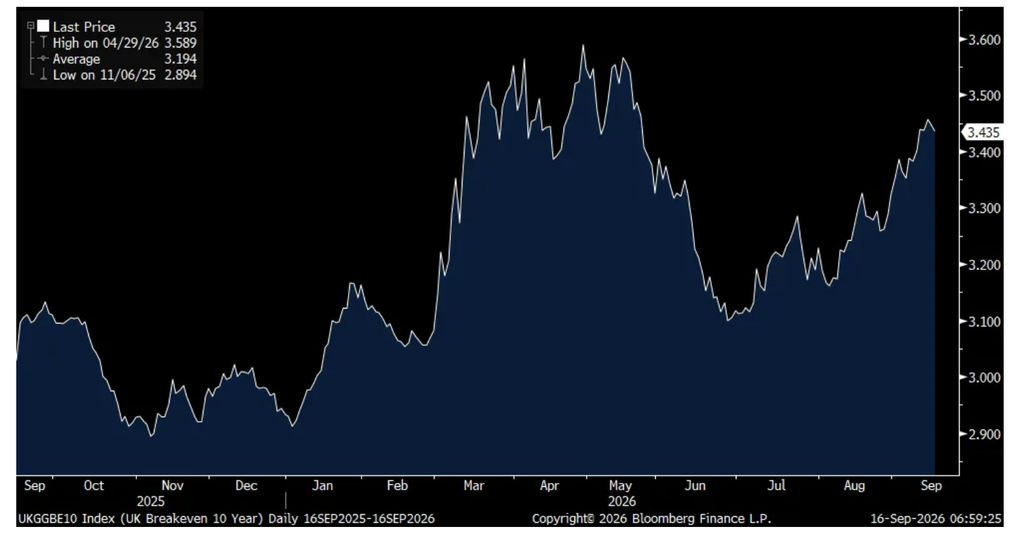
As there were no surprises, the 10 yr UK inflation breakeven is little changed at 3.44% and gilt yields are lower.
UK 10 yr Inflation Breakeven