Why the Debt Will Do Us In


The markets hit some turbulence last week with technology leading equities down. The Nasdaq fell nearly 3% on the week. Tensions flared again in the Middle East as escalation took a nasty turn. U.S. forces expanded their target list to telecommunication towers in retaliation for Iranian interference with some ships trying to navigate the Strait of Hormuz. Iran hit U.S. military bases throughout the gulf region and also damaged a major desalination plant in Kuwait. WTI oil spiked 15% on the week and four dollar a gallon gasoline feels like it is around the corner again. Prospects for fully restoring traffic through this global choke point feel slimmer than they have been for some time.
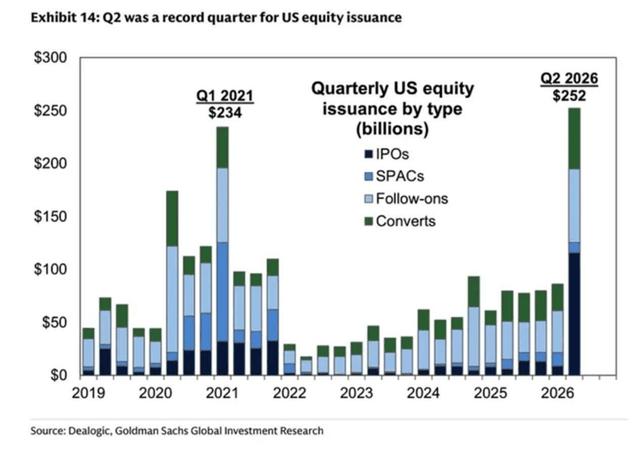
Fears around much cheaper Chinese AI models continued to increase last week with the launch of Moonshot. Chinese AI players have made considerable progress in gaining token utilization market share in recent months. If investors start to worry more about these potential impacts to Anthropic’s and OpenAI’s business models and long-term profitability aspirations, the AI bubble could start to become a house of cards. The two companies have over $1 trillion in future compute commitments to the likes of Oracle ($ORCL) and Alphabet ($GOOG). Roughly half of AI data center capacity is being built for Anthropic and OpenAI. Both of them hope to IPO in coming quarters and raise tens of billions of dollars of funding.
James Carville’s famous quip, “it’s the economy, stupid,” rings frequently in my ears these days, with one modification: “It’s the debt, stupid.” That sums up my No. 1 fear around the economy and the markets right now. S&P Global downgraded Oracle’s debt to one notch above junk this month. Oracle’s debt load now stands at north of $120 billion after rising 43% in its recently completed fiscal year. Most of this has been added for the compute capacity Oracle is building, notably for OpenAI. The companies signed a five-year $300 billion agreement last summer.
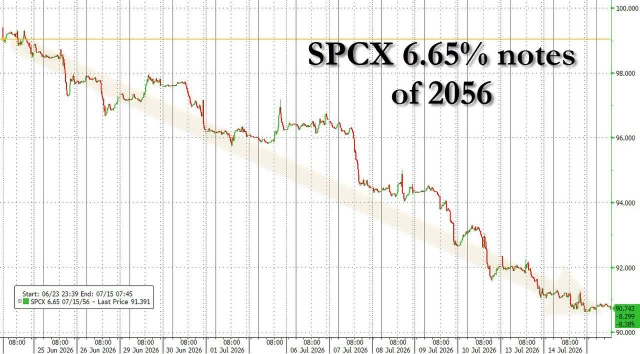
Space Exploration Technologies Corp. ($SPCX) is now trading below its IPO price and has eviscerated nearly $1.2 trillion of market valuation from its post IPO Peak. The debt issued in a $25 billion bond deal soon thereafter has started to trade quite poorly as well. Another sign that the credit markets are starting to choke on all the debt and equity issuance from the technology titans.
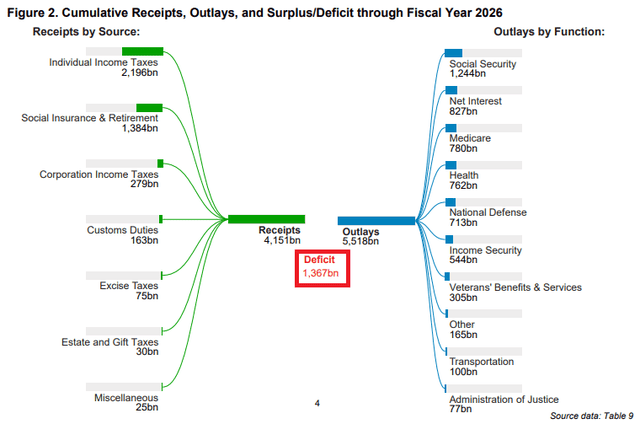
Then we have the roughly $40 trillion in federal debt and yawning fiscal deficit. The U.S. now spends well north of $1 trillion annually to service that debt, and it should soon be the largest line item in the federal budget. The need to constantly refinance this growing debt load is pushing interest rates higher, along with a more elevated inflation level. The yield on the 30-Year treasury is around 5.05%, its highest level since 2007. The 10-Year treasury yield is at 4.55%.
Ironically both treasury yields are notably higher than when they were in September 2024, when the Federal Reserve started to cut the Fed Funds rate — by a cumulative 1.75 percentage point to date. The same goes for mortgage rates. This is a key reason housing activity is moribund for the fourth-straight year now. I don’t think investors have priced in that interest rates are going to remain ‘higher for longer’ within their investment views.
Higher interest rates is the last thing the commercial real estate market needs as well. There is approximately $5 trillion CRE debt outstanding. The delinquency rates on commercial mortgage-backed securities, or CMBS, has moved from under 2% at the start of 2022 to around 7.5%. CMBS delinquency rates against office properties are higher than they were at the peak of the Great Financial Crisis. Multi-family is growing more problematic, and these two property sectors account for roughly 70% of CRE debt outstanding. Nearly $1 trillion of CRE debt matures between now and year end 2027. And at significantly higher rates than the zero-interest-rate era following Covid. Then there is the near $2 trillion private credit market where another cockroach seems to emerge every few weeks.
So, while the war in Iran and the AI narrative will continue to dominate headlines, it is the burgeoning debt levels that deserves more focus.
At the time of publication, Jensen had no position in any security mentioned.
