The Best Argument to Buy Alphabet and Meta Now


Here’s why I initiated a position in Alphabet and added to Meta after their selloffs.
Here’s why I initiated a position in Alphabet and added to Meta after their selloffs.
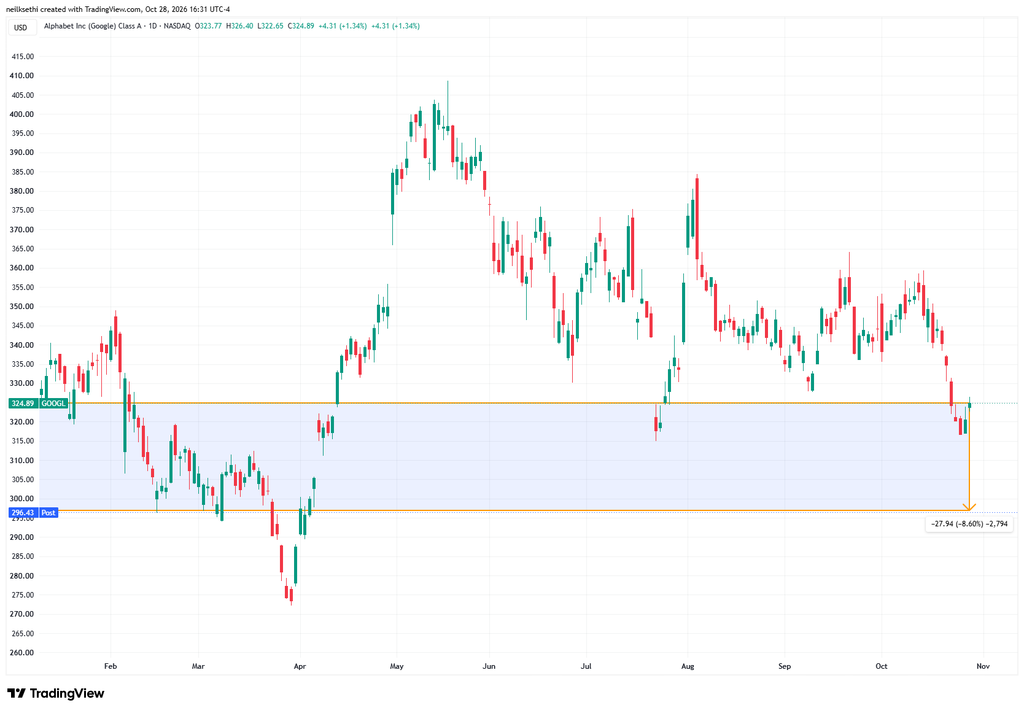
Just opened a small position in $GOOG at $280. There is good support near $271, so I see it as a high-reward, low-risk opportunity. Now that the stock has dropped 13% today and nearly 30% since May, GOOG is reasonably valued.
We also added to our initial position in $META, and now have a cost basis of about $630 in that stock. This plan was laid out in a previous article.
Writing up GOOG and META with charts and explanations now, article to follow tomorrow morning.
Alphabet ($GOOGL) shares are down over 8% in after-hours trading Wednesday after third-quarter revenue and earnings missed expectations, and a blowout quarter from Google Cloud was overshadowed by softer core advertising which heightened concerns about its search business, and a swing to negative free cash flow.
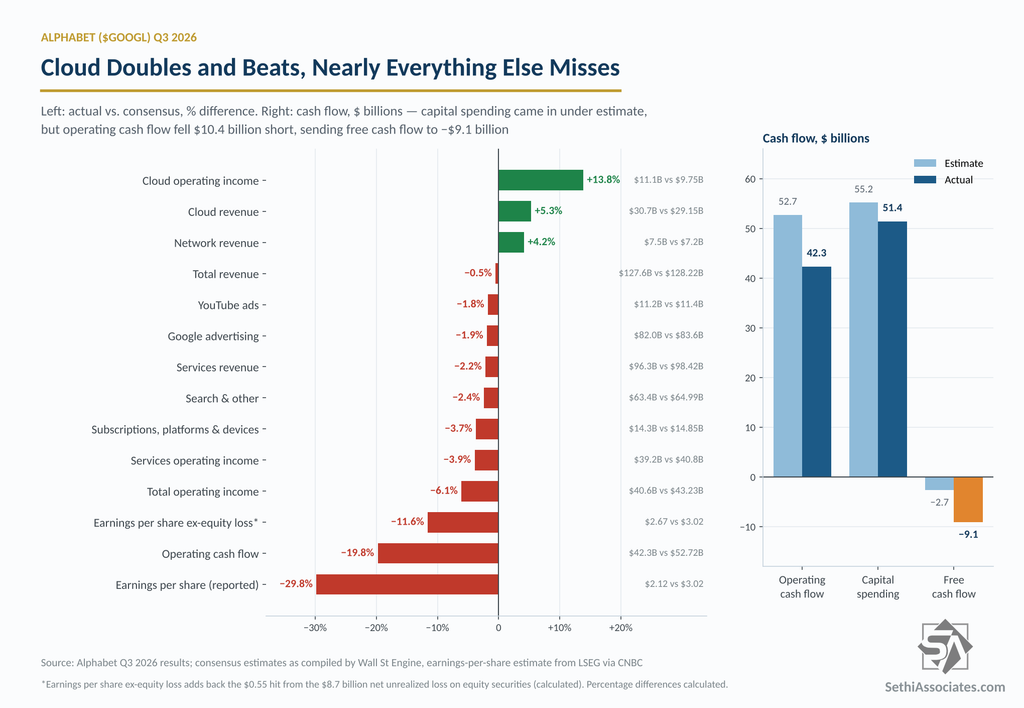
Revenue climbed 24.7% year over year to $127.58 billion, missing expectations of $127.96 billion, according to TipRanks.
Earnings came in at $2.12 a share against the $3.02 consensus estimate. Much of that gap came from about $8.66 billion in losses on stakes Alphabet holds in other companies, which cut 55 cents from earnings per share after taxes. Without that hit, earnings would have been about $2.67 a share, still short of the estimate. That marks a sharp reversal from the second quarter, when other income was a $98.0 billion gain, mostly from gains on its equity holdings that added $6.26 to earnings per share, according to the company’s second-quarter release.
Cloud was the standout. Google Cloud revenue more than doubled to $30.7 billion from $15.16 billion a year earlier, topping the $29.15 billion analysts expected, per TipRanks. The unit’s $11.1 billion in operating income puts its margin at about 36%. The company said its custom-chip business was a “meaningful contributor to revenue growth.”
The rest of the business was mixed. Search revenue rose 12% to $63.35 billion but missed the $64.96 billion estimate, according to CNBC. “This may be the quarter we feared,” Gil Luria from D.A. Davidson told CNBC’s MacKenzie Sigalos
YouTube ad revenue of $11.21 billion fell short of the $11.5 billion Wall Street expected, per TipRanks. Subscriptions, platforms and devices revenue grew 11% to $14.29 billion. Cloud revenue has now climbed past YouTube’s ad revenue, per TipRanks’ segment data.
Operating income still grew 30% to $40.58 billion, even as research and development spending jumped to $20.64 billion from $15.15 billion, TipRanks noted. That operating income figure missed the $43.19 billion FactSet forecast, though, per CNBC.
Cash flow was the sore spot. Capital expenditures more than doubled to $51.36 billion from $23.95 billion a year earlier, and free cash flow fell to negative $9.07 billion, against the negative $2.70 billion analysts expected, according to CNBC. Alphabet bought back no stock in the quarter.
“Google Cloud revenues grew 103%, powered by huge demand for our AI infrastructure and AI solutions,” CEO Sundar Pichai said in the earnings release. He added that the Gemini app has reached 1 billion users, making it the company’s fastest-growing product ever.
I’ll put an update out in the morning if anything notable comes out on the call.
As we await the Anthropic IPO, the Fed and the possibility of renewed Iran fighting, I’m taking the path of Buffett.
This new inflection point might just be the pin that finally pops the AI bubble.
Blowout SpaceX results lifted a swath of AI names, sending the Nasdaq up over 1%.
We’re seeing equity valuations collapse for semiconductor stocks, and bond yields for CoreWeave soar to distressed levels. Is the AI bubble bursting?
The S&P notched its first record close since August on a continued broadening as Treasury yields remained subdued. The Nasdaq added a second straight record, but small-caps gave up an early gain.
Treasury yields reversed from two-decade highs, helping stocks recover morning losses as gains broaden beyond Tech, but higher oil prices remained a headwind.
A cooler-than-expected core PCE lifted stocks early, but a rebound in yields and a sharp final-hour selloff left the Nasdaq as the lone gainer on the day and month.