3 Short-Circuiting Charts: CoreWeave, Nvidia, Palo Alto


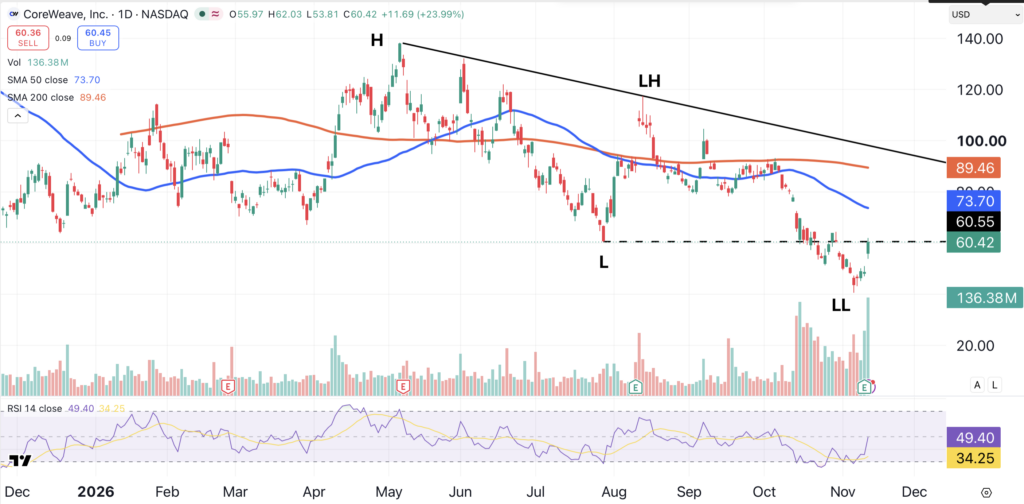
CoreWeave ($CRWV) brought relief to the AI trade on Wednesday. The stock bounced 24% after reporting strong revenue and a narrower-than-expected loss in its third quarter, and raising its guidance for the full year.
CoreWeave’s news was welcomed by the markets, especially by tech stocks. The Nasdaq Composite gained 1.6% on the news, and many of the top AI names were the biggest beneficiaries. Sandisk ($SNDK) gained 13% and Micron climbed nearly 12%.
CoreWeave has made a rebound to a former support level (dotted line), an area that also marked the stock’s breakdown from a descending triangle. It could rally further, but ultimately the stock’s pattern of lower-highs (LH) and lower-lows (LL) dominates the chart. I wouldn’t be a buyer here.
Charts by TradingView
Despite Wednesday’s ferocious rally, CoreWeave is still down 22% year-to-date. That was before the stock fell after the closed, due to CoreWeave’s relationship with Nvidia.
What About Nvidia?
Many investors think of Nvidia and CoreWeave as close relatives. Nvidia owns nearly 13% of CoreWeave, and invested $2 billion in the company’s infrastructure buildout earlier this year.
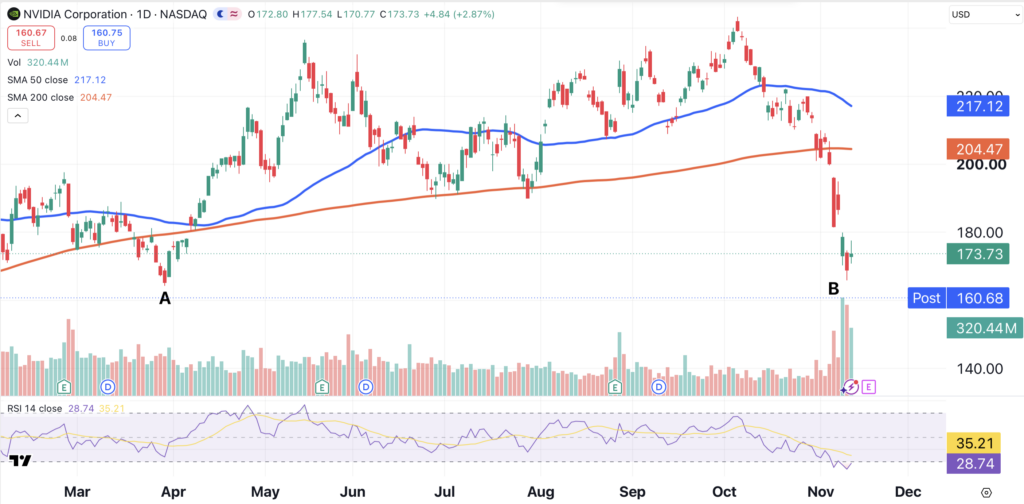
Technically, Nvidia was forming a double bottom (points A and B). It actually looked like a promising setup.
Then the news broke after the close that CEO Jensen Huang reportedly had another affair, and that the Nvidia board was planning to oust him. The stock declined to $160, breaking support.
Nvidia’s Jensen Huang had a reputation as a “rock star” CEO. He was an obvious target for a honeypot. According to reports, various U.S. officials were aware that Huang was dating an alleged spy before he knew.
Following the report that came out after Wednesday’s close, I sold my few remaining Nvidia shares. This comes after two earlier sales, and all that remained was a miniature quarter-sized position.
It was a great ride, but now it’s over.
Exit Sign for Palo Alto
No matter what happens with the AI trade, companies need to protect their networks and infrastructure. Maybe that’s why Palo Alto Networks has held up relatively well through the volatility of the past few weeks.
Despite trading well off its highs, Palo Alto is still up by 86% in 2026. The stock has gained over 120% since we first recommended it over two years ago.
Unfortunately, Palo Alto’s chart is sending warning signals. The stock recently reached its lowest price since June. A lower-high (LH) and a lower-low (LL) are visible on Palo Alto’s ($PANW) chart.
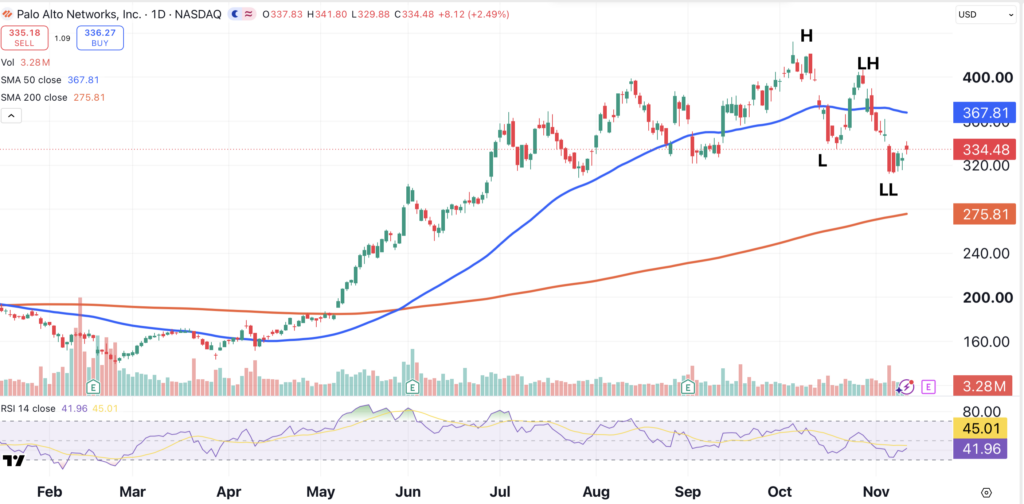
With earnings right around the corner, it’s time to lock in our gains on Palo Alto Networks. Even solid names are suffering due to rotation away from the tech sector. Palo Alto is scheduled to report earnings after the close on Nov. 18.
At the time of publication, Ponsi had no position in any security mentioned.
