A Look Back on a Very Dark Day on the Market


Remembering Oct. 19, 1987; also an AI warning from Wall Street Journal and a check on the market’s charts.
Remembering Oct. 19, 1987; also an AI warning from Wall Street Journal and a check on the market’s charts.
Let’s scan through the headlines for the stories of the week that speak to our Pro Portfolio holdings.
We put capital to work in two holdings, exited another and bumped up our price target for a long-time position.
A few observations:
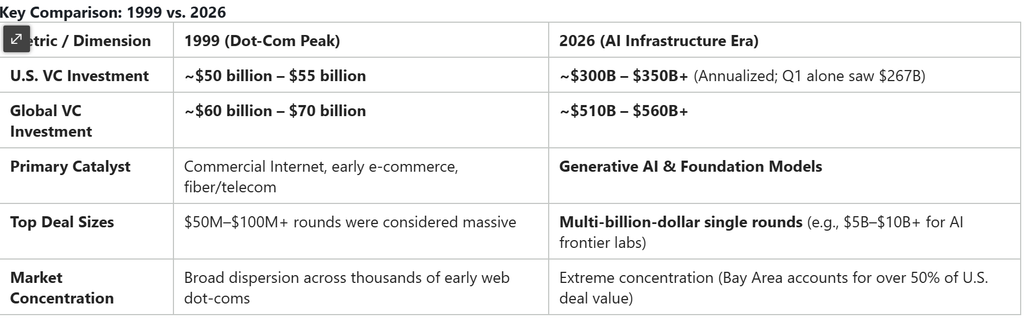
* Per my previous “Tales” in which I made the point regarding the low-quality revenue in this space due to a lot of it coming from venture-backed firms that have no future like Character AI, here is some data. Tweet and subtweet. The first tweet claims 80% of Anthropic’s and Open AI’s revenue comes from startups. I have no idea if this is true or not, but it seems plausible, when you see what these startups are actually doing both on the revenue and expense side. The subtweet from Chamath Palihapitiya of all people verifies these numbers. Then the bar graph he includes also indicates 80% of all venture funding is now going into the AI space. In dollar terms, that is a massive number, and dwarfs the $ invested in the dot-com cycle per the data below, and is also much more concentrated. The scale at which they and private capital now invest in these startups is now at another level.
A giant hunk of OpenAI and Anthropic revenue is coming from garbage that has no economics, does not need to exist, and only exists due to greater fool theory investing, and will eventually not exist, just like Character AI, which went from $2.7 billion to almost $0 in an instant. Same thing that happened in the dot-com era and sent Exodus and a lot of other things to $0. On top of that, another giant hunk of the revenue that remains for Anthropic and OpenAI comes from distillation, which will have to slow because everything for the most part has already been stolen. Even Meta ($META) apparently did it to build their new model, and has now cut it off, which is funny and ironic.
Silicon Valley really did create its own circular self-fulfilling money-recycling machine. That is one more reason they are all so promotional about this stuff. There is no underlying economics, the only thing they have to rely on is the next greater fool.
* Nvidia’s ($NVDA) Jensen Huang saves the day yesterday by claiming he doesn’t need to backstop CoreWeave ($CRWV), “because their cost of capital is decreasing.” There was a time when you would lose all credibility for saying something obviously that stupid, wrong, and untrue. Because of that, nobody even would even say that sort of thing. Now, it is the exact opposite world. The more crazy and outlandish a statement, the more one is rewarded for it. These guys, and their circle, have become worse than politicians.
He then went on to extol the virtues of CRWV. If CRWV is so great, why doesn’t NVDA just buy them, capture the value, and solve the whole problem? Because none of it is true and if NVDA were to buy CRWV, they inherit all of the losses, and the balance sheet, and lose the ability to sell into them and recognize all the revenue without the offsetting expense. For all intents and purposes, CRWV is really just an SPV that was created to consume NVDA parts. It is an accounting vehicle built to inflate NVDA revenue and profits, in my view. NVDA invested $100 million into CRWV privately in 2023, and anchored the actual IPO with $250 million, and without their participation, the deal might not have even gotten done.
It is amazing to me GAAP allows for all of this shenanigans. If it didn’t, the internet bubble implosion, where the same stuff was done to lesser of a degree, may not have happened as well. When it is all over, the history books will reference this stuff, but nothing will probably change, and then it will happen all over again with something else in another 10-20 years.
CoreWeave’s CEO claimed his stock was going down due to the market selling his stock irrationally. If it is irrational for the market to sell his stock, why do he and all the insiders there sell it like nobody’s business? The amount of insider selling there is staggering.
“Before CoreWeave imploded, its three co-founders had been busy dumping stock, a lot of it, totaling $3.3 billion since the company’s March 2025 IPO. Michael Intrator, Brian Venturo and Brannin McBee sold $2.4 billion this year alone, according to Bloomberg’s new report on corporate filings. Intrator has sold more than $907 million in shares this year. McBee’s sales since the IPO total $1.06 billion, equivalent to 40.4% of his undiluted stake at the listing. Venturo has sold more than $1.2 billion, representing over 35% of his original holding.”
https://www.zerohedge.com/markets/coreweave-founders-cashed-out-33-billion-meltdown
If it is so irrational to sell the stock, where is the press release from them indicating ALL insider selling will now stop, and the 10b5’s are cancelled? Diversification is no longer an excuse. They have taken enough money out. I will cut these guys a break. The stock peaked at $184. I will give them a break and allow them to include the term that no selling is allowed until the stock gets back to $150, which is still well below the all time high.
Position: Short CRWV (S)
* But there are important differences which will likely produce more muted downside to the hyperscalers and more muted upside to consumer staples…
“History doesn’t repeat itself, but it often rhymes.”
– (Attributed to) Mark Twain
The U.S. stock market is starting to look like the spring of 2000 when the dot-com boom came to a halt and technology began a steep slide. At the same time, consumer non-durable (staples) stocks (as well as Berkshire Hathaway ($BRK.A $BRK.B) have began to perform well both absolutely and relatively.
There are, however, deep differences in both periods of time.
* Today’s large-cap technology stocks (as opposed to the dot-com stocks) have deep moats and though their commitment to massive AI spending has transformed some of the tech equities from capital light to capital intensive, they have maintained strong operating and profit profiles. Unlike 26 years ago, the Mag 7 represents a large percentage of the indices — which, amid a backdrop of passive products and strategies (ETFs, quants), means that investor inflows go into and directly/steadily support/buoy the shares of Nvidia ($NVDA), Amazon ($AMZN), Microsoft ($MSFT), Alphabet (GOOGL), Micron ($MU), Sandisk (SNDK) and Meta ($META).
* Today’s defensive consumer staples have faced the competitive threat of generic and unbranded products over the last 15 years. In more recent years, they’ve encountered the introduction of GLP-1 agonists (a new class of medications that can help manage Type 2 diabetes and obesity (by reducing appetite). Unlike 26 years ago, a combination of these two factors are pressuring consumer staples’ top and bottom lines.
As a result of these differences, the downside to the Mag 7 constituents (and memory and semiconductors) is much more muted than 2 1/2 decades ago (vis a vis dot-com ‘ers). And the upside to the classically defensive consumer non-durables is also more limited than 2 1/2 decades ago.
Importantly, given the rise in the risk-free rate of return (using the 10-year Treasury note) to almost 5.3% suggests to me that rather than find a home in the consumer staples space, it is more likely that market participants will seek refuge in fixed income.
Though hyperscalers and semis/memory stocks are beneficiaries of a changed market structure, we own no large-cap tech stocks (and are short some on the periphery of Mag 7) because of our AI reservations and concerns. (See our 260 issues of the “More Tales From Nvidia” series).
We have previously taken a position in consumer staples — Kimberly-Clark ($KMB), PepsiCo ($PEP), Coca-Cola ($KO) and Procter & Gamble ($PG). But, given the profit threats, we have treated the space more as “trading sardines” and have recently trimmed all four on strength. (Earlier in the week we got lucky and sold the sharp ramp in PEP shares and sold out of the very small balance yesterday on news that KFC has ditched PepsiCo for Coca- Cola.)
Position: Long KMB (VS), KO (VS), PG (VS)
Netflix exec choice raises more questions, Anthropic’s shifting IPO valuation, and other headlines moving the market this morning.
The hyperscalers pay for AI out of their own cash. The companies that borrow to build it are starting to trade like rate-sensitive stocks.
Stocks recovered from early losses as Tech bounced and the largest drop in 10- and 30-year yields in over a year saw five sectors gain over 1%.
We continue to see chip capacity tightness ahead, creating an even bigger industry pain point.
Hot inflation data burns up AI, tech and small-cap stocks as CoreWeave unravels and ‘neocloud’ names in ‘crash mode’; also the chart looks precarious.