Tech Weighs on the Market, Midterms and Inflation Data Around the Corner: 8 Key Items Shaping the Stock Market Friday


Microsoft’s debt deal, Binance’s $6.3 billion hack and other headlines moving the market this morning.
Microsoft’s debt deal, Binance’s $6.3 billion hack and other headlines moving the market this morning.
Get on the helmet and flak jacket: Intel and Amazon are down big overnight after earnings. Binance gets hit by massive hack. And oil? Not pretty.
Amazon gave investors a promising story for its cloud business, but the market is worried about short-term costs.
* I mean baa(d) – Baa? Baa(d)
What full lips you have
They’re sure to lure someone bad
So until you get to Grandma’s place
I think you ought to walk with me and be safe
I’m gonna’ keep my sheep suit on
Until I’m sure that you’ve been shown
That I can be trusted, walking with you alone
Awooh
Little Red Riding Hood
You sure are lookin’ good
You’re everything that a big, bad wolf could want
Awooh! I mean baa
Baa? Baa
– Sam the Sham and the Pharaohs, Little Red Riding Hood
Wolf Street howls about “tech as in drek.”
Tech Makes a Mess as Wrinkles Start to Show. Markets Are Edgy Now, Aren’t They? | Wolf Street
As noted by Wolf Street we have seen unprecedented and large percentage and dollar drops in the world’s biggest technology stocks that have highlighted the last 48 hours of trading:
* Alphabet ($GOOGL)
* Amazon ($AMZN)
* ServiceNow ($NOW)
* Intel ($INTC)
* Fortinet ($FTNT)
* Reddit ($RDDT)
The consensus has been unabashedly optimistic going into this week’s technology earnings releases:
1. From the head cheerleader, Fundstrat’s Tom Lee, whose changing narratives have incorrectly but confidently called for an imminent and massive stock market rally:
2. “Group stink” and simplistic first-level thinking from another Halftime panelist shrouded in hubris:
To me, the most audacious part of all this is that there will be no admission of a massive investment mistake nor will there be pushback from the shows’ moderators.
Position: None
Over 400 of the S&P 500’s components were higher even as the index ended lower and the Russell 2000 gained for a fourth day while Amazon and Intel dropped after hours
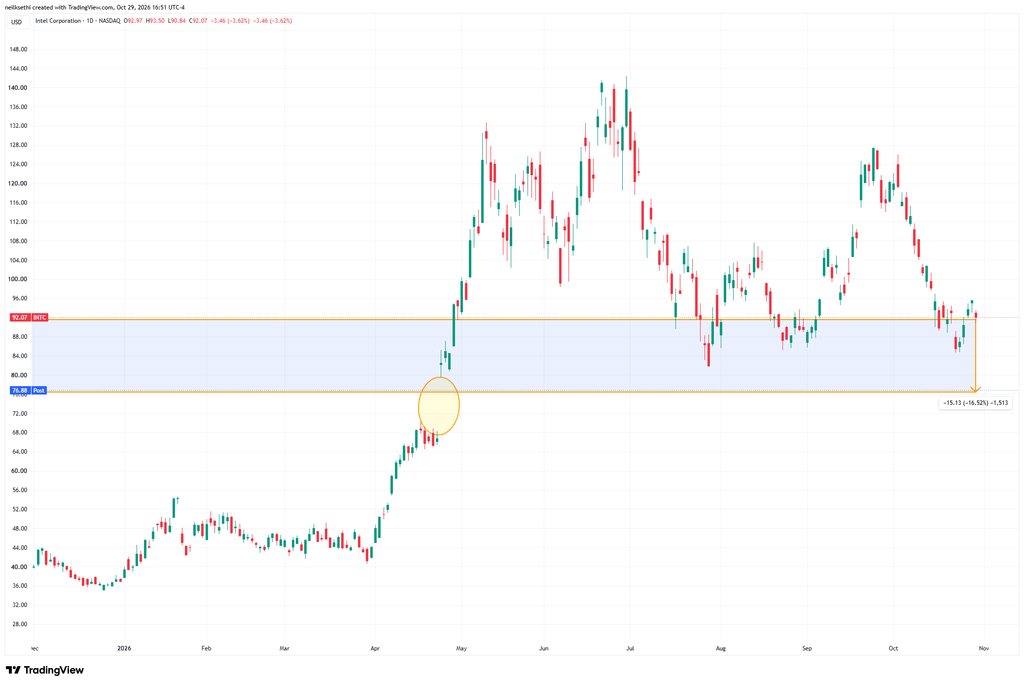
Intel ($INTC) shares are down over 16% after hours Thursday after the chipmaker forecast fourth-quarter revenue and profit well below Wall Street estimates, blaming a deepening PC slump and supply problems, even as its data center business posted its fastest growth in 15 years.
Notably, this would put Intel into a gap formed from its April earnings which extends down another 8% from where it was trading as of 4.50 p.m. ET.
Third-quarter adjusted EPS of 52 cents beat the TipRanks consensus of 41 cents. Revenue rose 21% to $16.51 billion, a hair below TipRanks’ $16.56 billion estimate, Intel said in its earnings release.
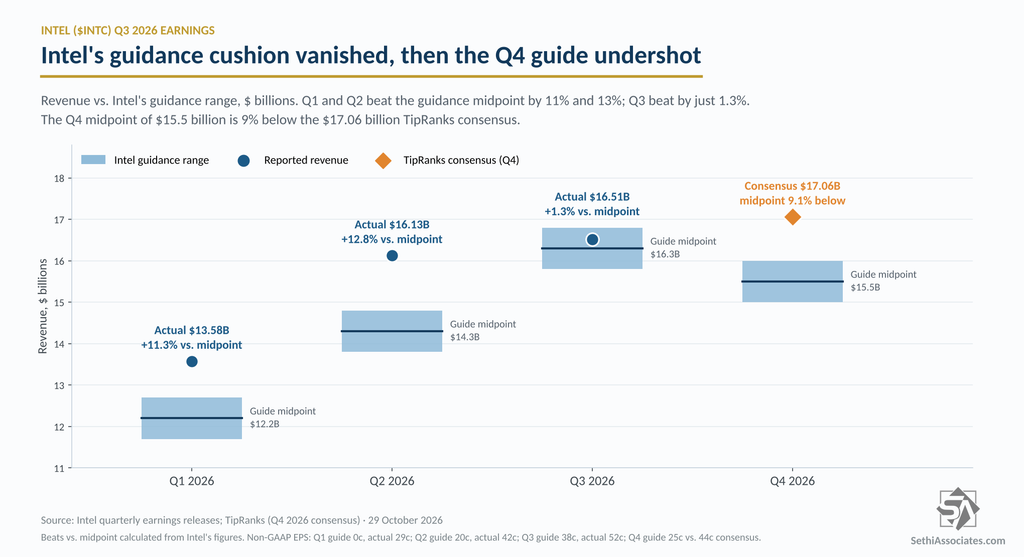
Intel topped its own targets though. In July, it guided third-quarter revenue to $15.8 billion to $16.8 billion, adjusted EPS to 38 cents and a 42.0% non-GAAP gross margin. Revenue landed $213 million above the midpoint, EPS beat that guide by 14 cents and gross margin came in at 44.1%.1
Non-GAAP gross margin rose 4.1 percentage points from a year earlier and 2.3 points from the second quarter. Non-GAAP operating margin climbed to 19.6% from 11.2% a year ago and 17.2% last quarter.
Per-share growth lagged profit growth. Adjusted net income jumped 169% to $2.76 billion, but adjusted EPS rose 126% because the diluted share count grew 17% to 5.31 billion after this year’s equity raises.1 GAAP EPS of 60 cents included a $1.0 billion gain on the mark-to-market of shares held in escrow for the U.S. government, worth 17 cents a share, which Intel excludes from adjusted results.
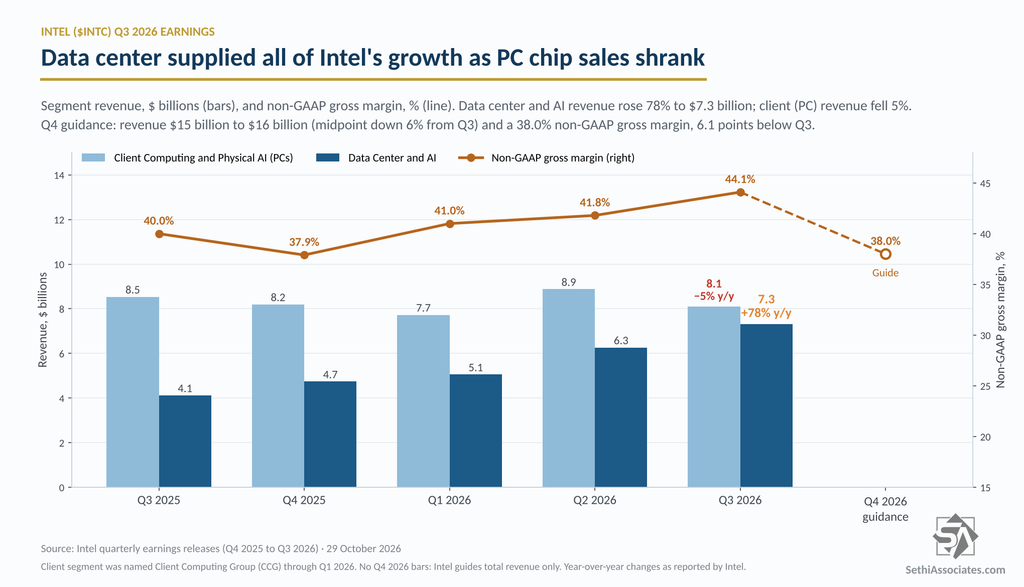
Data center and AI accounted for 112% of Intel’s $2.86 billion year-over-year revenue increase; excluding it, sales fell 3.6%.1
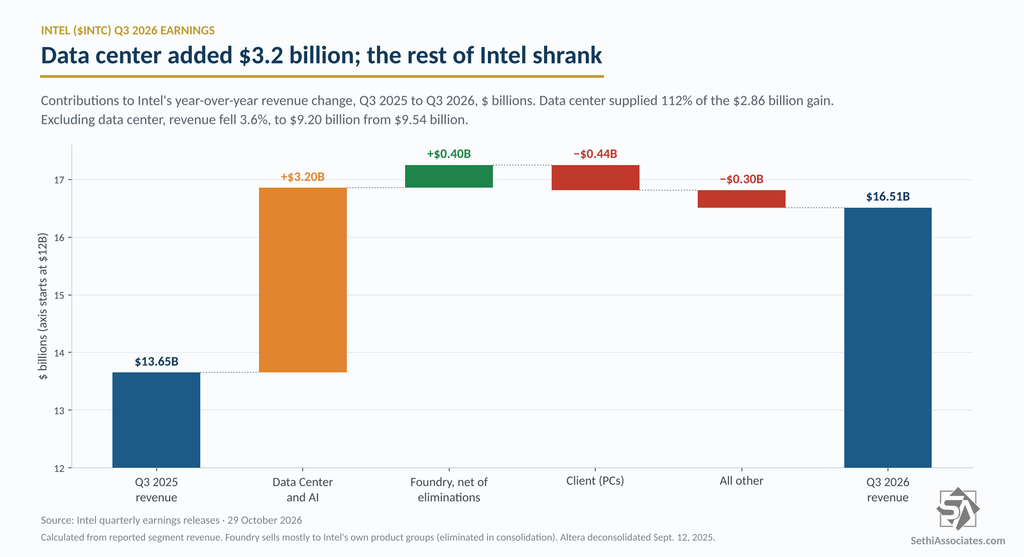
The segment’s revenue rose 78% to $7.3 billion, well above the $6.7 billion analysts expected, MarketWatch reported, and rose 17% from the second quarter. Its operating margin widened to 41.5% from 23.4% a year ago, and about 65 cents of each extra revenue dollar fell to operating income.1 Data center operating income of $3.04 billion topped the client unit’s $2.29 billion for a second straight quarter.
Client Computing and Physical AI, the PC chip unit, fell 5% to $8.1 billion, short of the $8.9 billion FactSet consensus cited by MarketWatch, and dropped 9% from the second quarter. Its operating margin slipped to 28.2% from 31.6%.1
The mix shift is stark. Data center now makes up 47.5% of Intel Products revenue, up from 32.5% a year ago and 41.4% last quarter.1
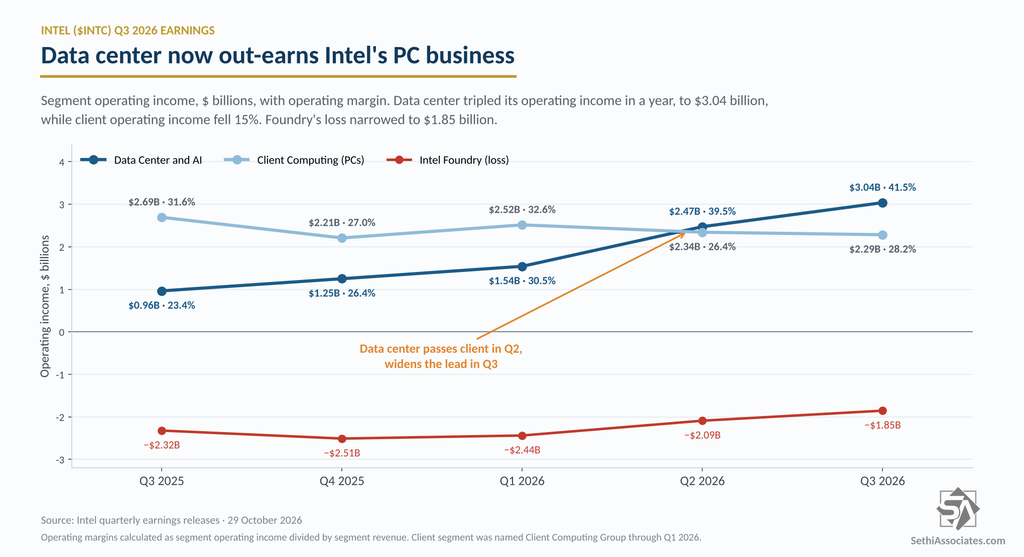
Intel Foundry revenue jumped 58% to $6.7 billion, ahead of the $6.4 billion consensus, per MarketWatch. Most of that is chips made for Intel’s own product groups and is eliminated in consolidation. The foundry operating loss narrowed to $1.85 billion from $2.32 billion a year earlier, cutting its loss margin to 27.7% from 54.8%.1 “All other” revenue fell 30%, partly because Intel deconsolidated Altera on Sept. 12, 2025.
The $15.5 billion midpoint of Intel’s fourth-quarter revenue guide is $1.56 billion, or 9%, below the TipRanks consensus, and its 25-cent EPS guide is 43% below.1
Intel guided revenue to $15 billion to $16 billion, against $17.06 billion expected, and adjusted EPS to 25 cents, versus 44 cents, TipRanks reported. The midpoint implies a 6% sequential decline and slows year-over-year growth to about 13% from 21%.1
Margins take a bigger hit. Intel guided a 38.0% non-GAAP gross margin, 6.1 points below the third quarter’s 44.1%. On a GAAP basis, the guide is 37.1%, which is why some outlets reported 37% and others 38%.
Intel blamed a PC market squeezed by soaring memory prices. CFO David Zinsner said in the release that the PC slowdown will last “at least through the first half of next year.” Intel expects the PC market to shrink 10% in 2027 after a 12% drop in 2026, Bloomberg reported. CEO Lip-Bu Tan told Bloomberg data center sales would have been higher without raw-material shortages and a factory shutdown in Israel. Intel investor relations chief John Pitzer told MarketWatch an explosion at the Israel plant earlier this month weighed on the outlook.
Inventory rose 4.6% from the second quarter to $13.1 billion, and 12.5% since year-end, while client revenue fell.1 Work-in-process inventory, at $8.8 billion, accounts for most of it. Intel says it is building working capital to increase supply, but rising inventory into a PC downturn is worth watching.
The client miss came from the bigger of Intel’s two product businesses. A segment analysts expected to grow 5% shrank 5%, and the fourth-quarter guide suggests the decline deepens.
Operating cash flow was $5.1 billion. Gross capital spending rose to $4.2 billion from $3.0 billion a year earlier, and adjusted free cash flow was $1.64 billion, up from $0.9 billion. Year-to-date gross capex totals $11.8 billion.1 Intel has pledged to spend $20 billion in 2026, the FT reported. If that refers to gross capex, it implies about $8.2 billion in the fourth quarter.1
The $23 billion equity offering completed in the quarter transformed the balance sheet. Cash and short-term investments reached $54.0 billion against $50.1 billion of total debt, a net cash position of $3.9 billion, compared with net debt of $9.2 billion at the end of 2025.1
The AI demand story for Intel held up this quarter, and the data center business is now Intel’s profit engine. But the stock had priced in a smoother transition. Expectations were high with shares up more than 140% this year coming into the print despite a more than 20% drop over the past month, per the FT. A guide that cuts revenue, margins and EPS at once, blamed on PCs, memory costs and a fab disruption, breaks that narrative for at least a quarter. Before the report, analysts’ average price target of $114.23 implied 24.1% upside, per TipRanks.
1 Calculated from figures in Intel’s third-quarter 2026 earnings release and, for prior-quarter and guidance comparisons, its second-quarter 2026 release. Segment contributions to the year-over-year increase use reported segment revenue; Intel Foundry net of intersegment eliminations added $398 million (14%), client subtracted $438 million and “all other” subtracted $301 million. Segment operating margins equal segment operating income divided by segment revenue. Net cash equals cash, cash equivalents and short-term investments minus short- and long-term debt. Consensus figures are from TipRanks unless noted; FactSet figures are via MarketWatch.
Microsoft is rewarded for trimming its spending plans. Alphabet is hit on profitability, and it may be its worst earnings reaction ever.
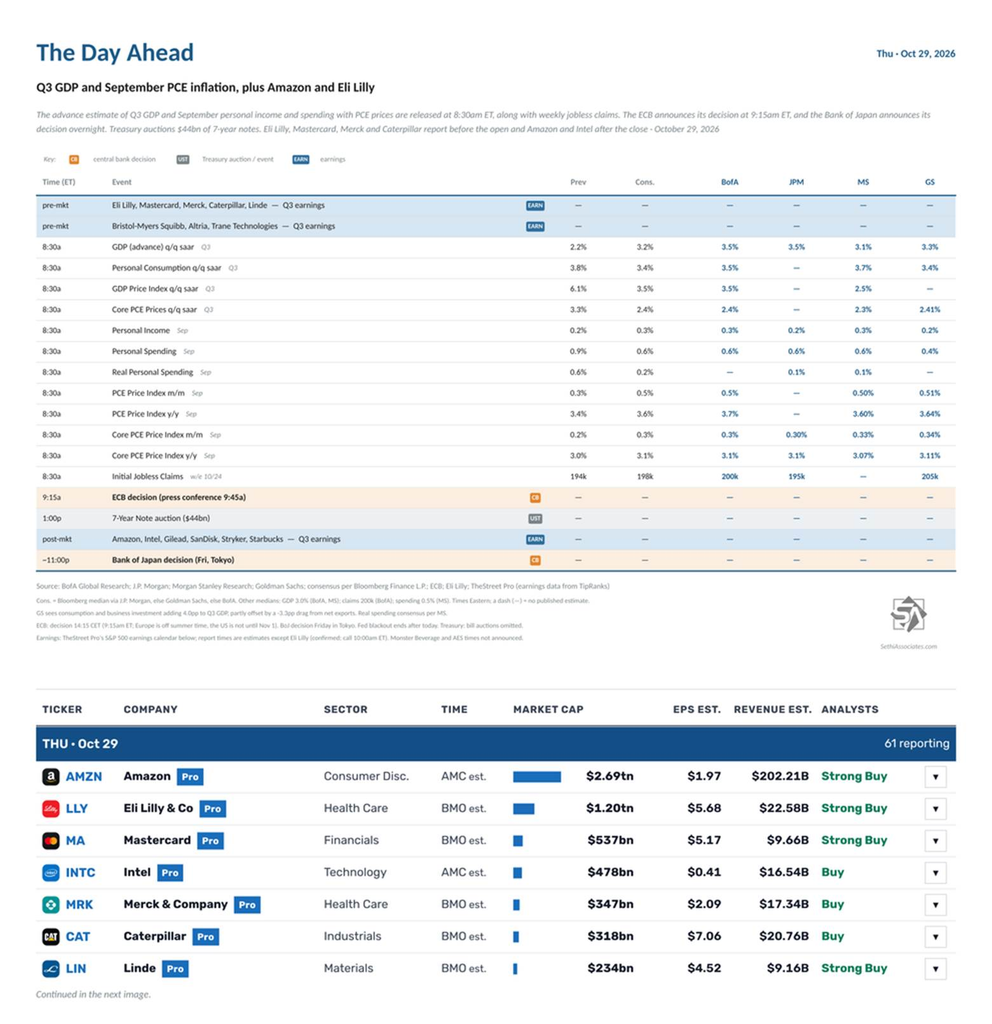
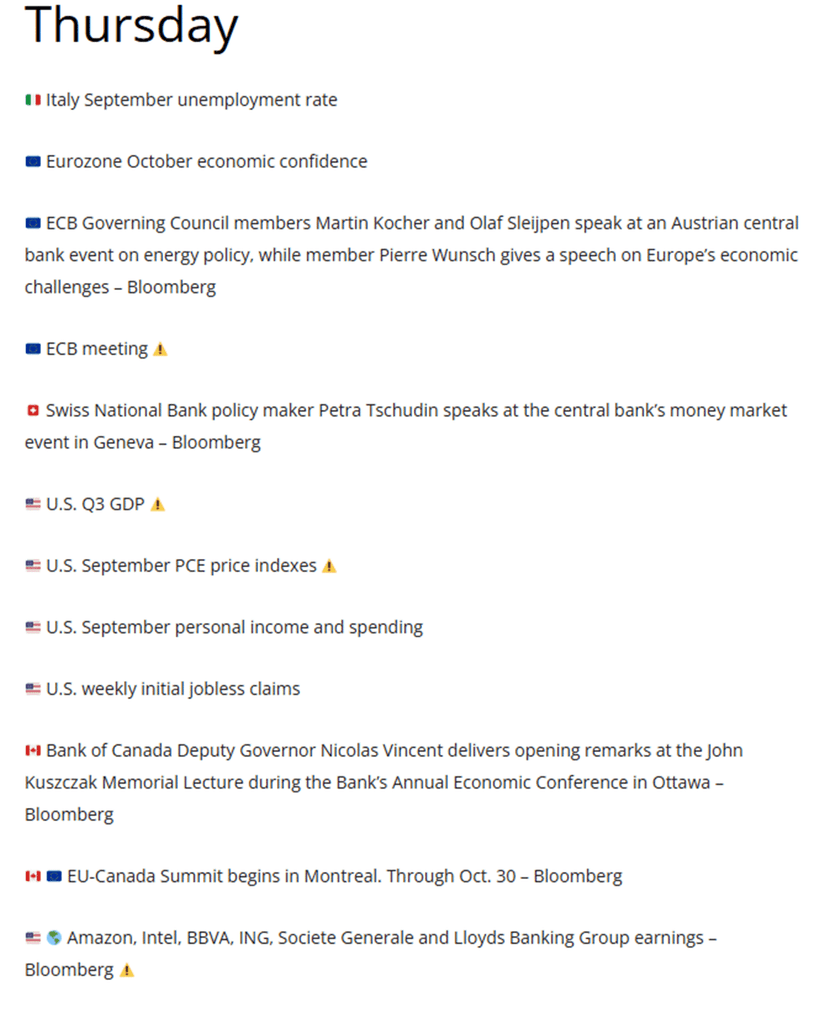
US economic data includes the advance estimate of Q3 GDP, which will incorporate September personal income and spending with PCE prices that will also be separately reported. We’ll also get weekly unemployment claims.
The Fed’s blackout period extends until midnight, with Fed speakers resuming Friday.
The non-Bill (>1yr in maturity) US Treasury auction is $44bn of 7-year notes.
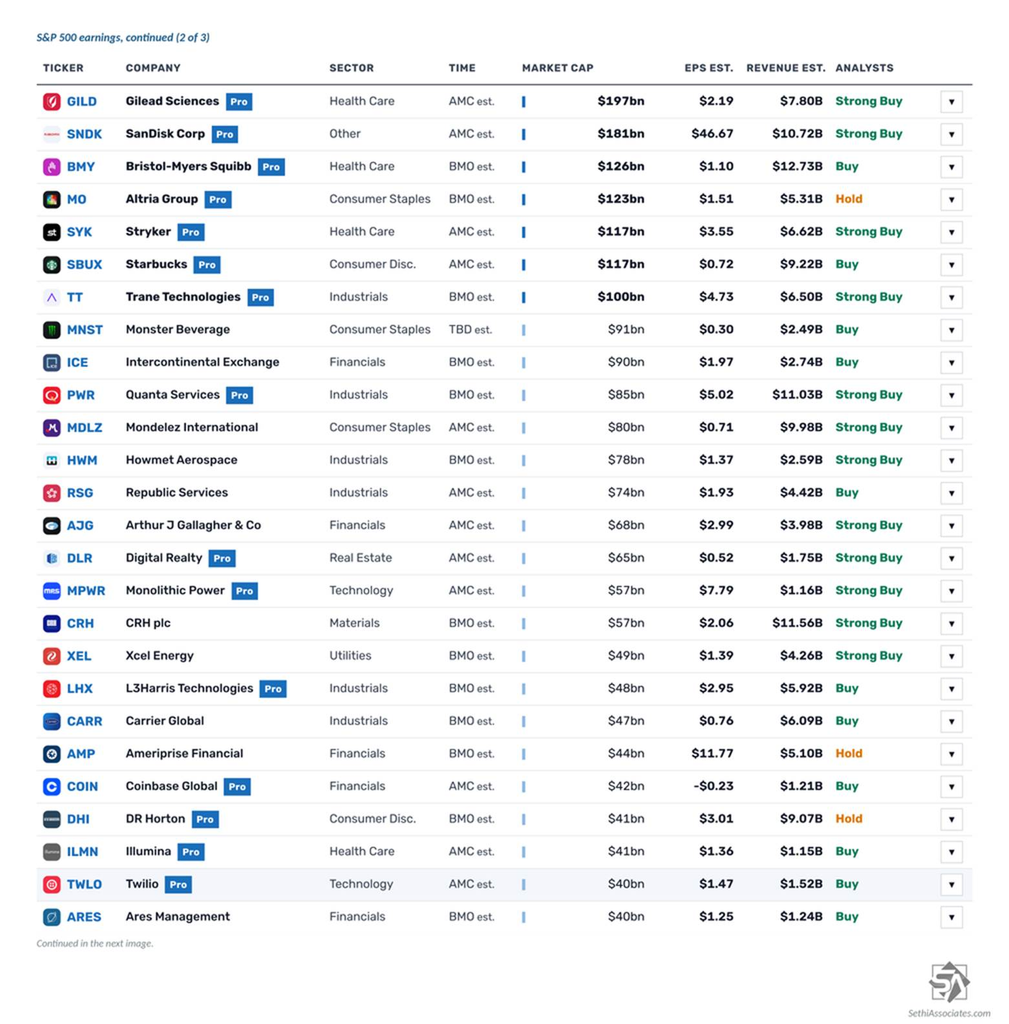
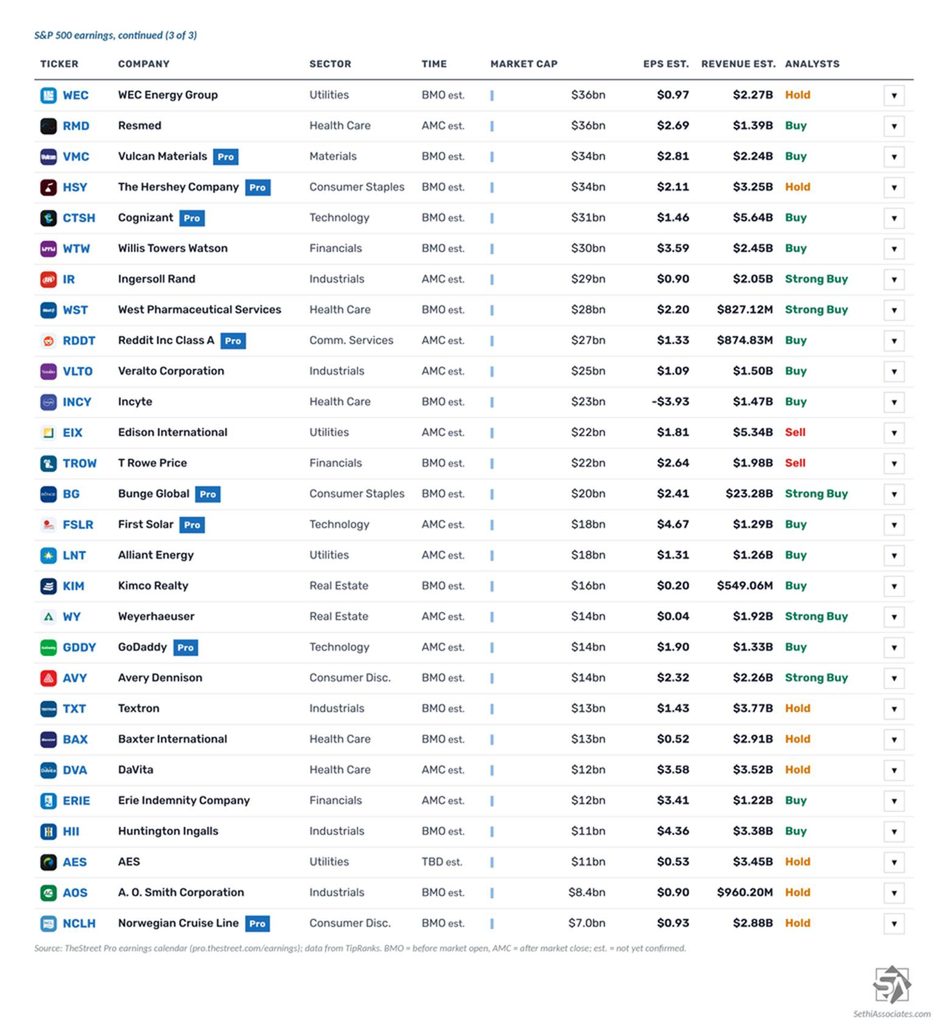
61 S&P 500 components report, 14 of them with market caps over $100bn:61 S&P 500 components report, 14 of them with market caps over $100bn:
Before the open: Eli Lilly ($LLY), Mastercard ($MA), Merck ($MRK), Caterpillar ($CAT), Linde ($LIN), Bristol Myers Squibb ($BMY), Altria ($MO), Trane Technologies ($TT), Intercontinental Exchange ($ICE), Quanta Services ($PWR), Howmet Aerospace ($HWM), CRH ($CRH), Xcel Energy ($XEL), L3Harris ($LHX), Carrier ($CARR), Ameriprise ($AMP), D.R. Horton ($DHI), Ares Management ($ARES), WEC Energy ($WEC), Vulcan Materials ($VMC), Hershey ($HSY), Cognizant ($CTSH), WTW ($WTW), West Pharmaceutical ($WST), Incyte ($INCY), T. Rowe Price ($TROW), Bunge ($BG), Kimco Realty ($KIM), Avery Dennison ($AVY), Textron ($TXT), Baxter ($BAX), Huntington Ingalls ($HII), A.O. Smith ($AOS) and Norwegian Cruise Line ($NCLH)
After the close: Amazon ($AMZN), Intel ($INTC), Gilead ($GILD), SanDisk ($SNDK), Stryker ($SYK), Starbucks ($SBUX), Mondelez ($MDLZ), Republic Services ($RSG), Arthur J. Gallagher ($AJG), Digital Realty ($DLR), Monolithic Power ($MPWR), Coinbase ($COIN), Illumina ($ILMN), Twilio ($TWLO), ResMed ($RMD), Ingersoll Rand ($IR), Reddit ($RDDT), Veralto ($VLTO), Edison International ($EIX), First Solar ($FSLR), Alliant Energy ($LNT), Weyerhaeuser ($WY), GoDaddy ($GDDY), DaVita ($DVA) and Erie Indemnity ($ERIE)
Time not announced: Monster Beverage ($MNST) and AES ($AES)
Outside the US, Shell ($SHEL), TotalEnergies ($TTE) and Volkswagen ($VWAGY) report.
Ex-US highlights include a policy decision from the ECB, UK September net consumer credit and M4, Japan October consumer confidence index, Italy September unemployment rate, October consumer confidence index, economic sentiment and manufacturing confidence, Eurozone October economic confidence and Sweden Q3 GDP indicator.
From Christophe Barraud’s international Week Ahead rundown:
The Fed held rates steady with two hawkish dissents, Oracle’s aggressive long-term targets lifted AI names, but Alphabet fell about 9% after missing expectations.
SK Hynix and ASM International see tight chip capacity, here comes Fed Chair Kevin Warsh and other headlines moving the market this morning.