Weekly Roundup: Renewed AI Concerns Weigh on the Market and Portfolio


We added to six holdings, and upgraded and lifted a price target on another as favorable AI data conflicted with market emotion.
We added to six holdings, and upgraded and lifted a price target on another as favorable AI data conflicted with market emotion.
Neil’s note earlier on Michigan Consumer Sentiment dropping to lows (although beating expectations) got me thinking about research I did back in my Fear & Greed days. Back then, I noticed that lows in Consumer Sentiment happened around lows in the S&P 500.
Here’s the thing. It’s not a timing tool. And you might even say that Consumer Sentiment leads stocks. So, where are we now?
The red line is the S&P 500 and the blue is Mich Consumer Sentiment. What I see is a relationship between the two and according to my stats, Sentiment explains 40% of the movement in the S&P 500. Now, this is a simplistic analysis, but it has some merit.
Basically, consumers lose faith in the economy, and then stocks fall. Consumers have no faith in the economy right now, and haven’t for years! (This isn’t a political statement.) I probably should have used RSP for this analysis instead of S&P 500, but it doesn’t go back as far.
So, the stock market may continue to go up, but risk is only increasing.
Trend is your friend, except at the ends, where it bends.
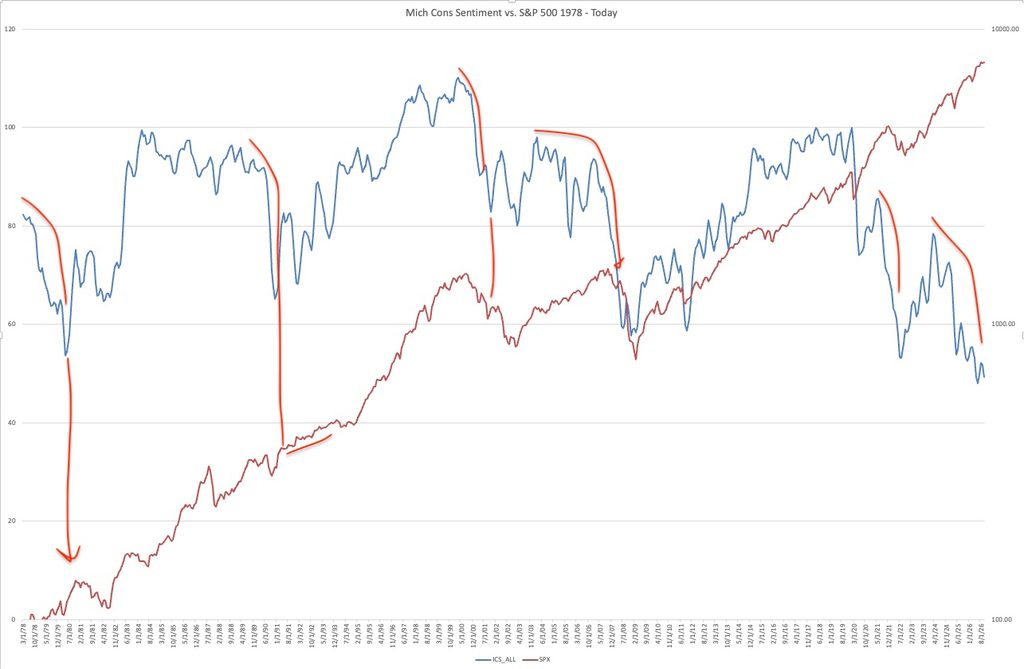
Data from: https://data.sca.isr.umich.edu/ and https://shillerdata.com/
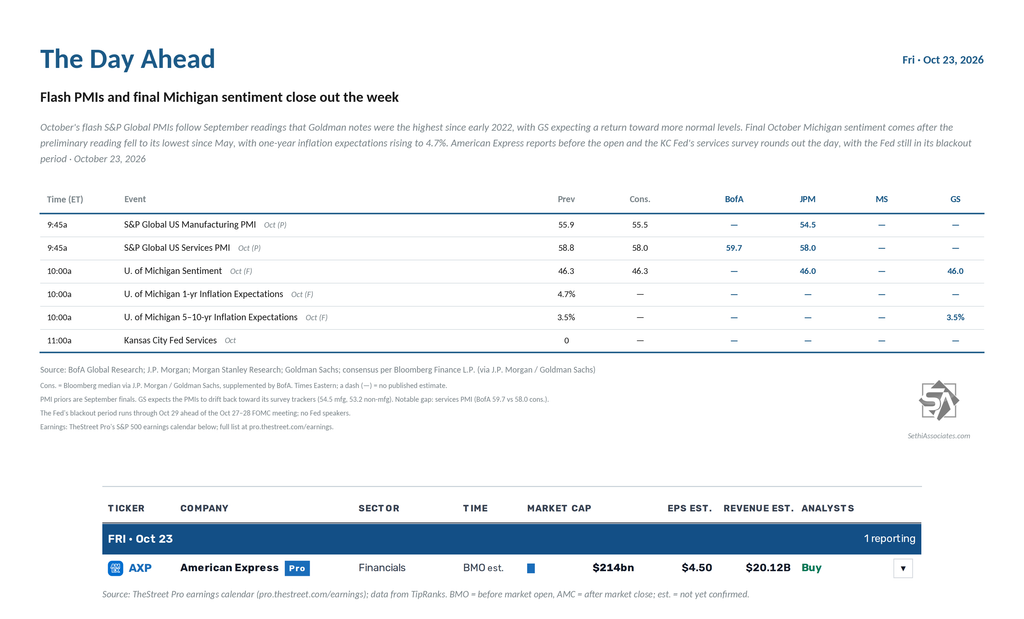
US economic data closes out the week with October’s flash S&P Global PMIs, final University of Michigan consumer sentiment and the Kansas City Fed’s services survey.
The Fed remains in its blackout period ahead of next week’s October 27–28 FOMC meeting.
No non-Bill (>1yr in maturity) US Treasury auctions.
Q3 earnings season continues with one S&P 500 component, American Express ($AXP).
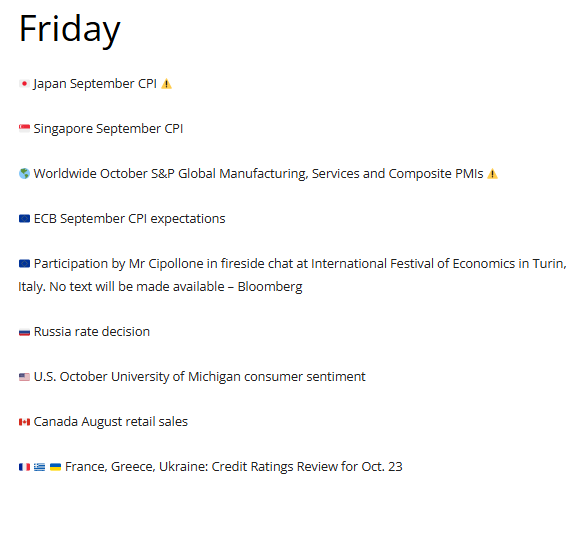
Ex-US highlights are global flash PMIs, ECB consumer expectations survey, UK October GfK consumer confidence, September retail sales, Japan September national CPI, and Canada August retail sales.
From Christophe Barraud’s international Week Ahead rundown:
Worries about the sustainability of the AI trade surfaced once again, driving down a swath of related stocks, but other stocks rallied as Treasury yields dropped the most since August 2025, seeing equal-weight vs cap-weight the most extreme since 2024.
Starts fell more than every Bloomberg estimate with single-family the least in a year, while single-family permits dropped to the lowest since March 2023.
Ryanair CEO on airline fares, OpenAI races to complete fundraising round and other headlines moving the market this morning.
The megacap growth sectors went from worst (Friday) to first (Monday) as chipmakers snapped an eight-session losing streak, but rising Treasury yields left seven sectors, the Dow Jones Industrial Average, and the equal-weight S&P 500 lower.
NAHB’s Housing Market Index falls to 29 in October, with all three components also hitting multi-year lows even as 43% of builders cut prices.
AI worries are pressuring Tech and sending yields lower as we embark on a heavy earnings week including several names in the cross-hairs.
Another selloff in AI names broadened to encompass most of Tech, sending the Nasdaq-100 to its worst week since April 2025. Five sectors though would finish the week up 2% or more, as 30-year Treasury yields fell the most since April 2025.