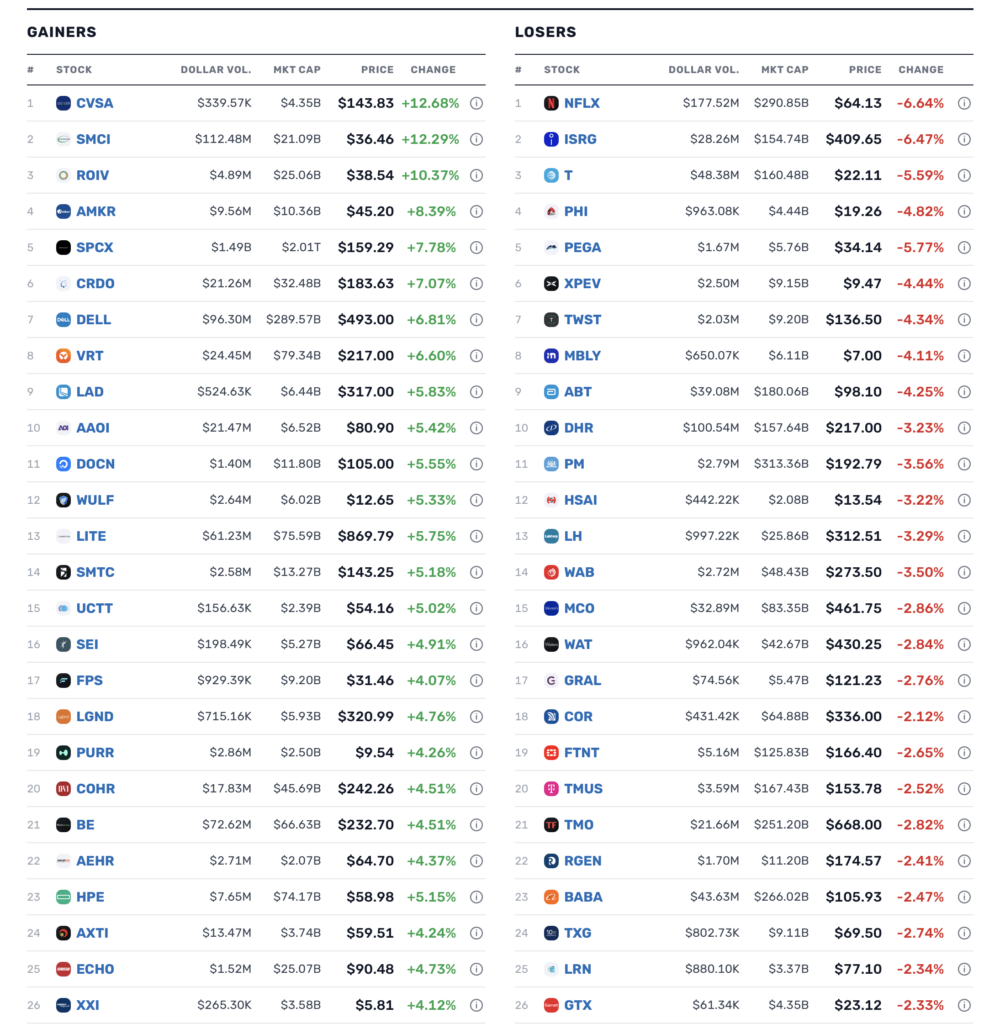
Super Micro Computer crushes expectations while United Airlines and Alaska Airlines confirm energy input concerns. Those and other headlines are moving the market this morning.
The SpaceX ($SPCX) quarter beat on revenue and EBITDA across all three segments (Intelligence/AI, Space, Connectivity). The only blemish was a miss on Starlink subscriber adds, offset by better pricing. Guidance calls for revenue of $33B to $37B by Q1 FY27. Management says it expects 2 to 3 GW of compute by year-end 2026 and plans to add 10 GW in 2027, well above prior expectations, and told JPMorgan it is not considering raising equity.
Price targets:
JPMorgan: $500 from $240 (Overweight). Biggest move. Says the forward driver is superintelligence, not the segment beats.
Cantor Fitzgerald: $345 from $246 (Overweight). Sees $500B to $1T in year-end 2027 ARR, self-funded compute expansion, and chip supply constraints giving SpaceX pricing power.
Barclays: $300 from $254 (Overweight). Model update on the beat.
Morgan Stanley: $300 reiterated (Overweight). Says the story is only now getting interesting.
Citi: $240 from $200 (Buy). Also opened a 90-day upside catalyst watch, pointing to Q4 beat-and-raise continuation and Starship Flight 15 as a major reusability catalyst.
UBS: $230 from $210 (Buy). New compute deals ramping in Q4, Starship catch milestones, Grok improvements.
TD Cowen: $224 from $200 (Buy). Estimates up on the beat.
Susquehanna: $176 from $173 (Neutral). The lone holdout. Flags execution risk on the compute buildout and dependence on Starship commercialization.
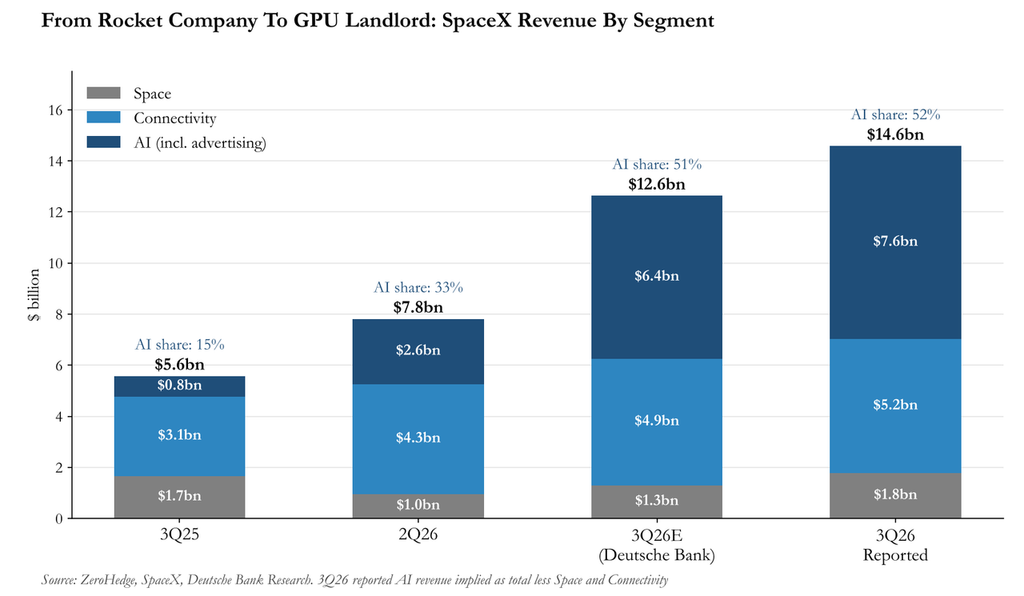
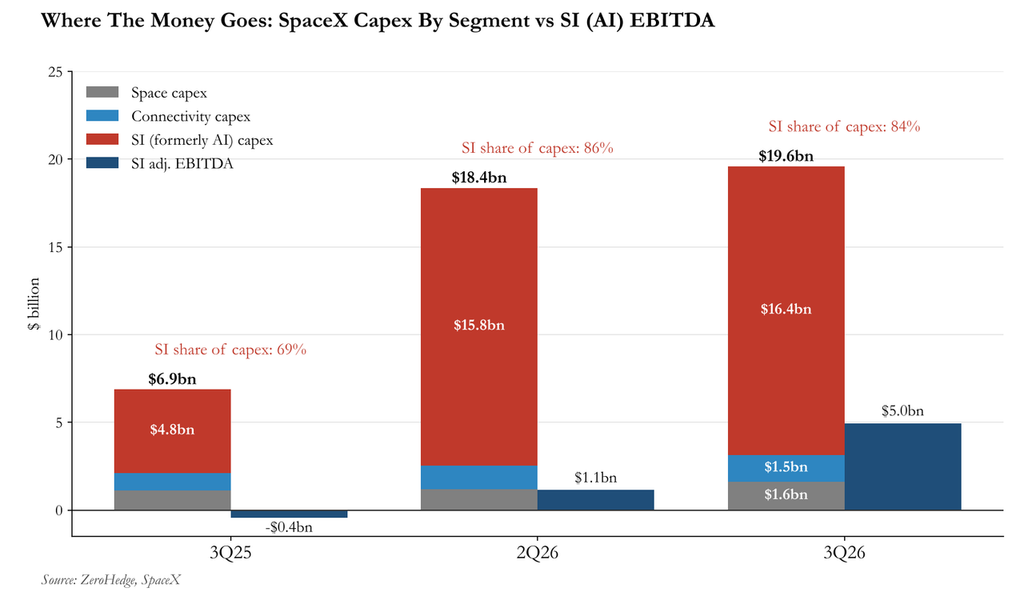
Below are two charts that speak volumes about the economics of AI.
SpaceX ($SPCX) just reported 3Q2026.
All of a sudden, AI (ergo data centers) is their biggest business. Along with that, cash and cash equivalents came in at $51.29 billion, versus an estimate of $91.2 billion. CAPEX for their AI segment was $16.4 billion versus $5 billion of EBITDA. Is this compelling?
I guess they can buy all the revenue they want; good thing the cost of financing it is so low??? Feels like double dilution is on the come here. Continued issuance to do whatever they are doing chasing WeWork landlord revenue, and dilution to potentially acquire Tesla ($TSLA), which is becoming more and more apparent.
Clearly Elon Musk wants to goose SPCX stock where he has much more of his net worth (~70%) to acquire TSLA (~25%) to hide it, on more favorable terms for SPCX (ergo himself).
This is the same trick Musk used when Tesla acquired Solar City. Hide the biz that can’t meet its promises, then to the next B.S. story.
Boy did that thing burn cash, holy heck, never seen a whiff this bad. Good thing borrowing costs are low these days. Oopsie:
Japan now has a gross government Debt-to-GDP ratio of 204.4%, the highest among any major world economy.
Italy follows at 138.4%, while the United States stands at 125.8%, which is only below the ~132.0% record set during the 2020… pic.twitter.com/2AhtoeKN53
Despite the protestations from the value cabal, I have been cautious on financials/banks all year:
Bank of America just gave back its entire year.
The stock peaked near $64.50 in September and has since fallen to about $51, erasing all of 2026's gains in weeks. When Wall Street decides the problems will linger, it sells first and asks questions later. A 20% round-trip in a… pic.twitter.com/QasYAboF1i
Fan fave Netflix ($NFLX) materially reduced forward guidance after the close of trading — and its shares are trading -$4 (or -6%) in premarket trading.
Netflix revenues hit a record $12.9 billion in Q3, up 12% YoY. This was the slowest revenue growth rate since Q3 2023. Net Income of $3.7 billion was up 44% YoY. Operating margins moved up to a record 34.6%. The stock was down 45% over the past year heading into earnings. $NFLXpic.twitter.com/oB01SlmzEK
From my Diary yesterday afternoon and last night on Netflix:
My View on Netflix
Repeating for emphasis, I would not bottom fish in Netflix (NFLX).
I expect in line-to-better 2Q2026 results but a possible lower forward guidance as margins are pressured.
From last month:
Netflix Is Too Low to Short and Too High to Buy
I would continue to avoid buying (and “bottom fishing”) in Netflix (NFLX) for the reasons I have previously mentioned:
* Netflix has nearly saturated the domestic market (as well as many other developed countries). These markets are significantly more profitable than the non developed arena.
* Future Netflix sales/profit growth will come from developing country markets that provide substantially less revenue (and income) per subscriber.
* Netflix’s original content programming has been unspectacular over the last 12 months (or more) — and existing content has suffered.
In the past I have been short NFLX, but it is no longer priced as an attractive short.
Netflix, according to AI, was among the most recommended equities of the panelists on the “Show:” But viewers, in light of no timestamping or memorializing of recommendations, probably have no clue.
As I seem to be doing with ever greater regularity, I will be taking a time out on X (could last a few days, a few weeks or more – I frankly have no idea how long I will be off Twitter. I won't even be looking at my Twitter feed, thread and timeline): 1. My criticism of @CNBC is…
Though, as seen by my tweet above, I have stopped using X as a forum for my constructive criticism, I have a clue. Here is a recent recommendation of Netflix by one of the more particularly smug panelists seen on the Noon Show:
We will likely never hear the name (Netflix) again from this particular panelist — or any of the others. As night follows day none of the panelists have modelled Netflix, spoken to management (and its competitors) or have performed any serious analysis.
Images and franchises are polished by panelists showing successful investment recommendations and not their conspicuous and frequent investment boners.
Instead the shows and panelists will likely all discuss SpaceX ($SPCX) today (whose shares are up by 6% after their EPS release)..