High Rates Are Not Helping the Homebuilders

The homebuilding sector, or the ($XHB) ETF, has been mired in a massive slump this year. We can directly see the cause as being high interest rates, mortgages are comfortably above 7%. That is a huge difference from just five years ago when a new housing boom and refinancings took place (started when Covid was the issue). Many of those refinancers have very low interest rates and not only won’t pay off their mortgage but they won’t sell their house, either. The conundrum is about supply — is there too much or too little? It seems buyers are out there but maybe credit is an issue, or job security. Demand for housing is weak, this week saw housing starts and permits in negative territory.

Whatever the case, homebuilders are not in the best shape. Every chart looks the same, lower highs and lower lows, our textbook definition of a downtrend. The XHB has been fighting the 20-day moving average and losing, but eventually we’ll see it base and then move above there with some strong volume, it is just not happening now.

When might the homebuilders start to shine? It may not be in 2027, when Fannie Mae predicts mortgage rates will average 7.5%, far above its previous forecast of 6.75%. Not good times for the homebuilders, but maybe this is the down cycle for the group. Keep an eye on long-term rates.


More on Circular AI Financing

I wanted to make one more point on the circularity, which continues to fly under the radar. 

The revenue quality issue. 

See tweet below: 

The circular financing goes well beyond Nvidia ($NVDA)  and others funding their customers. It is also the Venture Capital firms who are financing the consumers of the compute, in the hopes that another greater fool takes them out at a higher valuation. 

These companies that the VCs are financing are consuming the bulk of compute, NOT corporate America, which actually has a balance sheet and sustainable businesses of their own volition. There is no shortage of data coming out that corporate America is finding little utility from AI. In fact the data shows the opposite and it is becoming more clear that AI is just a cost. 

At the end of day, AI is really all sort of an inter-linked Ponzi scheme and money recycling operation, underpinned by public market valuations that I believe have been goosed by Nvidia. The demand for compute is coming from businesses that really should not, and do not need to exist, and are just being financed by VCs that effectively are funneling money to compute infrastructure, in the hopes that valuations remain high and a greater fool takes them out of their investment. 

But most will go the way of Character AI – with $2.7 billion in market capitalization to near zero…  in a heartbeat.

Position: None

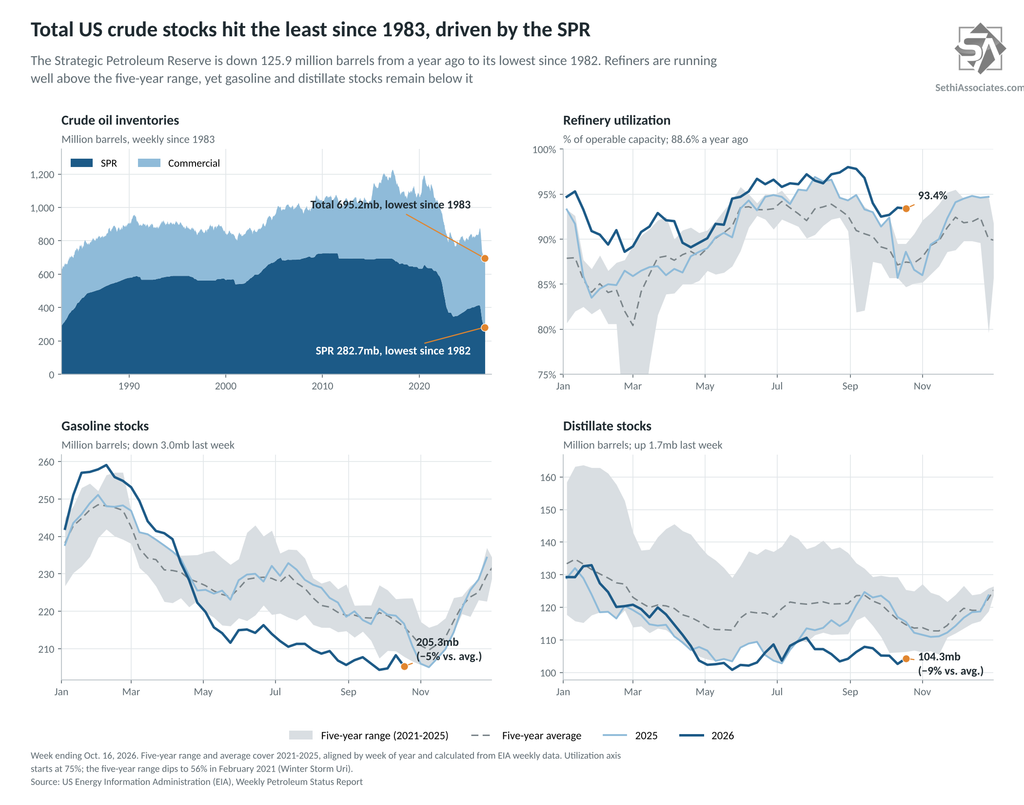
U.S. Crude Inventories Extend Slide to Lowest Since October 1983

Total U.S. crude oil inventories (commercial plus the Strategic Petroleum Reserve) extended their slide to 695.2 million barrels last week, the least since October 1983, per the EIA. The SPR is driving it, accounting for 125.9 million of the 136.2 million barrel drop in total inventories from a year ago.

The SPR slipped another 0.3 million barrels to 282.7 million in the week ending October 16, its lowest since 1982 and down 30.8% from a year ago. But commercial crude drew 3.1 million barrels to 412.5 million, the third straight draw (14.8 million barrels over those three weeks). That left it 3% below the five-year average and the lowest for this time of year since 2014.

Turning to products, those also remain historically low even as refiners are running hard:
▪️ Refinery utilization was 93.4%, versus 88.6% this week last year and well above the five-year range.
▪️ Gasoline fell 3.0 million barrels, the biggest draw since early May, to 205.3 million, 5% below the five-year average. Gasoline demand rose 575,000 barrels a day to 8.98 million.
▪️ Distillates rose 1.7 million barrels, the first build in five weeks, but are still 9% below the five-year average.
▪️ Products are also being drawn down by exports which are up 6.8% from a year ago on a four-week average.

One other notable: crude production fell 410,000 barrels a day to 13.27 million, the lowest since late January, as Hurricane Isaias kept Gulf of Mexico output offline (57% was still shut in as of October 12, per BSEE). Expect a rebound as platforms restart.

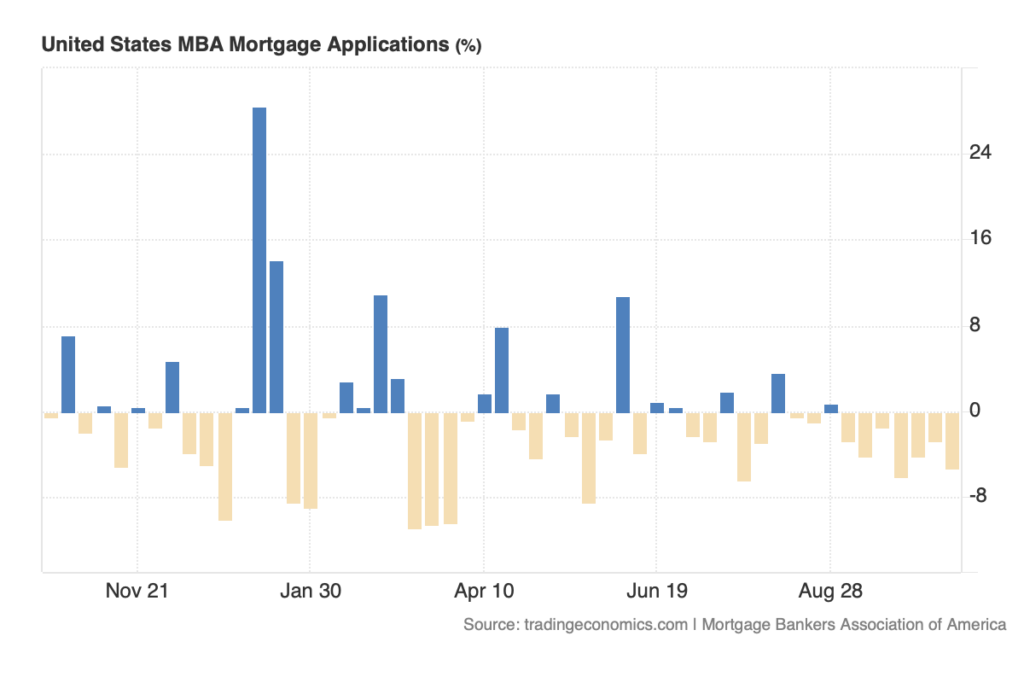
Mortgage Applications Drop for 7th Straight Week Despite Easing Rates

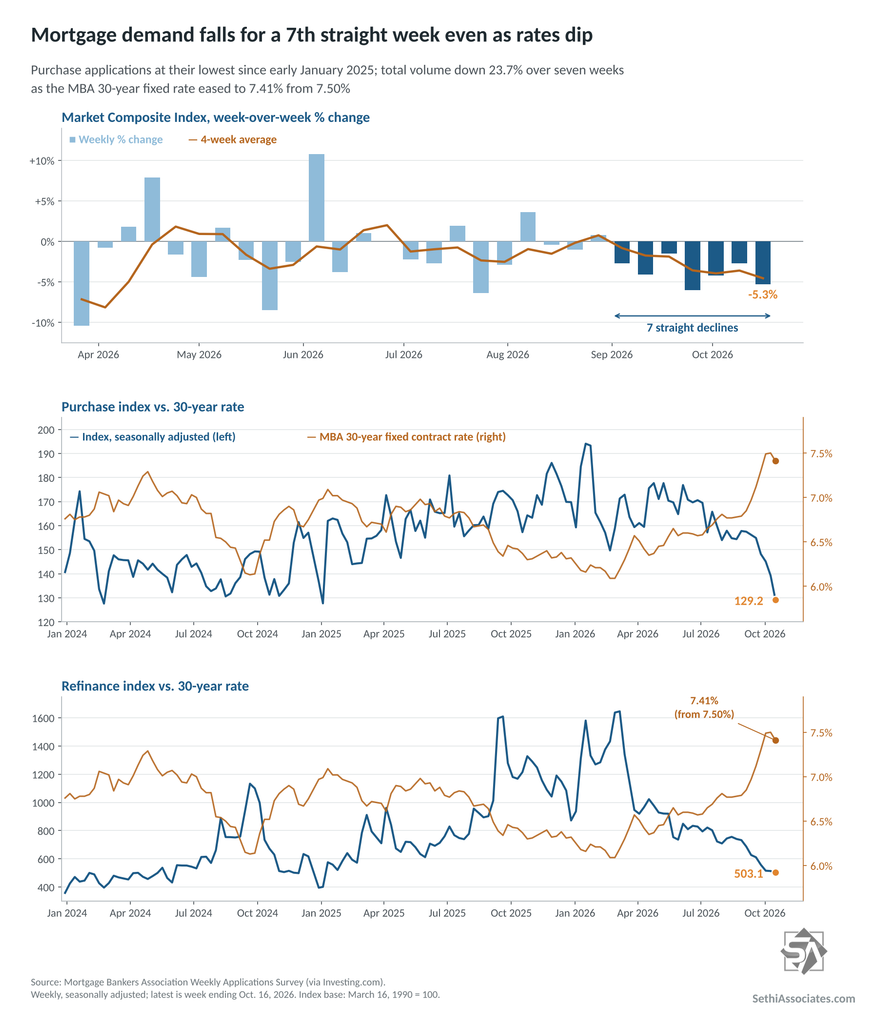
Mortgage applications fell 5.3% last week, according to the Mortgage Bankers Association (MBA), the seventh straight weekly decline, even as the 30-year fixed rate eased to 7.41% from 7.50%, its first drop in over two months. Total volume is now down 23.7% over those seven weeks.

▪️ Purchase applications fell 7% to their lowest level since early January 2025 and were 18% below a year ago.
▪️ Refinance applications fell 2% and were 59% lower than a year ago, with rates more than a full percentage point above where they were then.

MBA’s Joel Kan: “Lower rates were not enough to boost application activity, as both purchase and refinance applications continued to decline.”

CNBC’s housing reporter Diana Olick said buyers are reacting less to the weekly move in rates than to the overall higher level. The MBA’s 30-year rate has gone from 6.09% in February to 7.41% now.

U.S. Mortgage Applications Fall Again

Per the Mortgage Bankers Association, U.S. mortgage applications fell 5.3% for the week ending October 16, marking a seventh consecutive weekly decline and reaching their lowest level since January 2025.

In other words, as we can see in the chart below, the slide continues.