‘The Google of China’ Suddenly Looks Like a Great Deal

Baidu ($BIDU) operates the top search engine in China. Across all devices, the multinational tech company has a 46% market share of China’s search engine market. That’s more than twice its nearest competitor, Microsoft’s Bing ($MSFT) (21%).
In the mobile search space, Baidu is even more dominant, owning about 75% of the market. Despite this competitive advantage, Baidu shares have spiraled, falling by 38% year-to-date.
Has Baidu finally fallen to a point where investors should consider picking up shares? Let’s take a closer look.
A Change in Behavior
Baidu’s largest revenue stream is online advertising and marketing, and its fastest growing segment is AI cloud infrastructure. Alibaba and Tencent are among its biggest competitors.
The stock has been crushed due to a major change in consumer behavior. Instead of using a search engine in a traditional way, with a series of ads appearing prior to the search results, consumers are increasingly using AI, which places the answer directly at the top of the page.
This change has caused a collapse in Baidu’s ad revenue, which by mid-year had fallen by 19% on a year-over-year basis.
This in turn led to a huge earnings miss in the quarter ended in June. Earnings came in at $1.06 per share, well below estimates of $1.37. Revenues were about 1.5% below expectations.
Baidu’s Daily Chart
While Baidu has fallen 38% year-to-date, that doesn’t tell the entire story. First, let’s go to Baidu’s daily chart.
Charts by TradingView
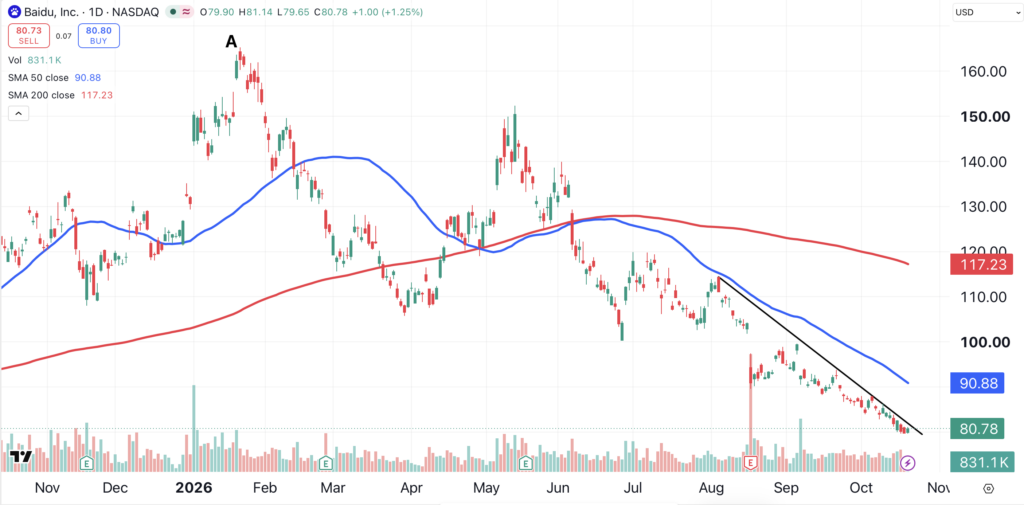
This stock has been cut in half since it traded above $160 in late January of this year (point A). Baidu is trading below its key 50-day (blue line) and 200-day (red line) moving averages, both of which are falling.
Baidu’s Weekly Chart
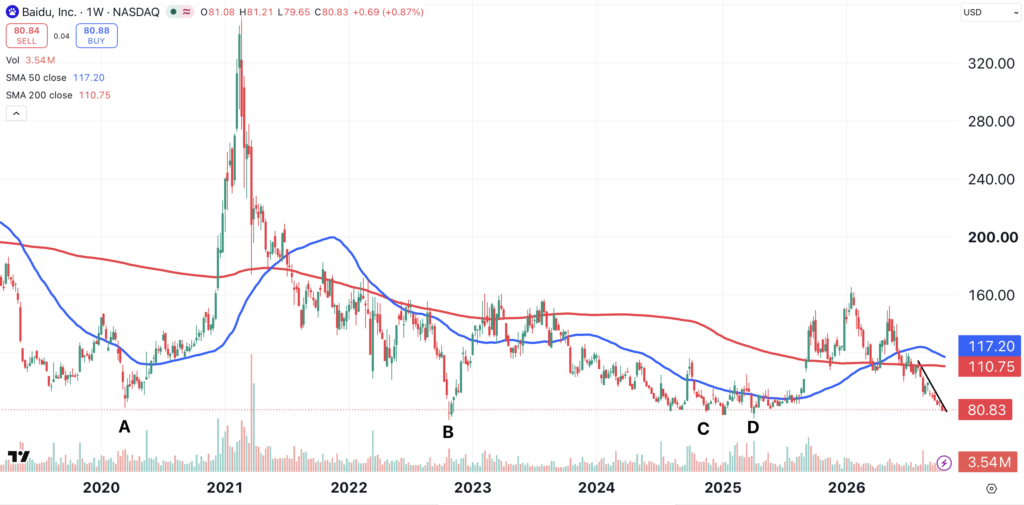
Clearly, this year has been a disaster for Baidu shareholders. However, if we zoom out to the weekly chart, the picture becomes interesting. Going back to 2020, there is a ton of support at or near Baidu’s current price.
In 2020, Baidu’s low was $82 (point A). The stock subsequently rallied above $350.
In late 2022, the stock bottomed out at $73 (point B). Within six months, Baidu traded at $160.
Baidu reached lows of $78 in 2024 (point C) and $77 in 2025 (point D). By early 2026, the stock had climbed to $160.
On Tuesday, Baidu closed at $80. It’s trading in an area that has acted as support for years.
Analyst Actions
Due to the steep decline in Baidu shares, most of the analysts covering the stock have lowered their price targets.
JPMorgan’s Alex Yao lowered his target from $205 to $175, while maintaining an overweight rating. Morgan Stanley’s Gary Yu cut his target price from $130 to $80, and Susquehanna Group reduced its target from $140 to $105.
Bottom Line
Baidu is often referred to as “the Google of China.” This company is still a market leader, but it needs to modify its business model to adjust to new market realities.
With the stock falling sharply and now trading at major support, it’s possible that the majority of Baidu’s negative news is now reflected in its price. We’re buying Baidu here and will add to the position if and when appropriate.
At the time of publication, Ponsi was long BIDU.
