Cerebras Soars After IPO

Cerebras Systems ($CBRS) opens at $350 after pricing IPO at $185/share.
Position: None
Cerebras Systems ($CBRS) opens at $350 after pricing IPO at $185/share.
Position: None
From TheStreet Pro’s Bob Lang, talking about the massive breadth divergence…
There are different ways to analyze market breadth, but I have found 2-3 styles that tell me a great deal about how a trend is working and when there are differences with price. Let’s remember, the price action is the king of all indicators, no matter what other indicators might be telling you. Certainly we can throw up a yellow caution flag if there are divergences between, say price and breadth. Could this be a test? Maybe, but the market needs to prove that it is not significant.
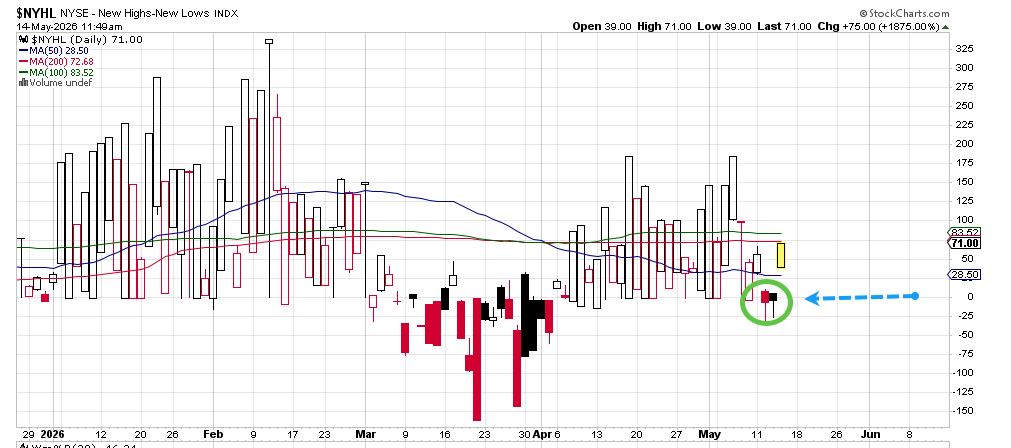
On that accord, we had a noticeable difference in new highs and new lows that is being talked about. On 5/12 and 5/13 you can see the new lows beat out new highs for the first time in weeks, a stark divergence. That explains the early weakness on Tuesday but not the strength on Wednesday. These divergences between new highs and lows are not common but when they do happen it throws a caution flag in the air. This is due to the lack of momentum in new highs, and the push by mega cap-weighted issues moving higher while smaller stocks are trailing. Overall market momentum is slowing down, even as the indices advance with new all-time highs.
The Hindenburg Omen requires this diverging characteristic among others. There is a long track record of weakness following the “Omen.” When it triggers there is an “ominous” moment of selling — usually — and markets move down helplessly. No indicator has a perfect record, though and we have had many Hindenburg Omens over the past several years that scared many investors/traders out of the markets but did not pan out. Divergences like this however are real and we should pay attention at all times.
Below is the criteria for a Hindenburg Omen to occur:
New Highs and Lows: The number of NYSE new 52-week highs and new 52-week lows must both exceed 2.2% (or 2.5%) of total NYSE issues.
Higher Highs/Lows Ratio: New highs cannot be more than twice the new lows.
Upward Trend: The NYSE index must be in an uptrend, defined as being above its 50-day (or 10-week) moving average.
Negative Sentiment: The McClellan Oscillator must be negative, indicating a decline in overall market momentum
Amazon is consolidating at a higher level, preparing for its next move.
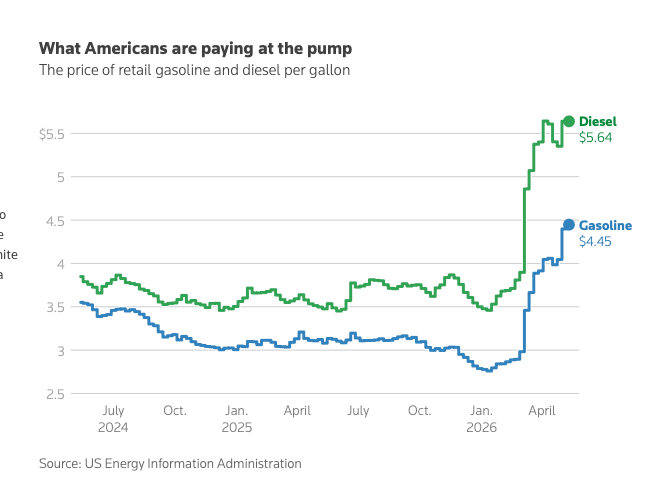
You can see the source for that data in the chart footer, but for what it’s worth, AAA shows the national average for a gallon of gas at $4.534 as of today (May 14).
Position: None
Stock picking is coming back to life. Here’s an example of a name that offers lower risk after earnings news.
What did Trump, Xi, and crew dine on at today’s summit?
Reportedly , Beijing roast duck, and beef ribs with dessert options for American guests that included tiramisu, fruits, and ice cream, and a “trumpet-shell shaped pastry.”
Position: … Hungry
U.S. import and export prices surged in April by the most in four years on oil-market pressures tied to the Iran conflict. This adds further evidence of higher inflation on top of this week’s April consumer price index and producer price index figures.
The import price index rose 1.9% MoM, the biggest increase since March 2022.
Export prices rose 3.3% from the prior month, also the most in more than four years.
And when we strip out petroleum, import prices rose 0.7% month-over-month in April, pointing to other factors than energy driving inflation pressures.
Other factors like tariffs and supply chain issues perhaps?
Position: None
Netflix’s ($NFLX) ad-supported subscription tier now reaches 250 million global users, the company announced at its Wednesday Upfront presentation, up from 94 million last year. (Netflix stopped reporting subscription numbers in Q1 2025.)
Its ad-supported tier will debut in 15 new countries this year.
Netflix also secured another five NFL games, including a Thanksgiving game the company had been publicly gunning for and a Week 1 match in Australia.
Other announcements included an aggressive push into advertising across new content formats. Ads will soon come to its recently launched vertical video feed, as well as its video podcasts—though it’s unclear whether ad-free subscribers will be exposed to these ads. New personalization tools will also debut to improve contextual targeting.
Position: The Pro Portfolio is long NFLX
This morning Visa ($V) published its updated look at the U.S. economy:
Over the last couple of months, we assumed the conflict would be short lived. This month we have once again revised this view and expect the conflict to last through early summer. While we think most of the upside to oil prices has subsided, it will likely take some time for traffic to begin moving through the Strait of Hormuz and for oil production to recover enough to rebuild global inventories. As a result, we now see oil and gasoline prices remaining elevated through at least Q3 of this year, resulting in higher inflation for longer.
This revised set of assumptions has a few material impacts on our outlook for this year and next. For starters, we now see inflation peaking around 3.9 percent on a year-over-year (YoY) basis this quarter as measured by the PCE deflator. The duration of elevated oil and gas prices has also led us to upwardly revise core inflation, which excludes food and energy prices, suggesting that higher energy prices will be passed on through other consumer goods as well. The good news is that the labor market still appears to be on solid footing. With higher headline and core inflation and job growth continuing, we no longer expect any interest rate cuts from the Federal Reserve this year and expect only one 25-basis-point cut in late 2027.
Higher inflation also has the effect of taking a bite out of consumer spending as real (inflation-adjusted) income growth is expected to reach stall speed towards the middle of this year, weighing on real consumer spending. We now expect the economy to grow 2.2 percent YoY this year, down from our estimate of 2.5 percent last month. Inflation pressures should ease next year, which should help lift real income growth once again, but only modestly. We are not expecting much change in next year’s growth outlook, with GDP likely expanding at the same 2.2 percent pace as this year.
In the back of Visa’s May report, on page 3, thumbing through its quarterly forecasts, we find the following:
Q1 2026 GDP: 2.0%
Q2 2026 GDP: 2.3%
Q3 2026 GDP: 2.3%
Q4 2026: GDP: 2.6%
Q1 2027: 2.1%
Q1 2026 CPI: 2.7%
Q2 2026 CPI: 3.8%
Q3 2026 CPI: 3.7%
Q4 2026 CPI: 4.2%
Q1 2027: 3.7%
Position: None
Underneath the pop we’re seeing the shares of Versant ($VSNT) we’re seeing things that confirm a few of our thoughts over at the Pro Portfolio.
First is the continued shift to digital content consumption, which has been highlighted rather nicely in the monthly data published in Nielsen’s The Gauge. While Cable commanded 24.5% of the market back in April 2025, as of February of this year that fell to 20.0%. Where did it go? Streaming, which accounted for 48.0% of TV viewing as of February 2026.
The top three platforms?
Google’s ($GOOGL) YouTube with 12.7% of total U.S. TV viewing
Netflix ($NFLX) at 8.4%
Disney ($DIS) gets the bronze with 5.0%.
Getting back to Versant, linear distribution revenue for its pay TV networks — which include CNBC, MS NOW and the Golf Channel as well as USA, E!, Syfy and Oxygen — was down roughly 7%.
Because advertisers look to spend where consumer eyeballs are, it’s not surprising to see Versant’s advertising revenue fell 5% year over year.
Position: The Pro Portfolio is long GOOGL, NFLX.