Lock In the Consumer Staples Sector With This ETF


Monday was another rough day for the major indexes. On the other hand, it was a pretty good day for the consumer staples sector.
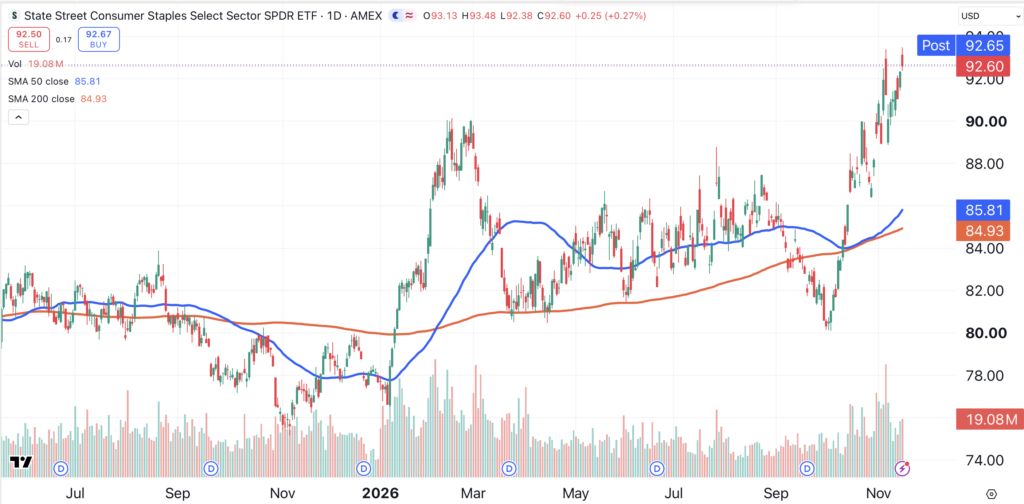
Consider that the S&P 500 is now up 8.7% for the year. Meanwhile, the State Street Consumer Select Staples ETF ($XLP) has gained over 19% year-to-date. Over the past month, XLP has gained 5.87%, while the S&P 500 has fallen by 2.6%.
XLP, which is a bellwether for the consumer staples sector, closed at an all-time high on Monday:
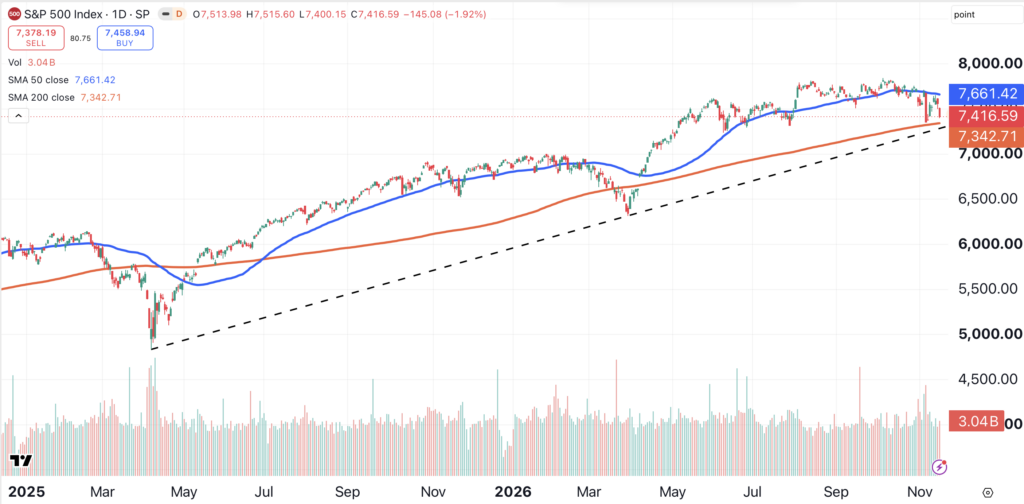
Meanwhile, the S&P 500 last reached an all-time closing high over a month ago, on October 6.
The S&P 500 is now less than 100 points away from its 200-day moving average (red), currently located at 7342. Just beneath it, near 7300, is a trend line that has been intact since April 2025 (black dotted line).
Nasdaq Correction
The Nasdaq Composite also last reached an all-time high on October 6, and has since fallen into correction territory, losing nearly 11%. For the major indexes, a decline of greater than 10% from the highs is considered a correction.
We’ve been selling tech and buying staples for some time now. In recent weeks, we’ve featured J.M. Smucker (here), McDonald’s (here), Walmart (here), and Merck (here). We did this while exiting the semiconductor sector (here).
If you’re late to the party, or if you’re just looking to add a diversified group of staples stocks to your portfolio with one click, I’d recommend the aforementioned State Street Consumer Select Staples ETF ($XLP).
What’s in XLP?
Here’s a recent breakdown of XLP’s top holdings:
Walmart ($WMT) 11.24%
Costco Wholesale ($COST) 9.6%
Procter & Gamble ($PG) 7.7%
Coca-Cola ($KO) 7.6%
Phillip Morris ($PM) 6.1%
Altria Group ($MO) 4.6%
Colgate-Palmolive ($CL) 4.5%
Mondelez International ($MDLZ) 4.3%
PepsiCo ($PEP) 4.2%
Target ($TGT) 4.1%
What’s the Downside?
In recent years, tech selloffs have been temporary. When those selloffs did occur, consumer staples stocks took off, only to fall back to earth as tech came roaring back.
While that could happen again, this time does seem different. We’ve just seen Nvidia ($NVDA), the darling of the market with a 371% return over the past five years, lose 35% since October 6. That stock is technically damaged, closing at a 52-week low on Monday.
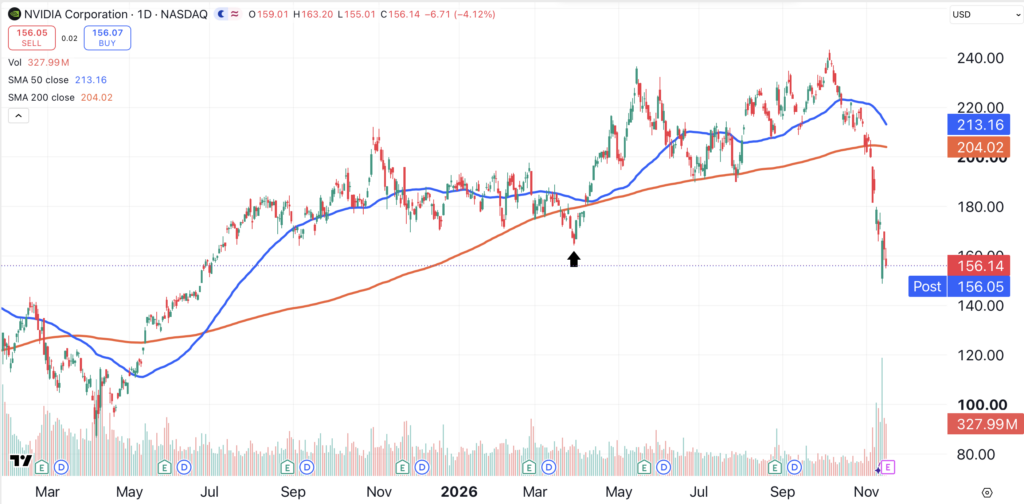
With the price falling below the $165 support level, (arrow), Nvidia could see a further decline. Earnings are expected after Tuesday’s close.
Broader Tech Selling
Although Nvidia’s problems are unique to that company, we’re seeing an across-the-board selloff in semiconductors specifically, and in tech in general.
Since October 6, Micron ($MU) is down 30%. Micron is trading below its 200-day moving average (red), and its 50-day moving average (blue) is curling downward.
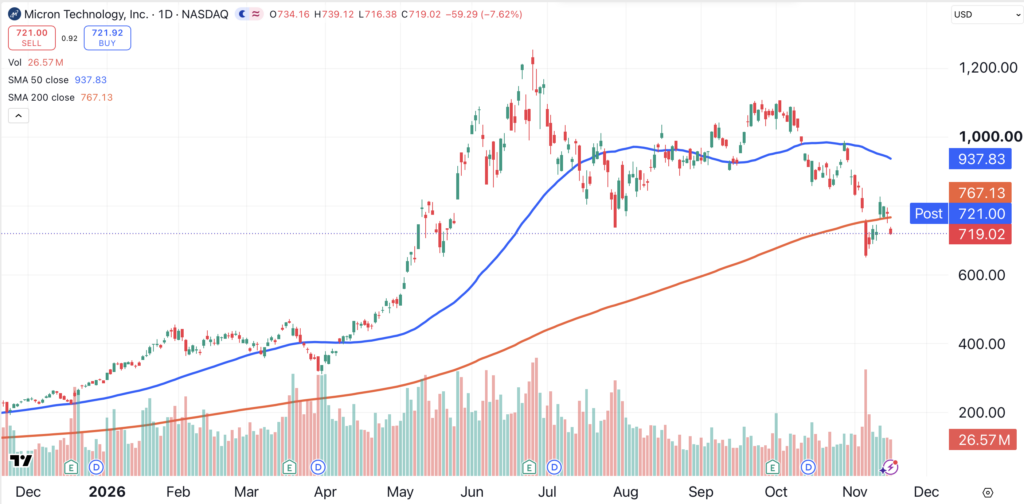
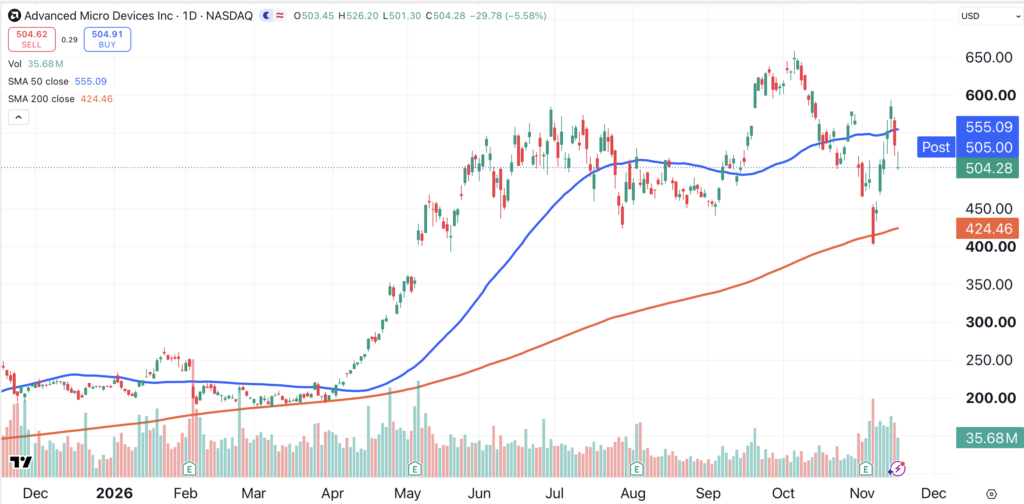
Advanced Micro Devices ($AMD) (right chart) is in better shape than Micron, but has lost 22% since October 6.
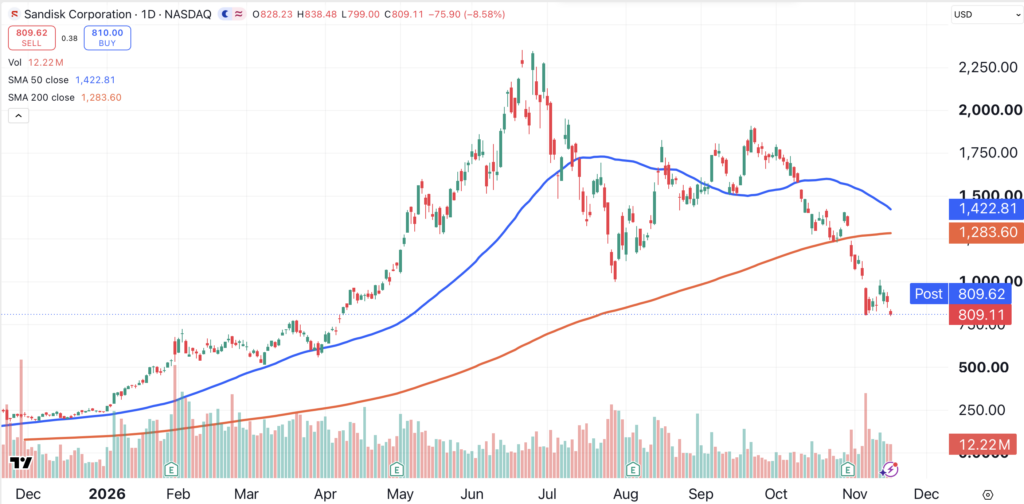
Sandisk ($SNDK) has declined an incredible 65% since June.
Bottom Line
While consumer staples aren’t guaranteed to outperform the markets, they are a steady alternative to volatile tech stocks. These are not the most exciting companies, but they make real products and have real earnings. The State Street Consumer Select Staples ETF provides a solid roster of names in this sector.
At the time of publication, Ponsi was long XLP, MCD, SJM, MRK, and WMT.
