Charting Super Micro After Stunning $7 Billion Update


Shares of Super Micro Computer ($SMCI) plunged 28% on news that the company plans to raise $7 billion to purchase components needed to fill $39 billion in AI server orders.
On the surface, that seems reasonable. Why not raise capital if the result is the fulfillment of orders worth more than five-times the amount raised?
Here’s the $7 billion breakdown:
$1.25 billion via a common stock offering
$3.75 billion via depository shares
$2 billion via an at-the-money (ATM) offering
Bigger Than Alphabet?
Super Micro’s $7 billion capital raise might not seem like much, especially next to Alphabet’s ($GOOGL) recent disclosure of an $84.75 billion capital raise.
However, Alphabet is a much larger company, with a market capitalization of $4.3 trillion. The $84.75 billion capital raise is equivalent to just under 2% of Alphabet’s current market cap.
Meanwhile, Super Micro Computer has a market capitalization of just $17.6 billion. A $7 billion raise is equal to nearly 40% of the company’s current market cap.
In this sense, Super Micro’s capital raise is much larger, when measured against the size of the issuing company, than Alphabet’s. We’re talking about massive dilution of Super Micro Computer shares, and it’s already being felt acutely by SMCI shareholders and reflected in the stock’s price.
Charting Super Micro Computer
Earlier this month, on June 2, shares of Super Micro Computer reached a six-month high. By the June 10 close, SMCI shares had fallen by nearly 42%.
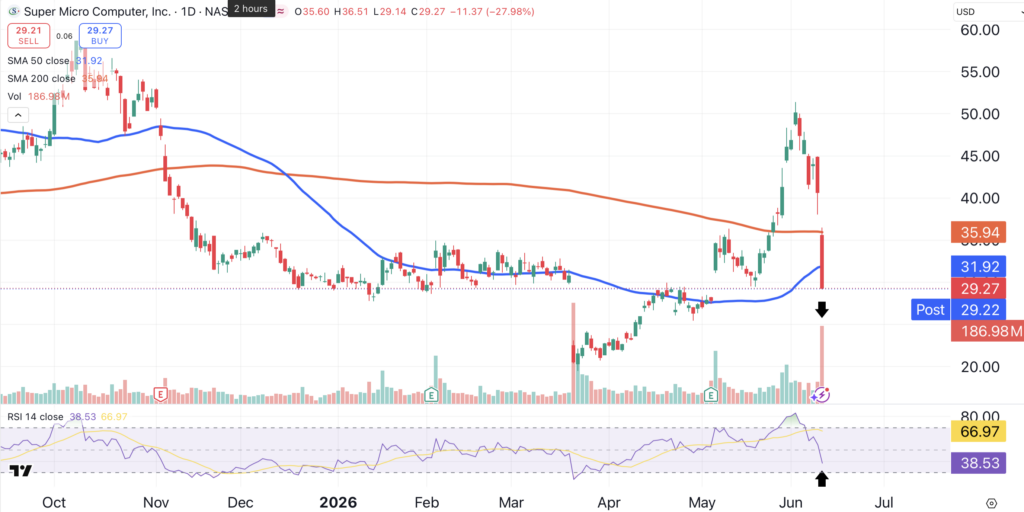
Despite this dramatic decline, Super Micro Computer shares are still not oversold (up arrow), according to the stock’s relative strength index (RSI). Institutional investors were likely among the stock’s big sellers on Wednesday, as volume more than tripled from the previous session (down arrow).
Supply Chain Issues
According to Super Micro Computer, the $39 billion in orders from over 20 clients came in recently, and the capital is needed to fulfill those orders. Clearly, business is booming.
But if that’s the case, why did Super Micro revenues decline on a quarter-on-quarter basis when the company last reported earnings on May 5?
In the quarter ended in December 2025, Super Micro reported revenues of $12.68 billion. More recently, in the quarter ended in March 2026, the company reported revenues of just $10.24 billion, a decline of about 19%.
To be fair, although the company missed revenue estimates in its most recent quarter, Super Micro’s revenues doubled versus the six-month ago quarter, when they came in at just $5.02 billion.
Unprecedented Spending Boom
Super Micro Computer blames the shortfall on severe supply chain disruptions and a shortage of required components. While competitor Dell Computer ($DELL) confirmed difficulty in obtaining certain components, that company saw a sharp increase in revenues in its recently-ended quarter.
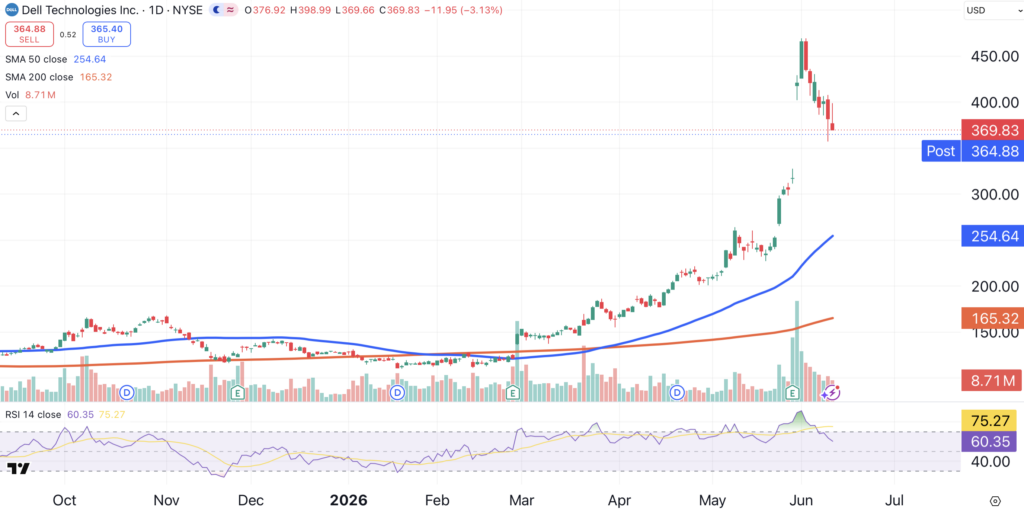
Dell’s chart looks considerably better than that of SMCI. Despite a recent pullback, Dell remains well above its rising 50-day (blue) and 200-day (red) moving averages.
Bottom Line
Although the $7 billion capital to be raised by Super Micro Computer seems reasonable and necessary, shareholders are opting to get out of AI-infrastructure play due to the potential for share dilution.
Will Super Micro Computer become attractive to own again in the future? Probably, but it might be wise to wait until the dust settles. A $7 billion capital raise is quite large for an $17.6 billion company.
At the time of publication, Ponsi had no positions in any securities mentioned.
