Boockvar on Hikes and Rates, Chatter on the Consumer

The following is from Peter Boockvar:
Can a hike tame long rates? Maybe/Chatter on the U.S. consumer/Overseas news
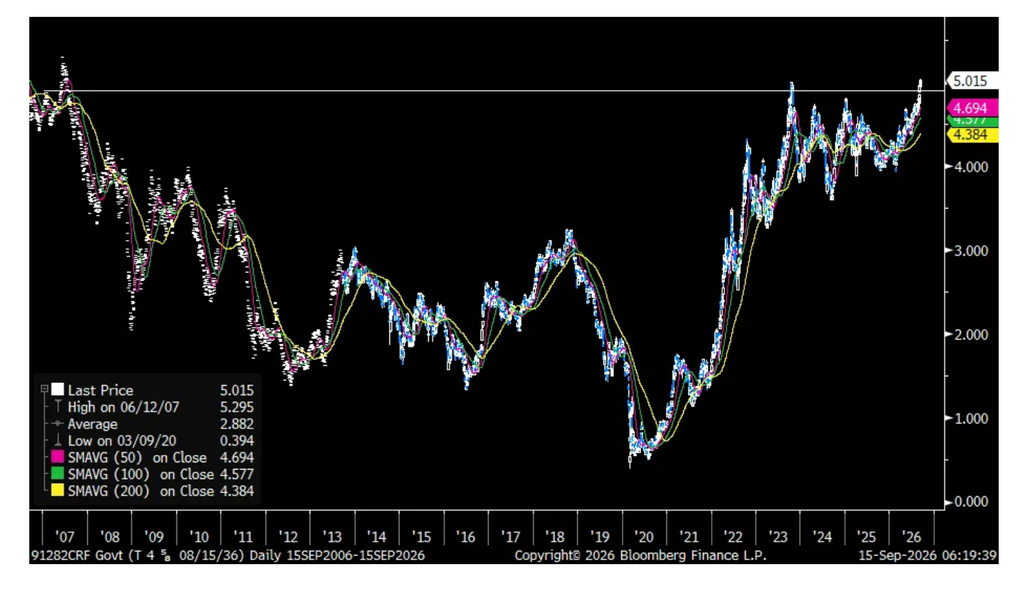
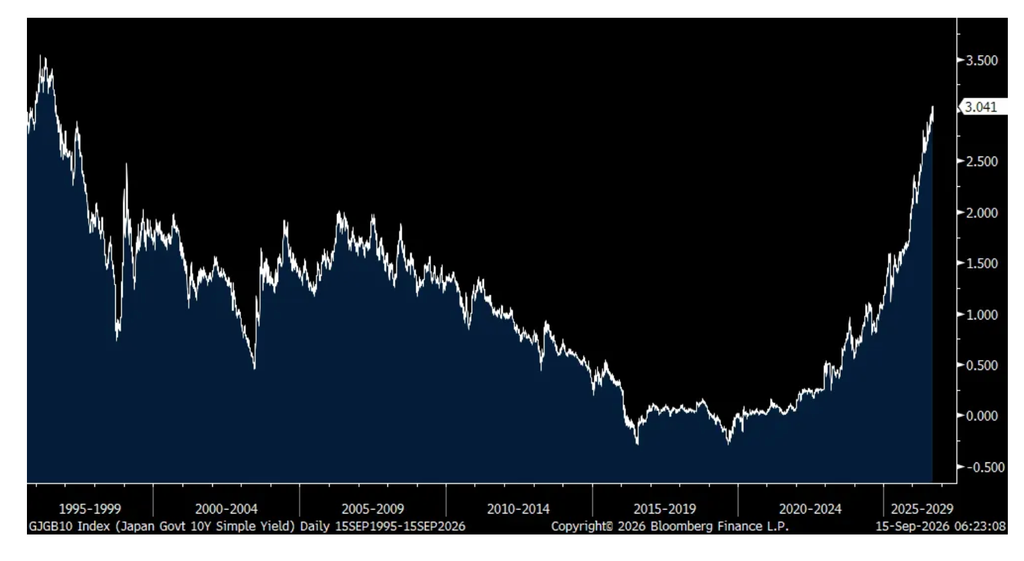
Just to remind, a close above 5% in the 10 yr note yield would be the first time since July 2007. The question after Wednesday afternoon is whether a Fed rate increase on the short end can calm this move on the long end as some hope/believe. As I think that much of the move higher in long rates has been REAL rates, I’m skeptical it could. What could instead is if the Bank of Japan this week not only raises rates but emphasizes the need for more, and long rates in Japan can fall, that might calm the rise in rates globally.
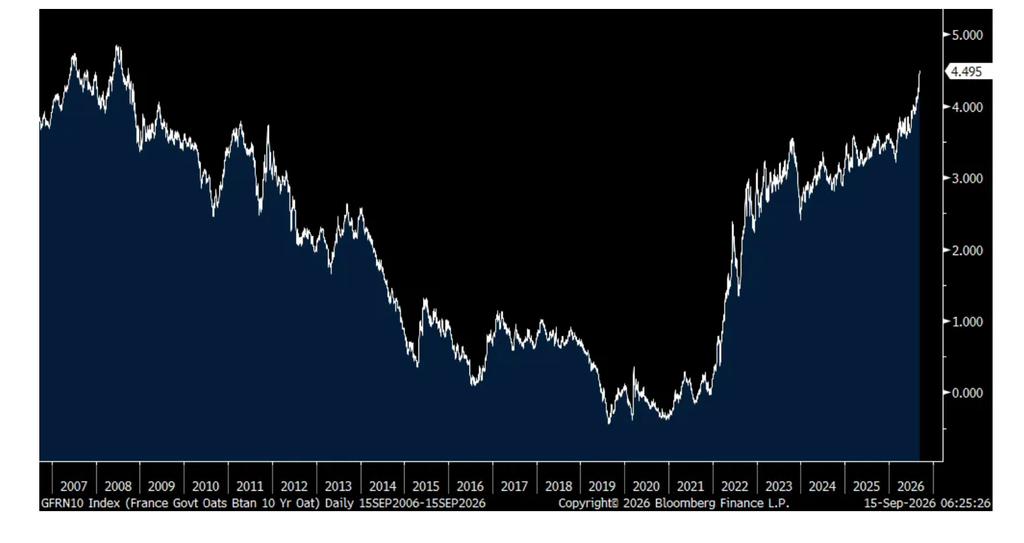
And the rise in rates today is global again with the 10 yr JGB yield in particular at a fresh 30 yr high, the 10 yr French Oat yield at a new 18 yr high, the German 10 yr Bund yield now at a 17 yr high and the UK 10 yr Gilt yield at an 18 yr high.
10 yr Treasury Yield
10 yr JGB Yield
10 yr French Oat Yield
In case you didn’t see, Bank of America fell 5% yesterday after they said investment banking fees in the quarter are expected to be under expectations and trading results were going to be flat q/o/q. This is what Brian Moynihan said on the consumer and business, and as always is positive:
“So if you look at the consumers in the month of August, they were up 4% of spending into the economy versus last August. And yes, gas drove a part of that. But the reality is that there was more spending on cruise bookings, more spending on restaurants, both quick serve, a lower growth rate, but regular full serve restaurants, a higher growth rate.”
“So the consumer spending on a broad basis, out-of-home entertainment, it’s been big. The movies have come back because they’ve had some good movies. So the consumer is spending money. And if you look at their paychecks, you can see the paycheck and you can see the wage growth is 3% plus to 4%.”
“And then we look at their credit. The credit quality is as good as it’s been in a long time…They’re normalized to levels that are equivalent to where they were pre-pandemic.”
“On the small, medium sized business, the good news is they’re using lines of credit a little bit more. They think about all the issues that you read about in the paper every day, but the good news is credit card is good in the commercial book, that the small and medium sized loan growth is solid. They’re using their lines, not all the way back to where they used them, but they’re using their lines, which is good news. And they seem to have a stable employee base…So we feel very good about the underlying US economy.”
From Dave & Buster’s, down 11% pre-market:
“It’s a tricky reality of where we are right now. As we’ve communicated in the past, certainly, that lower end consumer has been impacted more. That’s not unique to us, but that is a pressure we’re facing. I guess what I’d say, and I think you all have noted that we didn’t discuss the economy at all in our prepared remarks. And the reason is we believe all these areas that we’re focused on, there’s latent and significant opportunity there, notwithstanding the environment.”
“I’ll just talk about maybe the occasions with kids and occasions without kids. That occasions without kids is where we’ve seen more of a decline. And so when you think about how that’s impacting our strategy, we are an adult first occasion, but families are welcome, and we can’t alienate families. And so what you’re seeing is our focus on where do we drive that appeal for the adult occasion.”
The August Cass Freight shipments index rose 5% m/o/m and by 2.1% y/o/y and which marks “the first y/o/y gain since January 2023. This ends a 42 month downturn by this measure, the longest on record.”
The caveat, “As this roughly offsets the declines in the past few months, we hesitate to describe this as a major improvement in freight demand.”
As for pricing where we know trucking spot prices have risen sharply, they were up another .7% m/o/m and by 11.3% y/o/y. “The sequential increase is in line with expectations and as indicated by the spot market. Even as spot rates slow with modest sequential declines, the much larger contract market is adjusting higher.”
China’s economy in August remained a really mixed bag. Retail sales remained soft, up just .4% y/o/y, half the estimate as home prices continue to drop with weak sales still. From a wealth effect impact, I tie the two together and believe consumer spending won’t inflect much higher until home prices stop falling. Industrial production grew 5.2% y/o/y which was above the estimate of 4.8% and we know certain areas like EV’s, solar panels, robotics, tech hardware and software, etc… are doing well.
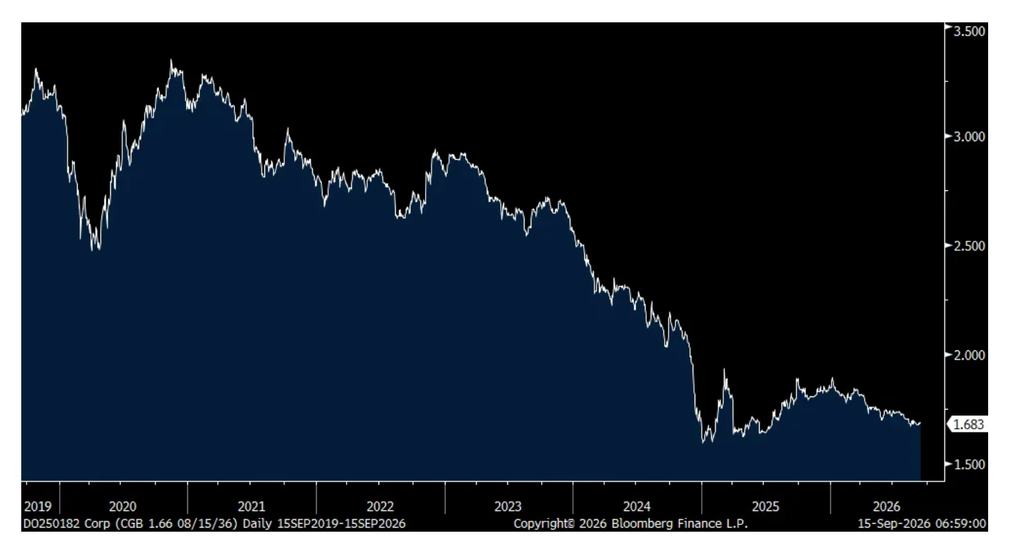
While yields around the world continue higher as we know, the Chinese bond market is the best performing. Their 10 yr yield was little changed in response to the data but only at 1.68%, just off the lows seen in early 2025.
China’s 10 yr Yield
UK payrolls in August shrunk by 26k, well more than the estimate of a 5k person drop and is now down for 7 straight months. Pay growth ex bonuses in the 3 months ended July rose 3.5%, unchanged with June with the private sector up 2.8%, near a 6 yr low.
There was also a drop in job openings and the ONS said “was driven mainly by smaller businesses, which cite labor and operating costs as reasons for not hiring new staff of replacing leavers.”
As seen with the Labor budget over the past year plus, we’re witnessing again that you can’t tax your way out of a budget problem because of the negative economic impact.
Finally with the economic data, the September German ZEW investor confidence index on their economy was little changed at 34.7 vs 34.2 in August. The positive was more in the Current Situation which was less negative at -47.1 vs -61.1 last month.
The ZEW said, “The ZEW indicator of economic sentiment remains stable. Experts are cautiously optimistic about a recovery of the economy. The growth continues to be driven by fiscal measures and is further bolstered by export momentum. Nevertheless, the risks are considerable: Persistent high energy prices resulting from a continued war in Iran and the additional uncertainty caused by hybrid attacks place a burden on the economy.”
