Boockvar Digs Below the Surface

From Peter Boockvar:
Earnings & the help it’s getting/TSMC price hikes/Margin debt/Pizza/Other notables
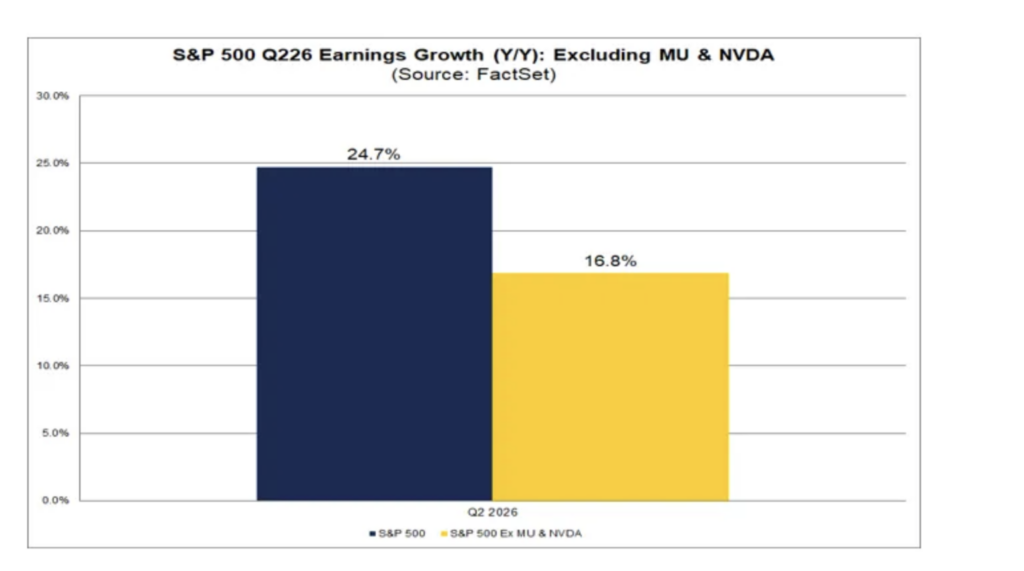
As my readers know, I like to dig under the surface and provide a broader perspective on things where we many times only hear about the surface level headlines. As the earnings reports start to pile up, this was an updated chart from FactSet yesterday and highlights the huge contribution to earnings growth for the S&P 500 from just Micron and Nvidia. What I’m also watching closely as part of the 16.8% Q2 growth rate ex-them, is the contribution from ‘other income’ on the P&L’s of the hyperscalers. As a reminder, 12 percentage points of Q1 earnings growth was ‘other income’ which mostly made up the marked to mark valuation changes in their holdings of private equity, like in Anthropic, OpenAI and now SpaceX with it now public, among some others.
The data center buildout continues to get more expensive, not that price has been an issue for the spenders, just yet. From Nikkei, “TSMC is set to raise prices for both advanced and mature chip production services by up to 10% in 2027 to reflect rising costs for materials, manufacturing equipment and construction of new overseas chip plants, multiple sources told Nikkei Asia…The base price hikes range from 5% to 10%, depending on the customer and product, according to people with knowledge of the matter. For additional high-performance computing chip orders beyond customers’ original forecasts, the company plans to charge an extra 10% to 15% premium on top of the base increase. As a result, the total price increase for some advanced chip orders could exceed 10%, the people said.”
Taiwan Semi helped to power a 59.4% y/o/y June export orders gain for the entire country of Taiwan. The estimate was for a gain of 47.3%.
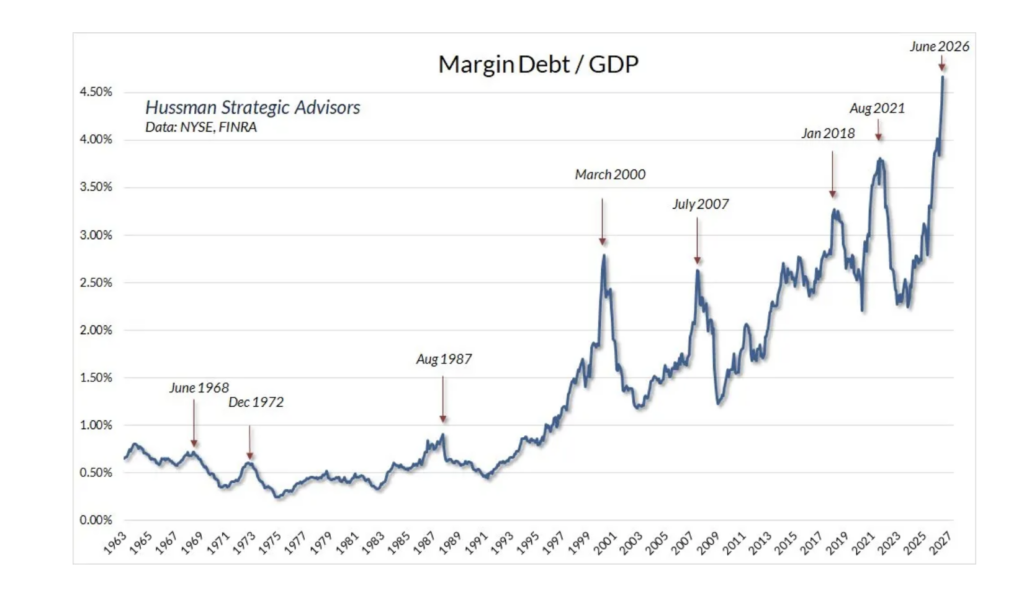
I don’t usually pay much attention to the NYSE margin debt number as it historically just mimics moves in the stock market but when something gets extreme, one has to take note. This was a chart I saw a few days ago from John Hussman who put into context the current level of margin debt relative to GDP. It’s not a market call at all but does highlight the elevated use of debt and I do want to mention again that last week Wells Fargo talked about the 30% increase in securities based lending their financial advisors are doing with clients.
Domino’s Pizza was up 2% yesterday after earnings and they said this of note:
“The QSR industry in the US has been struggling with order counts during a difficult period of macroeconomic uncertainty. We believe this continued in Q2, where QSR order counts were flat. And despite this backdrop, demand for Domino’s remained incredibly strong. While we have not shared specific order count numbers in the past, and I won’t start sharing them now on my last call what I will tell you is that our order counts were up meaningfully in total and individually in our delivery and carryout businesses. This means that while other restaurants were fighting for orders, millions of new customers came to Domino’s.”
And why? Is it because the pizza is so good? “Now one of the reasons we grew orders in Q2 was tapping into the aggregator marketplace. We continue to grow on both Uber and DoorDash and believe that we are now the number one pizza player on both platforms.”
But, “same store sales in Q2 did not meet our expectations due to the miss on ticket (they were up just .1% y/o/y). I don’t believe this miss was due to macroeconomic headwinds. Those were assumed in our plan. The miss on ticket was largely within our control which means we can and will address it moving forward. In Q2, we were lapping our Stuffed Crust Pizza launch which carried a higher ticket and mix in the prior year. To roll over this, we launched a premium series, inclusive of our new Slice Sauce. This did not resonate with customers the way it needed to. The messaging wasn’t compelling enough. The result was a drag on ticket which impacted our results.”
Macro still mattered though, said from the CFO: “Our business continued to be impacted by a challenging macro environment which is pressuring consumers as well as heightened competition.”
From Ryanair, down 4.6% yesterday after earnings and lower a touch again today:
“Q1 fares, which benefited from a full Easter during April 2025, required stimulation as the Middle East conflict led to consumer hesitancy, concerns about EU jet fuel shortages, economic uncertainty and later bookings.”
“While summer ‘26 volumes are strong, the booking window remains closer in than last year which further reduces visibility. Despite a recent slight uptick in volumes and less price stimulation, Q2 pricing is trending modestly down y/o/y. That is a decline from where we were on the full year results and we were hoping that Q2 pricing would be flattish y/o/y. They’re now trending modestly down low to middle single digits.”
Overseas, the July German ZEW investor confidence index of the German economy improved to 26.3 from 10.5 and above the estimate of 15.3. The Current Situation though was still deeply negative at -77.6 but up from -81 in June. The ZEW said “The economic outlook continues to improve in July; it seems that the reforms are having an effect. Especially the export oriented sectors as well as domestic demand experiencing sustained growth. Nevertheless, the uncertainty associated with the developments in the Iran conflict and the oil price remain a crucial factor affecting the prospects for a recovery of the German economy.” This data point is never market moving however.
In the UK, which is welcoming a new PM as we know, payrolled employment fell by 4k but the estimate was for a drop of 8k and follows a gain of 3k in June. Jobless claims in June rose 6.7k and May was revised sharply lower by 30k. As of May, their unemployment rate held at 4.9%. Also through May, weekly earnings ex bonus rose 3.4% y/o/y as expected and the same pace seen in April and compares with the expected CPI print for June that will be seen tomorrow of 2.7% headline and 2.5% core.
We now watch for the economic plans from Andy Burnham and the long end of the gilt market is certainly eager to hear as it stands at 5.03%, a two month high.
The Takaichi administration agreed on its economic and fiscal program that includes a lot more spending and the 10 yr JGB yield rose 3 bps overnight even though the news was not a surprise but global bond markets are paying a lot more attention and I believe calling out those with excessive debts and deficits with the punishment of higher rates. The US 10 yr Treasury yield is back to 4.60%.
With expectations of another BoJ rate hike, especially with another round of fiscal spending, the 2 yr JGB yield continues to hover around 30 year highs.
Position: None
