Blowout Retail Sales Report Shows Consumers Continue to Consume

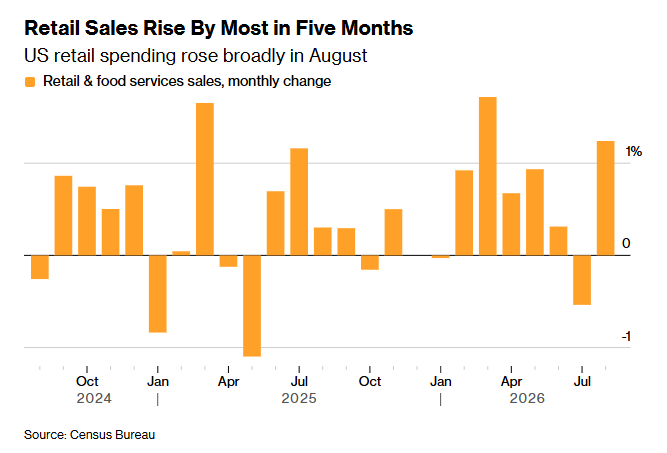
U.S. Retail Sales Advance (M/M): Aug: 1.2% (est 0.8%; prev -0.6%; prev R -0.5%)
- Retail Sales Ex-Auto (M/M): 1.4% (est 0.6%; prev -0.3%; prev R -0.2%)
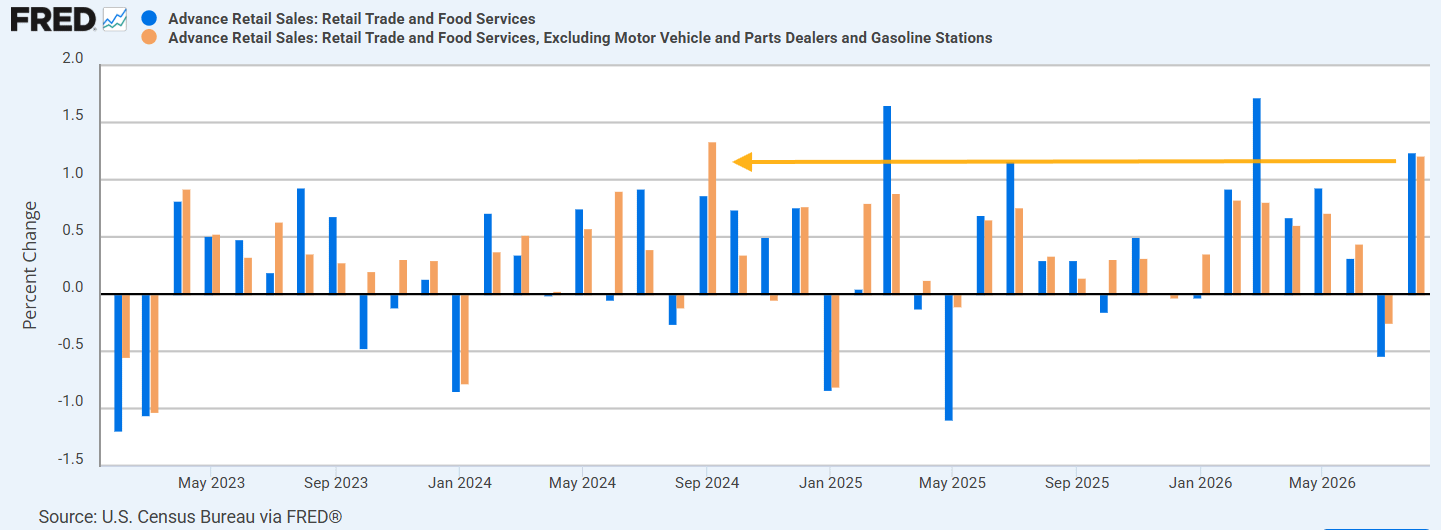
- Retail Sales Ex-Auto and Gas: 1.2% (est 0.4%; prev -0.2%; prev R -0.3%)
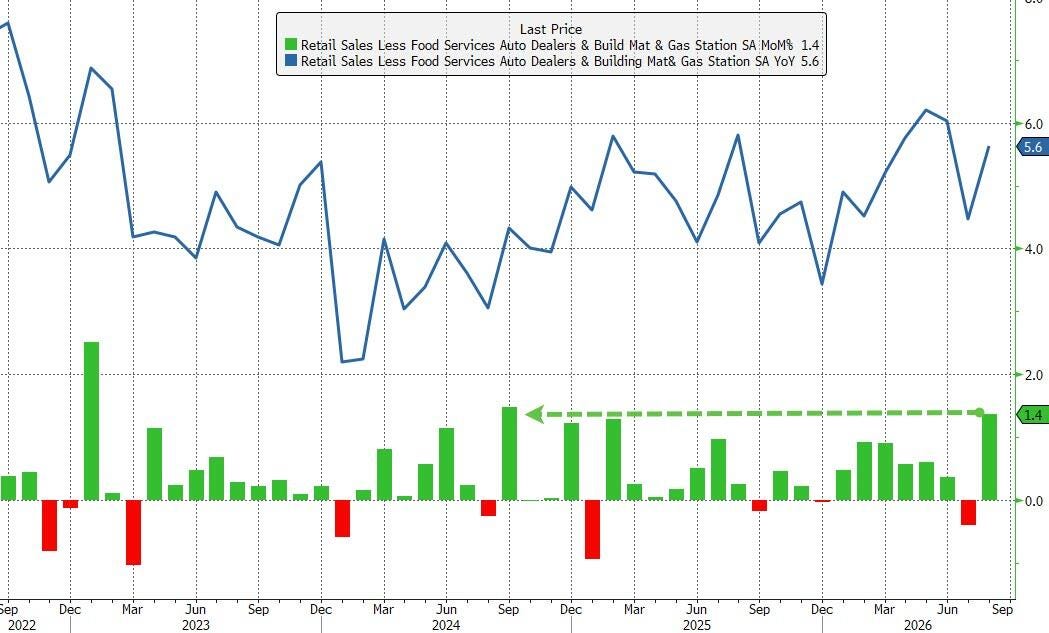
- Retail Sales Control Group (M/M): 1.4% (est 0.5%; prev -0.4%)
Note: All changes m/m unless otherwise noted. Usual caveats — First, these are not adjusted for prices so that also should be taken into account. Second, this report is more of a goods report with only one main services category (bars and restaurants) so it is not a complete picture of consumer spending, representing only around 35% of the total. Data on inflation-adjusted personal spending and overall services spending will be out later this month, offering a fuller picture of consumer outlays in the month. Finally this report is seasonally adjusted which can always cause distortions, particularly for retail sales which are very lumpy throughout the year.
Executive Summary
- August retail sales came in far better than expected and beat across every measure, with headline sales +1.24% from July (m/m) versus +0.8% expected, the best in five months.
- The advance was very broad with 12 of the 13 major categories higher.
- The key control group, which feeds into GDP as the goods consumption component, jumped +1.36% against a +0.5% estimate — what Bloomberg notes is the most in nearly two years — while ex-autos and gasoline also rose +1.21%, the best since September 2024.
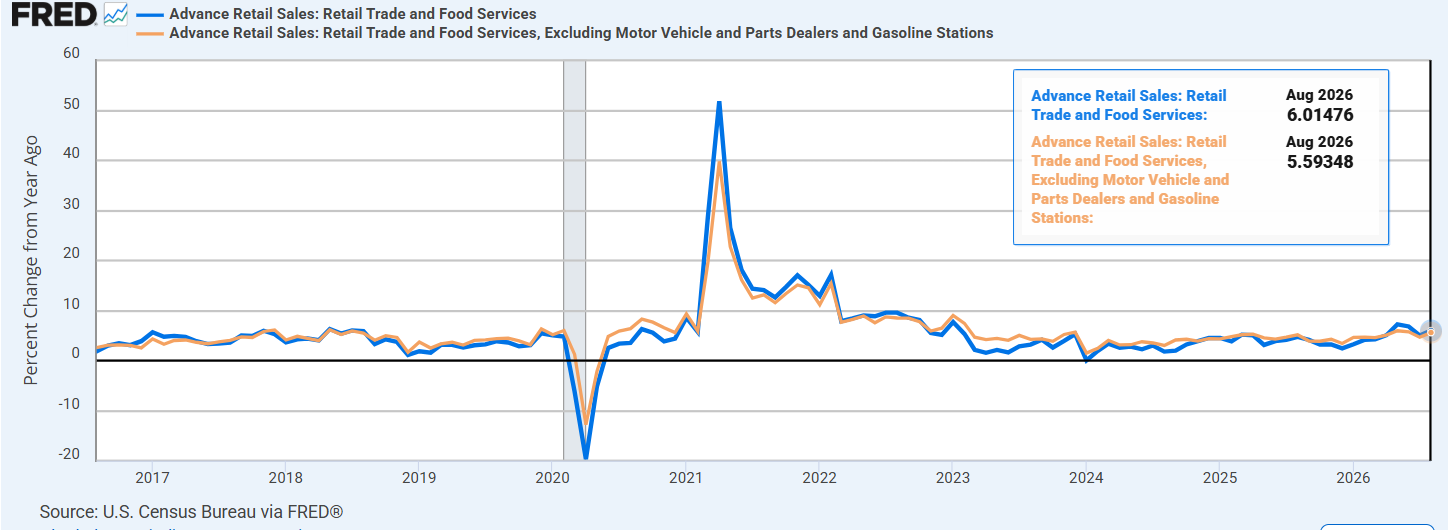
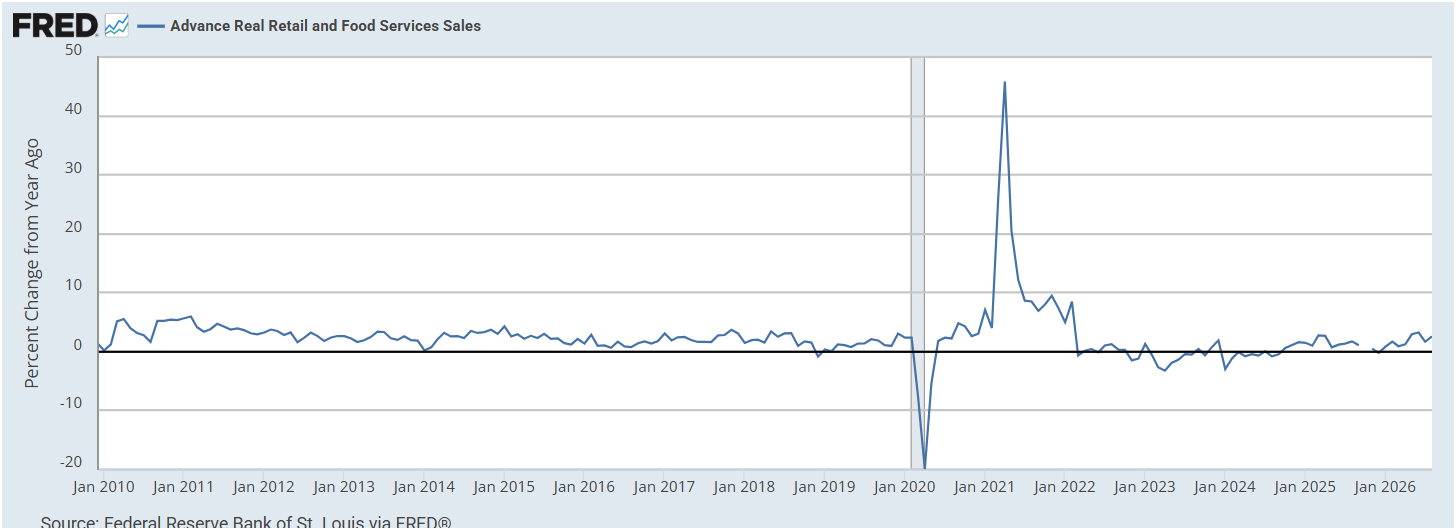
- From a year earlier headline sales accelerated to +6.01% from +5.03% in July, and real (inflation adjusted) sales improved to +2.58% from +1.67%.
Headline and Revisions
August retail sales rose +1.24% m/m versus the +0.8% median estimate in Bloomberg’s survey of economists, the largest monthly gain in five months, and July was revised up slightly to -0.54% (from -0.58% initially).
Autos and Gasoline Gave a Boost
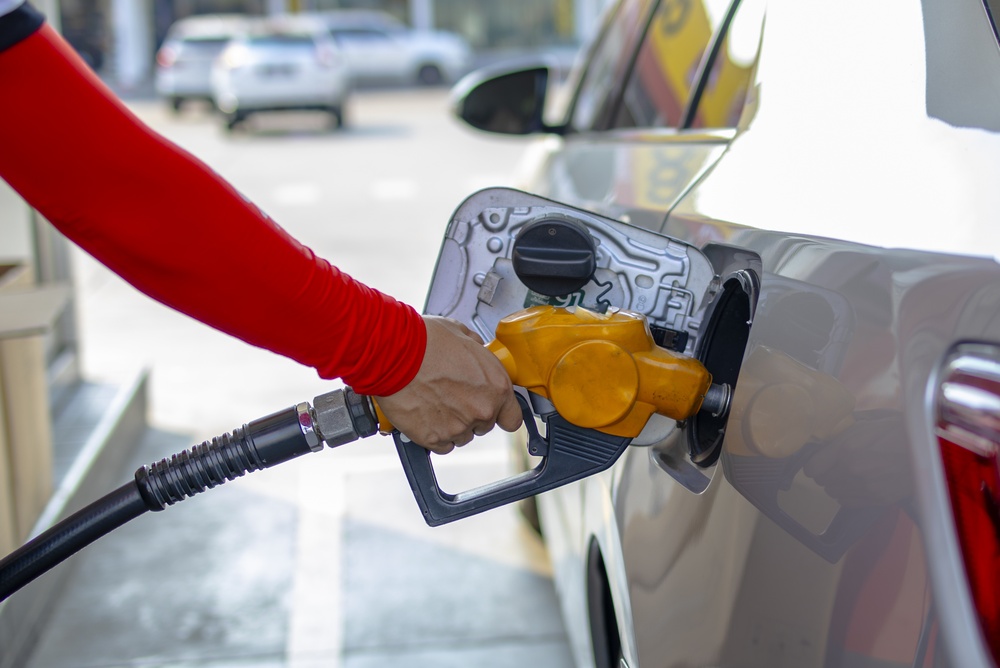
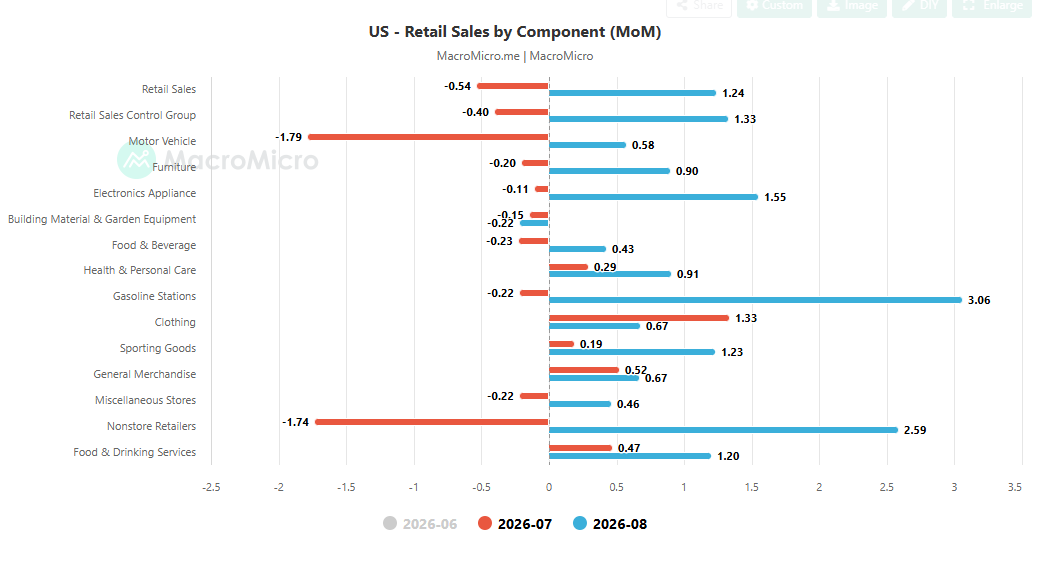
Gasoline stations rose +3.06% (after -0.22% in July revised from -0.91%) and are now +20.96% y/y. Per Bloomberg, the nationwide average price of a gallon of gasoline held above $4 through August according to AAA data, and has since climbed above $4.30 this month as wars in the Middle East and Ukraine limit fuel supplies — so this line should stay elevated near-term.
Motor vehicles rose +0.58% (after -1.79% in July) and +2.12% y/y. Bloomberg notes industry data earlier this month showed auto sales climbed in August to the strongest pace since April 2025.
Stripping both out, sales ex-auto/gas still rose +1.21% (after -0.25% in July), the best since September 2024.
GDP Readthrough
Control group sales (headline sales minus food services, auto dealers, building materials, and gasoline stations), which feed into GDP as the goods consumption component, jumped +1.36%, nearly triple the +0.5% estimate and the most in nearly two years per Bloomberg, easily reversing July’s -0.44%. The control group y/y accelerated to +5.58% from +4.41% in July.
That should provide a meaningful upgrade to third-quarter goods consumption.
Details Show the Breadth of the Advance
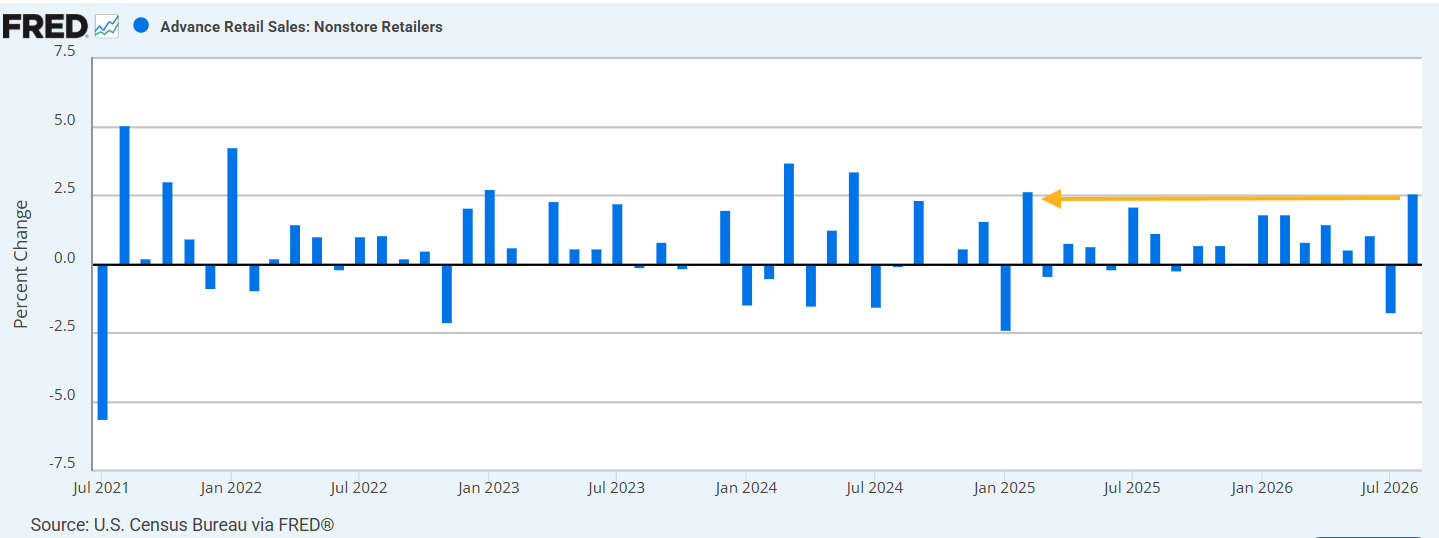
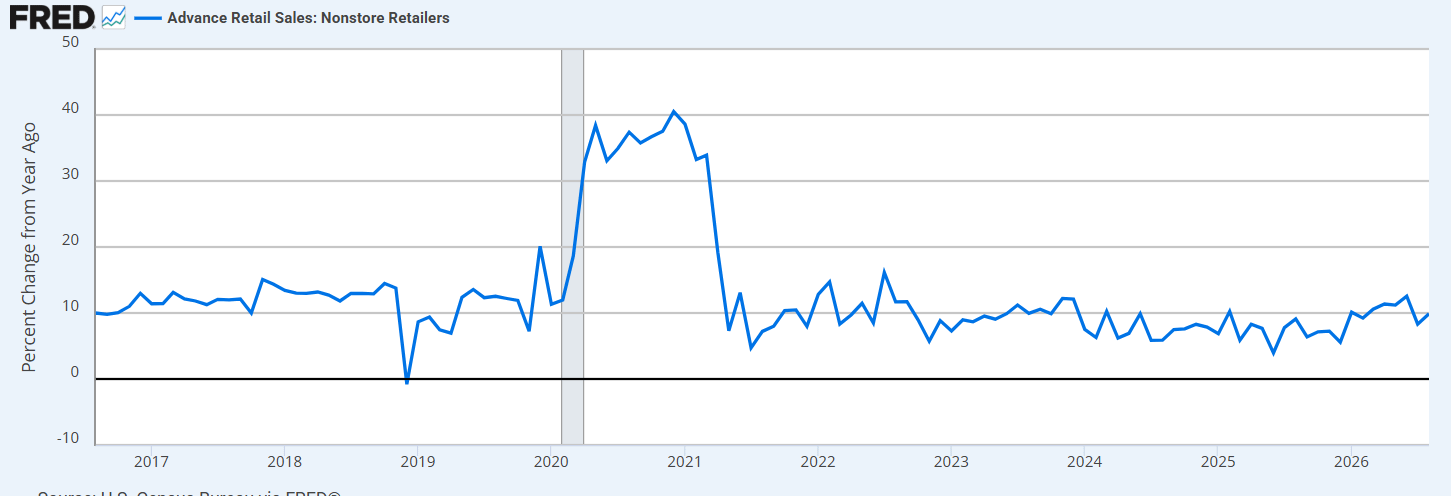
Twelve of the 13 main categories were higher (after seven in July, 12 in June) led on a percentage basis by gasoline +3.06% as noted and nonstore/online retailers +2.59%, the most since February 2025. That more than reverses the Prime Day distortion from July — Amazon.com ($AMZN) moved the event to June this year from July last year, which saw July fall -1.74% (as revised). The y/y lifted to +9.88%.
Other gainers included miscellaneous stores +1.85% (after -0.58% in July and +13.99% y/y, the strongest of any category on an annual basis), electronics +1.55% (+7.84% y/y), sporting goods +1.23% (+10.74% y/y), and bars/restaurants +1.20% (discussed below) followed. Health & personal care +0.91%, furniture +0.90%, clothing +0.67%, general merchandise +0.67%, motor vehicles +0.58%, and food & beverage +0.43% rounded out the gainers. Bloomberg notes back-to-school shopping likely supported general merchandise, clothing, sporting goods and electronics.
Food services & drinking places (bars/restaurants, the only service in the report) climbed a robust +1.20% (after +0.47% in July) and +5.85% y/y — a useful signal since discretionary dining tends to crack first when households are stretched.
The lone decliner was building materials -0.22% (after -0.15% in July), though it remains +5.13% y/y.
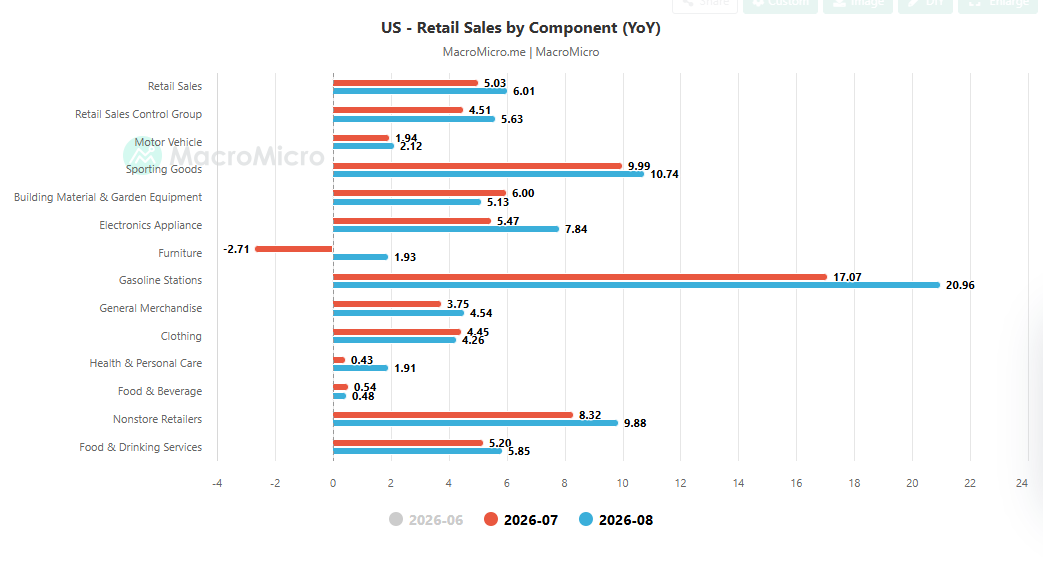
Notably, furniture at +1.93% y/y turned positive on an annual basis for the first time since August 2025, now leaving food & beverage (at home) at +0.48% y/y the weakest of the 13 categories, the only one below 1%.
Year-Over-Year Also Robust
Headline retail sales accelerated to +6.01% in August from +5.03% in July, while core (ex-auto/gas) rose to +5.59% from +4.67% and the control group to +5.58% from +4.41%. All three remain below the May-June peaks but reaccelerated sharply off July’s trough.
Even Taking Out Inflation
Even stripping out inflation, real (inflation adjusted) retail sales improved to +2.58% y/y from +1.67% in July, back above the long-run average of a little over 2%.
So no matter how you slice it, this was a very strong report.
Analyst Reaction
- “This consumer has time and time again surprised us with their resilience,” said Shannon Grein, an economist at Wells Fargo & Co. Still, “I don’t think the consumer has enough support behind them to keep at this pace. This is a very strong retail sales print, so I’d expect them to pull back.” (BBG)
- “It is hard to imagine that the degree of strength seen in August retail sales can be sustained through the fall, but I expect the consumer to weather this storm,” Stephen Stanley, chief US economist at Santander US Capital Markets LLC, said in a note. (BBG)
- “Strong consumer demand gives the Fed room to tighten — though the costs are likely to fall disproportionately on interest-sensitive sectors like labor and housing that are already weak.” — BBG’s Eliza Winger
- David Russell, head market strategist at TradeStation, told ZeroHedge the report “mirror[s] the strong payrolls report, dispelling worries about a slowdown anytime soon,” adding that “even if higher prices are making consumers unhappy, they’re not doing much to hurt the economy yet.” His read on policy is blunt: “The data is hawkish and the case for a rate hike keeps growing.”