An Adverse Market (Structure) Event Is Growing More Likely

*Anyone who has observed the market’s spectacular intraday volatility and outsized daily swings over the last several weeks should realize that something is amiss — the market is not behaving normally, it seems destabilized.
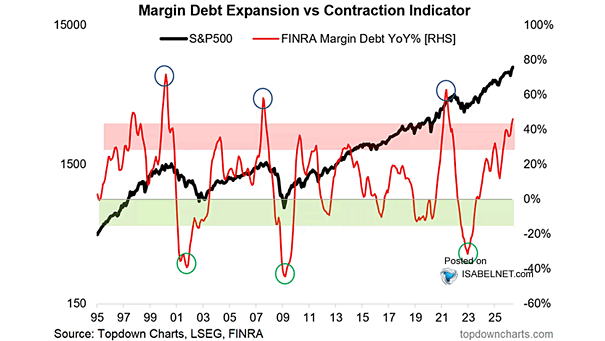
* The proliferation, popularity and acceptance of leverage products and portfolio concentration in quantitative strategies, margin debt, the options market and leveraged ETFs argue in favor of rising odds of another October 1987 (“Black Monday”) or a 2018 “Volmageddon” (or Vix Bloodbath) event.
* As noted in my Diary over the last few months, the market has grown casino-like in which gambling has been encouraged and traders have adopted the mindset of race-track bettors.
* Price discovery has become distorted and compromised as an increased number of market participants worship at the price of momentum (and not value) — in this backdrop YOLO (“you only live once”) investing and FOMO (“fear of missing out”) are conspicuous (and potentially toxic) conditions.
* But as night follows day and at a date uncertain, the market will discover that momentum is a two-way street that travels faster and more persistently on the downside than it does on the upside.
* In summary, changes in market structure that are implicitly celebrated in rising markets pose an unfathomable risk on the downside.

“Whenever you find yourself on the side of the majority, it is time to pause and reflect.“
– Mark Twain
The current speculative and levered conditions in the market remind me of the investment backdrop that immediately preceded the dramatic market declines of Black Monday (October 1987) and Volmageddon.
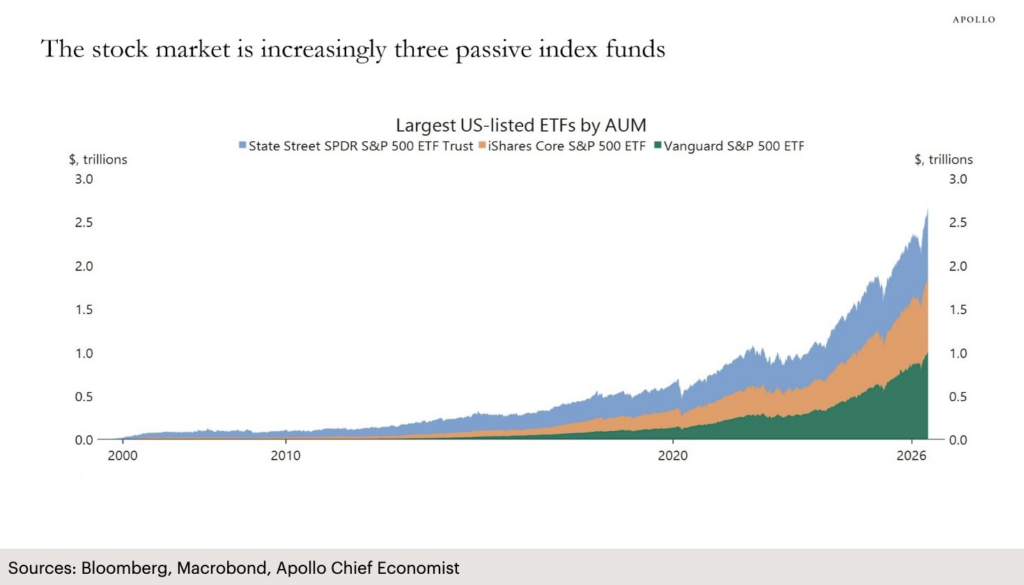
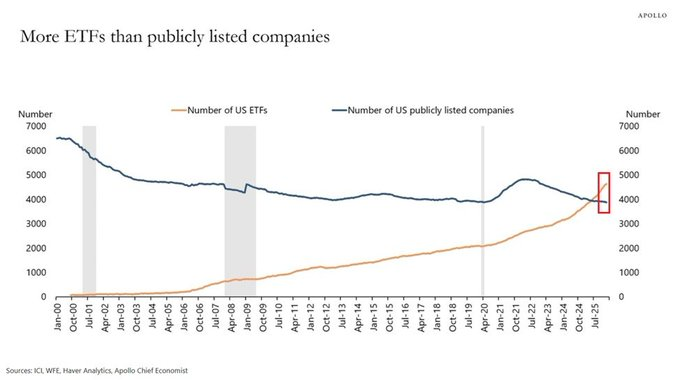
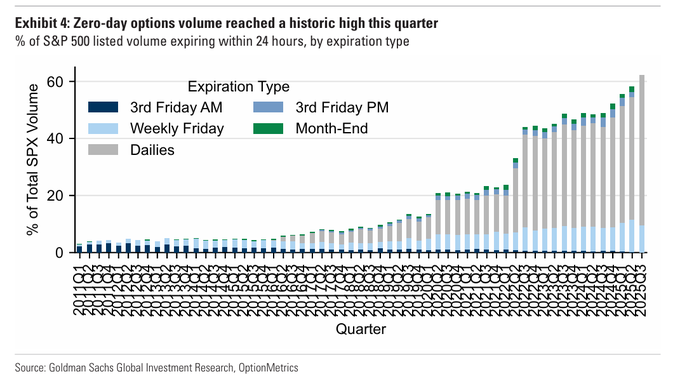
Never have passive funds and levered quantitative strategies been so dominant, leveraged ETFs so popular (total listed ETFs now surpass the number of listed individual equities), margin debt so high and options markets been so time compressed (with 0DTE options representing 2/3 of total options trading):
Market concentration is at an extreme:
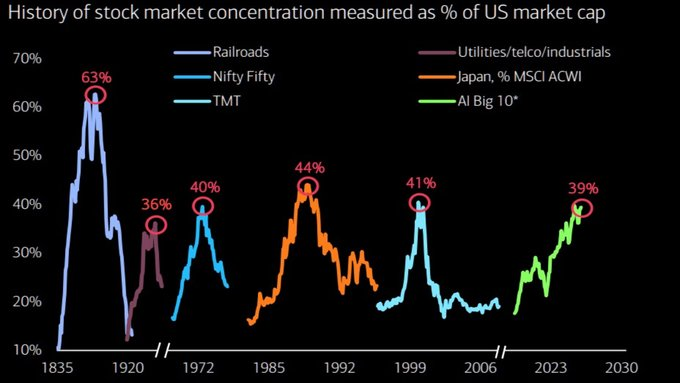
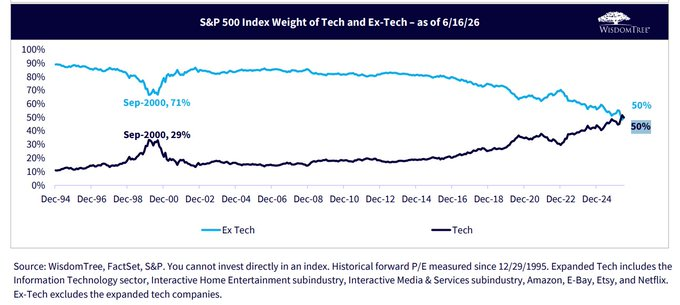
I can see several catalysts that could hasten an abrupt market dive or flash crash, including (but not restricted to) a marked acceleration in the rate of inflation, an unexpected geopolitical event, an abrupt rise in interest rates, evidence that the massive AI capital spending boom will not deliver adequate returns on investment, a negative fundamental development in semis/memory, a swift drop in the price of bitcoin, an accounting scandal (which often occur at the end of a benign market cycle), a failed Treasury auction, or a Gammageddon, among other factors.
However, in all likelihood it will be an event that no one is predicting and no one is prepared for.
Back in late 2024 I cautioned about and delved into the unexpected and leveraged corners of speculation (reposted here in its entirety):
——–
A Cause for Concern: The Unexpected and Leveraged Corners of Speculation
* The entirety of the recent four-week market advance has been based on an expansion in price earnings multiples.
* As narratives multiply and fear/doubt disappear, guards and disciplines are dropped with many asset classes at all-time highs.
* But as asset prices rise, diligence and the assessment of reward vs. risk should take on greater irrelevance – unfortunately just the opposite is occurring.
* And so should the concept of “a margin of safety” be evermore embraced – as it is an essential and integral ingredient to investing over a “market cycle.”
* Expect the unexpected…in the corners of leverage and those that are endorsing the narrative of a “new paradigm” (of higher valuations).
“What the wise man does in the beginning, the fool does in the end.”
– Warren Buffett
“A bull market is like sex, it feels best just before it ends.”
– Barton Biggs
Over history, market inflection points and economic dislocations often come from places not anticipated. Indeed, the most important turning points in markets (and in life) often come at the most unexpected times and in the most unexpected ways. In particular, leverage, as proven by history, is often uncovered in unexpected places. Think about the collapse of a generally unknown currency, the Thai Bhat that gripped Asia in 1997 and then spread to other countries (with a ripple effect), raising fears of a financial contagion and a worldwide economic meltdown. Or the failure of the highly leveraged (and formerly successful) Long Term Capital hedge fund (managed by several Nobel Prize winners in economics) in the following year — which was, in part precipitated by the Russian Debt crisis in 1998 and required a multi billion dollar bailout by 14 banks (orchestrated by The New York Federal Reserve). But the best example of hidden leverage (where no one was looking) was seen in The Great Financial Crisis of 2007-09 when one overleveraged segment, real estate, proved to be the Achilles Heel for the global economy.
Indeed, what started out as what many believed to be only a few California mortgages under water, multiplied geometrically and almost bankrupted our worldwide financial system — as the layers of leverage were swiftly uncovered and spread rapidly. This morning’s market commentary will highlight several significant market (and economic) risks that are not regularly discussed.
The “failure” or combustion of any of these factors could have a most adverse impact on equities and on the domestic economy.
* The U.S. economy has never been more levered to the U.S. stock market. Indeed, one can argue that — with household ownership of equities at an all-time high, with a chorus of “its different this time” and with dreams of a new investing paradigm (of higher valuations) dominating the narrative. As discussed below, it is almost as if the domestic economy is being collateralized by a foundation asset, equities.
From Tom Dyson:
The US stock market is such a foundational asset. You could say, the US stock market has become the collateral that backs the world economy, and all its debt. As long as the stock market keeps rising, everything’ll be okay. But as soon as it turns down, things will start breaking. Employment, real estate values, consumption, trade… and even the government’s finances. It’s the wealth effect, when the stock market is such an important store of wealth. They all rely on a strong stock market to function. The fact that the world’s prosperity has one single point of failure – even as it rises day after day – should terrify you. The market’s function should be to allocate scarce capital efficiently… not collateralise the entire system. In effect, it’s become too big to fail, which is an acute fragility for our capitalist system. As allocators of capital ourselves, how should we approach our investment discipline in a market where expectations (and stock market values) are literally “off the charts”? The bears say “every other time this has happened, there’s been a big wreck.” The bulls say “this time is different, and besides, the trend is your friend and getting the timing wrong is the same as being wrong. “What do you do? Neither position is falsifiable. Which means there is no way to figure out the correct answer with logic… or research… or data. So it comes down to philosophy. Are you a contrarian? Or are you a trend-follower?… The global debt stock surged by over $12 trillion in the first three quarters of 2024 to a record high of nearly $323 trillion. It’s a huge wealth bubble and when it pops, $400 trillion or $500 trillion of (mostly) paper claims ($323 trillion in debt plus whatever owners’ equity the system has) will rush for the exits and seek safety. And policy makers won’t be able to stop it.
* Elon Musk’s health and business/innovative successes are critical to a continuation of economic growth and stock market gains. Musk’s broad reach — on the road, under ground, in space, over the internet, in defense, in artificial intelligence — has now advanced into Washington, and in the formulation and implementation of policy. To have one person so immersed and involved in all these critical areas could pose broad risks — in many ways.
* An extremely leveraged cryptocurrency market represents potential systemic risks. It is my view that cryptocurrency is “the mother of all bubbles” perpetuated by a number of factors (including the rejection of fiat money) and developing digital narratives — many of which have a weak foundation of logic. The absurd notion that the limiting of supply of bitcoin is as stupid as it is damning — as there is no limit to the supply of other cryptocurrencies. To this observer, the sheet market size of bitcoin and other cryptocurrencies is a manifestation of the risks.
See: Crypto Market Cap Charts | CoinGecko
And, as I have written, MicroStrategy ($MSTR) (with its “math” in expressing the case of buying $1 bills for $3 and MSTR’s multiple derivative plays), is the standard bearer of the digital speculation today. See: TheStreet Pro
When the cryptocurrency markets implodes, which is my baseline expectation, the contagion effect will likely be pronounced on all of the capital markets.
* Both fiscal and monetary policy – which is needed to secure the foundation of growth — are travesties. Neither political party has been fiscally responsible — the profligate spending over the last few decades continues apace. (I do not, in any way, buy Elon Musk’s objective of cutting $2 trillion from the U.S. budget, as when you go over the numbers only about $1.5 trillion can be cut (and that is if one cut all that was “available” to be cut in total). As well, the Federal Reserve has been guilty of reckless, feckless and fatuous policy in its delayed response to inflation and, then, in effecting a rapid rise in interest rates. I have little confidence in Powell’s Fed steering clear of debris in his remaining time at that institution. Nor am I confident in any Fed chairman that might replace him.
* Changing market structure poses a significant market risk. Passive investing has engulfed the stock market landscape. We are all traders now, on the same side of the boat and worshipping at the altar of price momentum. (See the first bullet point!) Massive inflows into passive strategies and products have been the straw that has stirred the market’s drink:
https://www.twitter.com/Barchart/status/1864520940366725135
In part, those inflows, have contributed to a near unprecedented narrowing in the equity risk premium (to 20-year lows) while the risk to earnings growth are at 20-year highs:

I can guarantee you (and history has proven) that these inflows — as well as FOMO and the animal spirits — will not be permanent conditions.
Bottom Line
“We must stop regarding unpleasant or unexpected things as interruptions of real life. The truth is that interruptions are real life.”
– C.S. Lewis
The history of speculation is that it resides in areas that are rationalized (with broadening acceptance of a new paradigm).
It is also the condition of history that it is fueled by leverage and lasts longer than most expect. But excesses are never permanent. They become ever more dangerous when markets are consumed with optimism, are no longer fearful and are levered up.
Position: None
