Is Oil Telling Us Something?


Simple Man
Mama told me when I was young
“Come sit beside me, my only son
And listen closely to what I say
And if you do this it’ll help you
Some sunny day”
Oh, yeah
Oh, take your time, don’t live too fast
Troubles will come and they will pass
You’ll find a woman, yeah, and you’ll find love
And don’t forget son there is someone up above
And be a simple kind of man
Oh, be something you love and understand
Baby, be a simple kind of man
Oh, won’t you do this for me son, if you can?
– Ronnie Van Zant, Gary Robert Rossington (Lynyrd Skynyrd), 1973
Oil Defies the Headlines
A civilian oil tanker reportedly came under attack while trying to traverse the Strait of Hormuz on Saturday. Peace talks between the U.S. and Iran have gone in circles with no apparent progress in weeks. Despite this lack of movement toward a peaceful resolution that restores the use of regional commercial trade routes to their pre-war levels, crude oil prices remain well below their April highs and even their late July highs. In fact, front month WTI crude futures are trading lower overnight than where it went out on Friday afternoon.
Releases from strategic reserves and a belief that this war is coming to a close have helped to keep oil prices in check and therefore consumer-level inflation in the U.S. and on a global scale, while elevated, has not run wild. Can oil prices continue to hold at this level? That’s debatable. On Sunday night, the Wall Street Journal‘s website ran a front-page story describing how Iran’s hardline leaders have prepped what’s left of that nation’s military for a much larger conflict with the US and have been doing so even as they signed that memorandum of understanding.
In addition, U.S.-allied Arab nation intelligence officials have picked up communications between Iran and its proxies in countries such as Yemen and Iraq, describing a strategic shift in leadership from Iran and to get their militia-style forces ready to broaden the war. The idea would be to increase the cost of this conflict for the U.S. On top of that, in order to raise alarm in regional U.S.-allied nations such as Kuwait, Saudi Arabia and the U.A.E., Iran’s leaders have increasingly talked about moving offensive operations onto “enemy” territory.
On That Note…
On Monday morning, Bloomberg News is reporting that kinetic combat between Israel and Iran-backed Hezbollah flared back up in Lebanon over the weekend. This would be the latest setback in efforts to end these simultaneous but parallel wars in the Middle East. Israel Defense Forces reported on Sunday that they had killed Abu Hassan Alaa, a senior Hezbollah commander, in southern Lebanon on Saturday. Eleven people died in these Israeli strikes, which Prime Minister Benjamin Netanyahu said were in retaliation for an attack by the militant group that had seriously injured three Israeli soldiers.
This incident comes just days after Israel had also struck Iran-backed Hamas in the Gaza Strip, and the Yemen-based, Iran-backed Houthis had attacked ships in the Red Sea. All while tensions between Israelis and Palestinians in the West Bank area have meanwhile been on the rise. We can hope and pray for peace, but we must understand that the region is as much a potential powder keg today as it has ever been in the past.
Look to The East?
Maybe not. The mainland Chinese economy continues to lose steam. July retail sales missed badly here in the U.S. on Friday. July retail sales missed badly in China, as reported by Beijing’s National Bureau of Statistics this morning. Chinese Industrial Production for the month of July missed the mark as well. Perhaps most alarming was this. Fixed-asset investment in China, including real estate and infrastructure, has now contracted 6.7% this year through July from a year earlier. This was worse than the expected 6% decline. July was also the fourth consecutive month that this metric sported a negative number.
It may be worse than Beijing is even reporting. (You don’t say?) Barclays is estimating that new bank loans issued inside mainland China may have recorded their largest monthly decline on record. Investment in real estate reportedly declined 19.2% in the first seven months this year, while infrastructure and manufacturing investment contracted 3.6% and 1.7%, respectively. Does this mean that Beijing ramps up the fiscal stimulus as they have in the past to paper over hiccups in the economy? One would think that likely.
Tech News
- HIVE Digital Technologies ($HIVE) announced that its BUZZ High-Performance Computing subsidiary had signed a five-year graphics processing unit cloud services agreement with an investment-grade enterprise customer worth a rough $350 million in total contract value. The agreement is expected to add about $70 million in annualized revenue, bringing BUZZ HPC’s total annualized revenue up to around $180 million, with most of it expected to come online through the fourth quarter of this year.
- Under the terms of that deal, BUZZ HPC will deliver 2,016 Nvidia ($NVDA) Blackwell Ultra GPUs in GB300 NVL72 rack-scale systems, with Nvidia Quantum-X800 InfiniBand networking and VAST Data storage. The cluster is expected to become operational this year at the firm’s facility in Merritt, British Columbia, Canada.
- In other Nvidia-focused news, going into the weekend, the Wall Street Journal reported that Nvidia had reduced the level of financial backing it may provide for a massive OpenAI data-center project in Ohio, addressing concerns about how much risk the chipmaker would assume to support the artificial-intelligence build-out. Under the revised structure, Nvidia would guarantee less than $120 billion in financing, down from the $250 billion commitment that had been under discussion previously.
The Week That Was…
Last week was all about data covering July inflation. Neither the consumer price index nor the producer price index came in very hot, which allowed markets to relax a little. That coupled with an awful report for July retail sales on top of an awful report the week prior for July employment has made it all but impossible for the FOMC to “intelligently” increase short-term interest rates any time soon. The S&P 500 added a third consecutive winning week, and fifth winning week in seven. There were even record highs made during the week. The Nasdaq Composite has a similar steak going, just without the all-time highs. This is how last week went at the index level…
- The S&P 500 lost 0.17% on Friday but gained 0.36% for the week.
- The Nasdaq Composite gave up 0.28% on Friday but added 0.14% for the week.
- The Nasdaq 100 surrendered 0.13% on Friday but tacked on 1.09% for the week.
- The Russell 2000 gained 0.51% on Friday and 1.12% on the week.
- The S&P Small Cap 600 moved 0.48% ahead on Friday, gaining 0.95% for the week.
- The S&P Midcap 400 added 0.32% on Friday and 1,07% for the week.
- The Dow Transports lost 0.62% on Friday but gained 1.33% for the week.
- The Philly Semis gave back 0.31% on Friday but added 0.49% for the week.
- The KBW Bank Index stacked on just 0.47% on Friday, gaining 2.06% for the week.
On Friday, seven of the 11 S&P sector SPDR ETFs closed out the session in the green. Energy ($XLE) led for the day, while health care ($XLV) lagged. There was no clear outperformance across sector types, but cyclicals did claim three of the top flour slots on the daily performance tables.
For the week, nine of the 11 S&P sector SPDR ETFs finished the period in the green. Energy again easily led the way as a peaceful resolution to the war in Iran and a re-opening of those maritime passages now seems all but out of reach. Consumer discretionaries ($XLY) were the big losers for the week. Growth and defensive type sectors out-performed cyclicals for the five-day stretch.
Week Ahead
After a week lacking in volatility dispute the release of a number of high-profile macroeconomic data-points, we head into the week ahead:
- The Geopolitical: The war in Iran, if we can still call it that, has calmed, yet the Strait of Hormuz remains a problem. On that note, over the weekend, Pres. Trump told Sec. of Defense / War Pete Hegseth to scale back planned joint military operations in South Korea. While I find this news somewhat strange, I do not think that it approached the level of a market event. The risks associated with the conflict with Iran and the market price of crude oil matter much more.
- Macro: This week will not be like last week in terms of the magnitude of the scheduled domestic macroeconomic release\s that could impact our marketplace. Last week’s July consumer price index and producer price index data were market positives but did not cause much in the way of movement or in the way of participation. This week, there is a lot less going on.
This morning, the New York Fed will release their regional manufacturing-based survey. The Philadelphia Fed will follow up with their release this Thursday morning. On Tuesday morning, the Census Bureau will post Housing Starts and Building Permits for the month of July. Later on, that morning, the Fed will release data on Industrial Production, also for July. Later this week, on Friday, S&P Global will post their flash manufacturing and service sector PMIs for the month of August.
- The Federal Reserve: With the Kansas City Fed’s economic symposium at Jackson Hole, Wyoming, set for late next week, it doesn’t look like any Fed officials want to put themselves out on a limb this week making public appearances. There is literally no one on the docket. That said, the FOMC Minutes of the July policy meeting will be released this Wednesday afternoon.
- Earnings: This late in earnings season, the retailers go to the tape with their numbers en masse. So will a few others. Among those reporting this week will be Home Depot ($HD) and Toll Brothers ($TOL) on Tuesday, followed by Analog Devices ($ADI), Estee Lauder ($EL), Lowe’s ($LOW), Target ($TGT) and TJX ($TJX) on Wednesday morning. Advance Auto Parts ($AAP) and Walmart ($WMT) will steal the show on Thursday morning.
Charts
Readers will see that the S&P 500 broke out of our “Ascending Triangle” pattern of bullish continuation the week prior to last and has continued to work its way sideways to slightly higher.
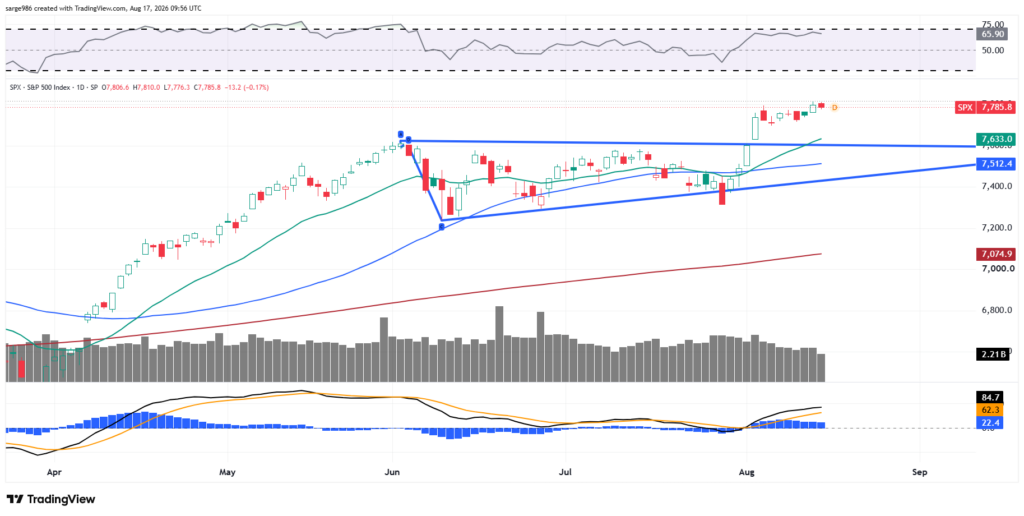
Last week, either due to a lack of conviction or perhaps due to late summer doldrums / vacations, trading volumes tailed off and remained light.
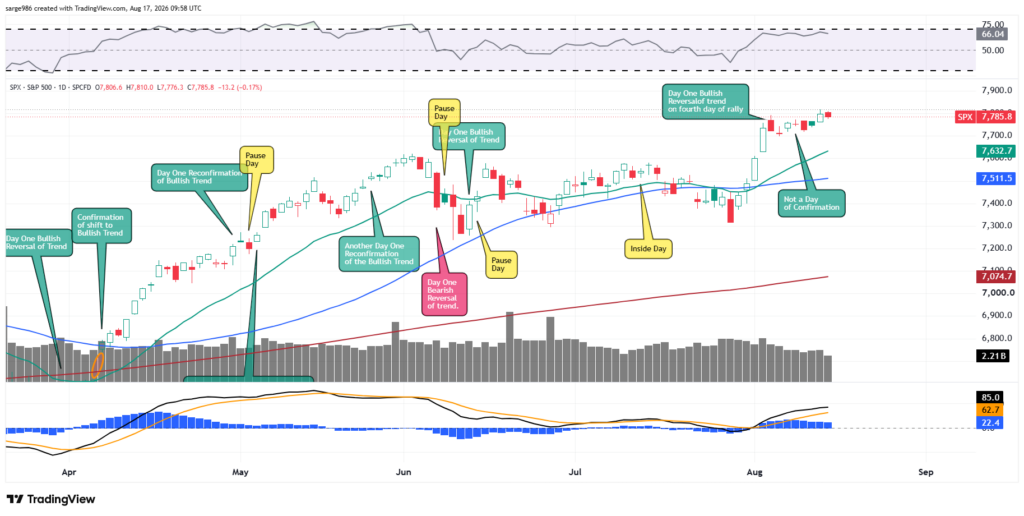
This means that we simply do not yet have technical confirmation of the bullish continuation of trend that we see before us.
Fed Funds Futures
Fed Funds futures trading in Chicago are currently pricing in a 67% probability for no change to be made to the current target range (3.5% to 3.75) for the Fed Funds Rate at the culmination of the next Federal Open Market Committee policy meeting on Sept. 16. That’s up from a 56% likelihood a week ago at this time. There is now a 68% likelihood priced in for a 25-basis point rate hike on Dec. 9. That’s been pushed back from a 59% probability for a haiku on Oct. 28.
There are no rate cuts fully priced in at any point in the future looking out toward year’s end 2027, though there is now a minority probability being priced in as early as September of 2027. There is now no second quarter percentage point rate hike priced in at any point in the future.
Economics (All Times Eastern)
08:30 – Empire State Manufacturing Index (Aug): Expecting 10.4, Last 15.6.
10:00 – NAHB Housing Market Index (Aug): Expecting 33, Last 34.
4:00 p.m. – Net Long-Term TIC Flows (June): Last $232.7B.
The Fed (All Times Eastern)
No public appearances scheduled.
Today’s Earnings Highlights (Consensus EPS Expectations)
After the Close: FN (3.81)
At the time of publication, Guilfoyle was long NVDA equity.
