Lagarde to Leave ECB Early, Adding to Leadership Turnover

After months of speculation that she would leave before her eight-year term ends in October 2027, European Central Bank President Christine Lagarde announced today that she will step down on February 7, 2027, just hours ahead of the Governing Council’s latest rate decision, according to Bloomberg. Hers is the third of the six Executive Board seats set to turn over by May.

Lagarde becomes only the second president in the ECB’s 28-year history to leave early, after Wim Duisenberg, whose shortened stint had been agreed in advance to break a France-Germany deadlock before the bank’s launch.

Lagarde, 70, told fellow policymakers she wanted “greater freedom to express her views” because she could not stay neutral on developments in France ahead of its April presidential election, the Financial Times reported. She has ruled out running herself and has been in talks to chair the World Economic Forum. In a video message, she said she leaves with “a sense of good work done, and an ECB that is fit for the future,” per Bloomberg.

The Decision

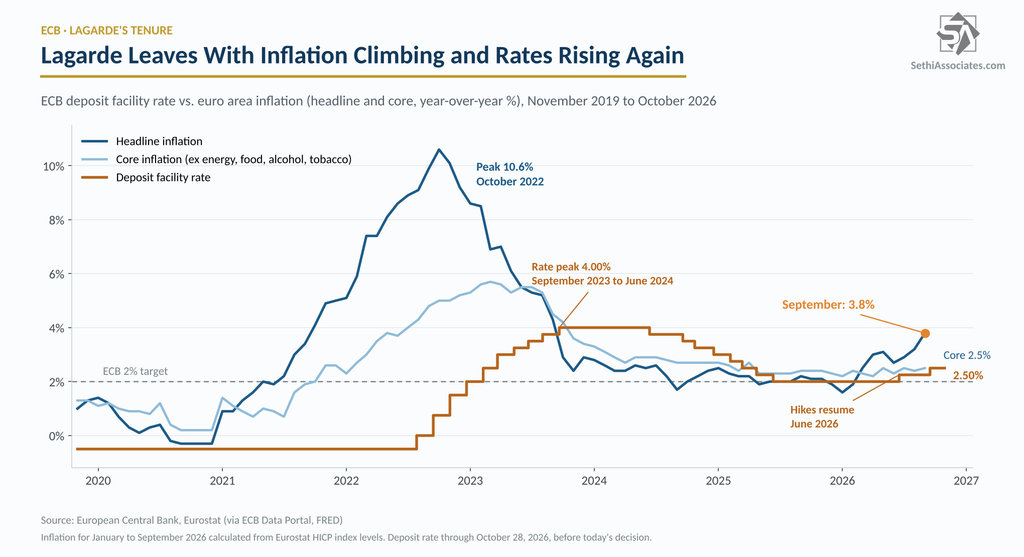
Markets and economists widely expect the ECB to hold its deposit rate at 2.50% later this morning as officials weigh higher energy prices and recent bond-market turmoil. That would follow hikes in June and September to counter elevated inflation tied to the Iran war, but markets expect further tightening, Bloomberg noted. Bloomberg Economics expects Lagarde to wrap up the hiking cycle in December, which could give her successor some room before any further rate changes are needed. Euro area inflation rose to 3.8% in September from 3.2% in August, with core at 2.5%, according to Eurostat.

The decision is due at 9:15 a.m. ET, followed by Lagarde’s press conference at 9:45 a.m. ET.
The Succession Race

Three of the six Executive Board seats — the presidency, the chief economist and the markets portfolio — turn over by May. Isabel Schnabel is leaving a year early to join the International Monetary Fund and Philip Lane’s term expires in May, so governments will likely try to settle all three in one deal, with EU summits in November and December, per Bloomberg.

For the presidency, Spain is backing Pablo Hernández de Cos, general manager of the Bank for International Settlements and former Bank of Spain governor, while the Dutch government is backing former Dutch central bank chief Klaas Knot, the FT reported. Economists surveyed by Bloomberg in October see De Cos as the favorite. Knot built a reputation as a hawk during the eurozone debt crisis but has since softened into a pragmatist seen as responsive to bond-market stress, according to The Wall Street Journal, which also noted that an outsider can’t be ruled out given Lagarde herself was a last-minute pick in a 2019 package deal.

The timing also lets President Emmanuel Macron help pick Lagarde’s successor before his final term ends, with far-right candidate Marine Le Pen leading French polls, which risks accusations of political encroachment on the ECB’s independence, Bloomberg added. Banque de France’s governor also left early, with Macron naming his chief of staff, Emmanuel Moulin, to the post.

Market Reaction

The news barely moved markets following the announcement. The euro was down 0.1% against the dollar at $1.114, per the FT, while the 10-year German Bund yield was 1 basis point lower at 3.36% and the French-German 10-year spread held at 154 basis points, according to Bloomberg. That spread recently hit its widest since 2011, and French long-term borrowing costs topped 5% last week for the first time since 2002 per the FT. Berenberg chief economist Holger Schmieding told the FT the departure doesn’t change the outlook for ECB policy or for how the bank handles French risks.

Subscriber Question of the Day (And My Response)

James Babcock

8m ago

Doug, why did Trumps executive order with medical cannabis usage not have to jump thru all the hoops that adult use has had to do? Thanks 

Dougie Kass

just now

Very good question.

They used (in medical marijuana) The Treaty Obligation….   

The medical half rode on 21 U.S.C. §811(d)(1), which lets the AG reschedule a substance by order, without the normal §811(a)–(b) rulemaking, when doing so is necessary to carry out U.S. treaty obligations. Blanche’s order reviewed the history of those obligations and concluded that the Single Convention would still be satisfied with marijuana in Schedule III, so he immediately reclassified state-licensed medical cannabis and FDA-approved products under his authority to reschedule drugs to carry out Single Convention obligations. The treaty route only stretches as far as the treaty does, though. The Single Convention confines cannabis to medical and scientific use, so DOJ’s position is that drawing the line at medical reasonably confines federal authorization to medical and scientific channels. Adult-use cannabis has no treaty-compliance rationale to hang on, so §811(d) can’t carry it.

That leaves the adult-use half stuck in the ordinary §811(a)–(b) process: HHS evaluation, notice-and-comment, and, because interested parties requested one, a formal on-the-record hearing before an ALJ. That proceeding already existed (it relates to the May 21, 2024 NPRM, which found currently accepted medical use and lower abuse potential than Schedule I or II), but it had been frozen since early 2025. Rather than start over, Blanche set the adult-use reclassification aside to go through the traditional APA process, including an ALJ hearing commencing June 29, and ordered DEA to finish the Biden-era proposed rule in the most expeditious manner, per Trump’s order.

The practical logic is speed and insulation. The order followed a December 2025 executive order directing the AG to expedite rescheduling; the treaty route delivered immediate 280E relief for state-licensed medical operators while leaving adult-use in Schedule I, and it did so without exposing the medical reclassification to the CAMU fight in the hearing record. The ALJ even walled it off: the judge ruled the hearing would not revisit the medical rescheduling, which had already occurred, and would take no evidence on it. The cost is the vulnerability you’ve already been pressing on — whether §811(d) actually authorizes a use-based split, which is exactly what the state and prohibitionist challenges in the D.C. Circuit are testing.

Positions: None

Google’s Investors’ Guard Dropped in Recent Months

* Bona fide business threats had emerged but were ignored as passive and relentless buying of Google’s shares masked a growing AI headwind

* Is Amazon as vulnerable as Google?

Google ($GOOGL) is not only an example that the threat to its search business is real…

Price Is Not Truth

… But it is also testimony to the threat represented by market structure.

What do I mean by that? Let me explain…

Well, passive price momentum-based products and strategies carried Google’s shares ever higher in recent months — and the blind monkeys in the business media (without any or with limited analytical rigor), confidently took the price increases as a sign of fundamental progress. Indeed Google became the darling of the hyperscalers based principally on chart gazing.

Here is perennial bull Gene Munster voicing his concerns:

This gets me back to Amazon ($AMZN).

What has kept me from buying AMZN at seemingly an attractive price-earnings multiple is what has threatened Google. Is the utility of using Amazon markedly reduced as AI/Personal Bots expand their tasks? 

Again from Gene Munster:

Finally, about two years ago we observed the dramatic change in the hyperscaler from capital light to capital intensive — suggesting that this was not market friendly and that it was price-earnings multiple altering/contracting:

Position: None

There Is No Gold in Them Thar Hills

“Gold is in Quad 2 crash mode…”

– Hedgeye’s Keith McCullough

I have positioned (trading sardine) $GLD profitably three times in the last two months — buying the dips and selling the rips.

At some point, gold is a buy and hold (based on, in part, sticky inflation, the lack of fiscal discipline in Washington DC and currency debasement), but quite frankly I have no idea at which level.

This morning GLD is down by another -$4.59 and shows no evidence of stabilizing:  

The proximate cause for this morning’s precipitous decline is the strength of the U.S. dollar:

Position: None

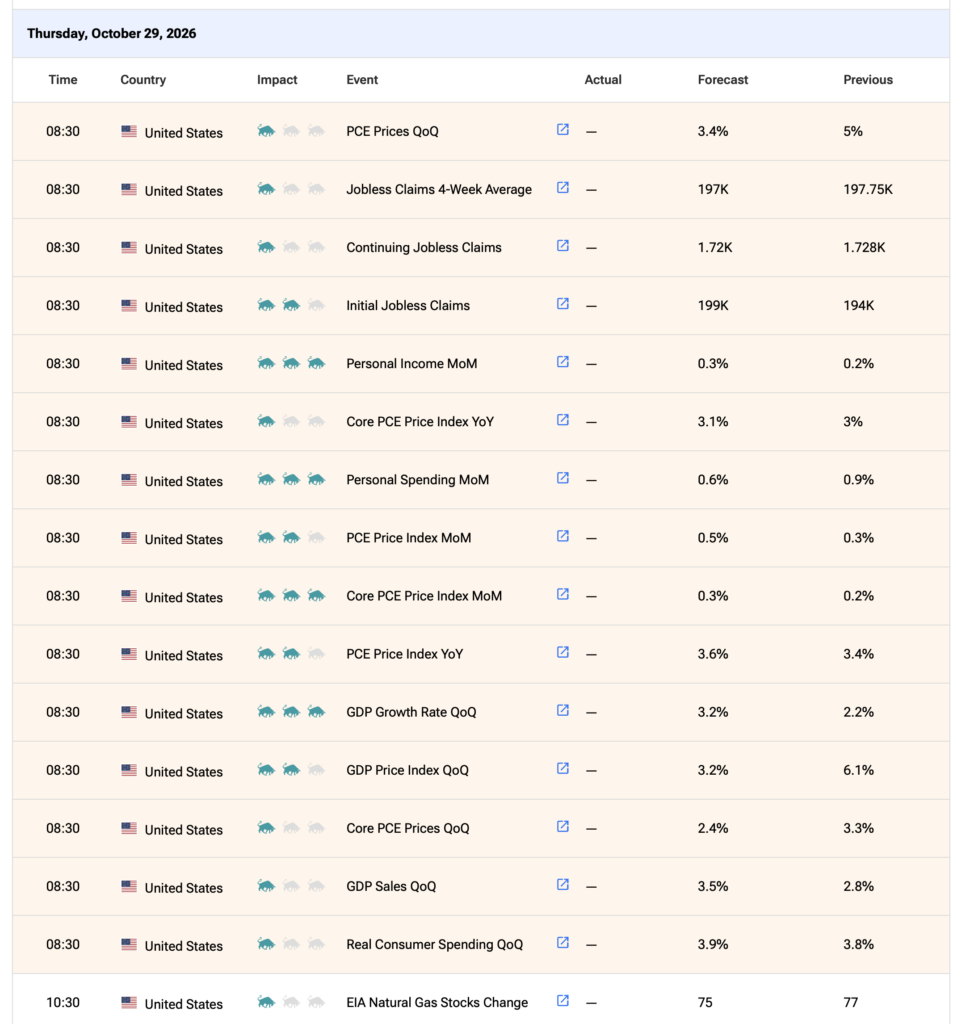
Q3 GDP Trackers Cluster Near 3.3%, but GDPNow’s History Says Watch for an Upside Miss

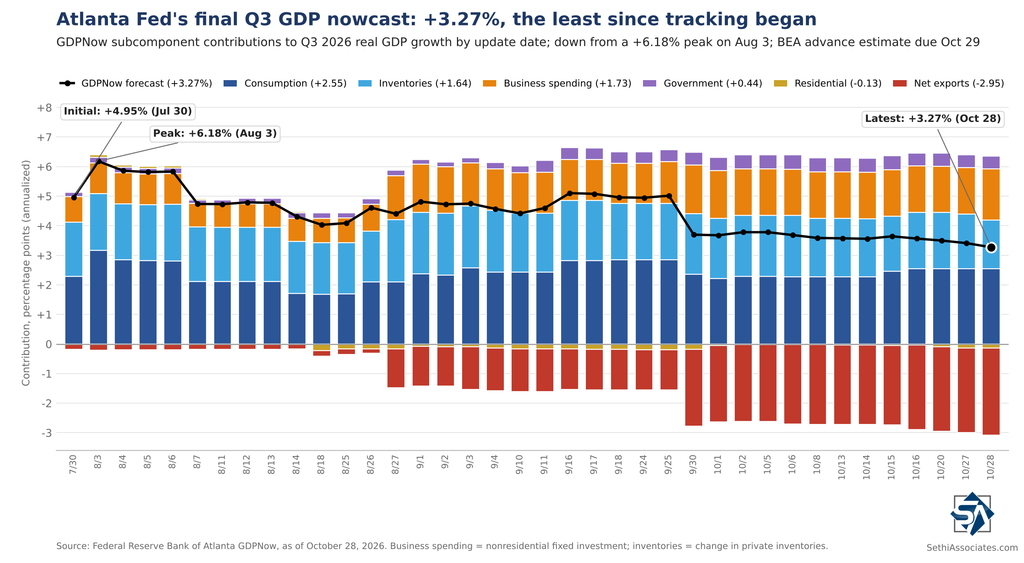
Ahead of Q3 GDP later this morning the Atlanta Fed’s GDPNow final Q3 nowcast came in at 3.27% Wednesday, the least since it initiated tracking for the quarter, down from its 6.18% peak on August 3.

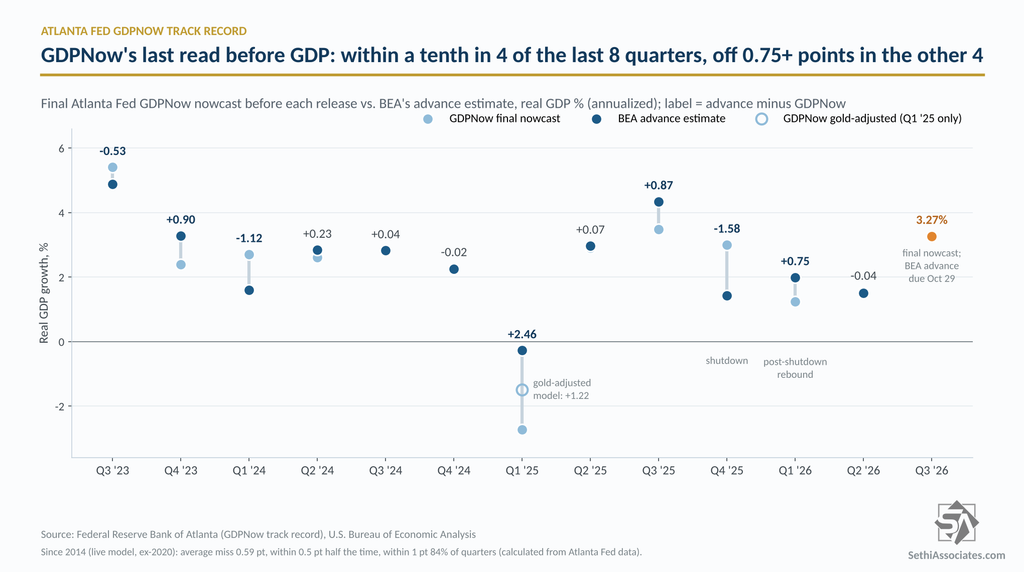
Over the past two years, GDPNow’s last reading before the advance GDP report has been either very close or well off, with little in between. It was within a tenth in four of the last eight quarters (Q3 and Q4 2024, Q2 2025 and Q2 2026) and off by 0.75 percentage point or more in the other four.

Over its history since 2014 (excluding 2020), GDPNow’s average miss has been 0.59 point. It has been within half a point half the time and within a point 84% of the time.

But a couple of unique historical tendencies are worth keeping in mind:

▪ GDPNow’s final reading usually falls from where it stood a month before the release (34 of 56 quarters excluding 2020). That’s what we saw in Q1 and Q2, and now Q3, down 1.75 points from 5.02% on September 25. But when it has fallen more than half a point in that final month, the actual print has come in above its final reading in 16 of 22 quarters.

▪ In third quarters specifically, the advance print has come in above GDPNow’s final reading in 10 of 14 quarters (excluding 2020), by an average of 0.31 point.

Here’s GDPNow’s final breakdown of the components as of October 28 and changes from my last update October 20:

Consumption = +2.55% (0.00%)

Business spending (nonresidential fixed investment) = +1.73% (+0.16%)

Inventories = +1.64% (−0.21%)

Government = +0.44% (0.00%)

Residential investment = −0.13% (−0.03%)

Net exports = −2.95% (−0.09%)

GDPNow Forecast: +3.27% (−0.23%)

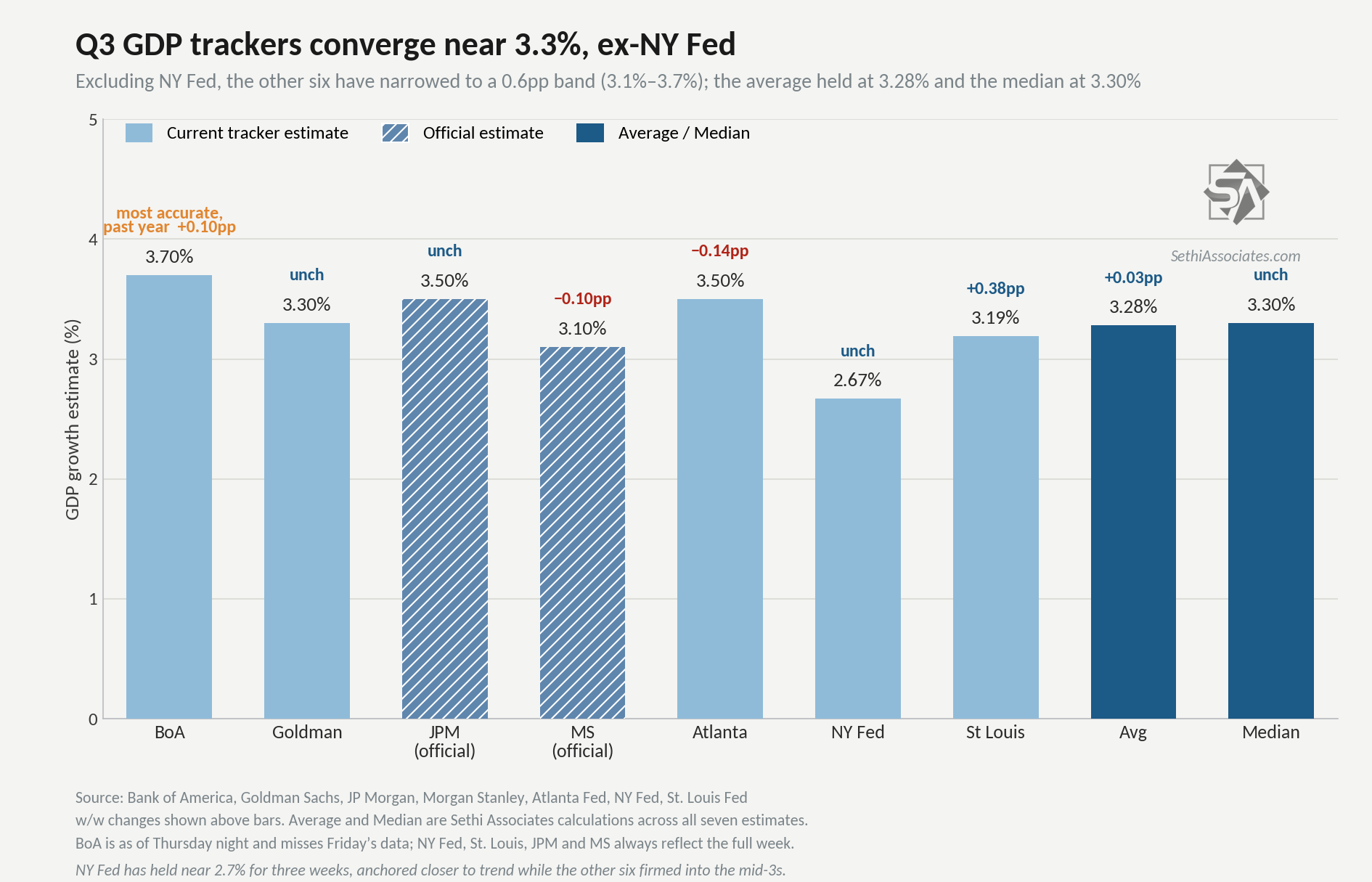
GDPNow, though, has plenty of company this quarter. As of Friday, six of the seven major trackers I follow were between 3.1% and 3.7%. The outlier is the New York Fed’s Staff Nowcast at 2.67%, where it has held for three weeks. The average as of Friday was 3.28% and the median 3.30%.

Bank of America’s tracker has been the most accurate of the group over the past year and is the highest this quarter at 3.70%.