Alphabet Miss, Why Fed Shouldn’t Raise Rates, All Eyes on Amazon


Sunshine day? Well, a cold slap in the face was to come. Before that rude realization even occurred, the Fed’s FOMC did exactly as expected. No surprises there. Financial markets handled the Fed’s “non-event” quite well. There was a bit of an equity market rally precisely at 2 p.m. ET as keyword reading algorithms tried to create a little momentum in response to the fact that the Fed did not increase its target for short-term interest rates. When that petered out, the algos then sold off the rally of their own making and then ran stocks higher into the closing bell.
Wednesday, at least during the regular session, ended up being a net positive. The AI trade was in vogue for a third consecutive trading session. The Nasdaq Composite gained 0.27% on the day as the S&P 500 added 0.28%. More importantly, as far as that trade is concerned, the Nasdaq 100 tacked on 0.55%, as the 11 S&P sector SPDR ETFs were led by technology ($XLK), also for a third straight day.
Perhaps more impressively, despite that the yield paid by the U.S. Ten-Year Note moved higher (+4 bps) to 5.04%, the Two-Year Note enjoyed a minor rally as that yield contracted (-2 bps) just a bit. Yes, if you push that range out a little, the long bond sold off more so than did the 10-Year and T-Bills were strong. What does a steeper yield curve do for the economy? The truth, as long as you don’t listen to the “Chicken Littles” in the financial media and as long as the long end of the curve does not get out of control, is that it sets the stage for economic growth, because the slope of that curve takes on a healthier shape.
Not to be all “pollyannaish” or anything. I recognize that probably too large a portion of recent economic activity or growth or both has been driven by investment in technological development (also known as AI) and that AI is not and will never be a labor-intensive industry. That said, growth for now, at least statistically, is growth… and most of the jobs have not yet been lost.
Performance for the session across those 11 sector SPDRs revealed expectations for a strong Q3 GDP print this morning. While tech led, the cyclicals were strong as defensives lagged. A steeper yield curve coupled with an equity set up where defensive sectors sputter? Consensus for today’s GDP print to be published by the Bureau of Economic Analysis, is for growth of 3.1%, but it could run hot in my opinion.
Readers will see below that my “official” projection is for growth of 3.2% (q/q, SAAR), but to be honest, I would not be surprised to see this number in the high 3% or even creep up toward 4%. Now, be cognizant that the real-time regional Fed models are not truly supportive of my thinking here. Yes, Atlanta is at growth of 3.3% for today’s release, but New York is lower, at growth of just 2.67%.
My concern is this. Higher statistical growth coupled with accelerating statistical inflation will unfortunately provoke first-level thinkers at the Fed to raise interest rates in an attempt to tamp down on aggregate demand. While that seems rational, conditions are different this time. Demand for labor will face pressure in 2027 that it may not bounce back from. Increased borrowing costs will ignite that painful process that many middle-class Americans don’t even see coming.
I also see both consumer- and producer-level inflation abating on its own quite rapidly once the war in Iran concludes, once the war in eastern Europe concludes and once Americans with jobs realize how little demand for their services there is going to be going forward. Not only is economic growth going to look strong and not only is unemployment going to accelerate into 2027, but by mid-2027, consumer-level inflation is going to drop below an annualized 2% by mid-2027. The Federal Open Market Committee may have to ease monetary policy, perhaps aggressively, if it tightens in December of this year … within a year.
Cold Slap in the Face!
Don’t look at Nasdaq futures this morning. There was some positivity on Wednesday afternoon into evening that the Fed had nothing to do with. First Oracle ($ORCL) of “embarrassing” balance sheet fame, projected 2027 earnings and sales that were below expectations, timing its Investor Day to run concurrently with the Fed. That should have hurt the stock.
Oracle also projected that capital spending will peak next year into the following year and that by fiscal 2029, free cash flow will blossom. Huzzah! Yeah, right. The stock ran more than 10%. My take? If Oracle’s capital spending slows, it’s because the debt-load got out of control.
Microsoft ($MSFT) reported after the close. Earnings beat. Revenue beat. Cloud business growing like a weed. Huzzah! The stock is up overnight despite the weak tape. Then came Alphabet ($GOOGL). Cold slap in the face. Severe earnings miss (I mean really, really severe). Revenue miss as well. Interesting thing is that the AI / Cloud businesses are doing well. Still, ugly is ugly. GOOGL is down more than 10% overnight. Hold AMZN into tonight’s earnings? I am. I don’t see the two companies as similar, though a lot of algos and funds do throw all of the hyperscalers into the same basket, so we shall see.
Marketplace: Why Tonight’s Earnings Matter
No, we do not have a “Day One” bullish reversal as of yet. On Monday and then on Tuesday, trading volumes did not cooperate. On Wednesday, we had trading volume, but breadth across NYSE-listings and across the S&P 500 went negative. That said, there is certainly technical hope for the broader market for large cap stocks.
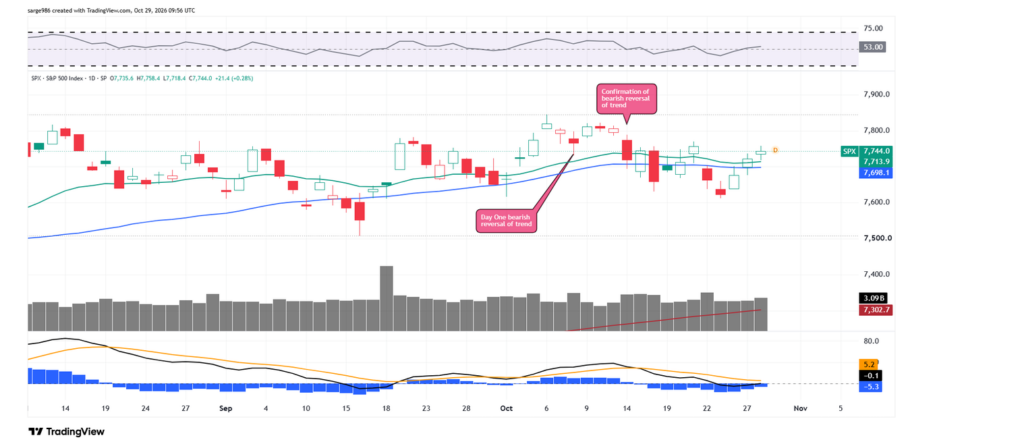
Note that the S&P 500 took and held its 50-day simple moving average over the past two days. Note that the S&P 500 took back its 21-day SMA on Wednesday. That probably forced some professionals to put some cash to work. This may have also provoked swing traders to get behind the long trade on Wednesday. Can that set-up hold? The S&P 500 can, in my opinion, lose a rough 30 to 31 points on Thursday without completely losing the swing crowd. We probably have 46 points or so before the professionals are tested.
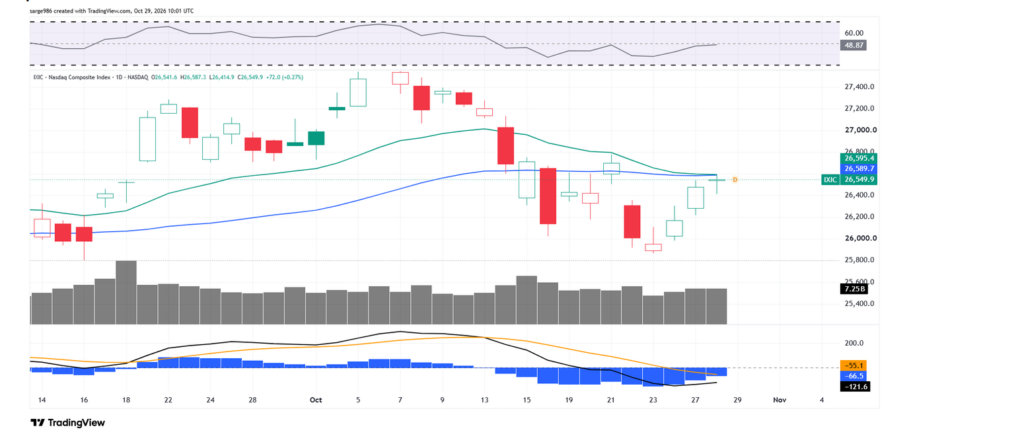
What’s at issue on Thursday morning is where the Nasdaq Composite apexed on Wednesday. That index hit resistance at its 21-day exponential moving average and 50-day SMA. Those two lines are running together and with Nasdaq futures trading lower, could very well end up posing as stiff resistance. This is a very realistic threat to the AI trade. Tonight’s earnings matter. A lot.
Economics (All Times Eastern)
08:30 – Initial Jobless Claims (Weekly): Expecting 198K, Last 194K.
08:30 – Continuing Claims (Weekly): Last 1.728M.
08:30 – GDP Growth Rate (Q3-adv): Expecting 3.2% q/q, Last 2.2% q/q, SAAR.
08:30 – Personal Income (Sep): Expecting 0.3% m/m, Last 0.2% m/m.
08:30 – Consumer Spending (Sep):
Expecting 0.6% m/m, Last 0.9% m/m.
08:30 – PCE Price Index (Sep): Expecting 0.5% m/m, Last 0.3% m/m.
08:30 – Core PCE Price Index (Sep): Expecting 0.3% m/m, Last 0.2% m/m.
08:30 – PCE Price Index (Sep): Expecting 3.6% y/y, Last 3.4% y/y.
08:30 – Core PCE Price Index (Sep): Expecting 3.1% y/y, Last 3.0% y/y.
10:30 – Natural Gas Inventories (Weekly): Last +77B cf.
The Fed (All Times Eastern)
No public appearances scheduled.
Today’s Earnings Highlights (Consensus EPS Expectations)
Before the Open: CAT (7.06). DHI (2.99), LLY (5.86), MA (5.17), MRK (2.09)
After the Close: INTC (.41), RDDT (1.33), SBUX (.72), AMZN (1.97)
At the time of publication, Guilfoyle was long INTC, AMZN, MSFT, AMZN equity.
