While the Fed’s Doves See More Hikes, They’re in Less of a Hurry

As things with the Fed are moving at a blurring pace (for the Fed), I thought I’d lay the groundwork ahead of the six Fed speakers to come today, including a couple of the more “core” members in Governor Barr and New York Fed President Williams.
After Governor Waller (Fed’s Waller Floats a Half-Point Hike if CPI Runs Hot) and Dallas Fed President Logan (Dallas’ Logan Adds to 50 Basis Point Speculation) opened the door to faster rate hikes Tuesday, Chicago Fed President Goolsbee (a 2027 voter) called October’s CPI “another distressing report, borderline disturbing” in an interview with PBS NewsHour, adding that “services inflation is not coming down” and “we have got a real inflation issue on our hands.” Asked about a half-point hike, he said “everything is always on the table, and we must get inflation back down to target, and it’s going the wrong way at this point.”
So momentum toward a quicker hiking pace is building, but it’s important to note there’s another side to this argument. Two of the committee’s most dovish members, Vice Chair for Supervision Michelle Bowman and Philadelphia Fed President Anna Paulson, made clear Tuesday that while they’re on board with more hikes, they’re in less of a hurry.
Bowman said in a speech that “there is still work to do to bring inflation closer to 2 percent,” that Tuesday’s CPI suggests core PCE “likely moved up further to 3.3 percent in October,” that pressures “may be broadening,” and that she’s “more attentive to the inflation side of our mandate,” she added more caveats than the hawks. Financial conditions “have tightened a bit recently because of lower equity prices, higher private interest rates, and a stronger dollar,” so “the benefit of additional policy tightening has to be carefully weighed against its costs for interest-rate-sensitive sectors.” She also sees tariffs, energy and AI-related pressures each driving “roughly one-fourth” of above-target core PCE inflation, which she says are mostly “relative price shocks in specific sectors,” and expects core PCE “to move closer to 2 percent next year.”
That’s a very different read than Goolsbee, who worries AI-driven demand is starting to “drift out into just overall overheating prices of a whole bunch of things, including services.” Bowman also added a dose of caution about the AI trade, saying the risks “seem to be concentrated in only a few large firms that provide AI services,” with “the appearance of circular financing,” and that a shortfall in AI revenues could bring “a sharp correction in equity prices for AI firms, higher financing costs, and reduced access to credit.” That takes on added importance given the issues with Nvidia ($NVDA).
Paulson, who votes in December before Philadelphia rotates off the committee, said in her speech that “skipping a meeting is a matter of pace, not direction. There is likely more work to do,” but “for now, further gradual tightening seems appropriate.” For a dove, like Bowman, she is still relatively hawkish: “Underlying inflation is above target, and it hasn’t come down. That tells me that elevated inflation isn’t just about factors that will go away on their own.”
Still she argues that going gradually “gives households, businesses, and the financial sector time to adjust.” In addition it “lets me learn as we go,” she said, noting “big swings in the stock market and in oil prices” and that “some of the strength in consumer spending is tied to the stock market, and that may prove less durable than we expect.” She would “act more quickly if inflation expectations drift up, if wage pressures build, or if underlying inflation moves higher. Right now, that’s not what I’m seeing.”
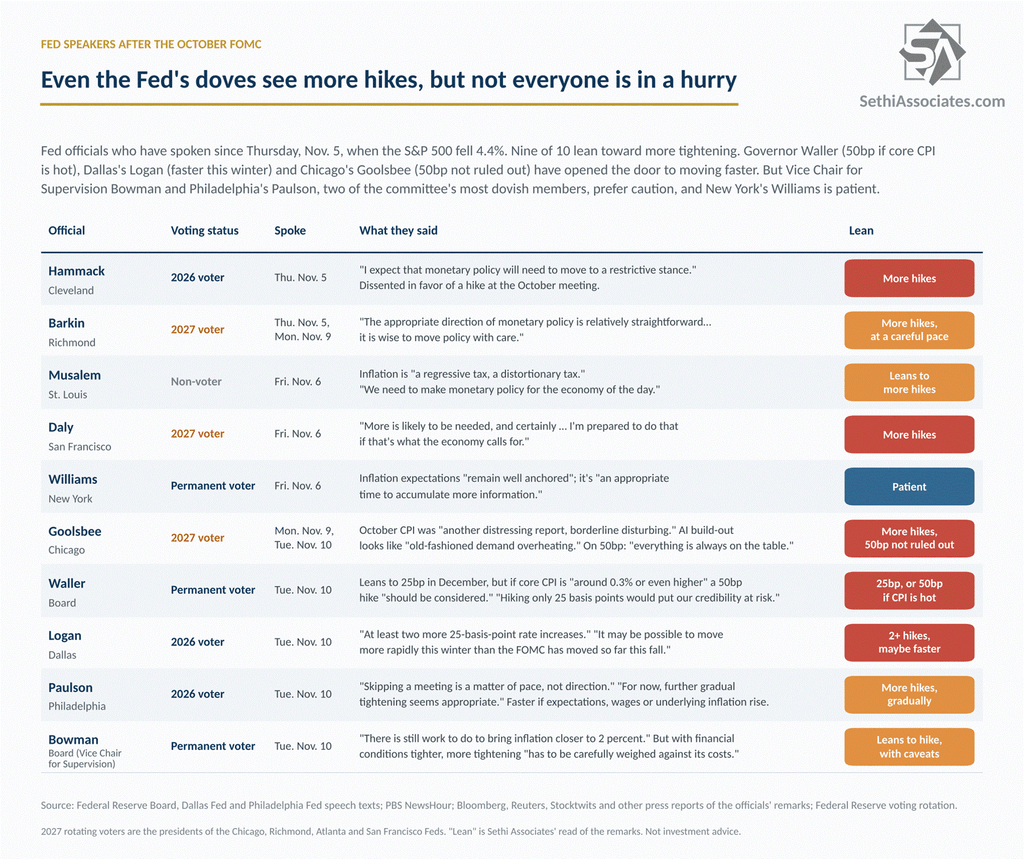
So nine of the 10 officials who have spoken since last Thursday’s selloff lean toward more tightening, but with Bowman and Paulson preferring caution, Richmond Fed President Barkin saying “it is wise to move policy with care” and New York Fed President Williams calling it “an appropriate time to accumulate more information,” a half-point move in December looks like a tougher sell. We’ll hear more today from Goolsbee, Williams, Cleveland Fed President Hammack, San Francisco Fed President Daly, Kansas City Fed President Schmid and Governor Barr. Of those Williams, Hammack and Barr will vote in December.