Treasury Refunding Disappoints Bond Bulls

Treasury’s Quarterly Refunding announcement is out, setting auction sizes for the coming quarter. The sizes came in as expected, but the long end jumped on the release before settling back with several factors to blame for disappointment from bond bulls.
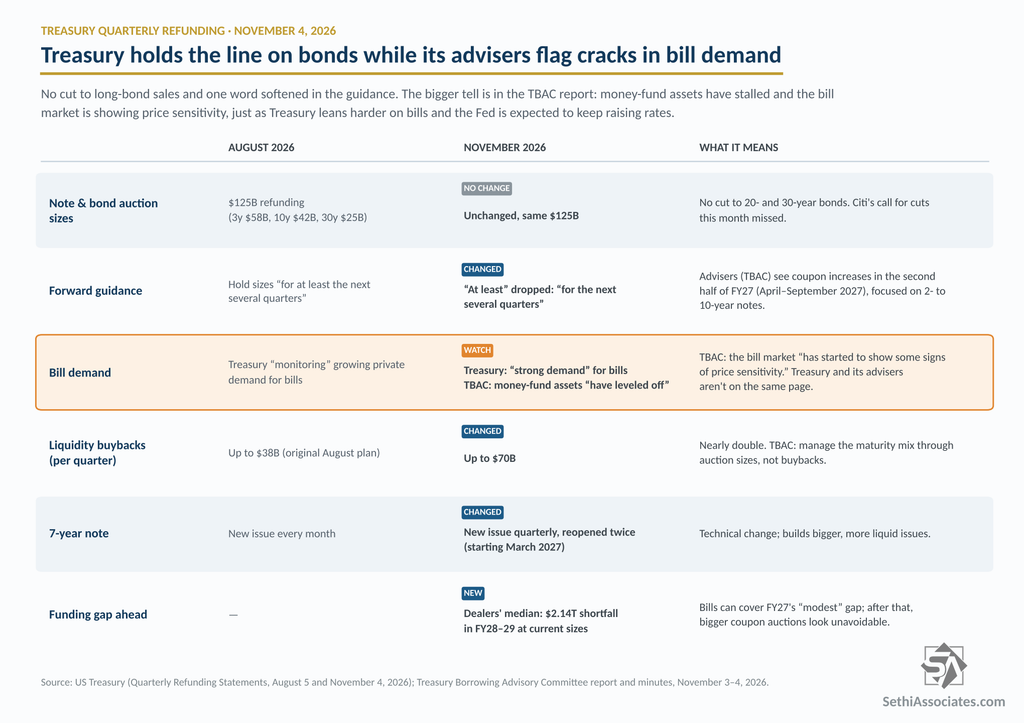
First, Treasury kept note and bond auction sizes unchanged at $125 billion for next week’s refunding auctions of 3-, 10- and 30-year securities. That means no cut to 20- and 30-year bonds, which some, including Citi, had expected this month. Treasury also repeated that it continues to see “strong demand” for bills.
Treasury also softened its guidance to holding auction sizes “for the next several quarters,” dropping “at least.” Starting in March 2027, the 7-year note will move to a new issue each quarter with two reopenings.
Second, the Treasury Borrowing Advisory Committee (TBAC), a panel of Wall Street bank and investor executives that advises Treasury on its debt sales, sounded less sure about that. In its report, the committee said money market fund assets “have leveled off” and that the bill market “has started to show some signs of price sensitivity.”
The committee also recommended larger coupon auctions in the second half of fiscal 2027 (April through September 2027), focused on 2- to 10-year notes, with “meaningful discussion” about future 20- and 30-year sizes. According to the meeting minutes, dealers see a $2.14 trillion funding shortfall in fiscal 2028 and 2029 at current auction sizes. Bills can cover fiscal 2027’s “modest” gap, but not that much.
The committee further advised that the mix of maturities should be managed through auction sizes, not buybacks. That came even as Treasury nearly doubled its planned liquidity buybacks this quarter, to as much as $70 billion from $38 billion in August’s plan.
As I noted in Monday’s post, bills could reach close to 24% of marketable debt by March, the highest since late 2020. The Fed has already hiked once, and markets price over two more increases over the coming year, according to the committee. If bill buyers also start demanding higher yields, it would be a double whammy for Treasury’s interest costs.