Staples Are Priced Like It’s 1999

Consumer Staples just had their biggest one-month lead over the S&P 500 since March 2020, and they’re now priced like it’s 1999. History says shorting them after a run like this usually works, but only if the broader market goes on to rally. In the three times since 1999 that stocks kept falling, Staples kept winning.
Valuations Have Flipped Since 2000
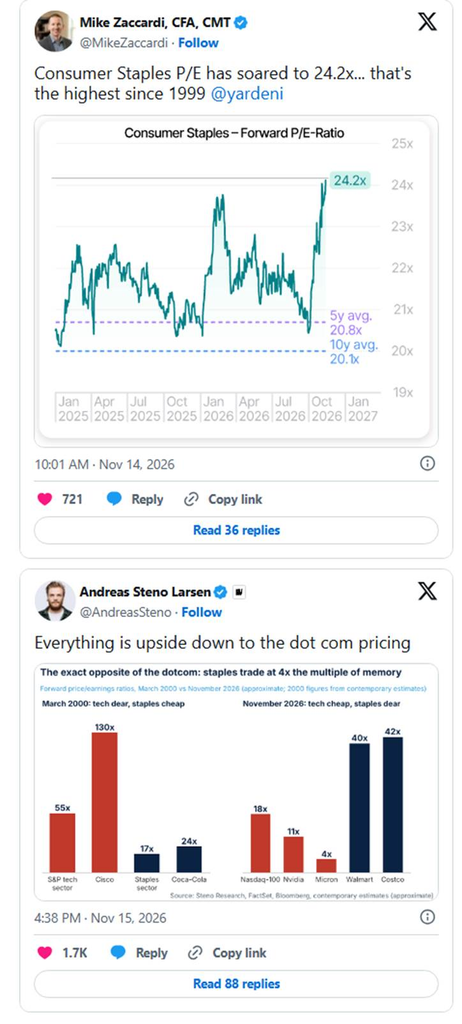
Christophe Barraud’s Monday Morning Brief (a nice, free daily collection of posts) had two charts comparing this market to the internet bubble. Andreas Steno says “everything is upside down to the dot com pricing.” In March 2000, S&P 500 tech traded at about 55 times forward earnings and Cisco ($CSCO) at 130, while Staples sat at 17. Today the Nasdaq 100 trades at about 18, Nvidia ($NVDA) at 11 and Micron ($MU) at 4, while Walmart ($WMT) and Costco ($COST) trade at 40 and 42 (Steno’s figures are approximate).
Mike Zaccardi, citing Yardeni Research, shows the Staples sector’s forward P/E at 24.2, the highest since 1999 and well above its five-year (20.8) and 10-year (20.1) averages. As I noted in Sunday’s Week Ahead, the Nasdaq 100’s forward P/E hit 18 last week for the first time since the Covid crash.
Goldman Likes a Short
As I noted in last week’s Week Ahead, Goldman Sachs’ thematic desk said it likes shorting its Staples basket after the group beat the S&P 500 by nearly 20% in a month. Its case: the sector’s valuation premium to the index is the highest in more than 10 years, and the basket’s 2.84% dividend yield sits 2.05 percentage points below the 10-year Treasury yield, the 1st percentile of the last decade. Goldman adds that Staples have historically lagged over the next three months after similar runs, except in late 2021 and early 2022.
What the History Says
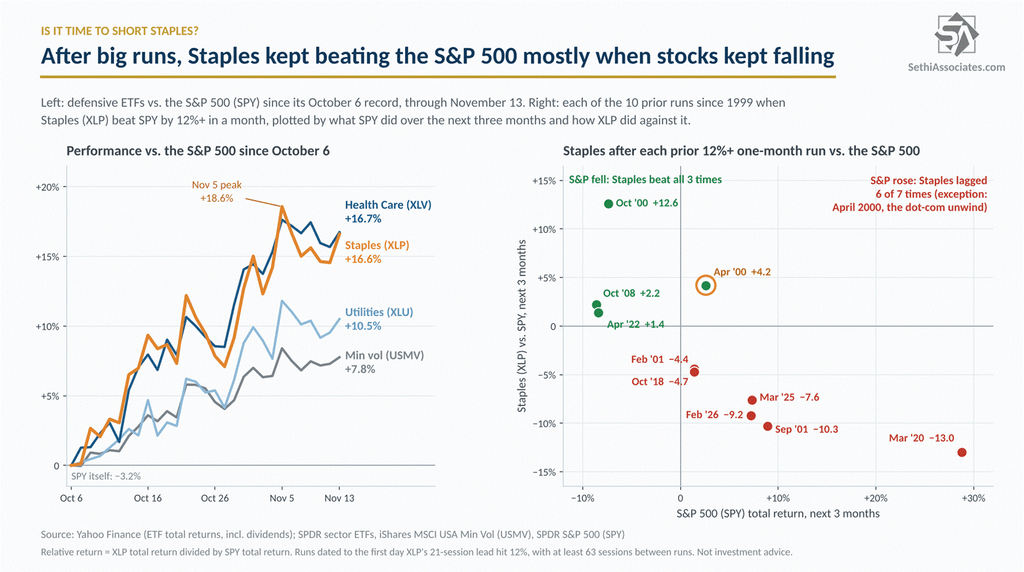
I looked at the Consumer Staples Select Sector SPDR Fund ($XLP) against the SPDR S&P 500 ETF ($SPY) using total returns back to 1999. On November 5, Staples’ lead over the prior month hit 18.4%, a level topped only in April and October 2000 and March 2020. There have been 10 earlier runs of 12% or more, and Staples lagged over the next three months in six of them, by a median of 4.5%.
Based on history, whether the short works comes down to what the S&P 500 does next. In all three cases where the S&P fell over the following three months (October 2000, October 2008 and April 2022, each down 7% to 9%), Staples beat it. In six of the seven cases where the S&P rose, though, Staples lagged, by as much as 13 percentage points after the March 2020 run.
The one exception to the rule was April 2000, a month after the Nasdaq peaked. The S&P rose 2.6% over the next three months and Staples still beat it by 4.2 points, rising 7% on their own. One difference is Staples went into that unwind at 17 times earnings. They’re going into this one at 24.
Positioning
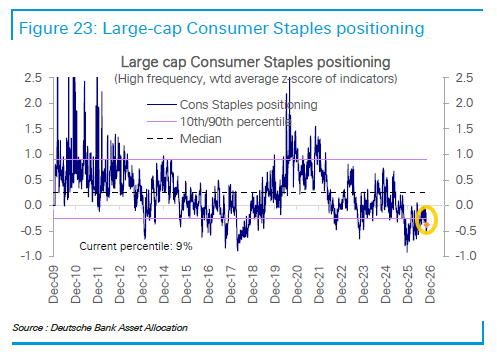
One thing working against the short is positioning. Deutsche Bank’s data, which I covered in Sunday’s Week Ahead, show investors are still underweight large-cap Staples (9th percentile, up from the 4th), which leaves less to unwind.
Bottom line: a Staples short has mostly been a bet that the selloff is over. If stocks keep sliding, history says Staples can keep working even from rich valuations. Nvidia’s earnings Tuesday are the near-term test