Retirement Investors, Beware the ‘Direct Indexing’ Schemes


When an asset manager or brokerage starts touting the “opportunity” they see, forecasting that industry-wide assets will more than double in the next two years, retirement savers should greet the news with some skepticism.
In a recent sponsored article published in Wealth Management magazine, “The Appeal of Direct Indexing in Today’s Markets,” Northern Trust Asset Management’s Ken Lassner made his company’s case for the strategy.
Direct indexing means owning the individual stocks in an index like the S&P 500. That’s instead of simply owning an exchange-traded fund like the Vanguard S&P 500 ETF ($VOO). That would mean the account owner is responsible for managing gains, losses and rebalancing on this entire basket of stocks.
Among the direct-indexing benefits Lassner named:
- Tax efficiency: Selling losing stocks in a separately managed account creates tax credits that offset gains elsewhere, meaning investors can keep more capital invested, rather than turning it over to the government.
- Customization: Investors can overweight, underweight or avoid specific stocks rather than owning a regular index ETF.
- Finding alpha: Lassner says the direct-indexing strategy can add 100 to 200 basis points of excess after-tax return versus a comparable ETF.
- Lower minimums: Direct-indexing strategies within separately managed accounts were once available only to the uber-wealthy with a minimum investment of $5 million, but now minimums can be as low as $100,000.
Not as Perfect as it May Seem
Sure, there may be some advantages, on paper anyway.
But think about some of the potential problems.
For starters, “direct indexing” isn’t always a do-it-yourself endeavor. That makes sense, considering that it would be monumentally challenging for an individual investor to DIY a portfolio of all of the S&P 500 stocks. Even if you chose, say, the 30 Dow Jones stocks instead, it would still be a hassle to properly time buys, sells and rebalances.
That’s where the separately managed account comes in. If you hire a “done for you” manager to oversee your direct indexing account at a brokerage like Schwab or Fidelity, you’d pay a fee somewhere in the range of 0.30% to 0.40%.
Hmmm… wait a second. Let’s take a quick glance at the fees for popular S&P 500 ETFs:
- Vanguard S&P 500 ETF ($VOO): 0.03%
- iShares Core S&P 500 ETF ($IVV): 0.03%
- SPDR S&P 500 ETF Trust ($SPY): 0.0945%
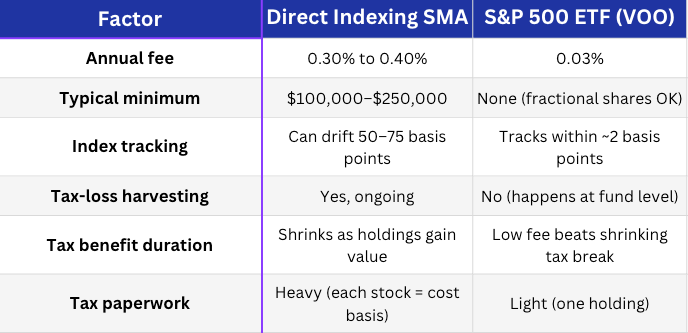
In a nutshell, for what amounts to the same S&P 500 exposure, VOO charges you $3 a year on $10,000. Meanwhile, a direct indexing SMA charges you $30 to $40 a year on that same $10,000. Oh, and you also get the privilege of generating a bunch of extra trades, as well as tracking error and more tax-season paperwork.
So you’re paying a lot more, betting that the tax-loss harvesting will save you more than that fee.
Sometimes that bet will pay off. For example, in a year of higher-than-normal market volatility (which happens), if you’re in a high tax bracket and your taxable account is huge.
But for most investors? Nah. You’d be paying upfront for a potential tax benefit that may not show up at all. The chances of a hefty tax benefit decrease over time, as more of the individual stocks in the portfolio post gains rather than losses. That leaves you with less to harvest each year. Kind of like a subscription you bought a long time ago, but keep paying for, even though you’re not using it anymore.
Beware What Sounds ‘Sophisticated’
As three financial advisors at Park Avenue Capital put it in a June 2025 Journal of Financial Planning article, direct indexing is “more sizzle than substance.”
For most investors, a low-cost ETF still wins. That’s not because the tax benefits of direct indexing are fake, but because they’re smaller, shorter-lived and more tenuous than the fees attached to them.
But as with many strategies, it often feels more sophisticated than something that’s simple, yet makes more sense for most investors.
According to the advisors from Park Avenue Capital, “We find that, ironically, leading with a simple investment framework is the path of most resistance because it’s not newsworthy or interesting cocktail party conversation.”
