Projecting Big Growth For This $13 Billion Biotech Name


The first full week of trading for the fourth quarter was a bit choppy. Higher energy costs and interest rates continue to be increasing headwinds for the economy. As I highlighted in my column on Friday, market breadth is quite dismal, despite the NASDAQ and S&P 500 hitting all-time highs earlier this week. The biotech sector is just one of many significant laggards in the market over the past few months.
Today, I am going to take advantage of lower entry points to spotlight a recent covered call trade for my portfolio. It is around a mid-cap named BridgeBio Pharma, Inc. ($BBIO) that has a market cap of just south of $13 billion. The company has one primary product on the market, known by its Attruby brand name. This is an oral high-affinity transthyretin (TTR) stabilizer. It was approved by the FDA in late 2024 to treat adults with cardiomyopathy of wild-type or variant transthyretin-mediated amyloidosis or ATTR-CM.
Attruby is now also approved in Europe and Japan and competes with several products including Pfizer’s ($PFE) tafamidis in a market worth north of $20 billion. A potential competitor in the ATTR-CM space from AstraZeneca ($AZN) and Ionis Pharma’s ($IONS) failed in a Phase 3 study this summer, triggering a bit rally in BBIO in late July. The shares are down nearly 30% from that peak, providing a more advantageous entry point.
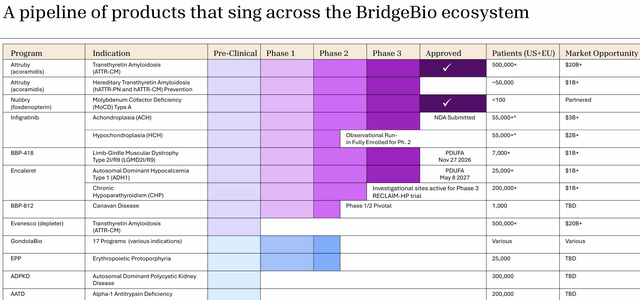
Attruby is off to an impressive marketing rollout. Sales in the first half of 2026 came in a bit above $400 million, a better than 270% increase over the same period in the prior year. BridgeBio is not resting on its laurels. The company is advancing a diverse pipeline and is counting on three additional FDA approvals over the next year.
The biggest of these opportunities is around an oral FGFR3 inhibitor and discontinued bile-duct cancer med that is now undergoing assessment for the treatment of achondroplasia and hypochondroplasia called infigratinib. Management believes this approval for these indications could unlock a $5 billion potential market. A once-weekly injectable CNP analog Yuviwel (navepegritide) from Ascendis Pharma’s ($ASND) did garner accelerated approval for pediatric achondroplasia patients in February 2026. Infigratinib is marching toward approval for achondroplasia one year later.
An oral glycosylation substrate dubbed BBP-418 has a PDUFA date with the FDA where it should be green lighted for the treatment of limb-girdle muscular dystrophy type 2I/R9. This is an inherited neuromuscular disorder characterized by lower-limb weakness, which can lead to ambulation and other health complications.
The company’s oral antagonist of the calcium sensing receptor (CASR) called encaleret has a potential approval date next May for the treatment of autosomal dominant hypocalcemia type 1 (ADH1) and chronic hypoparathyroidism (CHP). Leadership pegs the domestic potential market of just north of $1 billion.
The company’s balance sheet was topped off with a recent secondary offering and if all goes according to plan, BridgeBio will become cash flow positive in the second half of 2027. The company’s revenues should just top $1 billion this fiscal year and analysts believe sales will rapidly accelerate to north of $4.5 billion by FY2030. That makes BBIO a solid GARP stock which I can make more attractive via the following covered call strategy.
Option Strategy
This is how one can initiate a holding in BBIO with a covered call order. Using the May $60 call strikes, fashion a covered call order with a net debit in the $51.50 to $52.50 a share range (net stock price – option premium). At the top of the range, this strategy provides downside protection of 20% with 15% upside potential even if this equity trades down 9% over the option duration.
At the time of publication, Jensen was long BBIO.
