More Tales From Nvidia: Stalling AI Growth, Astronomical Losses and the Fed and AI (Issue #240!)

Let’s start the day with a brief discussion on the deterioration of the underlying AI fundamentals.
I suspect most have seen the news per the WSJ about OpenAI’s most recent quarter being quite ugly, but you wouldn’t know this if you watch the ubiquitous and shallow daily discussions of AI and hyperscalers on Fin TV.
Revenue growth decelerated sharply. They only grew revenue by about $1 billion sequentially, while increasing operating losses by $3 billion sequentially (to buy that revenue). They managed to lose $12.3 billion in the quarter alone ($48 billion annualized) on the $6.7 billion of revenue.
It is not very impressive to lose $2 for every $1 of revenue (I do not think I have ever seen anything quite like it). It must truly be revolutionary technology to pull that off. This speaks volumes about the economics of this industry and why all the borrowing and circular financing needs to happen to keep it propped up.
It is not a surprise their revenue growth slowed. Token prices are cratering, and both OpenAI and Anthropic continue to lose share to open source. Given this macro overlay and what happened to OpenAI, one would think Anthropic’s trajectory would start showing the same slowing as well. The recent growth engine was token consumption for coding and the related tokenmaxxing (which has now been stopped or slowed).
At any rate, I have no idea where these guys get the data, but it looks like Anthropic’s coding-related revenue, after skyrocketing December-April, went almost completely flat starting in June. No wonder Anthropic’s backward-looking revenue is being hyped by the usual mouthpieces. My guess is the going is going to get a lot tougher going forward for them:
The other thought I have about coding is a lot of it is a one-time project.
If a company wants to use an AI tool to write code, to replace a CRM app, for example, that can certainly be done (and part of why Salesforce ($CRM) stock got hammered). But once those tokens are consumed, and the code is written, that code becomes the property of whomever used the AI tool to write the code. It is a one time project, and does not repeat. Then, the code can then be run on said company’s internal server architecture, or very low cost, low value added hosted capacity (which is a fraction of the cost of higher value added cloud capacity or AI capacity). There are a lot of one-time projects being done now, driving token demand for coding.
How long that bolus of stuff lasts before it is done is also something to monitor.
This may be part of why overall token growth seems to be flattening as well (and token price is cratering while both OpenAI and Anthropic seem to keep losing share):
https://openrouter.ai/rankings#leaderboard-table
Token prices:
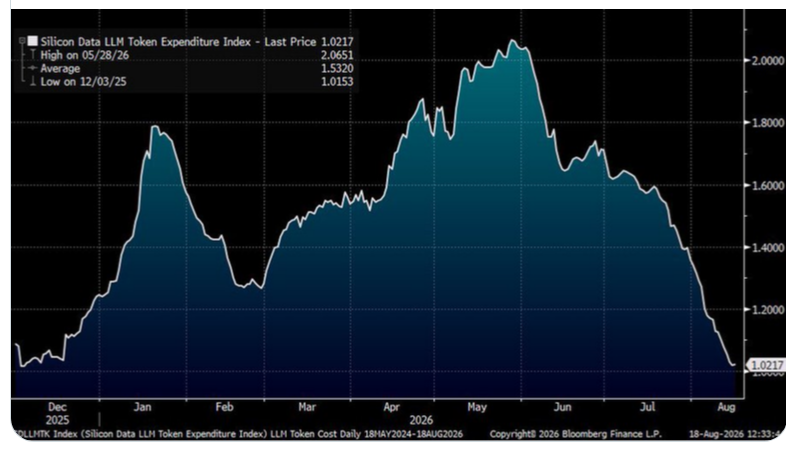
And these are the two companies that are the pillars supporting the whole circular scheme while fighting a very tough macro trend and one of them at least seems to be losing almost $2 for every $1 of revenue.
The Fed and AI
Well whaddya know, even the Fed seems to think AI is inflationary, as based by the hawkish minutes that were just released.
So much for the great productivity enhancer.
Left out of their commentary is how the investment in AI is also clearly raising the cost of capital (rates) in the economy overall, which may be even more problematic. It seems Secretary Bessent is bringing a knife to a gunfight in this regard. This latest announcement (which is really just a sterilized twist and not money printing) will probably work about as well as his yen intervention: https://josiahwaters.substack.com/p/the-yen-intervention-bessents-desperate
It Was All About Inflation
“Most participants anticipated that inflation would step down over the rest of the year as the effects of tariffs and earlier energy price increases wane, but many participants noted the possibility that inflation might be more persistently elevated,” the minutes said.
- Fed staff economic outlook showed inflation outlook was similar to one prepared for June meeting but economic outlook was “a touch weaker.”
- FED: PARTICIPANTS JUDGED INFLATION RISKS WERE SKEWED TO UPSIDE
- FED: SEVERAL SAW AI INVESTMENT HAVING BROADER EFFECT ON PRICES
- FED: SEVERAL SAID TARIFF PASS-THROUGH WAS NOW LARGELY COMPLETE
- Several participants noted price increases over last year were broad based, spanning various categories of goods and services.
- The record showed participants’ inflation outlooks were “highly uncertain” and the re-escalation of the Iran war “clouded the inflation outlook.”
Position: None
