From Microsoft to Oracle, Charting Software Stocks Amid Resurgence

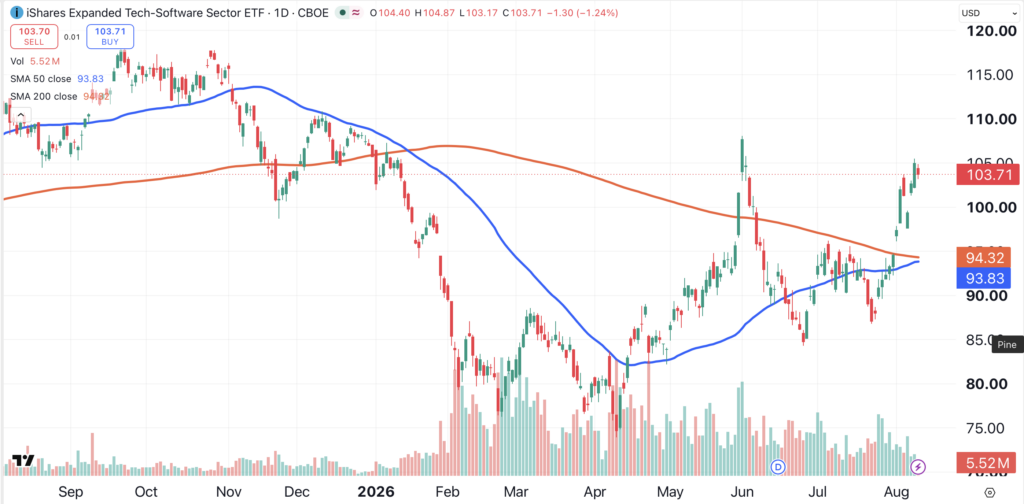
Markets had a strong first half in 2026, but software seemingly missed the party.
The sector was out of favor, with much concern centered around AI’s effect on software stock valuations. Subscription and software as a service (SaaS) business models have been called into question.
In the second half of 2026, software stocks are finally experiencing a resurgence. An industry bellwether, the iShares Expanded Tech Software ETF ($IGV) has gained 12.3% over the past month.
Let’s take a closer look at the individual stocks within the software industry, to see which names have the greatest potential.
Palo Alto Networks and Crowdstrike Leading the Way
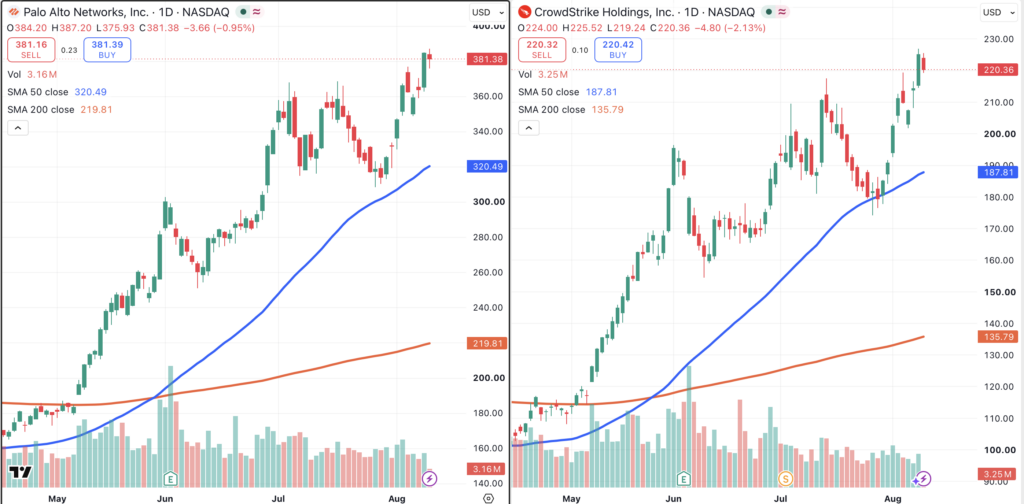
Security is the hottest part of the software sector, and two pure-plays in that area are Palo Alto Networks ($PANW) (left chart) and Crowdstrike ($CRWD) (right chart).
Both stocks reached all-time highs this week. Year to date, Palo Alto has gained 114%, while Crowdstrike has climbed 95%. You can read more about Palo Alto Networks here.
Why is software security such a hot area? Advancements in AI are causing an increase in both the scale and sophistication of cyber threats and attacks.
Other names in this group include Cloudflare ($NET) and Fortinet ($FTNT), both of which also recently reached all-time highs.
GRADE: A-
Joining the Party: Microsoft and Palantir
Both Microsoft ($MSFT) and Palantir ($PLTR) have come roaring back after disappointing investors earlier this year. Recently, shares of Microsoft (left chart) reached a nine-month high, while Palantir vaulted to a six-month high.
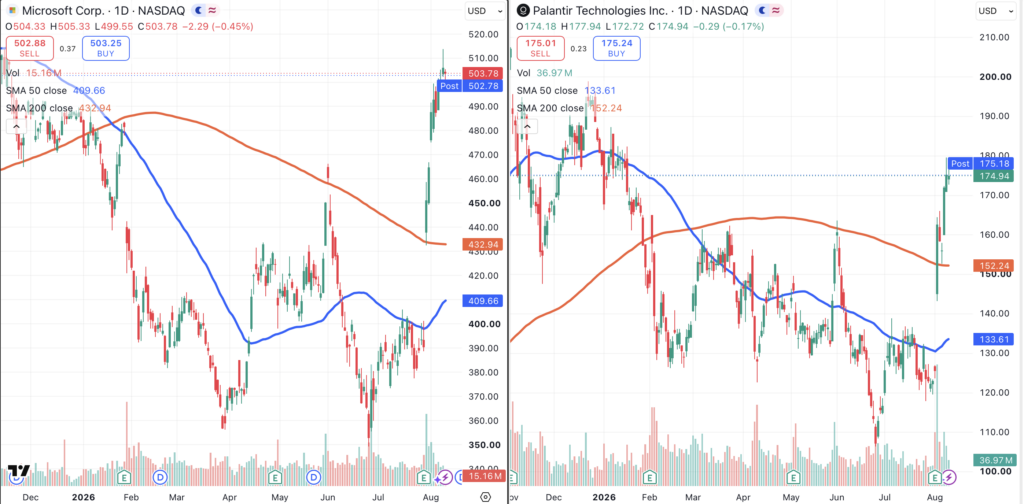
Compare the Microsoft/Palantir charts to the Palo Alto/Crowdstrike charts, and you can see why the latter pair is a cut above.
Microsoft and Palantir have been impressive too, but for a shorter period of time. Both stocks easily shot past their June highs and cleared their 50-day (blue) and 200-day (red) moving averages, but still haven’t scaled their respective all-time highs.
GRADE: B+
Playing Catch Up: ServiceNow and Salesforce
This brings us to software names that have struggled to keep up with the leaders listed above. Two of the most prominent names in this group are ServiceNow ($NOW) (left chart) and Salesforce ($CRM) (right chart).
Salesforce is down 22% for the year, but has gained 15% over the past month. ServiceNow is down 13% year-to-date, but has climbed 14% over the past month.
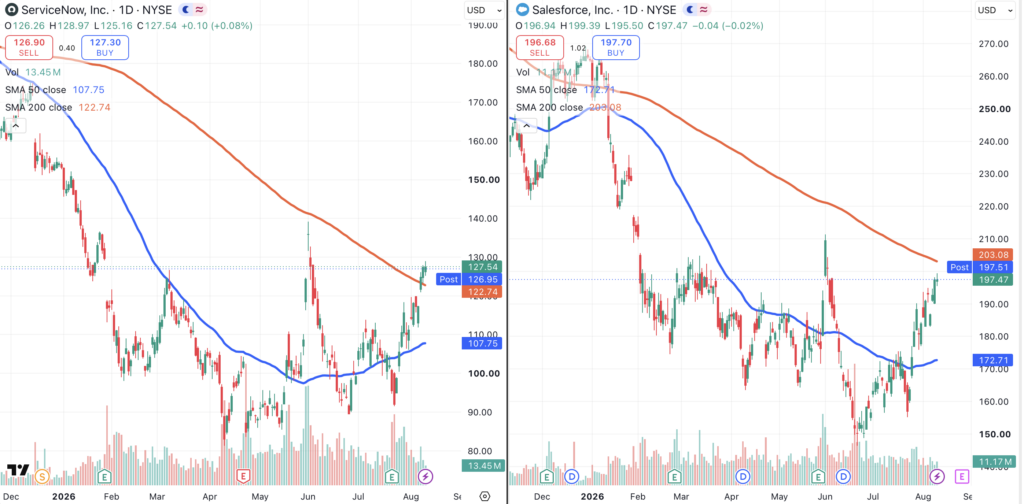
Both names have failed to climb above their respective June highs. ServiceNow recently climbed above its declining 200-day moving average, while Salesforce is still struggling to reach that key indicator.
It’s never a good sign when a stock underperforms both the overall market and its own sector.
GRADE: C
Then There’s Oracle
As you can see, Oracle ($ORCL) is in a class by itself. This stock has managed to scratch out a 10% gain over the past month, but has lost 25% year to date, and 42% over the past 12 months.
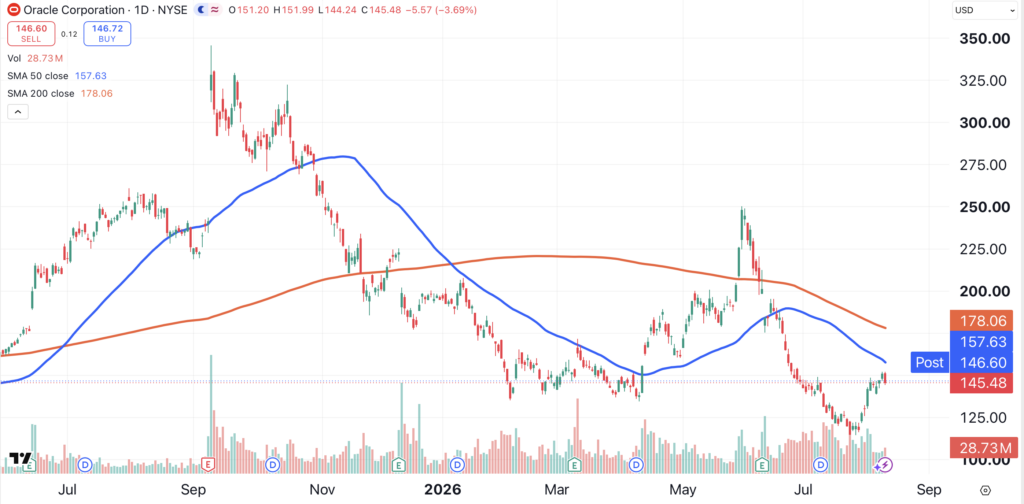
The underperformance here is staggering, and it raises concerns beyond this one stock. High debt levels and massive AI capital expenditures recently pushed Oracle’s credit default swaps to multi-year highs. If that trend continues, market participants may begin to question Oracle’s ability to pay its bondholders.
GRADE: D
At the time of publication, Ponsi was long PANW.
