Democratic Sweep the Answer to China’s Stock Market Malaise?

While China’s stock rescue package got a shrug, as I posted on Tuesday (see China Reloads Its 2024 Stock Rescue Tools, but Markets Aren’t Buying It), the U.S. midterm results got a rally.
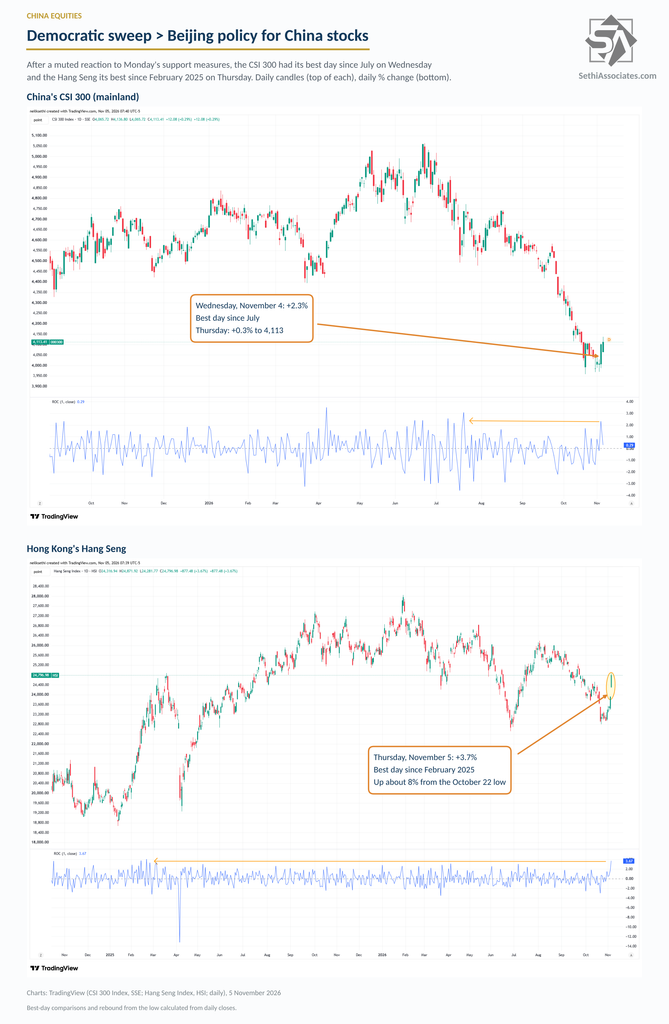
After Beijing rolled out its 2024-style support tools on Monday, the CSI 300 slipped 0.2% Tuesday and the tech-heavy Star 50 fell 3.8%. Then Democrats swept both chambers of Congress, and the CSI 300 jumped 2.3% Wednesday, its best day since July. It added 0.3% Thursday to 4,113, up 2.6% in two sessions.
Hong Kong followed with a bigger move Thursday:
- The Hang Seng rose 3.7%, its best day since February 2025 (+4.0% on February 21, 2025, during the DeepSeek rally). It’s now up about 8% from its October 22 low.
- The Hang Seng Tech rose 5.6%, the most since February 2025, per Bloomberg.
- Alibaba and Tencent each rose more than 7%, and Meituan added 6.8%.
Positioning added fuel. Short selling was 32% of Hong Kong’s turnover on Tuesday, the highest in more than three years, according to Bloomberg. Lotus Asset Management’s Hao Hong calls the move “one of the biggest short squeezes in recent years.” The cost of hedging the Hang Seng Tech fell to its lowest since July, and options volume on the Tracker Fund hit a one-year high as bullish bets dominated.
Investors, according to Bloomberg, are reading the result as a risk to the U.S. AI hardware trade and rotating into value. Bloomberg notes the Hang Seng Tech traded at 13 times forward earnings last month, the lowest since 2024. Bloomberg Intelligence’s Marvin Chen sees three rotations at once. Money is moving out of Korea and Taiwan into China, into value after China was “stuck at trough valuations” while the rest of the world rallied, and away from “tech hardware and pure AI plays.”
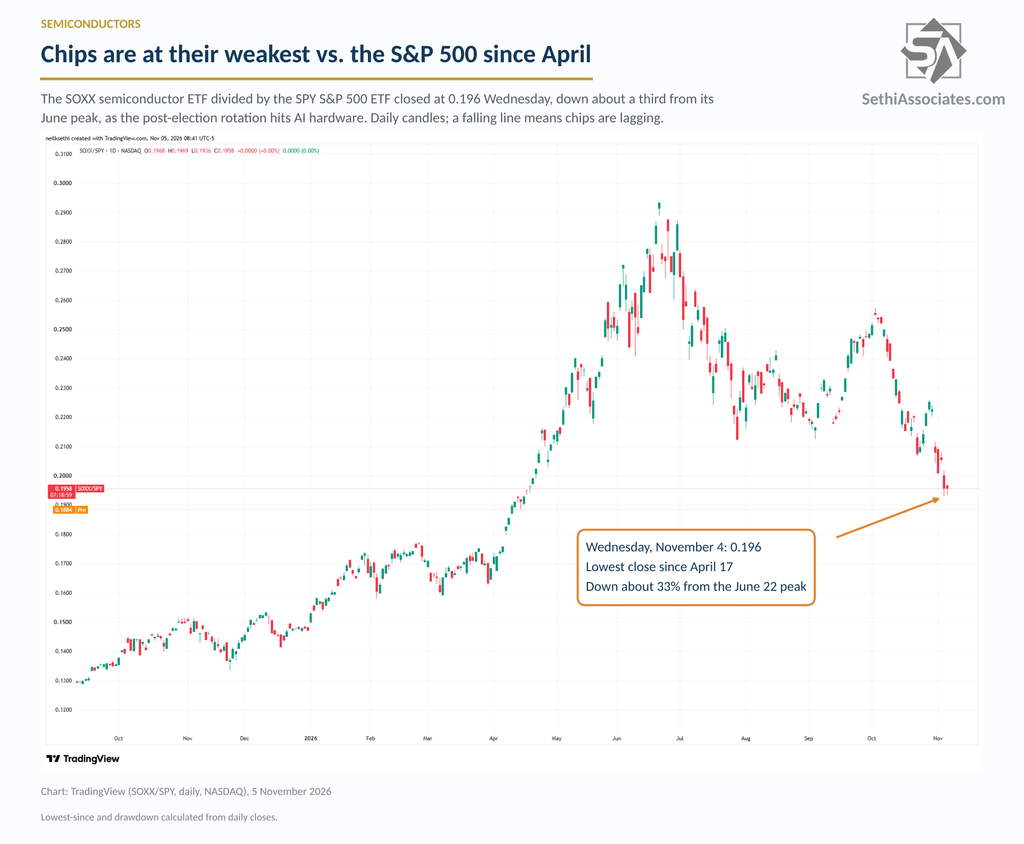
A similar rotation shows up in the U.S. Bespoke says 91.5% of consumer discretionary stocks are above their 50-day averages, the highest in at least a year, compared with 35.5% of tech stocks. And the Philadelphia Semiconductor Index ($SOX) is at its lowest relative valuation to the S&P 500 since April.
To be fair to Beijing, Bloomberg also reported stepped-up national-team buying and buybacks Wednesday, so the policy floor is perhaps part of this.
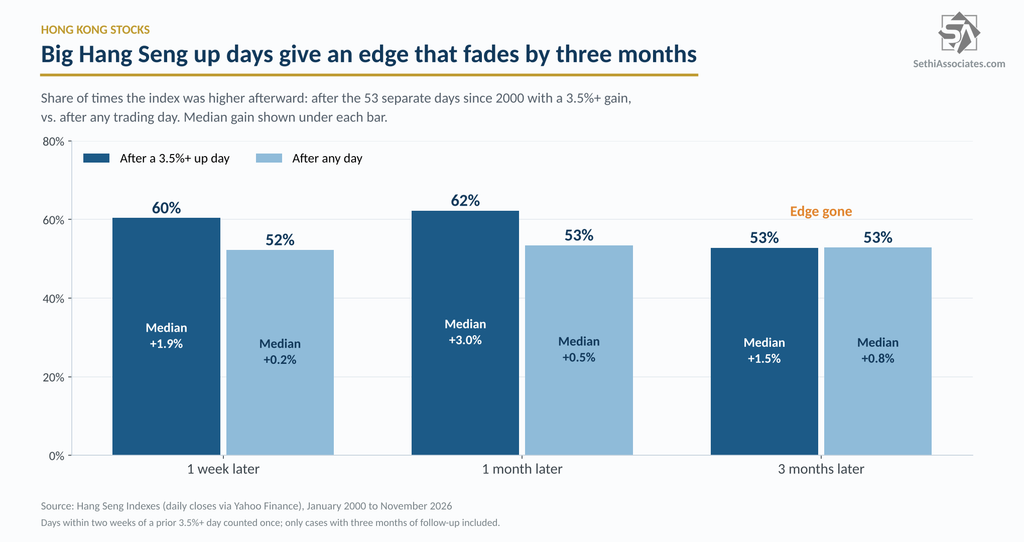
The good news: History says days like Thursday tend to carry over for a few weeks: since 2000, the Hang Seng has been higher a month after a 3.5%-plus day about 62% of the time, compared with 53% for any day.
The caveat: That edge is gone by three months, when it’s back to roughly even odds.