Boockvar: What’s With the Blanket Tariffs?!

From Peter Boockvar:
I just don’t get it/Don’t forgot those huge lease obligations too/Great earnings intel/PMIs
I understand the desire to reshore key activities like producing rare earths, pharma ingredients, etc… and the goal of making more things in the US but I just don’t get this obsession with blanket tariffs, especially as US importers and consumers are eating most of it, inflation both for consumers and business is already a major economic pain point and it’s on many things we will never make here. I’ll stop there.
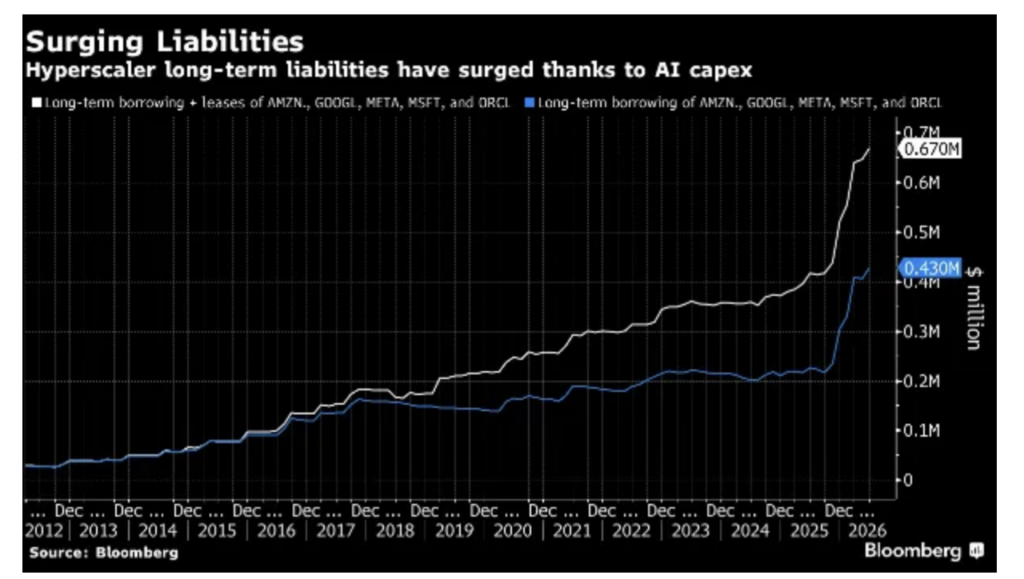
I mentioned yesterday my belief that even after the massive hyperscaler CapEx slows down in a few years (maybe), high maintenance CapEx will remain. One of those expense lines are committed leases for these data centers. Bloomberg had a great chart yesterday that highlighted the size and growth with lease obligations now totaling $240 billion for the five large hyperscalers (and will only grow from here). That is in addition to $430 billion of debt they have in total which DOES NOT include all the off balance sheet liabilities they have committed to.
To the bombardment of earnings and I’ll try to keep as succinct as possible. The economic picture is still mixed I believe.
From American Airlines and whose stock fell 8% because of lower guidance due to a rising fuel bill:
“Revenue strength was broad based, reflecting robust demand for our product and an improving pricing environment. Geographically, all regions exceeded our initial expectations during the quarter.”
“Premium unit revenue increased more than 13% y/o/y, driven by strong leisure and corporate demand across all entities. Main cabin demand was solid. Unit revenue increased nearly 9% and accelerated during the quarter.”
“In the second quarter, fuel expense increased by over $2.2 billion, or 83% y/o/y. Despite that unprecedented headwind, American was able to recover nearly half of the increase with the strong revenue performance in the quarter.”
And why the stock fell, “Since the beginning of July, expected third quarter fuel expense has increased by more than $700 million and nearly $1.6 billion for the remainder of the year. Even in the last week, our fuel forecast has increased $230 million in the third quarter and nearly $550 million for the remainder of the year.”
From Tractor Supply, bucking the trend with a 3% rise yesterday, though comps fell 1.5%:
“We had positive comparable store sales in April and June. However, they were more than offset by unusually adverse conditions in May, which drove second quarter results below our expectations.”
In May, “Fuel prices peaked during the height of our spring selling season, putting meaningful pressure on our customers’ discretionary spending at the most important time of the quarter. Our customers often drive longer distances to shop, frequently in pickup trucks, many of which are diesel powered, making them especially sensitive to higher fuel costs.”
“At the same time, persistent drought conditions across several key southeastern markets limited normal seasonal activity and reduced demand for lawn care and other outdoor related purchases…These conditions disproportionately affected discretionary and project oriented categories, while our needs based businesses remain resilient.”
Albertson’s plunged by 22% and said this:
Identical sales fell .8% and “While pharmacy and digital delivered strong growth, their performance was not enough to offset broader pressures in our core business.”
“the decline was most pronounced in our lower income customer segments, where we continued to see softness in both units and baskets.” Also, egg deflation cut comps by 50 bps.
“As we look to the balance of the year, we are planning prudently around a softer unit environment while continuing to invest in actions that strengthen our competitiveness and customer value proposition. Our more cautious view reflects ongoing pressure on lower income consumers, softness in grocery industry unit trends, and the potential for additional affordability pressure from supplier cost increases.”
From Dow, which fell 1% yesterday:
This was some macro commentary, “And looking around the globe, in the Americas, consumers have remained steady, economic activity is constructive, and spending has held up, even as the US housing market is still soft under the weight of affordability concerns and high mortgage rates. In the Middle East, geopolitical tensions remain elevated and logistics are still constrained…The geopolitical impacts on energy and feedstocks continue to support higher risk premiums, and we are seeing renewed value placed on supply security, including both reliability and logistics.”
“In Europe, deeper structural pressures like high operating and labor costs persist. But with that, some constructive dynamics are beginning to emerge, including government support and trade protection measures. This includes recently announced support for EU anti-dumping and anti-subsidy actions, each of which support a more balanced environment for European produced products, including polyols that have been impacted by anti-competitive imports.”
“And across Asia-Pacific, we continue to see mixed signals. Regional consumer demand remain soft, with weakened retail sales in May, but industrial production and manufacturing activity have recently accelerated. In the energy space, refinery operations are normalizing in China, improving energy availability across the region. So globally, a supportive but higher cost feedstock environment, paired with resilient, but uneven demand leaves us to expect a more measured but still solid third quarter.”
United Rentals stock had a big day yesterday, up 10% and said this on their call of note:
“construction posted strong growth led by non-residential and infrastructure. And on the industrial side, power continues to post double digit growth, while metals and minerals also grew at a healthy rate.”
“In the quarter, we saw projects kick-off in a variety of end-markets, including hospitals, airports, and LNG terminals to name a few, while data centers continue to be a source of growth.”
From Knight-Swift Transportation, down 4.9% yesterday:
“So, the truckload freight market has rapidly progressed over the past few months, with spot rates trending well ahead of normal seasonality, tender rejection rates reaching levels not seen since 2021, and contractual bid activity growing increasingly supportive. This has continued to be largely supply driven, though signs of improving demand are starting to emerge.”
From Robert Half on the labor market and lower pre market:
While revenues fell 3% y/o/y adjusted, “Hiring demand continues to improve and market conditions are increasingly more supportive of our business.”
“Technology was our strongest performing practice group within contract talent solutions…Client engagement remained strong throughout the quarter with job orders and project activity increasing across many markets, particularly in technology modernization, data, cybersecurity and IT infrastructure.”
“Many of our small and mid sized business clients continue to operate with lean organizations after several years of disciplined cost management. As confidence improves and strategic priorities advance, we’re seeing demand for specialized talent and consulting expertise to help execute those initiatives. While clients continue to approach hiring thoughtfully, we are seeing steady progress in client interactions and activity.”
“The labor market for specialized talent remains tight.”
“Artificial Intelligence continues to complement, not replace the work performed by the professionals we place. We’re seeing growing demand for candidates who combine deep domain expertise with AI fluency and the judgment required to apply these technologies effectively and responsibly, including verifying the accuracy of their outcomes.” I bolded to highlight.
“The rapid adoption of GenAI by job seekers has also changed the recruiting landscape, increasing application volumes and making candidate evaluation more complex.”
I’ll finish with the economic data of note from overseas.
Japan’s June core/core CPI rose 1.7% y/o/y vs the estimate of 1.8% and still kept subdued because of subsidies but still above the overnight interest rate. The headline CPI gain was also 1.7% but with the renewed jump in oil prices, this news is old. While the 10 yr inflation breakeven was unchanged at 2%, the 10 yr JGB yield rose another 2.5 bps to 2.82% and is 5 bps from matching the highest since the 1990’s.
The Japanese July manufacturing PMI was little changed but staying firmly above 50 at 54.7 while services slipped to 51.9 from 52.2. S&P Global said “The cloud of war in the Middle East continues to loom over the Japanese private sector. Manufacturers continued to report efforts to build stocks of goods and raw materials amid ongoing supply chain disruption and higher prices linked to the conflict, despite a slight easing in overall cost inflation over the month. Selling prices continues to rise sharply, with service charge inflation accelerating as firms sought to protect already squeezed margins by passing higher costs on to clients.”
Australia’s July services PMI was higher by 2.5 pts to 53 and manufacturing was 51.7 vs 51.5 in the month before.
In the Eurozone, services rebounded back above 50 at 51.6 from 49.4 while manufacturing improved again to 52 from 51.4. S&P Global said “Germany is reporting growth for the first time in four months. France’s downturn has softened to the weakest since February, and the rest of the region as a whole is growing at a pace not seen since last November as its order book inflows jumped to a degree not beaten in over four years.”
And, “The improving picture also spreads to the labor market, where companies reported the first rise in payroll numbers so far this year as business growth expectations revived to the highest since February.”
They also mentioned that ‘cost pressures have meanwhile cooled sharply’ but energy prices have done nothing since but go up over the past few weeks and high energy costs relative to the rest of the world is Europe’s competitive disadvantage.
Services in the UK drove the lift in its PMI as it rose 3 pts to 51.8 m/o/m. Manufacturing was up to 52.8 from 52.5. S&P Global said “Hospitality companies saw demand boosted by good weather, the FIFA World Cup (England was so close!) and more domestic holidays, as high costs and uncertainty continued to deter some foreign travel. However, overall services growth remained lackluster amid cost of living pressures.”
With manufacturing, “manufacturers and their customers continued to build precautionary stocks, widely linked to supply chain disruption caused by the war in the Middle East, meaning part of the recent factory upturn could prove short-lived.” We’ve been hearing this globally now for months.
Nothing market moving here but it does seem that economies around the world are doing their best, and doing a decent job, of managing through the oil price volatility and supply chain issues out of the Strait.
Positions: None.
