Boockvar on Waller, Warsh and More

From Peter Boockvar:
These two don’t see eye to eye on this/Other good stuff
It’s clear that Fed Chair Warsh and Fed Governor [Waller] don’t see eye to eye when it comes to giving forward guidance because Chris Waller loves telling us all of his thoughts seemingly each time right before a CPI report. While the next FOMC gathering is still a month away, Waller said today “While I am hoping for an improvement over September, even if this occurs, I would still support a 25 basis point increase in the FOMC’s policy rate at our December meeting. However, if inflation comes in substantially higher than I expect, more robust action by the FOMC may be called for.”
Further, “Let’s just say it. September’s inflation data were bad. There was no silver lining.” And after the CPI report in two hours, “Later today, I will be looking to see whether this breadth of elevated inflation continues, including whether high-tech goods prices related to the AI buildout continue to rise at the very high rate of recent months. I also want to know if the run-up in energy prices of the past several months is being passed through to goods and services directly or indirectly, because of higher input costs.”
And his bottom line, “even if, as I expect, the monthly rate of inflation improves in October, I am leaning toward supporting an increase in our policy rate of 25 basis points at the FOMC’s December meeting…But if the October CPI inflation data out later today are similar to the past two monthly readings—with core CPI inflation around 0.3 percent or even higher—then a stronger policy move may be needed. In that case, I believe a 50 basis point hike in the policy rate should be considered at the December meeting. Hiking only 25 basis points would put our credibility at risk, a risk I am not eager to take.”
Nowhere in his speech did he discuss what has gone on with the AI trade over the past few months (with many picks and shovels stocks cut in half), the rising cost of financing it and the now uncertain pace of data center construction so for now that seems to be just a Chair Warsh focus, as he told us at the last Fed meeting presser.
I want to emphasize, I am an inflation hawk and believe that should be the only job of the Fed. But, I’m just pointing out that because of the enormous influence the AI data center construction has on the economy and the stock market, the Fed should have no choice but to be following it closely and be very sensitive to how it unfolds from here because it will impact notably the labor market, inflation and the overall economy.
By the way, because of the government shutdown one year ago, we’re only going to get m/o/m figures for CPI.
The Dallas Fed yesterday released its Banking Survey and was summarized with this:
“Loan volume continued to grow at the same pace as the prior period. Credit standards and terms tightened, and loan pricing increased broadly. Despite the higher interest rate, loan demand increased further. Overall loan performance weakened slightly after having improved for the last two surveys.Bankers reported a decrease in general business activity on net. Outlooks are mixed. Survey respondents expect an increase in loan demand but a decline in business activity six months from now, as well as a deterioration in loan performance.” I bolded to emphasize.
In the NY Fed’s Consumer Expectations Survey, one year inflation expectations held at 3.9%. Elsewhere they said this, “Labor market expectations were mixed with unemployment and job loss expectations deteriorating, while job finding expectations improved. Expectations of an increase in unemployment reached the highest level since April 2020. Conversely, job finding expectations reached their highest level since November 2025. Income and spending growth expectations were broadly stable while delinquency expectations deteriorated.”
On that last point on delinquencies, “The average perceived probability of missing a minimum debt payment over the next three months increased by 1.6 percentage points to 13.8%, its highest level since December 2025.”
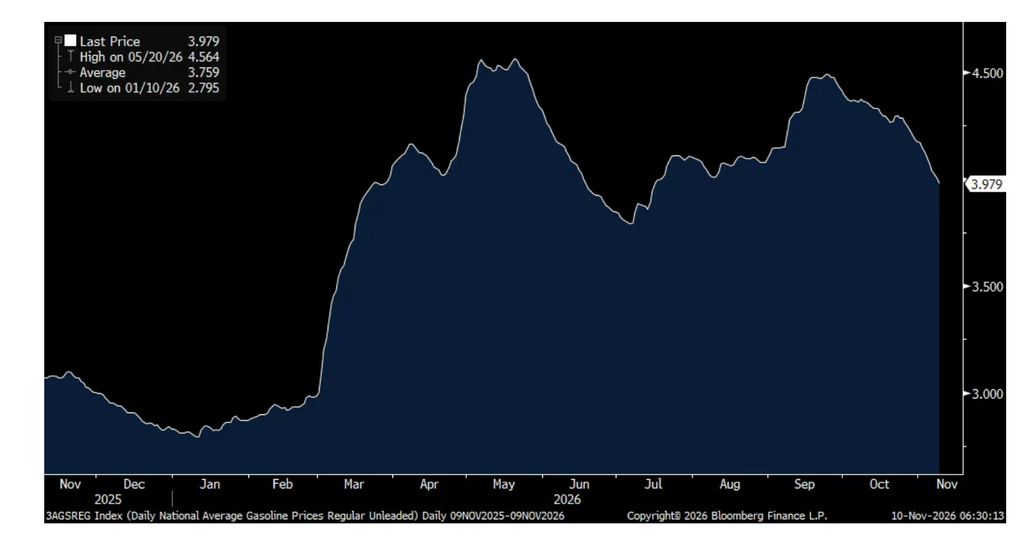
The average gallon of gasoline did dip below $4 yesterday for the first time since mid-July at $3.98 but still up from $3.07 one year ago. For the consumer, particularly the lower income one, we’ll take what we can get.
AAA Avg Gallon of Gasoline
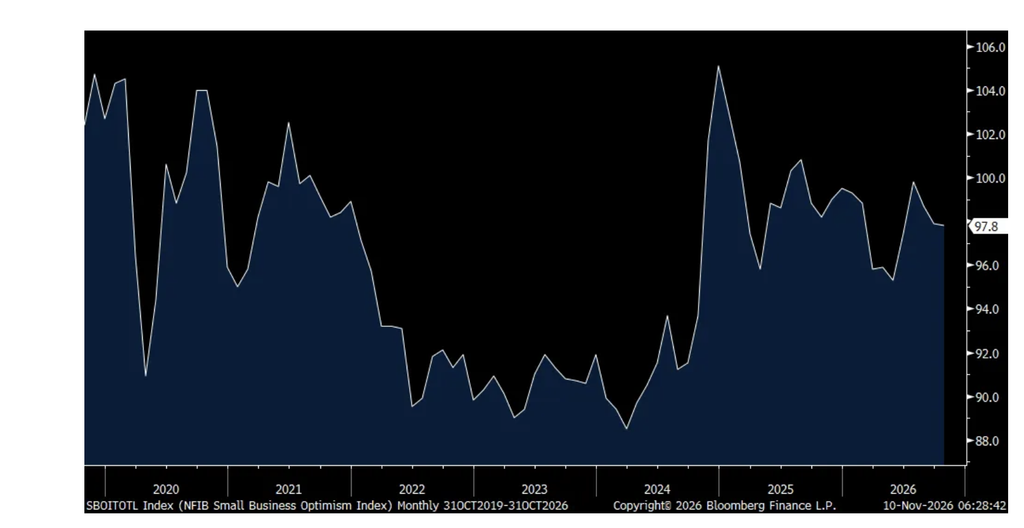
The October NFIB Small Business Optimism index was little changed m/o/m at 97.8 vs 97.9. Hiring Plans rose 1 pt to 18, 3 pts above the 6 month average and job openings were up by 4 pts and 3 above its half yr average. While current pay plans were little changed, up 1 pt, comp plans jumped 4 pts to 24%, 5 percentage pts above the 6 yr average.
Capital spending plans fell 1 pt and down for a 2nd month and inventories dipped by 3 pts.
The Economic Outlook rose 2 pts after dropping by 4 last month and there was no change in Expected Sales. After declining 5 pts last month, Good Time to Expand rebounded by 4 pts.
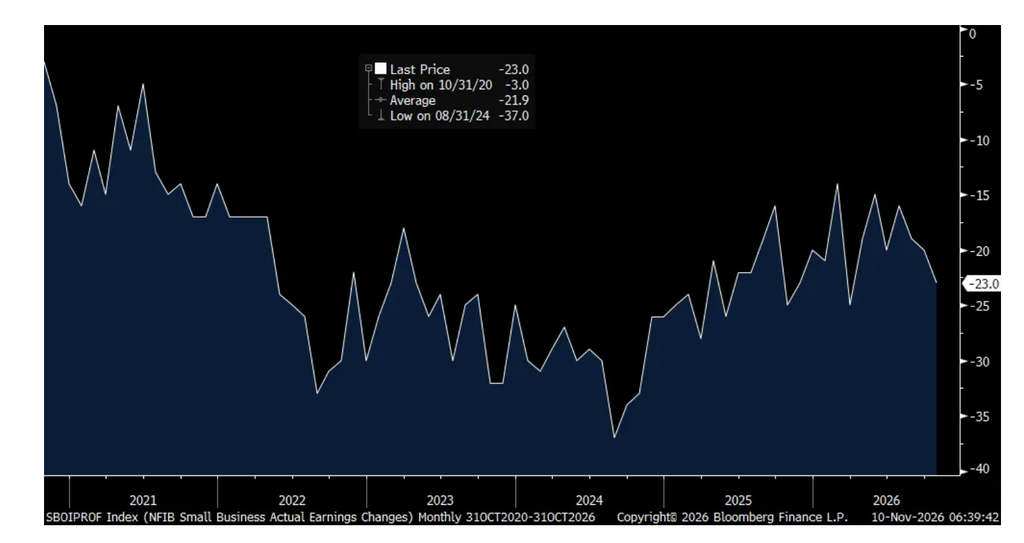
Higher Selling Prices rose 2 pts to 33%, right in line with the half yr average. Of note, and just maybe a reflection of PPI running 260 bps above CPI, Current Earnings Trend fell 3 pts to the weakest since March.
The bottom line from the NFIB, “There was little change in optimism among small businesses in October as owners navigated enduring challenges, though there were some encouraging developments. Even with inflation pressures continuing to strain operations, more Main Street owners reported their businesses in good or excellent health, and actual sales improved. Looking ahead, continued strength in consumer spending will support economic growth, while persistent inflation, labor shortages, and policy risks will weigh on the small business outlook.”
Labor quality remains the top small business worry and higher taxes has moved into #2, rising 10 pts to the highest since May 2021. This a particular quote on the labor side, “Our biggest hindrance to growth is finding quality employees.” – Services, WV. Inflation is the #3 concern.
NFIB
NFIB Earnings Trend
ZipRecruiter reported last night and said this of note on their earnings call:
Their internal execution and improved product offerings have definitely improved and why the stock is higher premarket. On the macro, they mentioned “we are growing again despite a low, hire, low fire market.” And they also said “hires and quits in the US remained relatively flat y/o/y and q/o/q.”
Sector wise, “there was clear strength in technology, transportation and logistics and construction over the past quarter.” On the flip side, “some of the flatter, not as strong areas included healthcare, retail and education.”
From Ferguson Enterprises, up 11% yesterday and one of the largest distributors in North America of “a wide range of products and services from plumbing, HVAC, appliances, and lighting to PVF, water and wastewater solutions, and more”:
“Our diversified exposure across large capital projects, public works, municipal and water and wastewater treatment helped us offset ongoing weak new residential construction.”
Their commercial/mechanical business rose 17% and “This momentum was driven by our disciplined execution on large capital projects such as data centers, pharma, biotechnology and general manufacturing.” I bolded and will add power generation too but data centers are only about low to mid single digits of revenue for them.
This was from Friday’s Bloomin’ Brands call, the owner of Outback Steakhouse, Carrabba’s Italian Grill, Bonefish Grill and Fleming’s Prime Steakhouse and whose stock fell last week:
With Outback, their main chain, “we’re cautiously optimistic on the consumer. There’s some macro choppiness. But what we’re seeing with the consumer is casual dining is still an affordable luxury. Consumers, they’re resilient financially, they are cautious and they continue to be discerning about when, where, and how often they dine out. So it just gets to the ‘what you get for, what you pay for’ dynamic. And when we get it right, people are showing up.”
“The only thing I would say in terms of sensitivity, which we flagged in previous quarters, there’s a little bit of sensitivity on check with households that are under that $75,000 range. And it’s a little bit on the older guests where we’re seeing some check management.”
To the economic data of note overseas. In the 10 months of 2026, China’s trade surplus is already at $1 trillion after today releasing its October data where exports rose 35% y/o/y and imports jumped by almost 42%. China has become a global player in EV’s, solar panels, batteries and other industrial equipment, some of which is AI hardware and software and they are selling a lot of this stuff to the rest of the world.
Position: None
