Boockvar on the Why the Fed Won’t Act, American Express Comments

From Peter Boockvar:
This is why they will do nothing/Important to watch/Other stuff
What we’re seeing with this drop in oil prices in response to the pause in kinetic actions, for now, is exactly why the Fed will do nothing this week and will be on hold, I believe, until this is over. How can one properly calibrate monetary policy when geopolitics are driving such a key economic input, that being the cost of energy? Imagine if oil was $100 on Wednesday, the Fed hikes rates and then on Thursday we got a deal and oil drops back down to $80 or less? What was the point of hiking? With oil prices, at least for now, it’s clear that we’re carving out a wide trading range of about $70-$100.
Also, if the purpose of a few of the task forces was to refine as best as possible the economic data accumulation to make it as precise as possible for the very difficult job of picking interest rates, doesn’t the FOMC need to see the results before making a fully educated decision on rates? I think so.
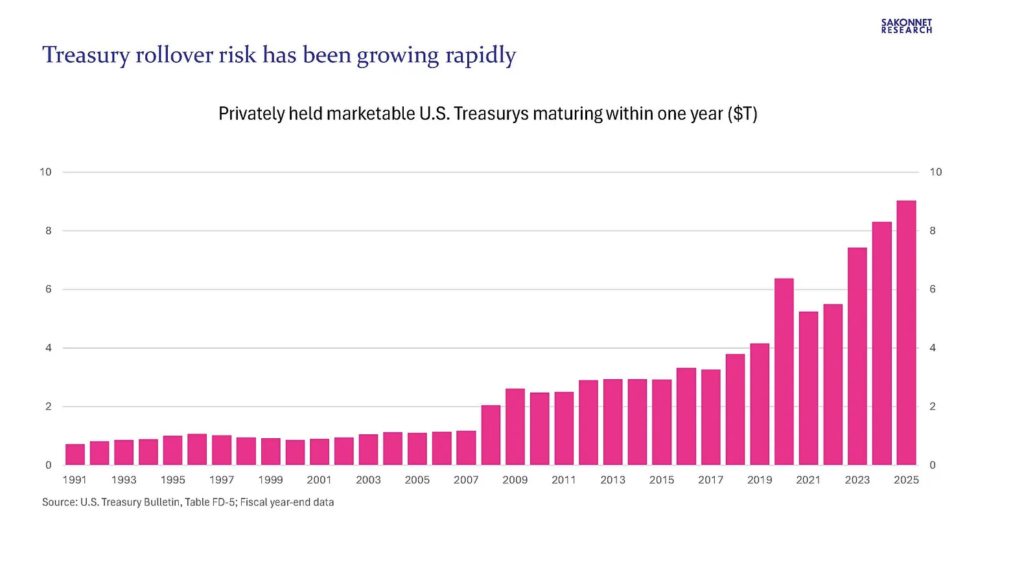
Also, Treasury Secretary Bessent has been front loading Treasury issuance on the short end of the yield curve which then of course makes US interest expense highly sensitive to changes in the overnight rate. Hikes from here certainly benefit interest income for holders of Treasuries but gets really costly for the federal government. My friend Adam Josephson showed this chart on Friday to highlight:
Bottom line, while the bond market is pricing in a 32% chance of a hike Wednesday and a 100% of one hike and 68% chance of a 2nd by year end, in my guesses, I’m just sticking to the upcoming meeting because so much can change every six weeks and the crystal ball, always cloudy, is now ever more so. Also, the Fed can do nothing and it’s become clear that the longer end of the yield curve will still go its own way, and that’s been higher in yields as seen.
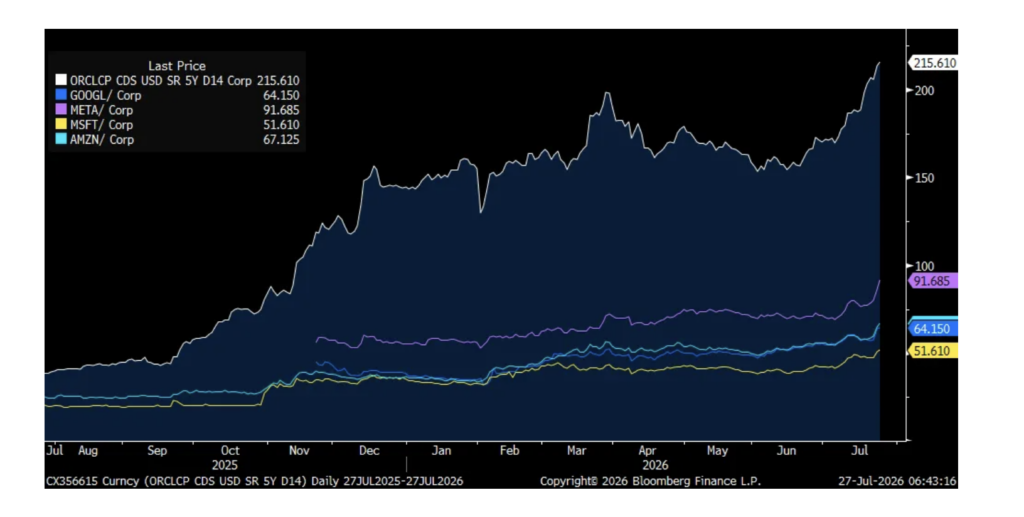
When I included the chart Friday that reflected not just the on balance sheet debt levels of the five big hyperscalers but also its growing lease obligations, I forgot to include the 5 yr CDS of each. Here it is as of Friday’s close and by the way, the Nvidia deal with Open AI continues with the massive vendor financing that is now endemic throughout the data center buildout, as we know and that continues on.
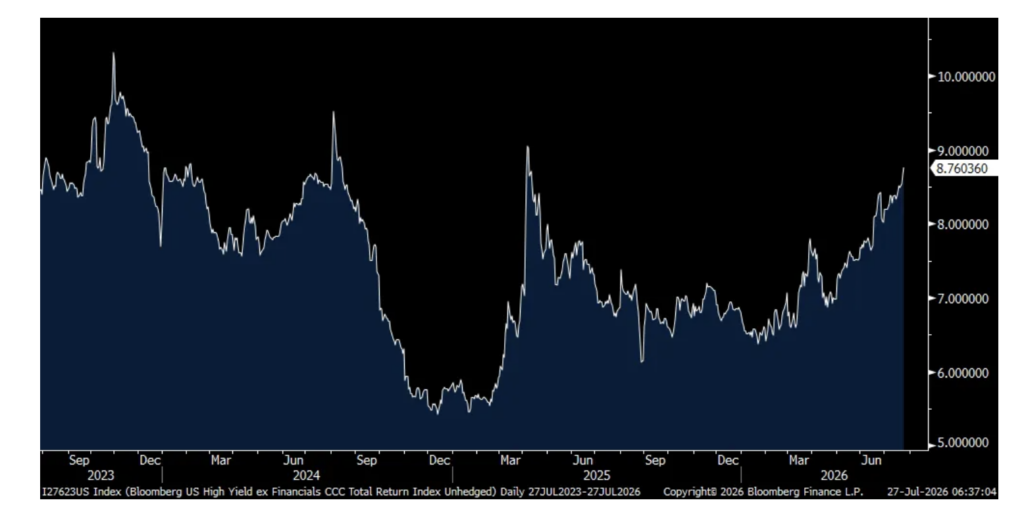
I want to point out the spread widening that is taking place in the CCC category of high yield. Friday’s close of 876 bps is the highest since April 2025. Something to take note of.
This was from the American Express call and whose stock fell 4.3% Friday because of higher marketing costs and is down 6 days in a row:
“We can either drop the overperformance to the bottom line and buy back more shares, or we can invest to grow the business further through the wide range of attractive growth opportunities we have across our business, both in the US and international. We’ve chosen the latter because, in the long run, it is the one that creates the most value for our shareholders, as demonstrated by our high ROE.”
“our focus on premium products continues to drive improvements in credit performance…As a result of that strategy, both delinquency and write-off rates remain below 2019 levels, and delinquency rates have been between 1.2% and 1.3% for over three years.”
With respect to spend, “Growth was broad based across categories, with goods and services spending up 9% and T&E up 10%. Retail spending continued to be very strong, up 13% FX adjusted in the quarter. Restaurant spending, our largest T&E category, was up 10%. Airline spending picked up further from the strong growth we saw in Q1, also up 10% y/o/y.”
“Commercial spending picked up to 5%, with both US SME (small, medium sized enterprises) and large and global customers growing at the same pace.”
This was from Lamb Weston Friday, the maker of french fries:
“Looking at the underlying market drivers for this quarter, as reported by Circana CREST, US restaurant traffic was flat, QSR traffic was also flat, led by 3% growth in QSR chicken, largely offset by a 4% decline in QSR burger traffic.”
“For the company, inflation in the quarter was up more than we had expected. All inputs other than raw potato prices were up, with a substantial increase in edible oils and transportation costs. Demand for biodiesel has driven up the cost of most edible oils, and while we are hedged against oil, we are seeing spot price inflation.”
One thing to note overseas with the economic data, the July German IFO business confidence index rose a touch to 86.6 from 85.7 with all of the gain in the Expectations component as the Current Assessment slipped by a .5 pt m/o/m. IFO said simply, “Despite the uncertain situation in the Persian Gulf, companies are less pessimistic.” On manufacturing they said, “Demand picked up, and material shortages eased.” On the service sector, “Sentiment among tour operators has picked up.”
Nothing market moving but bund yields are dropping as they are around the world with the drop in oil prices.
Positions: None.
