Boockvar on Rents, Bond Yields and the U.S. Consumer

From Peter Boockvar:
I’m looking forward to hearing what Kevin Warsh has to say in his speech but I have to say that I see the Fed as the least relevant in decades in terms of their market influence because elevated inflation relative to pre-Covid trends continues to put them in a box with limited flexibility. The rest of the yield curve, particularly 10s, is where the action is as the market really now sets the cost of capital, notwithstanding the Treasury’s attempt to tame that.
I’ve been of the belief all year that the slowdown in new rental growth this year was going to begin to reverse in the latter part of 2026 and more so in 2027. Apartment List released its August data a few days ago and said this about new leases, not renewals which always trend much higher:
“The national median rent increased by .1% in August, and now stands at $1,390. Rents are still down .8% compared to one year ago, but y/o/y rent growth has been inching up and the vacancy rate is inching down, signaling a modest tightening of rental market conditions.”
“we now appear to have hit an inflection point, signaling that the rental market may finally be stabilizing as construction slows and a recent influx of new units gets absorbed.”
“Despite being at the tail end of the construction boom, the market had still been struggling to absorb the swell of new inventory. That is now finally changing, as we see multifamily occupancy also hitting an inflection point in tandem with rent growth.”
San Francisco is the best market in the country right now with rental growth up by 11% y/o/y. San Antonio is the worst with rents down 5.7%.
Bottom line, every month that passes and buying home is not affordable for some, rental absorption is only going to continue and we thus move closer to new rental growth reaccelerating again. Apartment List’s bottom line, “The market is definitely turning the corner, but the shift is occurring gradually.”
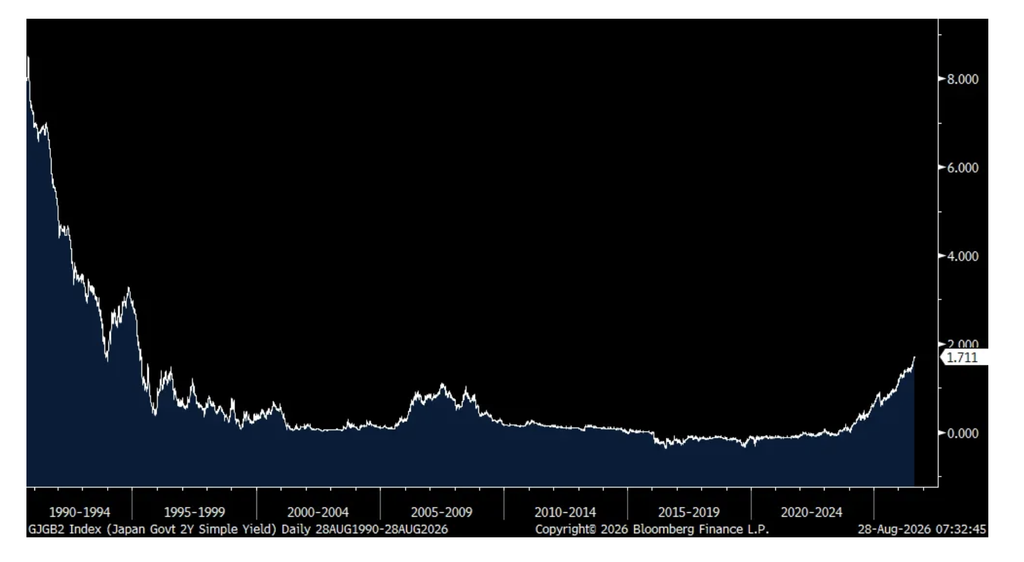
Global bond yields are rising again after a soft Japanese 2 yr note auction as the market gears up for a rate hike in a few weeks from the BoJ. The 2 yr JGB yield is at a fresh 31 yr high. Also, the August Tokyo CPI rose 2% ex food and energy, as expected but up from 1.8% in July.
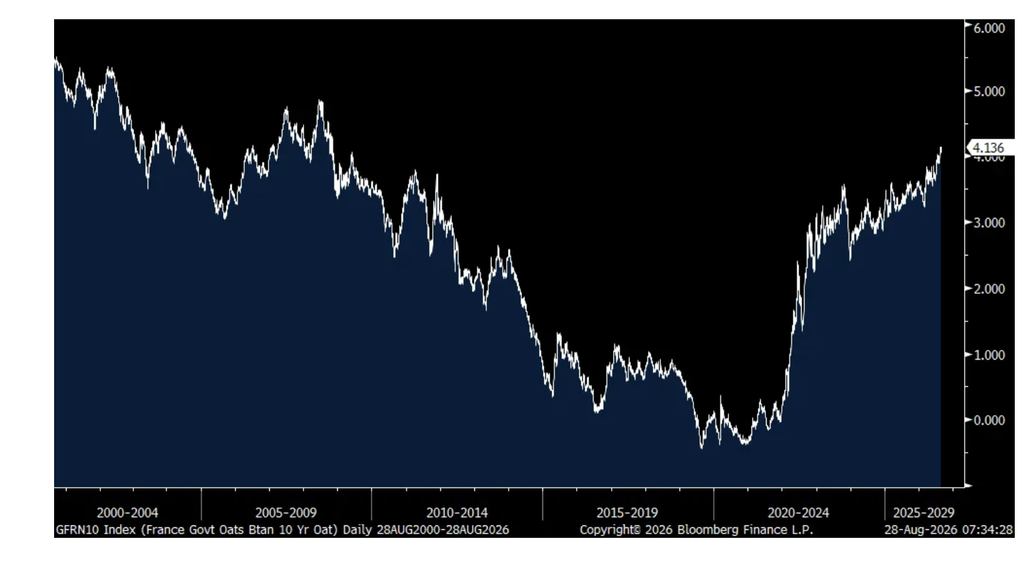
Keep your eye too on French oats as their 10 yr yield rose to an 18 year high at 4.14%.
2 yr JGB Yield
French 10 yr Yield
A lot of earnings calls to go through.
From Best Buy, down 4.4% yesterday:
Comps grew 4.1% “with positive comps across almost all our major product categories” and with “computing growth” leading the way “driven by a combination of customer need to upgrade and replace and product innovation.”
“Home theater was the 2nd biggest weighted comp driver this quarter.” And, “We saw continued strong growth in the group of newer and emerging categories, including AI glasses, trading cards, and health rings.”
“Consistent with the past several quarters, we see a customer who is still spending, but is value focused and attracted to sales moments. Importantly, while customers continue to be thoughtful about big ticket purchases, they are willing to spend on high price point products when they need to, or when there is technology innovation.”
On the budget conscious consumer side, from Dollar General, up 2.5% yesterday:
“We were especially pleased to see our share gains accelerate in the quarter, which we believe demonstrates the strength and broad appeal of our unique combination of value and convenience, particularly in rural communities across America.”
“Same store sales increased 3.5% during the quarter, driven by customer traffic growth of 2% and average basket growth of 1.5%. Notably, this marks the 5th consecutive quarter of growth in customer traffic as we continue to build on the momentum in our business with both new and existing customers” and “the growth rate in non-consumables, once again, outpacing consumables.”
“Our core customers continue to be financially constrained, with a variety of factors impacting their budget. Most notably, higher and more volatile fuel prices have forced customers to further prioritize purchases with a focus on value and affordability. As customers have continued to reduce trips and shop closer to home, Dollar General is uniquely positioned to meet their needs, with more than 21,000 stores located within 5 miles of approximately 75% of the US population.”
“For the quarter, we once again experienced strong trade-in across middle and high income cohorts while also driving productivity gains with our low income customers.”
From Dollar Tree who pretty much said the same thing but whose stock fell for a 3rd day:
Comps rose 3.7% as “Customer traffic was positive .4%, while average ticket increased 3.3%.”
“Customers continue managing household budgets carefully, shopping with purpose, and prioritizing value and affordability. Our data shows we grew sales across all income cohorts. Households we served were up nicely y/o/y, with gains skewing to the middle and higher income households. Comp strength was broad based across the assortment, with personal care and toys notable outperformers. Discretionary performed well, and consumables delivered exceptional comp growth.”
“the inflationary backdrop continues to pressure all household budgets, particularly for lower income consumers. As our customers look for ways to stretch their dollars, they are increasingly turning to Dollar Tree for everyday essentials at compelling opening price points and pack sizes that help them manage their budget.”
The value retailer Burlington Stores, down 7.6% yesterday said this:
They got back $55 million in tariff refunds and “We intend to fully reinvest these refunds into the business in the back half to deliver even sharper values to our customers. So, we expect the direct impact of these tariff refunds to be neutral to full year earnings.”
Comps rose 2% on top of 5% one year ago, “But candidly, I was hoping for more than a 2% comp in the 2nd quarter.”
They are optimistic about the back half of the year “but there are also some reasons to be a little cautious. From a macroeconomic perspective, gas prices rose in the 1st quarter, and that increase has not gone away. And as we look at the full range of retailer results that have been reported over the last couple of weeks, there are some exceptions, but overall, the comp results have been weak.”
“At all, the commentary that we see and hear right now suggest that shoppers are under a lot of pressure. So that gives us some concern about the back half.”
From Ulta Beauty and whose stock is down pre-market:
Comps rose 3.8% y/o/y. “Importantly, our sales outpaced the US beauty market in a dynamic environment. We increased our share of prestige beauty while holding mass share flat, according to Circana.”
“Fragrance continued to be our strongest category this quarter.” The upper income spender helped broadly too and they saw “strength in our core luxury brands, Prada, Carolina Herrera, and YSL” among others.
And to the bifurcated consumer, “Comp sales in the makeup category were approximately flat, with growth in prestige makeup offset by a decrease in mass makeup.” Though Ulta did not attribute the mass as customer related.
“value is an increasingly important consideration for the guest as they are facing some heightened economic uncertainty and everybody is watching their pocketbook. The overall promotional environment did tick up a little bit in the market and we were a little bit more promotional y/o/y. But what I would say is that we were really strategic in our promotional plan and we were very thoughtful in how we participated.”
“We’ve not seen any notable changes in consumer behavior in the quarter and that means both the demographics from an age perspective and also from an income perspective is that we’re seeing increases in spend across the broader segmentations. So we’ve not seen trade down behavior happening.”
From Affirm and whose stock is jumping more than 10% pre-market as gross merchandise value continues to grow:
The use of BNPL continues to grow notably. But they also said “30+ day delinquencies excluding Peloton and Pay in X loans increased 19 bps y/o/y and decreased 26 bps q/o/q to 2.5%. Allowance for credit losses as a percent of loans held for investment was 5.9%, up from 5.6% in FQ4 ‘25 and down from 6% in FQ3 ‘26.”
“Recent cohorts of monthly installment loans are tracking towards approximately 3.5% ultimate net charge-offs as a percent of cohort GMV, which is in-line with expectations and consistent with the performance of historic loan cohorts.”
Marvell Technology stock is down sharply pre-market as good wasn’t good enough:
“The increase in our revenue outlook continues to be driven by our data center business, which we now expect to grow by approximately 60% this fiscal year, up from our prior expectation of approximately 50%.”
“For communications and other end-markets, the trajectory remains largely as expected.”
