Boockvar on Oil Market, Japan Economy, Earnings

The following is from Peter Boockvar:
If interested in the oil market, I highly recommend this read/Other earnings notables and stuff overseas
For those following the energy sector, I highly recommend reading the snippets I included below from the Saudi Aramco earnings call yesterday. If you don’t want to read it all, skip to the last two paragraphs for the bottom line from them. While they are talking their book, it’s something we agree with and remain long oil and gas stocks even if the Strait is about to reopen.
From Saudi Aramco:
“In May, we were clear that the trade disruptions are the most serious we have ever seen in the energy market, and that if the Strait did not fully open by the end of that month, the impact would continue well into 2027. As we have seen, trade flows via the Strait have not normalized since then, and the impact are even more severe. The measures taken by various industry participants, such as the use of inventories to mitigate the impact, have had short-term effects. The release of inventories have now been largely deployed and are not only more difficult to be maintained, but now need to be rebuilt from critically low levels. This would require a call on additional restoration of production, and that additional production also calls on access to reserves, where we had already highlighted before that the level of investment has been insufficient from many in the industry and needs to be addressed.”
“Moving to the macro environment and market dynamics, we see some clear themes. Global oil demand has remained resilient as the supply shock was masked by an estimated 9 million barrels per day of strategic petroleum reserves and commercial inventory withdrawals and around 2 million barrels per day in demand management. The unprecedented liquid supply loss has continued into Q2, and the world lost over 2.6 billion barrels of oil that was distinct to a number of critical industries such as food, semiconductors, mobility, and petrochemicals.”
“This has been partially offset by alternative flow bypassing Hormuz, the release of strategic petroleum reserves by government and the utilization of Aramco’s East-West pipeline, which resulted in reducing the net supply loss to currently around 1.8 billion barrels. The key element of these are, first, the IEA Emergency Release Program of 426 million barrels is coming to an end in August, and with it, a 2 million barrels per day cushion will likely come off the market. Second, after utilizing oil on water and SPR volumes, the world tapped into an estimated 600 million barrels, reflecting 6.5 million barrels per day between May and July of commercial inventories, the only remaining buffer in the system today. Third, within Asia, crude oil imports were reduced by around 6 million barrels per day through a combination of SPR release, drawdown from commercially refined products inventories, and demand management. The East-West pipeline has enabled Aramco to mitigate the impact of the disruption much more than the IEA Coordinated Strategic Reserve Release. All in all, significant drawdowns of commercial inventories have helped but not met end user demand.”
“The aggregate inventory level globally are not a proper reflection of the current physical market tightness…We see an apparent disconnect between future and physical markets as evident in the strong refining margins that reflect the market tightness. Margins are expected to stay exceptionally strong throughout the second half of 2026, supported by limited export availability from key regions like the Middle East, Russia, and Asia, resilient fuel demand, and persistently low inventories. The refining system today, excluding stranded Arabian Gulf and Russian refineries that have been under attack, is stretched and is operating at near maximum utilization rates. Currently flows through the Strait of Hormuz are a tenth of a pre-conflict level.”
“Let me be clear, demand remains strong and has not been met by supply in the first half of this year, but rather from commercial and strategic inventories…Demand in the 2nd half of the year is expected to be around 2 million barrels per day higher than the first half. Restoring commercial inventories and strategic reserves to pre-conflict levels will materially add to calls on crude oil throughout 2027 and likely beyond.”
“To put this into context, if the Strait of Hormuz was to open today, it would take up to 18 months at an average rate of 2.1 million barrels per day to replenish depleted inventories on top of demand.” I bolded to highlight.
From Caterpillar, up 5.6% yesterday and has been for sure on a wild ride over the past month:
“Second quarter sales and revenues were better than expected due to strong sales volume growth in Construction industries and Resource industries, while Power & Energy was broadly in line with our expectations.”
“Power generation grew 72% driven by very strong demand for large gen-sets and turbines used in data center applications.”
How long can it last with data center construction? “There is a lot of discussion around AI demand. We have constant discussions with our customers, and all I can tell you is what our discussions with them is no one is slowing down at the moment. In fact, if we can get more units out, they’re asking us to give them more units.” I bolded.
“Our positive outlook for 2026 continues to reflect strong demand in power generation and oil and gas.” Also, “sales to users is expected to increase primarily driven by rising demand for copper and gold and positive dynamics in heavy construction and quarry and aggregates.”
They are also benefiting from public highway spending “supported by the IIJA (Infrastructure investment & Jobs Act), with the remaining funds to be spent over the next few years.”
From Cummins that fell 2% because earnings missed expectations because of lower margins but they are getting helped by data centers and the higher truck transportation prices:
“Cummins delivered record second quarter results, reflecting robust customer orders for standby power for data centers and improving North American truck markets.”
From McDonald’s, up 1.2% yesterday with mixed numbers:
“Turning to the US. After a solid start to the year, the business slowed significantly, posting comparable sales growth of .8% in the quarter. This was below our expectations and something we’re going to address in greater detail on today’s call. We don’t have a strategy problem. We simply didn’t execute at the level we needed to in the 2nd quarter.”
“Global comparable sales grew 1.3%, reflecting a challenging consumer environment that saw QSR industry traffic in several of our largest markets continued to be flat to negative. Global comparable sales were also impacted by execution that was below our expectations in the US business.”
From Wayfair, whose stock had a big day, up 30%:
“Compared to Q1, orders were up over 12%, the best sequential growth we’ve seen in Q2 since the 2nd quarter of 2020.”
“While there’s still some broader macro uncertainty and depressed housing turnover, by our measure, this marked the first quarter of flat to slightly positive y/o/y category growth that we’ve seen in the US since 2021, though skewed towards higher growth in the higher income segments.” I bolded.
“In keeping with the often discussed K-shaped recovery, we saw noteworthy outperformance from both our specialty retail brands, which grew by nearly 20% in the 2nd quarter, and Perigold, which grew by more than 35% in the luxury segment.”
From Sysco and whose stock fell 2.6%:
“For fiscal 2027, we expect to deliver positive case volume growth for national contract customers, despite a macro foot traffic environment that remans challenged. Foot traffic to restaurants remains down y/o/y, and Sysco is growing our business, taking share, and delivering profitable growth y/o/y.”
“Local restaurants are performing better than national chains for a host of reason, and increasing our work focus on local customers is a net, net positive for the long term.”
From Booking Holdings and whose stock is rallying pre-market:
“While long-haul international travel remained pressured by elevated airline prices and reduced capacity due to the conflict in the Middle East, domestic and inter-regional travel remained healthy across many parts of the world.”
“Globally, we saw a modest contraction in booking window and length of stay during the quarter, although both began to normalize in June. Importantly, in Europe, our largest region, both metrics were approximately flat for the quarter.”
Wynn Resorts said their upper end Vegas business is doing just fine and is up pre-market:
“More recently, the business has seen solid volumes and increases in both slot revenues and RevPAR, though we experienced unusually low hold in the month of July. Looking ahead, we remain positive about the business in Las Vegas. We are currently on track for another strong F1 weekend and pacing ahead of last year in our transient and leisure business for that event.”
“On the group and convention side, we saw the forward booking pace accelerate as July progressed, and the business looks strong heading into both Q4 and 2027.”
Boston and Macau also had good quarters ex the World Cup impact in Macau as business picked up in the back half of July and in early August.
From Dupont, up 1% yesterday:
“Top line growth was broad based, led by continued strength in healthcare, aerospace, and industrial water and semiconductor markets. In addition, we saw y/o/y growth in our building technologies business on strength in residential and non-residential end markets.” Asia Pacific is where they saw most of the strength in residential and non-residential markets.
Even transportation brokers like Expeditors, that focuses on air and ocean freight, are benefiting from the data center build out:
“Air buy and sell rates were highly elevated during the quarter, as demand for air capacity continued to outweigh available space, particularly late in the quarter and driven largely by a reduction in passenger flights and constrained belly capacity due to the conflict in the Middle East.”
“The ongoing heavy demand from AI hyperscalers shows no sign of slowing down, and we have seen increased demand for freighter space, as some hyperscalers are requiring upper deck access for their servers.”
“In addition, e-commerce out of North Asia has been climbing closer to where it was before the US government began restricting de minimis entries in Q2 2025, putting further pressure on capacity and rates. Given the current geopolitical state of the world and rising fuel costs along with tight capacity and routing challenges, air carriers are under enormous strain and may continue to be for some time.”
“Despite all of the complications impacting the ocean markets, the carriers have adapted well and managed capacity very carefully, driving an increase in rates particularly late in the quarter as demand also increased.”
To some economic data.
More PMI’s are out. The July China services index from RatingDog and focused on their private sector (yes, they have a big one with more than 80% of those employed working for a private company) was soft, falling to 50.4 from 54.1. They blamed slower domestic demand for the weakness while strength was seen in services exports with “Anecdotal evidence linked to higher overseas client demand to exhibitions, study tours, increased settlement business and effective management.”
Hong Kong’s July PMI fell 1 pt to 51.
Singapore’s PMI rose to 59.4 from 57.4 and remains an economic bright spot. We remain bullish on that country and hold stocks there.
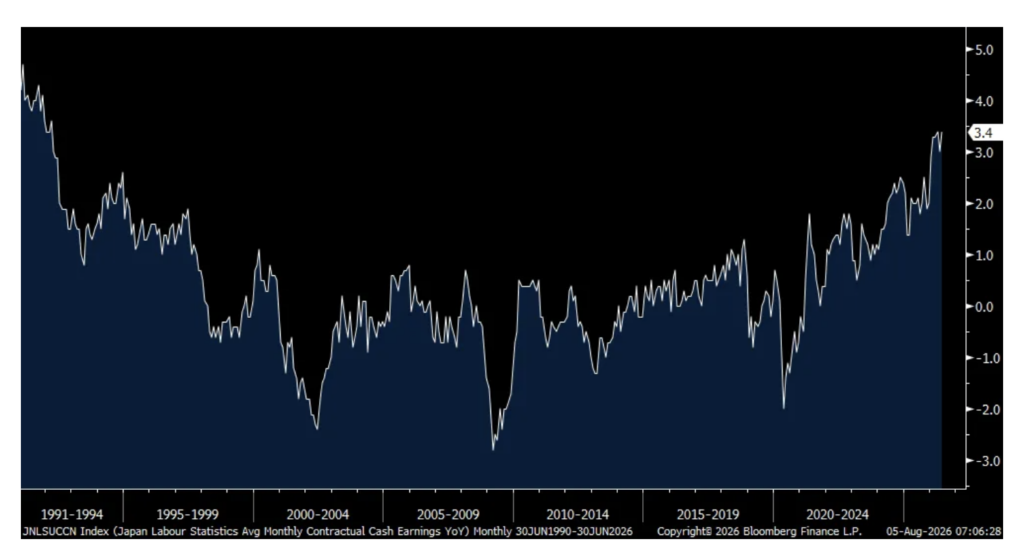
Japan continues to have reason to hike rates again with the strong 3.4% y/o/y rise in June base pay. That matches the fastest pace since 1992. The yen though did not respond and is little changed but JGB yields fell, following the US drop yesterday.
Base pay in Japan y/o/y
The July Eurozone and UK service indices were left little changed with the revisions but both holding above 50 at 51.7 and 52.2 respectively.
Positions: None.
