Boockvar on ‘Kindness of Strangers’ Financing Deficits, Ag Prices, UK Jobs

The following is from Peter Boockvar:
Market says again, ‘I don’t want long duration paper’/Other important stuff
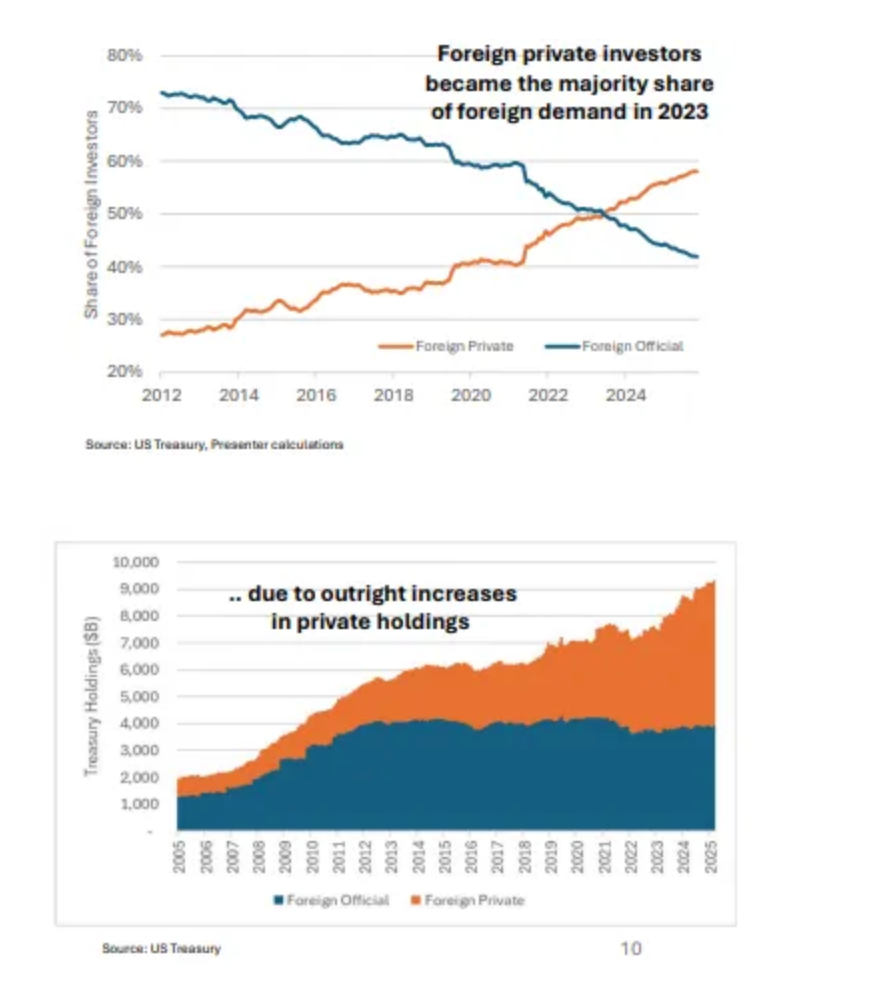
Seen again, the aversion to taking on long duration risk in bonds continues globally. Fresh multi decade highs in yields are being seen in Japan, Europe and the US (almost in Australia). With the US in particular, we continue to rely on the kindness of strangers in financing our deficits and at least from a foreign government perspective, they continue to walk away from our market. Foreign private investors have taken their place to an extent but some of that has been Cayman Island buyers, aka, hedge funds and buyers tapping UK banks and Euroclear in Belgium. Natural foreign buyers that recycle any balance of payments surplus are no longer parking that money on a net basis into US Treasuries. Gold instead has been a beneficiary.
Between a drop in holdings and declines in value, ‘foreign official’ holdings of both Treasury bills and bonds fell by $72.1b in the month of June according to the TIC data seen last night. Japan and China were the two biggest sellers with Japan still the biggest holder and China #3 behind the UK (which includes what’s been parked at UK banks from anywhere). Belgium, Cayman Islands and Luxembourg are right beneath them and can be anyone parking money there.
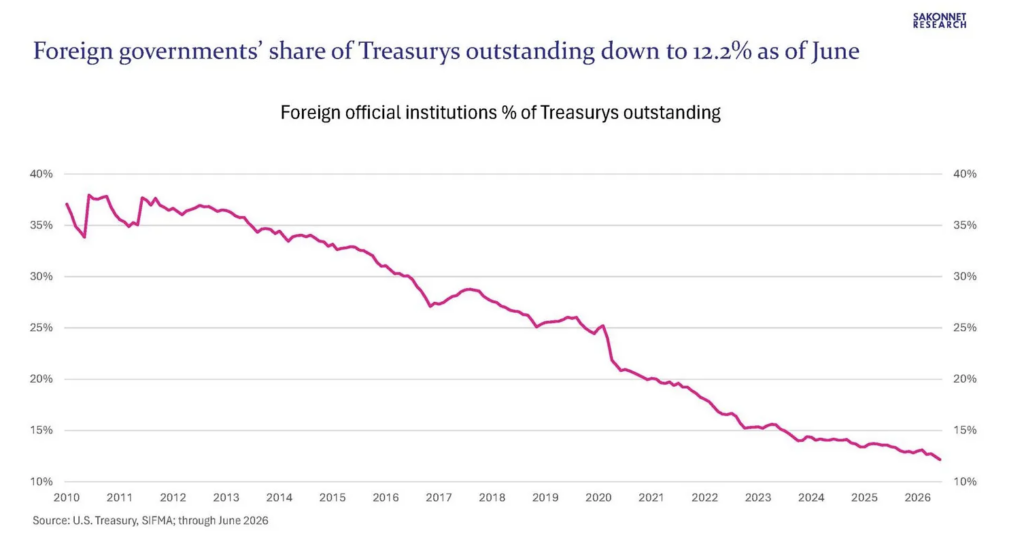
Foreign official holdings now make up just 12% of US Treasury holdings vs about 37.5% 15 years ago. This chart is from my friend Adam Josephson reflecting this:
Here are some other notable charts from the US Treasury in their TIC data release yesterday for June showing the total foreign breakdown of holdings.
Because of the strength of the AI trade, stocks haven’t cared about the persistent rise in global bond yields but it’s just a matter of when, not if, if this trend in rates continues, which I think it will as a bear on long duration.
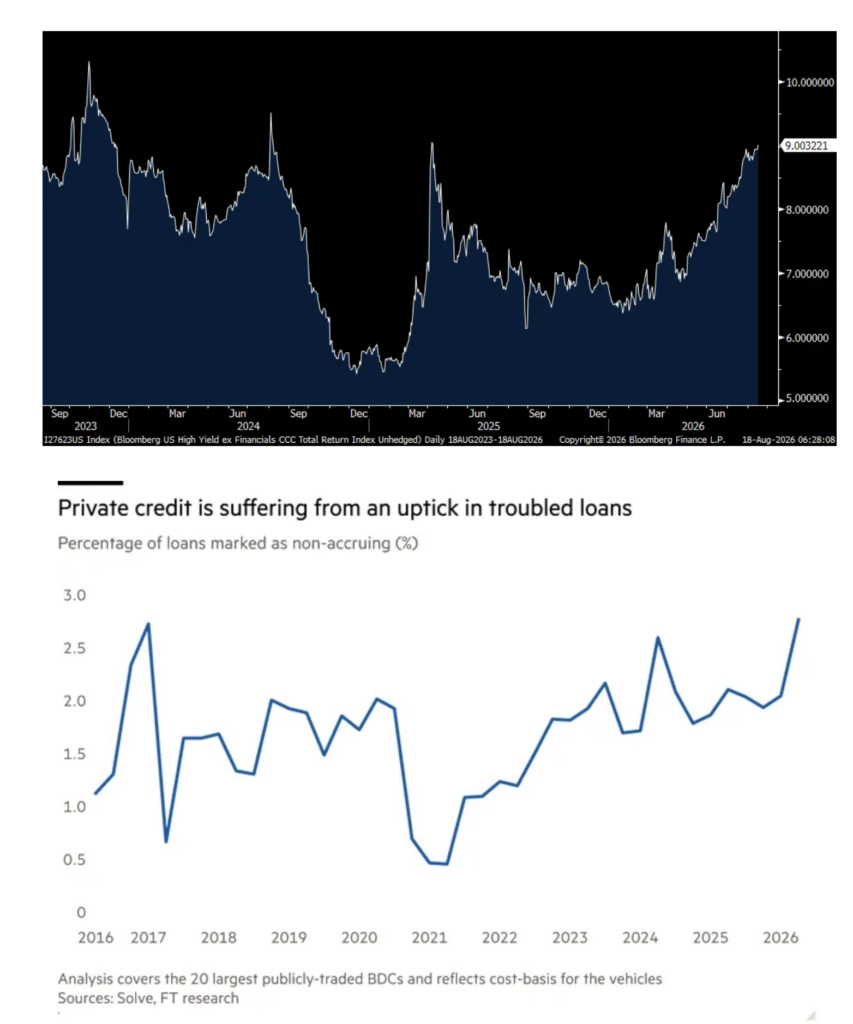
Whether due to the rise in supply and/or growing credit quality worries, I’m going to include here again the CCC spread chart as it touched 900 bps yesterday, the highest since Liberation Day. I will also add another chart from today’s FT showing a rise in the ‘percentage of loans marked as non-accruing’ in the private credit world. Something is going on here and something we must all pay attention to.
CCC Spread
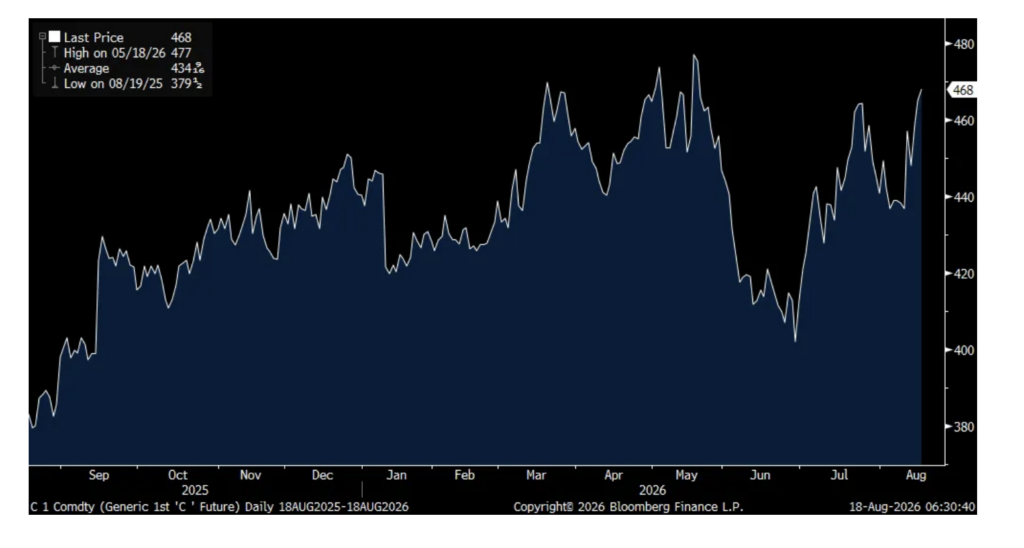
We’re just a few months from the US harvest and we’ll see the impact on yields from any cuts to fertilizer applications. I bring this up because corn prices are quietly at the highest level since May. Soybeans are back above $12 per bushel and wheat is $.20 away from $7. I continue to believe an ag bull market is ahead in the latter part of this year and into 2027 as yields feel the impact from rising fertilizer prices that reduced its use. We’re long fertilizer stocks.
Copper by the way is taking a breather after its recent run to its record highs.
Corn
This was from Home Depot and whose comps were slightly above expectations, up 1.7% vs the estimate of up .9%:
“We saw broad based demand across the business as customers continued to engage in smaller projects.”
The guidance they gave “includes IEEPA tariff refunds, which are expected to partially offset unplanned fuel, energy, and other product input costs throughout the fiscal year.” The comp guidance of flat to 2% is about as expected.
Cass Freight released its July shipments data yesterday and they fell 2.2% m/o/m and 4.8% y/o/y. They said “Some of the softness is the result of higher fuel prices, but to a large extent, volumes are still soft because capacity is declining. The Cass data are trucking intensive, among other modes, but rail intermodal is gaining share from trucking this year, also pressuring this index.”
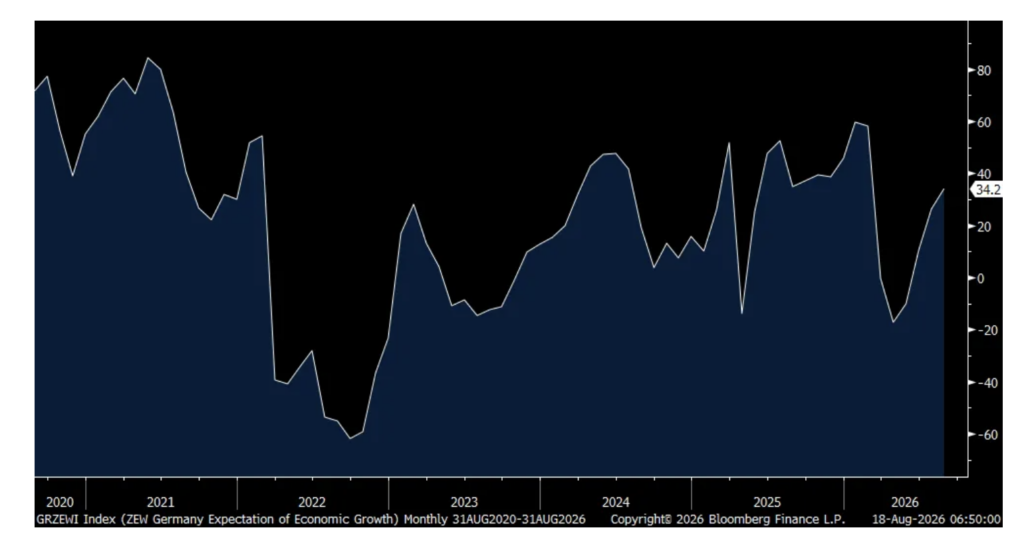
Overseas, the August German ZEW investor expectations survey on their economy rose to 34.2 from 26.3 and that was above the estimate of 30. The Current Situation improved as well to -61.1 from -77.6. The ZEW said “The positive trend in expectations further consolidates in August, likely due to the good quarterly results and the recent high level in exports. The German economy continues to benefit from the federal government’s infrastructure programs although the record low water levels on the Rhine River present an additional acute risk affecting economic activity.”
German ZEW
In July, ‘payrolled employees’ in the UK fell by 13k vs the estimate of no change and June was revised down to a drop also of 13k vs the first print of -4k. Also, job openings fell to the lowest since 2021. The offset was that jobless claims fell by 11k after a drop in June. Private wage growth thru June rose 2.8% ex bonus as expected. Their unemployment rate held at 4.9% also thru June.
Low hire, low fire is a thing there too.
Positions: None.
