Boockvar on Foreign Investors, Central Bank Bailouts

The following is from Peter Boockvar:
‘ECB, SOS!’
A main challenge that the bond markets of France, the US, the UK, Italy and German have is that foreigners are big participants and thus the pool of domestic savings in each country is not enough to absorb all the supply. For France in particular, about half the Oat market is owned by foreigners. For the US, UK German and Italian bond markets it’s about 1/3 of the tradeable market. And we are learning now the hard way that the kindness of foreign investors cannot be taken for granted. The Japanese JGB market in contrast, for those not familiar, is mostly owned by Japanese savers, Japanese institutions and the BoJ. And the trillion $/yen/euro/pound question is always when will Japanese institutions decide to bring more of their investing money home.
The WSJ has an article today titled “France’s appetite for ‘Magic Money’ has turned into a debt bomb…After years of overspending, the country has emerged as one of Europe’s weakest links. Investors are bracing for things to get worse.” That said by them, the contrarian in me tells me this likely marks a short-term top in French yields. I emphasize though, ‘short term.’
This was a quote in the piece from a portfolio advisor at a French asset manager, “France has been this free rider in Europe for years, if not decades. It has gotten away with fiscal murder. It worked as long as people were not noticing. Now people have started to notice.” A recent study from the French finance ministry estimates that “The cost of servicing France’s debt is expected to climb 59% by 2030.”
https://www.wsj.com/world/europe/france-debt-bonds-spending-c7981557?eafs_enabled=false
Another thing that France and others, including the US, got dependent on over the past few decades was getting bailed out by one’s central bank via QE (SOS, Morse code). This is what Marine Le Pen said today, “It’s essential to start a discussion with the ECB so that it intervenes and eases the burden of interest rates.” She not only said this, but stated her commitment to lower the country’s budget deficit to below 4% next year if elected.
Maybe the ECB does at some point and European bonds are rallying today, with French and Italian 10 yr yield each down about 10 bps. But we know that would only be addressing the symptoms, not the budgetary disease.
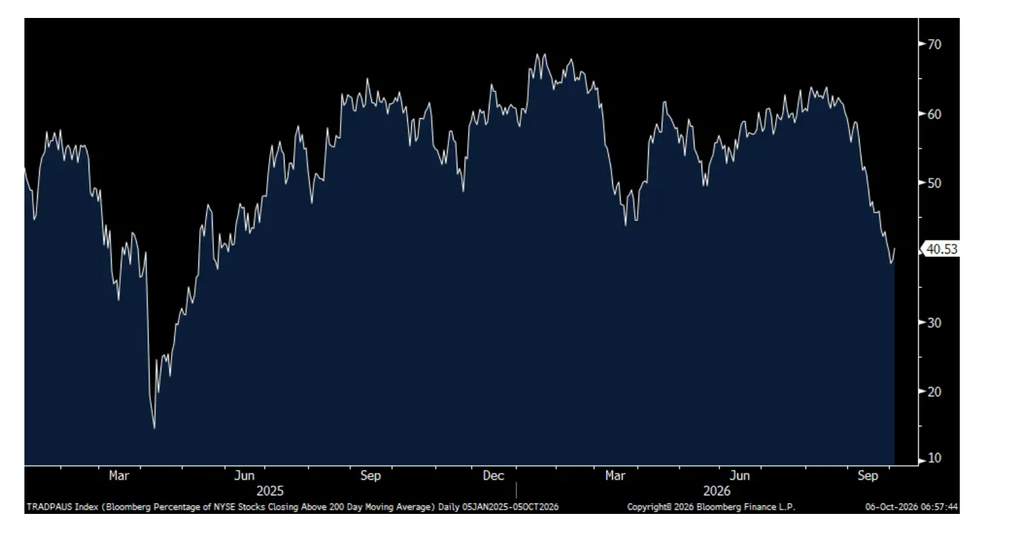
With respect to the rise in US yields and the AI trade continuing to power on notwithstanding, it seems we’ve entered into this game of chicken between bonds and AI stocks. Who will blink first. By the way, I’m only referring to AI stocks because everything else in the stock market has fallen sharply already. To quantify, just 41% of NYSE stocks closed above its 200 day moving average yesterday vs 64% about two months ago. That’s just off its lowest read since May 2025.
% of NYSE Closing Above its 200 day Moving Avg
For those utilizing the loan markets and where every basis point change in the cost of capital matters a lot (doesn’t matter now for the AI data center buildout), the move in rates is a really big deal, as it should be. Noting another WSJ article today, this one titled “The surge in rates is blowing up commercial real estate deals…Property buyers are demanding sellers renegotiate terms because of higher mortgage rates, signaling broader market distress” is worth the read.
It further said “Investors who agreed to a purchase price earlier this year when financing was cheaper are now demanding price cuts or other concessions before closing.”
https://www.wsj.com/real-estate/commercial-real-estate-interest-rates-22d04b1b?eafs_enabled=false
Moving on.
Similar to the very mixed Chinese economy, the September Hong Kong PMI remained under 50 at 49.2 vs 49.5 in the month before. S&P Global said, “Hong Kong SAR firms continued to face a challenging environment as the third quarter of the year drew to a close, although there were signs of demand stabilization amid success in securing new business overseas.”
