Boockvar on Fed’s Williams, Banks and More

From Peter Boockvar:
He agrees with me/Bank comments/Pizza/China
NY Fed president John Williams is seemingly agreeing with me that the Fed is more in a rate tweaking cycle rather than in an historically more aggressive rate hiking cycle. He said yesterday “I haven’t changed my view that it may be appropriate to have one more rate hike. I don’t think at this time I have any reason to believe that we would need to do more” after that.
He’s rather sanguine about the inflation picture. “I still believe there’s disinflationary forces at play. We definitely had the effects of tariffs and the energy prices, and now with AI. But some of those are, I think, not indicating upward movement in underlying inflation. In fact, these measures of underlying inflation have come down…This is not an economy that is overheating overall. This is not an economy where this added inflationary pressure is beyond these particular shocks that we’re experiencing.”
So, Williams is clearly in the dove camp, joined by some others like Michelle Bowman and countered by the hawks like Beth Hammack and Lorie Logan.
Rate hike odds for the meeting in a few weeks is at 22% and 86% for December. Notwithstanding Williams thinking that one more could be it, looking out to the fed funds futures curve for 2027 and the market expects two more rate hikes next year after the one in December.
From JP Morgan, down almost 1% yesterday:
“debit and credit spend grew 10% y/o/y with continued momentum across spending categories, including gas and travel, supported by consumer demand.”
With regards to their investment banking business, “While our outlook remains constructive, supported by ongoing client engagement, evolving market conditions have recently slowed activity a bit, so we’ll have to see how the quarter develops.”
Of note on their lending business, “we’re tightening up a little bit on credit. I think some of the credit terms have gotten a little bit loose. And you’ve heard us talk about that before…A little too much pay, a little too weak covenants, a little too much priming good assets, a little too much pushing on it. We just don’t feel you have to chase that kind of stuff anymore.”
On the consumer, “So far, what we’ve seen in the current data and what’s been true, I would say, for the last few years, is that the consumer has been quite resilient in the face of a number of headwinds that under different circumstances you might have expected would present a challenge…But fundamentally, the picture is pretty simple…the consumer is currently very healthy, primarily because of a healthy labor market. But if the central bank needs things to cool off, and that involves an aggressive extended rate cycle, almost by definition, that’s going to involve higher unemployment, which will produce weaker consumer credit results.”
On their middle market clients, “No question that higher rates, I think input costs, inflation, the diesel narrative, these things are tough for middle market clients. So we see them trying to manage that to the best of their ability, and I think it does create a little bit of caution in that space. But I think balance sheets are strong. People have been through a lot over the last few years, and so they’re well prepared. But yeah, I don’t think insatiable demand for capital applies to that subset of the client base.”
As for the credit quality situation with their business customers, “I would say that the corporate credit outlook is currently pretty stable. But obviously there are issues out there, and we’ll have to see how those flow through the performance of our borrowers. Energy prices, fuel inputs, higher rates, these are all things that will create challenges in different pockets of the economy and C&I space, as well as the CRE space for that matter. So, we’ll see.”
From Citigroup’s Jane Fraser on the macro and whose stock fell 5.6%:
“on the macro environment, conditions did soften a bit during the third quarter. And while various headwinds, most recently higher energy prices and tighter monetary policies, have been challenging, the global economy has held up remarkably well. In the US, whilst much has been made of the AI boom, the consumer is still driving much of the growth. The labor market is stable, and companies remain active. Our near-term economic outlook remains positive.”
“China is seeing similar benefits from AI, but without the consumer spend needed for balanced growth, and so, their economy leans heavily on exports. And Europe remains structurally challenged.”
From Wells Fargo, down 3.1% yesterday:
“Markets were trending towards achieving higher revenue growth, but was impacted by a slowdown in the last several weeks of the quarter.”
“While we’re growing our lending businesses and our customer base is still strong, our underwriting criteria recognize that at some point, consumer credit conditions will weaken. To be clear, we do not see signs of this yet, but we know that cycles are inevitable.”
“Consumer spending remains strong. Debit card spending increased 8% from a year ago, with broad based growth across categories accelerating from the 5% growth rate we saw in the third quarter last year. Credit card spending was up 12% from a year ago. Our growth has been amongst the highest in the industry, driven by strong new account growth. At the same time, consumer credit remains strong, with our charge-off ratio down from both the second quarter and a year ago and early stage delinquencies at historically low levels.”
Also of note, “High income households continue to benefit from strong asset prices, substantial home equity, and stable labor income. And while lower income households remain more sensitive to financing costs, inflation, and higher living and fuel expenses, they appear to be stable. Corporate America also continues to demonstrate strength. Our corporate and commercial customers remain in good shape.”
The caveat to this, “Inflation and higher interest rates continue to be headwinds, and the longer they persist, the more pressure they could place on both consumers and commercial clients. While markets have been strong, an unexpected or significant movement could filter through the broader economy.”
And finally from Wells of relevance on the AI spending binge, “The scale of investment here increasingly resembles prior infrastructure booms, creating both significant opportunities, but also risks given the significant leverage used to finance the build-out and the upward pressure on prices in selected industries and supply chains.”
From Goldman Sachs:
“I still think for capital markets activity, it is a top quartile environment. For strategic M&A, there is an enormous amount of dialogue that continues. Our backlog is incredibly robust.”
Shifting to food and my favorite, pizza.
This was from Domino’s Pizza, down 5% yesterday:
“Underlying demand for Domino’s remained incredibly strong. We continue to drive order count growth with orders increasing in both our delivery and carryout businesses. We also continued to gain share within the QSR pizza category. I believe growing orders is the most important thing a brand can do in the current environment.”
US comps though were up just .3% as “Our business continued to be impacted by a challenging macro environment, which is pressuring consumers. The comp reflected count growth in our core business, along with continued growth in our aggregator business. This was partially offset by a lower average ticket. While our ticket trend improved from the second quarter, it was impacted by a sequential decline in items per order in both our carryout and first-party delivery business. We believe this was due to the challenging consumer environment.”
More on the spending behavior, “So we had pressure on items per order, so customers still coming to us, but managing their ticket by managing items per order.”
“Pricing was up 1.2% in the quarter.”
From Albertsons, up 1.4% yesterday:
“The reality right now is that the economy is tough for many of our customers. Fuel prices are elevated and inflation remains stubbornly high for our customers and in our P&L. Traffic and units are below where they need to be, and our overall performance does not reflect the quality of our assets or the capabilities of our team.”
“we saw CPI pick up to about 2.5% in the second quarter. And I would tell you that we passed along less than that, maybe 2%, 2.1%…And as we look at the back half of the year, it’s probably we are seeing suppliers come with some cost increases. We obviously have a playbook by which we handle that. And we are seeing inflation across the P&L, but that’s not new for us. We’ve been dealing with headwinds for some time now and we’ll continue to do that.”
Cass Freight reported its September shipments data yesterday and said they rose by 2.3% m/o/m and 1.9% y/o/y. They said, “With modest retail and industrial growth, and some inventory restocking as container imports surge, freight demand is recovering. The combination of a smaller private fleet and rising new equipment sales also supports higher for-hire volumes.”
And, “With modest retail and industrial growth, and some inventory restocking as container imports surge, freight demand is recovering. The combination of a smaller private fleet and rising new equipment sales also supports higher for-hire volumes.”
I’ll add, this is following the recovery in manufacturing and the very tight trucking market currently, capacity and price wise.
To some data overseas. China’s trade stats continued to be robust, particularly on the export side where they rose 36% y/o/y, well above the estimate of 26%. Imports grew by 31%. That helped to further its gigantic trade surplus which was $134 billion in September. I’m sure price had an impact, along with the volume figures. Exports to the US in particular were up by 40% y/o/y.
Keep in mind, that massive trade surplus is NO longer being recycled into US Treasuries as they were prior to 2022. Gold has been a main beneficiary.
Also out of China, PPI in September rose 5% y/o/y, above the estimate of 4.4% and an acceleration from the 3.8% seen in August. Consumer price growth though remains benign, up .9% y/o/y and a core rate higher by 1%.
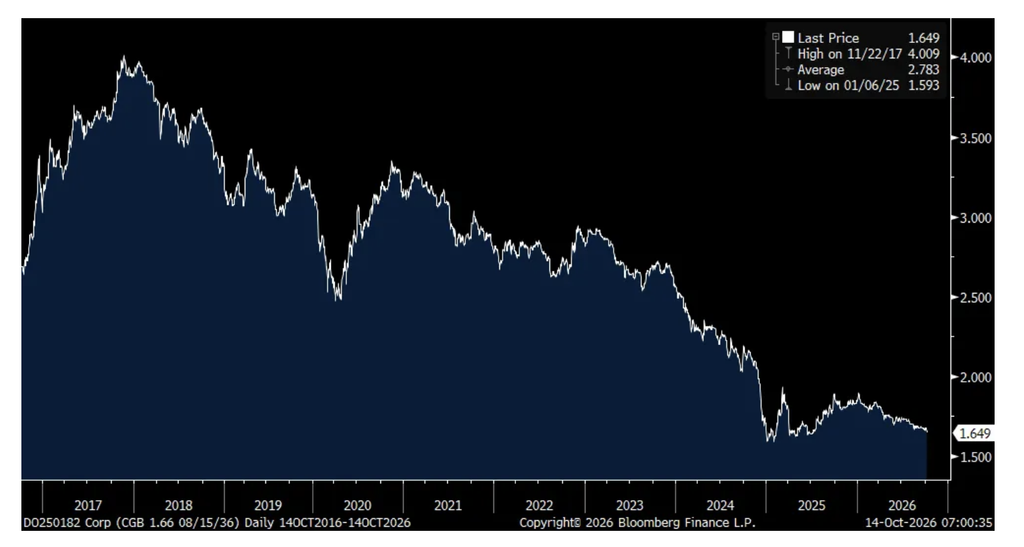
The low level of consumer inflation, along with very mixed economic growth, has helped to give China one of the lowest financing costs in the world with a 10 yr yield of just 1.65%.
China 10 yr Yield
Position: None
