Boockvar on Bessent, Walmart Earnings, Agriculture

The following is from Peter Boockvar:
It was good to hear from Scott Bessent the day after/Walmart on the US consumer/Other notables
It was important to hear from Scott Bessent immediately after Wednesday’s news to give us his thoughts on why he did what he did. In an interview with Sara Eisen on CNBC an initial reason he gave was the illiquidity in the back end of the Treasury curve, particularly with it being August. Leaving aside whether that’s correct or not, I’d argue instead that retiring supply on the long end will make the market even more illiquid.
He rightly called out what the true fix is and that is “fiscal consolidation” as he called it but I think you and me both believe there is zero chance of anything happening with that with Congress, especially in an election year.
To me it’s clear that Bessent decided to draw a line in the sand with rates at around 4.75% but the problem is he picked a fight with an entity much bigger than Treasury, that being the market. And in that fight, he just doesn’t have the tools nor the printing press that the Fed does. It is something the market believes, I think, and why it has pushed back against what he did with rates back to where they were just before the announcement.
I will finish with this though, the Federal Reserve over the past 30 yrs plus has been the ultimate market manipulator so what Scott Bessent is doing, compared to all the experiments to bully rates and influence the stock market over the years that the Fed has done, is peanuts.
The US dollar index by the way is at a fresh 3 month low while gold is back above $4,600.
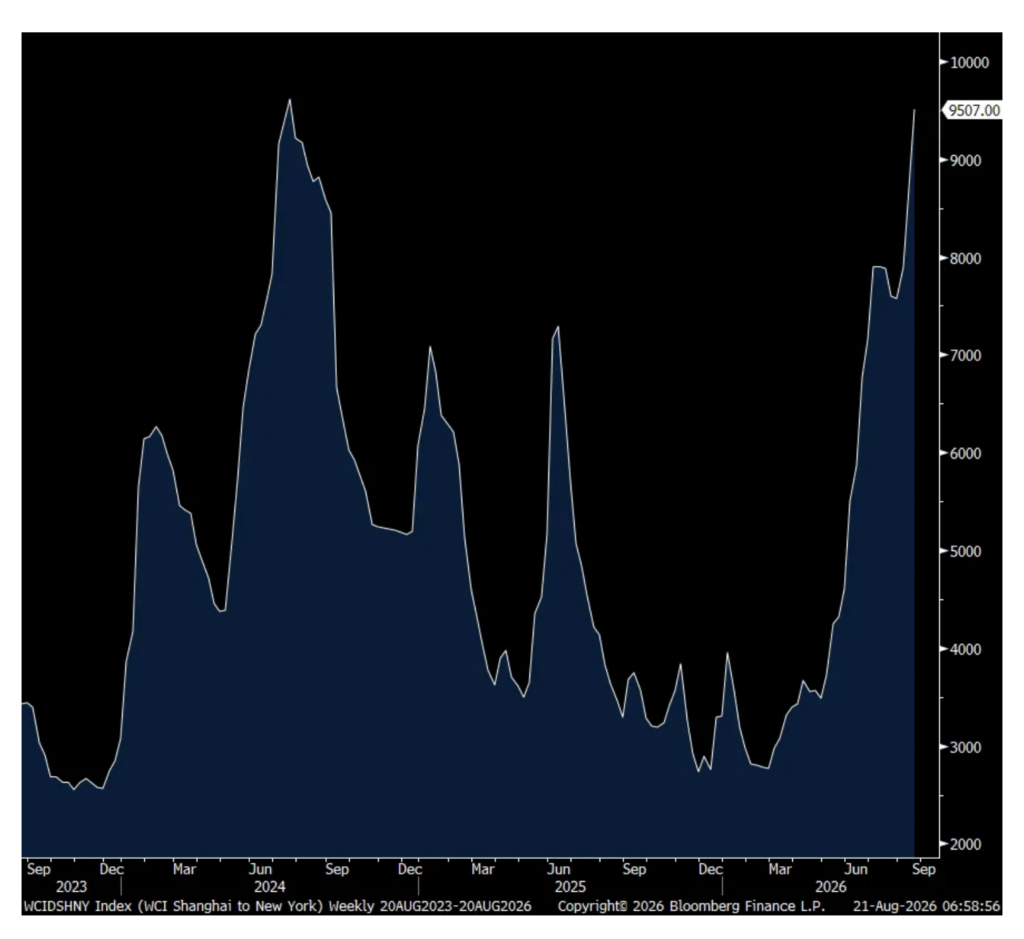
I forgot to mention yesterday the updated container price data and they continue to jump. The Shanghai to NY trip for a 40 foot container was higher by another 9.2% w/o/w, by $801 to $9,507 with water issues at the Panama Canal a factor. It was at $2,771 in the last week of February. To LA, the price rose 8.9% w/o/w to $6,802. While prices have doubled since late February to Rotterdam, prices from Shanghai fell for the 6th straight month because of its different route.
WCI Shanghai to NY
At least from a macro level, Walmart is probably the best earnings call read. From them of note and where I bolded the most relevant:
“As we said coming out of Q1, customers tell us they’re still feeling pressure, but it’s clear: customers are looking for value and convenience, and they want things fast.”
“The Walmart US team delivered more than 11,000 rollbacks during the quarter, up from 7,200 rollbacks at the end of the first quarter, demonstrating our commitment to price investment.”
“We’re investing heavily in price because customers need us to, and because we believe it drives market share gains over time. Our price gaps to conventional grocers here in the US are strong, and they continue to widen. The share gains we see from this channel have persisted alongside the drug and dollar formats.”
They mentioned “seeing some incremental pressure on the consumer relative to the beginning of the year with higher fuel prices. As you go through month by month in the last quarter, you can tell when fuel prices increase and got above $4 and perhaps there’s a psychological impact to that, that there are choices that consumers are making. So, June was a little more obvious as we look at the quarter in terms of customers making tradeoffs. And it’s why we have leaned so heavily into lower prices.”
From Ross Stores, the value focused retailer, and whose stock is rallying by 8% pre-market:
“Sales were strong in May and improved sequentially each month with July delivering our strongest performance despite cycling a strong back to school performance last year. Customer traffic once again served as a primary driver of our comparable store sales increase, which underscores the durability of our growth and the momentum we are building.”
“During the quarter, we saw gains from new and lapsed customers, along with more frequent trips and higher spending from existing customers…Importantly, the new customers we are attracting span a broad range of income demographics and age cohorts, including younger shoppers, which we believe reflects the broad appeal of our brand and the success of our marketing efforts in reaching and engaging a diverse customer base.”
After 5 days in a row of declines, Deere stock rallied by 7% yesterday and said this on their call:
I personally think this situation is about to get better for the ag economy but in the quarter, “producers remain focused on managing profitability, impacted by fluctuating commodity fundamentals and uncertainty around input costs and crop demand, all of which are influencing capital spending decisions by region.”
And the CFO agrees with me, “The agricultural environment remains challenging, but we continue to believe that 2026 represents the bottom of the ag equipment cycle.”
“In US and Canada, we continue to expect the large ag equipment industry sales to decline 15% to 20% y/o/y as farm profitability remains muted and producers navigate elevated input costs, commodity price volatility, and the ongoing uncertainty around agricultural markets.”
Where things are good, “The projection for global roadbuilding market remains steady at up approximately 10% for the year, supported by favorable infrastructure spending trends, healthy contractor backlogs, and continued investment in road construction across key regions.”
And of course, “Large-scale infrastructure projects, data center construction, and pipeline activity continue to support robust customer demand.”
Before I get to some overseas PMIs, Japan’s July CPI rose 1.9% y/o/y ex food and energy, as expected and with subsidies still kept below where it would be otherwise. The BoJ has all the reason to hike in September and I think they do. The yen is higher today, along with JGB yields.
Japan’s August manufacturing PMI rose to 55.1 from 54.5 as the manufacturing recovery has been global. Services lifted too to 52.3 from 51.2. S&P Global said, “While we saw growth momentum pick up across both manufacturing and service sectors, factories continued to lead growth, registering sharp increases in both production and new orders. Furthermore, manufacturers recorded the steepest increase in total sales and overseas demand for over eight-and-a-half years, with robust pipelines of new work noted across semiconductor and AI-related industries.”
Australia’s manufacturing PMI index remained at 52 while services slipped to 52.9 from 53.6.
In the Eurozone, its PMI for manufacturing rose to 52.8 from 51.9 though services remained unchanged at 51.7. S&P Global said this of note, “We are again seeing reports of precautionary stock building helping support the goods-producing sector amid the ongoing supply chain disruptions emanating out of the Middle East, with supply chain delays again remaining worryingly widespread in August. However, there are also encouraging signs of rising demand for AI-related tech goods and rising equipment demand thanks to higher defense spending, notably helping Germany in particular achieve increasingly impressive production gains.”
On the service side for the region, “rising tourism spending is helping boost economic growth, notably outside of France and Germany, where the region collectively saw the fastest services growth for over three years.”
On pricing, “Although high prices reportedly continue to dampen demand, price pressures have shown signs of further easing. Policymakers will be especially encouraged to see services selling price inflation back down to the joint-lowest so far this year (alongside March), with goods price inflation also continuing to moderate.”
In the UK, manufacturing fell a touch to 51.5 from 51.9, offset by a rise in services to 52.8 from 52.1. Said by S&P Global, “The expansion is being helped by sunny weather and tech investment, though as expected we have seen some softening of growth in the manufacturing sector as precautionary stock building cools. This reflects easing concerns, for now, over the economic impact of the war in the Middle East. Businesses are feeling more upbeat than at any time since the war began. Job losses are also moderating.”
Also, “Most worryingly, cost pressures remain high, largely due to energy prices and supply disruption linked to the Middle East conflict alongside high staffing costs.”
