Boockvar: If You Block It, China Will Build It

From Peter Boockvar:
If you won’t let me buy your stuff, I’m going to build it myself
If you won’t let me buy your stuff, I’m going to build it myself. That continues to be the mantra of the Chinese, which began in 2018-2020 and was reflected again over the past month with their fast advancing AI models and yesterday with the CXMT IPO and the news that Shanghai Aishengna Electronic Technology Group is going to start mass producing deep ultraviolet lithography machines (DUV) and if perfected, will need less from supplier ASML. The challenge for the non-Chinese tech industry, particularly in the US, is that China is climbing quickly up the tech expertise ladder. As I’ve said a few times over the past month talking about CXMT, and over the past year, ignore the competition of China tech at your equity peril.
The South Korean Kospi by the way closed down 11% overnight with Samsung down 13.4% and SK Hynix lower by 14.7%. The TAIEX fell by around 4% with Taiwan Semi lower by 3%. Memory producer Kioxia in Japan was hit by 18% and Tokyo Electron by about 11%.
This is all one big global trade.
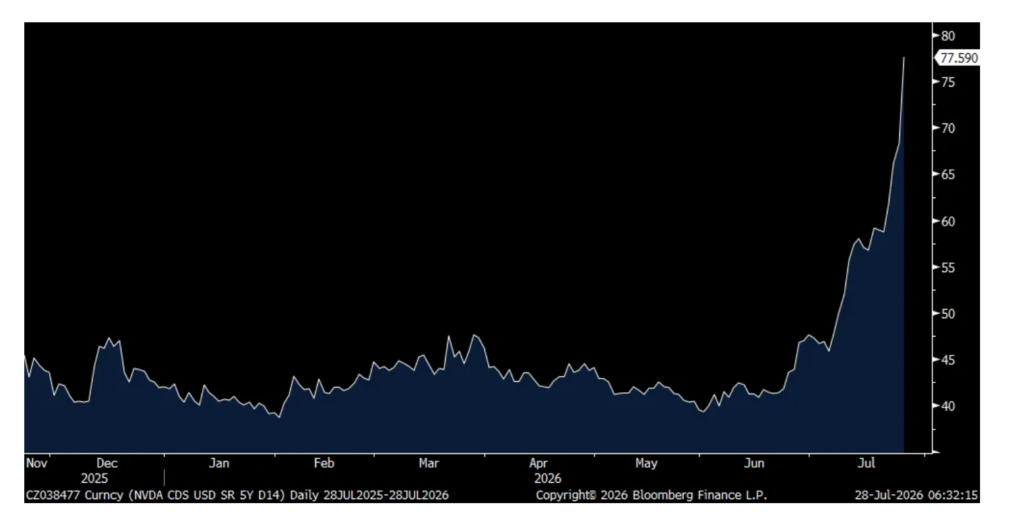
Finally here, this is a chart as of yesterday’s close of Nvidia’s credit default swaps as they take on ever larger obligations and tie their mast even closer to OpenAI. It now costs $77,590 to insure against $10mm of loan exposure to Nvidia vs about $40,000 just two months ago.
Getting right to some earnings calls.
From LVMH, down about 2% in France this morning:
“Revenue momentum accelerated sequentially in our three largest divisions; fashion and leather goods, selective distribution, with watch and jewelry at double digit growth in Q2. Our key geographies posted sequential acceleration.”
“US, Japan, and Asia, all posted mid single digit growth for the first half…Europe declined modestly 1%, penalized by lackluster touristic demand.”
Even their wines and spirits business saw 5% organic growth “predominantly driven by volume growth, reflecting improving demand for our products.”
Perfumes & Cosmetics was a softer spot with flat growth on an organic basis and “looking at key markets, while travel retail remained a headwind, Asia and Japan enjoyed good momentum.”
I went back to last week’s call from Comcast to hear what they had to say on their parks business. From them:
“The operating environment has softened more than we anticipated. Unpacking this by geography, in Orlando, Epic Universe continues to perform well and is delivering the strong guest response we expected. At the same time, attendance across the broader Orlando market began to soften in June, and that trend has continued into the third quarter. We believe there are some temporary factors at work, including higher fuel prices and weaker consumer sentiment, but we are watching these trends closely.”
“Internationally, Osaka continues to be affected by China related travel restrictions, while Beijing is operating against a challenging macroeconomic backdrop.”
From Royal Caribbean that just reported and whose stock is down pre-market but business seems good:
“The overall demand environment remains strong, supported by consumers’ continued preference for the company’s differentiated experiences. Since the last earnings call, the company has experienced a modest, near term impact on bookings for select itineraries, primarily due to prolonged geopolitical activity. The company remains booked at record prices, booking volumes are above last year’s levels, and load factors remain robust across its vacation portfolio. The company continues to benefit from strong guest engagement and demand for onboard and destination experiences, supported by ongoing enhancements to its product offerings and more targeted pre-cruise engagement.”
“While still very early, booking trends for 2027 are encouraging and pacing ahead of historical levels, including itineraries where demand was impacted by geopolitical developments this year.”
I’ll end with some of the comments from the Dallas manufacturing index for July seen yesterday which came in at +1.3 vs zero in June. They reflect still a very much mixed and uneven part of the economy if you’re not selling into the data center buildout.
This was the dourest and saddest one from a company in the Fabricated Metal Product Manufacturingspace:
“We will close our 1951-2026 business due to lack of demand.”
Also in that space from others:
“Lower demand is projected in the second half, but still strong.”
“Geopolitical and national political uncertainty, combined with inflation, undermines consumer and business confidence. People and businesses are sitting on the sidelines.”
In the Beverage & Tobacco Product Manufacturing sector:
“Increased gasoline prices create a burden on the consumer that we think can have a negative impact on spending on craft beer. We thought fuel prices were on the way down but now they are back up. This creates a certain amount of uncertainty going forward.”
From some in the Computer & Electronic Product Manufacturing industry:
“Our projected production increases, employee headcount and business improvements are based on a verbal commitment that we will soon receive a large, new contract from a German customer.”
“June was a very high month for us, but July is more normal. The war in Iran is impacting us in unexpected ways. Printed circuit board (PCB) pricing is unstable now because Iran attacked a facility in Saudi Arabia that produces a large amount of the global supply of a material used in the manufacturing process. We expected higher fuel costs to filter through but did not anticipate PCBs to be impacted in this way.”
“We are in a holding pattern but we continue to service existing customers.”
In Machinery Manufacturing:
“We’re still getting steady orders while having to increase prices due to raw material cost escalation. Maybe someday everything will settle down and be more predictable.”
“We see a very strong oil-based economy that will be with us for many years. We are losing competitors. Therefore, we are able to raise our prices but not increase our product costs. We’re investing in new machines that will increase our production but overall reduce our cost of manufacturing. However, we will not reduce our labor force, but productivity will increase substantially. We’ve been falling behind in maintaining our levels of finished products, but these new investments will solve those problems over the next six months.”
“This is our third straight month of sales below average.”
“The backlog is continuing to grow, and business is good in every respect for our operation.”
“Customer concentration in the oil and gas industry is increasing buying power and forcing more competitive pricing and faster delivery.”
In Textile Product Mills:
“We’ve seen an uptick in activity, orders and production. We also formalized and implemented our first price increase in 5 years to counter the rising product, wage and business costs. There was no pushback or negative feedback from customers—this was something they’ve experienced with other companies and understood.”
In Transportation Equipment Manufacturing:
“Too much noise in the economy and high interest rates make planning or taking risks difficult.”
