Heads Up on AMD?

I wrote a piece on one of my favorite holdings, Advanced Micro Devices ($AMD) here at TheStreet Pro earlier this week. I still believe what I wrote. My target price is still $588. I have been looking at the chart, though and think perhaps a bit of warning (not a call to panic) may be in order. This is the chart that I gave you… 
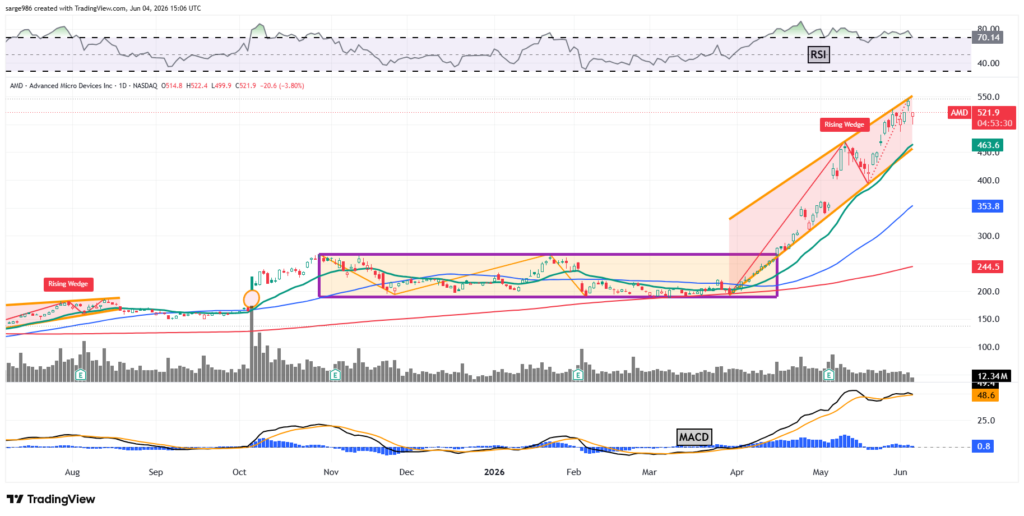
I wrote the following: “Readers will see that AMD broke out sharply in April from the basing pattern (rectangle) of consolidation that ran from late October into late April. The shares obliterated my temporary target price of $456 as May wore on. We sold a small amount. What now? The shares look to have created a Rising Wedge pattern of bearish reversal as Relative Strength had reached technically overbought levels. The daily MACD is also ripe for some bloodletting.”     

I then added, “How severe will it be? I’ll tell you what I’m doing. I am likely to add should the stock approach the mid-May high of $470, but not before.” So, I’ve had a clue that a sell-off could be coming. Now, we’ll erase the Rising Wedge pattern, which can be bearish to begin with, and see what we can see…       
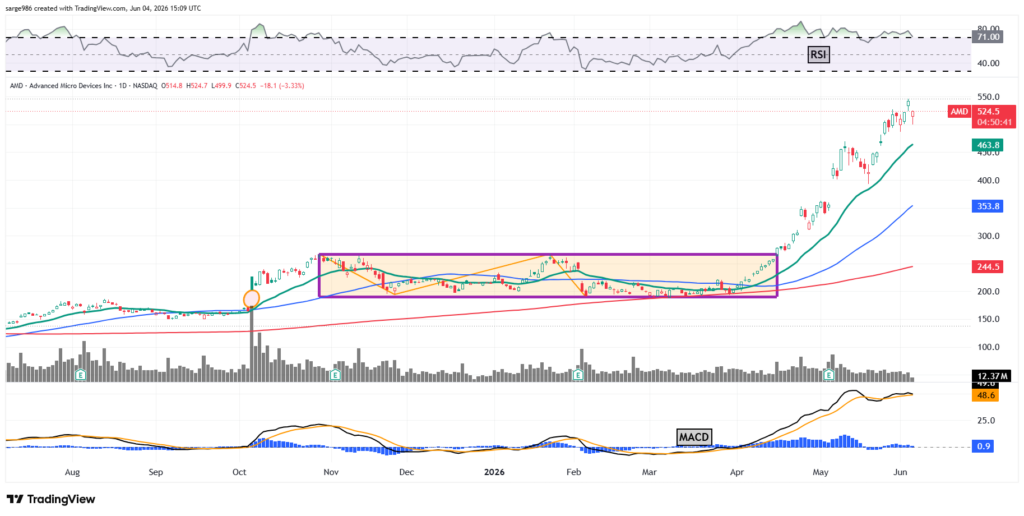
Looks a lot like a head & shoulders pattern of bearish reversal, doesn’t it. Should that pattern come to fruition, it should be noted that H&S patterns, in my non-scientific opinion, are more reliable than Rising Wedges that in theory can go on almost forever. Just some brain food for the crew here at the Diary. 


Positions: Long AMD equity.

Quantum Computing Stocks Hit Hard

Quantum computing stocks sold off hard on Wednesday ahead of the Quantinuum IPO at the Nasdaq Market Site on Thursday. Quantinuum, which is majority owned by Honeywell ($HON), will officially begin trading later today under the ticker symbol “QNT.”

On Wednesday, Infleqtion ($INFQ) gave up 12.4%, Rigetti Computing ($RGTI) gave back 10.4%, and D-Wave Quantum ($QBTS) surrendered 7.9%. Even the mighty IBM ($IBM) lost 7.2%.

Last night, Quantinuum announced that it has raised $1.68 billion in its initial public offering after pricing 28 million shares at $60 apiece.

I will be adding to my long position in IBM (still up 31.6%) at some point this morning.

Positions: Long IBM equity.

90 Minutes to Go

S&P Futures: -32 vs FV. 

Nasdaq Futures: -430 vs FV. 

10-Year Note: 4.46%.

2-Year Note: 4.05%.

3-Month T-Bill: 3.71%.

US Dollar Index: -0.33%

WTI Crude: $93.53. 

Gold: +1.17%

Silver: +0.74%.

Bitcoin: -4.54%. 

Position: Long physical gold & silver

The End of an Era

Since 2001, day traders in the U.S. have been required to maintain a balance of $25K in their accounts. If these traders failed to do that, they would only be permitted to execute three day trades over a five-day period. Making a fourth trade in five days would flag them as pattern day traders and they would then be locked out of their accounts. The pattern day trading rule was adopted by FINRA in 2001 in response to the collapse of the dot-com bubble. These requirements were implemented in order to cut excessive risk-taking and reduce speculative activity.

Under a new system, effective today, the $25K minimum balance has gone the way of the blacksmith. So has the rule that counts trades and so has the “Pattern Day Trader” moniker. Instead, broker-dealers will utilize new tools to assess the actual risk of any one trader’s activity.

By the way, existing margin requirements aren’t going anywhere. I, for one, am in favor of this development, as at times, I have had one smaller account or another become more active. The system did not adjust for traders with several accounts that might hold a larger balance in aggregate who needed to be active for a short time in a smaller account. 

Position: None